

A copper vs aluminum cold plate is a precision thermal management component that removes heat from high-power electronic devices by circulating liquid coolant through internal channels, achieving 10-25x better heat transfer than air cooling.

Copper vs Aluminum Cold Plate: Which Material Is Right for Your Application?
Copper vs aluminum cold plate is one of the most critical material decisions in liquid cooling system design. The choice between copper and aluminum directly impacts thermal performance, weight, cost, corrosion resistance, and manufacturing complexity. This comprehensive guide compares copper and aluminum cold plates across every dimension that matters for engineering decision-making.
ToneCooling manufactures both copper and aluminum liquid cold plates, giving our engineering team hands-on experience with both materials across thousands of customer applications — from NVIDIA GB200 AI server cooling to EV battery thermal management.
Thermal Conductivity Comparison
The most fundamental difference between copper and aluminum cold plates is thermal conductivity:
| Property | Copper (C1100/C1020) | Aluminum (6061/6063) |
|---|---|---|
| Thermal Conductivity | 385–400 W/m·K | 167–205 W/m·K |
| Density | 8,960 kg/m³ | 2,700 kg/m³ |
| Specific Heat | 385 J/kg·K | 900 J/kg·K |
| Melting Point | 1,085°C | 660°C |
| CTE (Coefficient of Thermal Expansion) | 16.5 µm/m·K | 23.1 µm/m·K |
| Machinability Rating | 20% | 170% |
Copper’s thermal conductivity is nearly 2x higher than aluminum — 400 W/m·K vs 205 W/m·K. This means a copper cold plate spreads heat faster and more uniformly across the plate surface, reducing hotspot temperatures at the chip interface.
When to Choose Copper Cold Plates
Choose copper cold plates when your application demands the absolute highest thermal performance:
- Heat flux > 50 W/cm² — AI GPU cooling (NVIDIA GB200: 2,700W TDP)
- Junction temperature tolerance < ±3°C — precision semiconductor testing
- Compact geometry — when space constraints require maximum heat removal per unit area
- High-power density applications — IGBT modules, SiC power devices, laser diodes
ToneCooling’s copper cold plates use T2 purple copper (C1100) with friction stir welding (FSW) or vacuum brazing construction. Our GB200-class copper cold plates handle 2,700W+ per chip with thermal resistance below 0.02°C/W.
When to Choose Aluminum Cold Plates
Choose aluminum cold plates when weight, cost, or corrosion resistance matter more than peak thermal performance:
- Weight-sensitive applications — EV battery packs (aluminum is 3.3x lighter than copper)
- Large surface area plates — energy storage BESS cabinets (500mm+ plates)
- Cost-driven programs — aluminum material cost is 4–6x lower than copper
- EGW coolant systems — aluminum has better galvanic compatibility with standard coolant loops
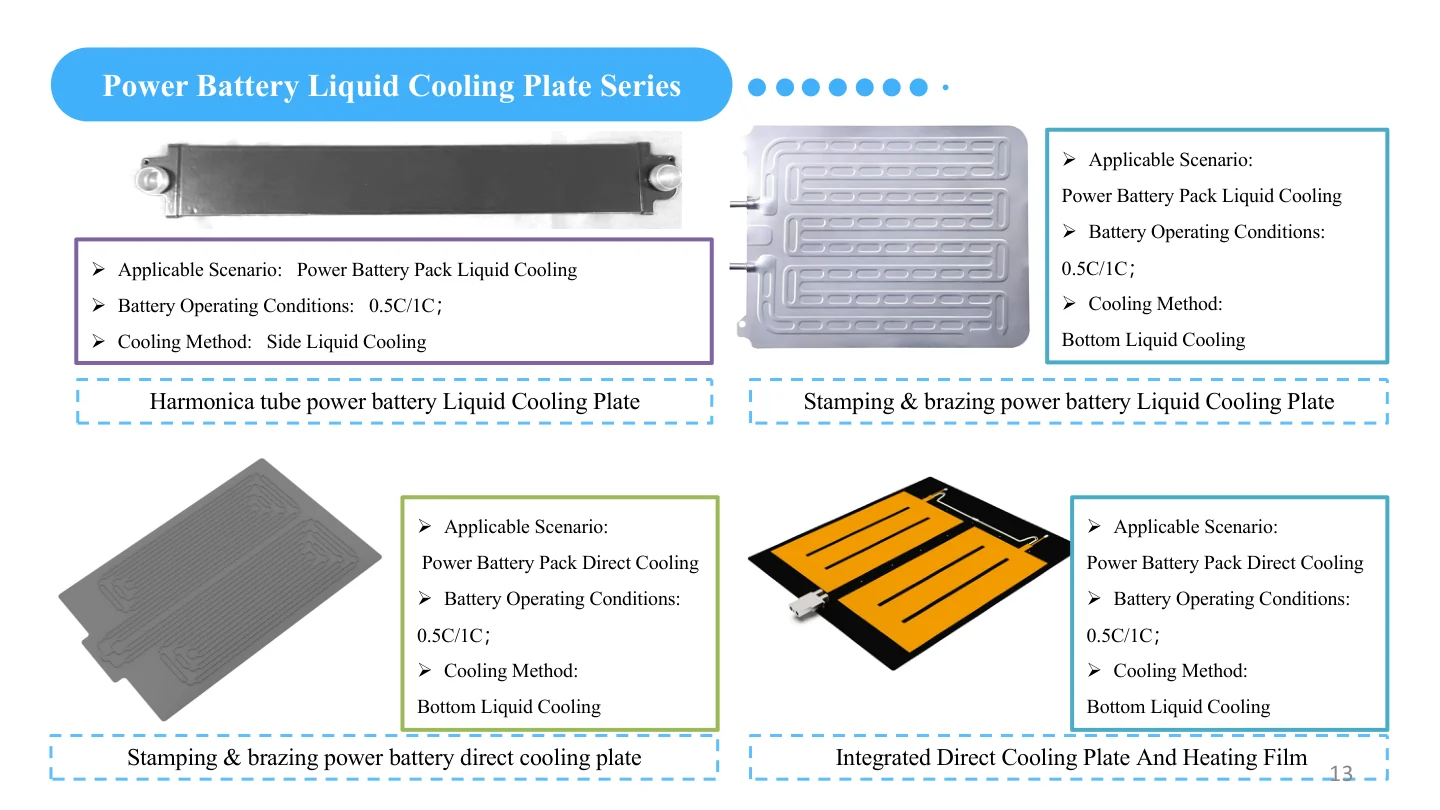
ToneCooling’s aluminum cold plates use 6061/6063 alloy with CNC machining, stamping+brazing, or extrusion+FSW construction. Our EV battery aluminum plates serve Tier 1 automotive suppliers globally.
Cost Comparison: Copper vs Aluminum Cold Plate
| Factor | Copper | Aluminum |
|---|---|---|
| CNC Machining Time | 3–5x longer | Baseline |
| Tooling Cost | Similar | Similar |
For a typical 100mm × 200mm cold plate, aluminum costs roughly 40–60% less than copper at equivalent geometry. However, if copper’s higher performance allows a smaller plate design, the total system cost difference narrows significantly.
Galvanic Corrosion: A Critical Design Consideration
Mixing copper and aluminum components in the same coolant loop creates galvanic corrosion risk. The electrochemical potential difference between copper (+0.34V) and aluminum (−1.66V) drives accelerated corrosion of the aluminum component when they share the same electrolyte.
Best practice: use a single material throughout the cooling loop, or add corrosion inhibitors to the coolant. ToneCooling provides material compatibility guidance for every customer project.

Manufacturing Process Differences
The manufacturing process for copper vs aluminum cold plates differs significantly:
| Process | Copper Cold Plates | Aluminum Cold Plates |
|---|---|---|
| CNC Machining | Slower (20% machinability) | Faster (170% machinability) |
| Friction Stir Welding | Higher tool wear, higher force | Standard FSW parameters |
| Vacuum Brazing | Standard | Requires CAB or flux brazing |
| Surface Treatment | Electroless Ni plating | Anodize or Ni plating |
| Leak Testing | Same: 100% hydrostatic | Same: 100% hydrostatic |
Weight Considerations
Copper is 3.3x heavier than aluminum. For a 100x100x10mm cold plate:
| Metric | Copper | Aluminum | Difference |
|---|---|---|---|
| Finished cold plate | ~450g | ~135g | Cu 3.3x heavier |
| Per rack (32 servers) | ~28.8 kg | ~8.6 kg | +20.2 kg |
For data center deployments, the extra weight is manageable. For EV battery cooling, aluminum is strongly preferred.
Application Decision Matrix
| Application | Material | Reason |
|---|---|---|
| AI GPU cooling (GB200, H100) | Copper C1020 | Maximum Rth performance for 700W+ |
| IGBT/power electronics | Copper C1100 | Thermal cycling durability |
| EV battery cooling | Aluminum 6061 | Weight reduction critical |
| Telecom/edge server | Aluminum 6063 | Cost-sensitive, moderate heat |
| Military/aerospace | Copper C1020 | Max reliability, hermeticity |

ToneCooling Recommendation
After manufacturing over 500,000 cold plates in both materials, ToneCooling’s engineering recommendation is:
- Use copper for AI/GPU direct-to-chip cooling, IGBT power modules, and any application with heat flux above 50 W/cm²
- Use aluminum for EV battery packs, energy storage systems, and large-format plates where weight and cost are primary concerns
- Ask ToneCooling when your application falls in the gray zone — our CFD simulation team can model both materials and recommend the optimal choice
Request a Quote — Copper or Aluminum Cold Plate
Whether you need a copper cold plate for maximum thermal performance or an aluminum cold plate for optimal weight and cost — ToneCooling’s engineering team designs and manufactures both. Submit your thermal requirements and receive a detailed comparison quotation.
prototypes from 1 piece | Prototype in 4–6 weeks | ISO 9001 Certified
→ Send Your Thermal Requirements | Contact Us
Copper Vs Aluminum Cold Plate Technical Specifications
| Parameter | Specification |
|---|---|
| Base materials | Copper (C1100, C1020), Aluminum (6061, 6063) |
| Joining methods | Vacuum brazing, FSW, diffusion bonding, CAB |
| Pressure rating | Up to 10 bar burst; 5 bar working pressure |
| Surface finish | Electroless nickel, anodize, bare metal |
| Leak test | 100% hydrostatic test per unit |
| Quality and compliance | ISO 9001; RoHS and REACH declarations on request |
| Prototype quantity | From 1 piece | Lead time: 4–6 weeks |
| Production volume | 50 pcs | Lead time: 6–8 weeks |
A copper vs aluminum cold plate from ToneCooling is engineered for your specific thermal requirements. As a direct manufacturer with 20+ years experience, we provide CFD simulation, custom design, prototype fabrication, and volume production from a single source.
Frequently Asked Questions
What is a aluminum liquid cold plate?
A aluminum liquid cold plate is a precision-engineered heat exchanger that uses liquid coolant flowing through internal channels to remove heat from high-power electronics, offering significantly higher thermal performance than air cooling. ToneCooling manufactures these for AI servers, data centers, EV batteries, and power electronics.
How does ToneCooling manufacture aluminum liquid cold plates?
ToneCooling manufactures aluminum liquid cold plates using vacuum brazing, friction stir welding, and CNC machining, with full in-house testing including pressure testing at 50 bar, helium leak detection, and thermal resistance measurement.
What materials does ToneCooling use?
ToneCooling uses 6061-T6 and 3003 aluminum alloys and oxygen-free copper (C11000). RoHS declarations for materials are available on request. Material selection depends on thermal conductivity requirements and coolant compatibility.
What is the minimum order quantity?
ToneCooling accepts orders from 1 piece prototypes to 10,000+ annual production. Prototype samples ship in 4–6 weeks.
How do I get a quote for aluminum liquid cold plate?
Submit your thermal requirements, dimensions, and flow rate specifications via our quote request form. Our engineering team responds with a detailed technical proposal.

