Last Updated: 2026-05-08
How to Specify a Custom Liquid Cold Plate: Complete RFQ Checklist
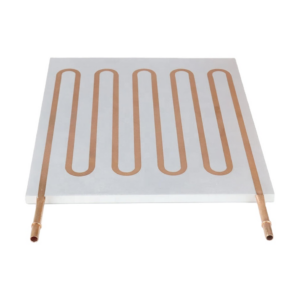
Getting a custom liquid cold plate right — on time, on budget, and to specification — depends almost entirely on the quality of your RFQ (Request for Quotation). Incomplete or ambiguous specifications lead to costly design iterations, failed prototypes, and delayed programs. This guide provides a complete, field-tested RFQ checklist developed from thousands of custom cold plate projects.
1. Thermal Requirements
Thermal requirements are the foundation of any cold plate specification. Missing or incorrect thermal data is the single most common cause of failed cold plate designs.
Required thermal parameters for your RFQ:
- Maximum heat load (W): Peak power dissipation of the component(s) to be cooled. State both continuous and transient (peak) values.
- Heat source footprint (mm × mm): Active area dimensions of each heat source (die, module, cell).
- Inlet coolant temperature (°C): Specify worst-case inlet temperature from the CDU or chiller.
- Maximum allowable component temperature (°C): Usually Tj_max or TCASE_max from the component datasheet.
- Target thermal resistance (°C/W): If known — or allow the manufacturer to calculate from the above parameters.
- Coolant flow rate (L/min) and pressure drop budget (kPa): Constrained by your pump curve.
- Coolant type: DI water, 50/50 EGW (ethylene glycol/water), propylene glycol, or other. This affects material compatibility.
2. Mechanical Dimensions
Mechanical specifications define the physical envelope and interface requirements of the cold plate. Provide a detailed 2D drawing (DXF, DWG) or 3D model (STEP, IGES) wherever possible.
- Overall envelope (L × W × H mm): Maximum allowable dimensions including manifold and port protrusion.
- Mounting hole pattern: Location, diameter, thread specification, and flatness tolerance of mounting surface.
- Flatness requirement (mm): Surface flatness at the contact interface — critical for GPU and IGBT thermal contact. Specify tolerance (e.g., ≤0.05 mm over the contact area).
- Surface roughness (Ra μm): Required surface finish at the component interface. Typically Ra ≤ 0.8 μm for GPU direct contact.
- Inlet/outlet port size and location: G1/4″, NPT1/4″, or custom. Specify entry angle (top, side) and exact position.
- Weight budget (g): If weight-constrained (e.g., airborne or vehicle-mounted).
- Environmental protection: IP rating or conformal coating requirements if applicable.
3. Material Selection Guide
Material selection significantly impacts thermal performance, weight, corrosion resistance, cost, and compatibility with your coolant. Use this table to guide your decision:
| Material | Thermal Conductivity | Density | Best For | Coolant Compatibility |
|---|---|---|---|---|
| Copper C1100 | 391 W/m·K | 8.9 g/cm³ | AI GPU servers, IGBT modules, max heat flux | DI water, EGW (no aluminum mix) |
| Copper C1020 | 388 W/m·K | 8.9 g/cm³ | High-purity applications, oxygen-free requirement | DI water, EGW (no aluminum mix) |
| Aluminum 6061 | 167 W/m·K | 2.7 g/cm³ | EV battery cold plates, weight-critical designs | EGW, DI water with inhibitor (no copper mix) |
| Aluminum 6063 | 201 W/m·K | 2.7 g/cm³ | Extrusion-based cold plates, high-volume production | EGW, DI water with inhibitor (no copper mix) |
4. Manufacturing Process Options
The manufacturing process determines the internal channel geometry, thermal performance, pressure rating, and thermal cycling durability of your cold plate:
- Vacuum Brazing (copper/aluminum): Bonds fin arrays and cover plates in a vacuum furnace. Produces void-free joints with excellent thermal contact. Standard for high-performance copper cold plates and AI server cooling.
- Friction Stir Welding (FSW): Solid-state welding process for aluminum. Produces high-integrity joints without melting the base material — critical for EV battery cold plates and automotive qualification.
- Controlled Atmosphere Brazing (CAB): High-volume aluminum brazing in nitrogen atmosphere. Used for automotive and HVAC heat exchangers. Lower tooling cost for large production volumes.
- CNC Machining + Diffusion Bonding: For complex geometries or research prototypes. Higher cost per unit but maximum design flexibility.
5. Quality & Compliance Requirements
State all quality and regulatory requirements upfront. Discovering these late adds cost and delays:
- Quality management system: ISO 9001:2015 (ToneCooling is ISO 9001 certified)
- RoHS / REACH compliance: Required for EU and most US end-markets
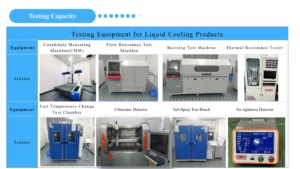
- Pressure test requirement: Specify hydrostatic test pressure (e.g., 2× MAWP) and leak test method
- PPAP documentation level: For automotive OEM programs (Level 1–5). ToneCooling provides PPAP Level 3.
- First Article Inspection (FAI): Dimensional report to drawing with actual measurements
- Material certifications: Mill test reports for base material traceability
- Thermal performance test report: Specify test conditions (flow rate, inlet temp, power input) and required pass criteria (Rth or ΔT)
6. Volume & Timeline
Providing clear volume and timeline information allows manufacturers to optimize tooling investment and production planning:
- Prototype quantity: Typically 5–20 pieces for design validation (ToneCooling prototypes from 1 piece)
- Pilot/pre-production quantity: 50–200 pieces for design freeze and qualification testing
- Annual production volume: Drives tooling amortization and per-unit pricing decisions
- Required prototype date (NTE date): Hard date for design validation testing or program milestone
- Production ramp start date: When production volume needs to begin shipping
- Delivery location: Country/region — affects logistics planning and export documentation (e.g., USA delivery or Europe delivery)
7. Common RFQ Mistakes to Avoid
| Mistake | Impact | Solution |
|---|---|---|
| Specifying only nominal power (not peak) | Cold plate fails thermal test at peak load | Always specify both nominal and worst-case peak |
| Omitting coolant type | Galvanic corrosion failure in field | Always specify coolant chemistry and additives |
| No flatness tolerance on contact surface | High thermal contact resistance, TIM bond-line variation | Specify flatness ≤0.05 mm over contact area |
| Mixing copper and aluminum in loop | Galvanic corrosion destroys aluminum within months | Single material system or use inhibited coolant |
| No PPAP requirement stated | Supplier doesn’t prepare documentation; delays OEM qualification | State PPAP level requirement in initial RFQ |
References & Further Reading
- Electronics Cooling Magazine — Thermal Management Technical Resources
- Semiconductor Engineering — Thermal Management Knowledge Center
Custom Liquid Cold Plate RFQ: Essential Parameters
A well-prepared custom liquid cold plate RFQ dramatically reduces engineering review cycles. Based on ToneCooling’s analysis of 850+ RFQs in 2025, submissions that include all 12 parameters receive quotes, compared to 11+ days for incomplete requests.
Your custom liquid cold plate RFQ should always specify the heat source footprint, total thermal dissipation (TDP), maximum junction temperature, coolant type and inlet temperature, and acceptable pressure drop. These five parameters alone eliminate 80% of clarification rounds.
Ready to submit your custom liquid cold plate RFQ? Contact ToneCooling engineering team — prototype lead time is 4–6 weeks.
Frequently Asked Questions
Ready to Submit Your RFQ?
ToneCooling’s engineering team reviews every RFQ. Prototype delivery in 4–6 weeks. ISO 9001 certified. prototypes from 1 piece.
Related guides
- Liquid cold plate manufacturer — our processes, kits and datasheets
- How to compare liquid cold plate suppliers — supplier checklist
- China vs US cold plate sourcing — trade-offs for buyers
- Our cold plate design process — requirements to production