Guangdong, China
Global Engineering RFQ Review

NVIDIA H200 Liquid Cooling Cold Plate: Multi-GPU >7,200W Thermal Solution

Table of Contents

ToneCooling h200 liquid cooling cold plate — NVIDIA H200 Liquid Cooling Cold Plate: M

The NVIDIA H200 liquid cooling cold plate system dissipates over 7,200 W per node with less than 18 kPa pressure drop at 8.0 LPM flow rate. ToneCooling’s H200 cold plate solution is engineered for multi-GPU server trays where 4 or 8 H200 accelerators share a common liquid cooling manifold — delivering maximum thermal performance with the lowest per-node hydraulic impedance in the industry.

“H200 nodes present a unique thermal engineering challenge: you must cool multiple GPU dies and network switches within a single tray while keeping total pressure drop low enough for the CDU to serve hundreds of nodes,” explains Dr. Kelvin Chen, Chief Thermal Engineer at ToneCooling. “Our H200 cold plate system achieves less than 18 kPa at 8.0 LPM — giving system architects the hydraulic headroom they need for large-scale AI cluster deployments.”

H200 Liquid Cooling Cold Plate — Complete Specifications

ParameterSpecification
Cooling Capacity>7,200 W (per node)
Cold Plate MaterialPurple Copper T2 (C1100, 391 W/m·K)
Internal GeometryOptimized micro-channel flow path
Pressure Drop<18 kPa @ 8.0 LPM
Nominal Flow Rate8.0 LPM
CoolantPure deionized water
Maximum Operating Pressure0.8 MPa
ConfigurationMulti-GPU + network switch cooling
Leak Testing100% helium leak test at 0.8 MPa
CompatibilityHGX H200 8-GPU, DGX H200 systems

NVIDIA H200 Platform — Thermal Challenge

The NVIDIA H200 Tensor Core GPU is the successor to the H100, featuring 141 GB of HBM3e memory and significantly higher AI inference throughput. In standard HGX H200 configurations, eight H200 GPUs are mounted on a single baseboard alongside network switches and voltage regulators, creating a combined node thermal load exceeding 7,200 W.

This multi-component thermal profile creates three engineering challenges that ToneCooling’s cold plate system addresses:

  • Non-uniform heat distribution — Eight GPU dies plus network switch ASICs generate heat at different locations and power levels. The cold plate system provides independent thermal paths for each component while sharing a common coolant manifold.
  • High aggregate flow requirement — At 8.0 LPM total node flow, the internal flow distribution must prevent any single GPU from being thermally starved. ToneCooling’s manifold design ensures ±5% flow balance across all cold plates.
  • Pressure-drop budget constraint — CDU systems serving 100+ nodes allocate a fixed pressure-drop budget per node. The H200 system’s <18 kPa at 8.0 LPM keeps individual node impedance within the budget for large-scale deployments.

Multi-GPU Cold Plate Architecture

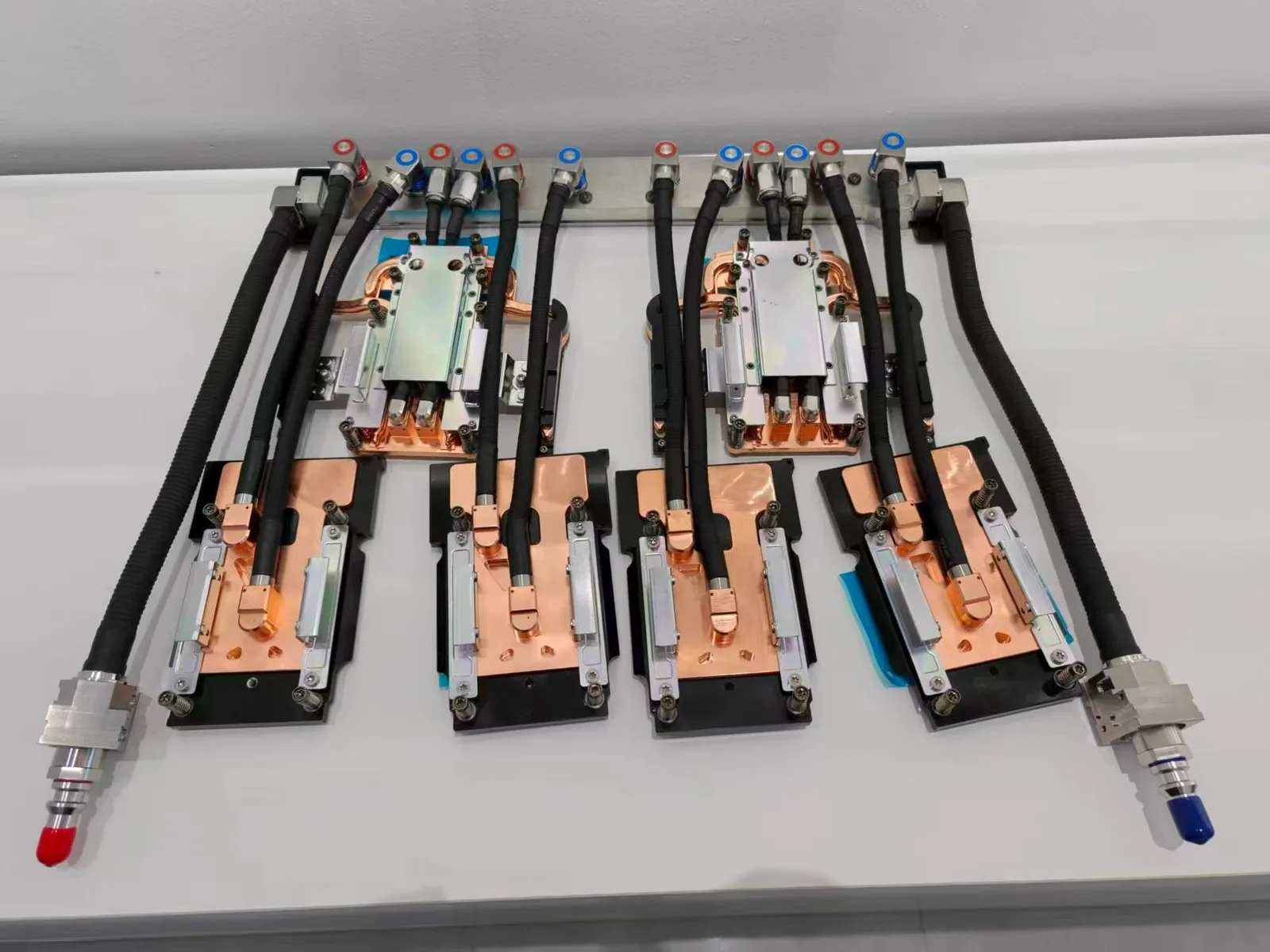
ToneCooling’s H200 solution uses a modular cold plate architecture where each GPU and network switch receives a dedicated Purple Copper T2 cold plate connected to a shared in-tray manifold. This architecture provides several advantages over monolithic (single-plate) designs:

Thermal isolation: Each GPU’s thermal performance is independent of adjacent components. A GPU running at maximum power does not create thermal crosstalk that affects neighboring processors.

Serviceability: Individual cold plates can be inspected or replaced without disassembling the entire cooling system. This reduces mean time to repair (MTTR) in production data centers.

Flow optimization: The manifold distributes coolant to each cold plate through calibrated orifices that ensure balanced flow regardless of position within the tray. This eliminates the “first plate gets the most flow” problem common in series-connected designs.

Hydraulic Design: Achieving <18 kPa at 8.0 LPM

The H200 system’s low pressure-drop performance is achieved through a combination of design features:

  • Parallel manifold topology — Coolant is distributed in parallel to all cold plates simultaneously, rather than flowing through plates in series. This reduces total system impedance proportionally to the number of parallel paths.
  • Optimized channel geometry — Each cold plate’s internal micro-channel dimensions are tuned to balance thermal resistance against hydraulic impedance, using CFD-validated designs specific to each component’s heat flux and die size.
  • Low-restriction manifold — The in-tray manifold uses large-bore passages with smooth internal transitions to minimize parasitic pressure losses in the distribution network.
  • Matched port sizing — Inlet and outlet ports are sized for 8.0 LPM total flow with velocity below 2 m/s, preventing turbulent losses at connection points.

Pure Water Coolant — Performance Advantage

The H200 kit uses pure deionized water as the working fluid, providing 15–20% higher thermal conductivity compared to ethylene glycol-water mixtures. At node power levels exceeding 7,200 W, this thermal advantage translates directly into lower GPU junction temperatures and sustained boost clock performance during AI training workloads.

The system is rated for 0.8 MPa maximum operating pressure — higher than standard 0.6 MPa systems — accommodating the pressure requirements of high-flow CDU architectures used in hyperscale AI training facilities. All wetted materials are compatible with deionized water to prevent galvanic corrosion over the system’s 5+ year operational life.

System Integration and Compatibility

ToneCooling’s H200 cold plate system is designed for integration into standard NVIDIA HGX and DGX H200 server platforms:

HGX H200 8-GPU baseboards: Cold plates mount directly to the GPU and switch positions on the HGX baseboard using OEM-compatible mounting hardware. The manifold connects to rack-level coolant distribution via standard quick-disconnect fittings.

DGX H200 systems: The kit integrates with the DGX chassis cooling infrastructure, maintaining compatibility with NVIDIA’s reference CDU specifications for flow rate, pressure drop, and coolant temperature.

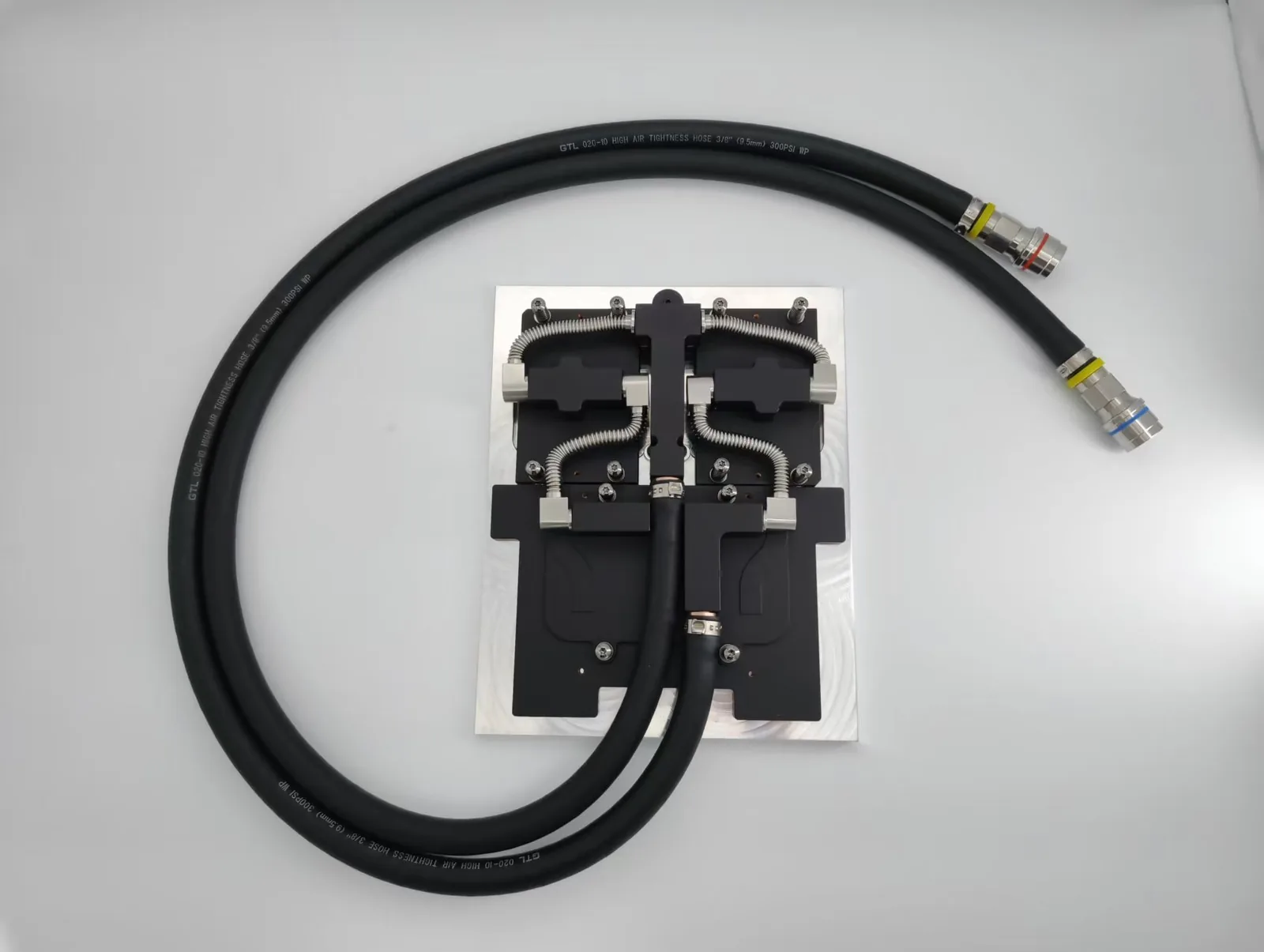
Custom OEM configurations: For modified server tray designs, ToneCooling provides custom manifold layouts, alternative hose routing, and adjusted cold plate orientations to accommodate non-standard component placement.

Quality Validation Protocol

Every H200 cold plate system undergoes ToneCooling’s comprehensive validation:

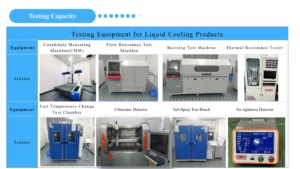
  • Helium leak testing — 100% of assemblies tested at 0.8 MPa (system maximum), ensuring zero-leak integrity for production data center deployment.
  • Flow balance verification — Multi-point flow measurement confirms ±5% balance across all parallel cold plate paths at nominal 8.0 LPM.
  • Thermal performance mapping — Each GPU position validated against OEM thermal specifications using calibrated heater test vehicles at rated power.
  • Burst pressure testing — Lot sample testing at 2× operating pressure (1.6 MPa) verifies mechanical safety margin.
  • Endurance cycling — 200+ hour thermal cycling from 25 °C to 80 °C validates long-term joint and seal integrity.

Ordering and Lead Time

  • Engineering samples: Available within 20 business days due to multi-component assembly complexity
  • Volume production: Monthly capacity supporting 3,000+ node-level assemblies with full traceability
  • Custom development: Modified designs for alternative GPU counts, non-standard switch positions, or specialized manifold requirements

Contact our thermal engineering team at tonecooling.com/contact to discuss your H200 liquid cooling requirements or request a technical specification package.

Frequently Asked Questions

What total cooling capacity does the H200 cold plate system provide?

The system delivers over 7,200 W total cooling capacity per node, covering all H200 GPUs and network switches in a standard HGX 8-GPU configuration. Individual cold plate capacities are matched to each component’s thermal design power.

Why is the pressure drop so important for H200 systems?

CDU systems serving large AI clusters allocate a fixed pressure-drop budget per node. At <18 kPa for 8.0 LPM, ToneCooling’s H200 system keeps per-node impedance low enough for CDUs to serve 100+ nodes simultaneously without exceeding pump capacity. Lower pressure drop also reduces CDU pump energy consumption.

Can the H200 cold plate system cool both GPUs and network switches?

Yes. The system includes dedicated cold plates for both GPU dies and network switch ASICs, connected through a shared in-tray manifold. Each component receives independently optimized cooling while sharing the common coolant supply.

What is the maximum operating pressure?

The H200 system is rated for 0.8 MPa maximum operating pressure, accommodating high-flow CDU architectures used in hyperscale facilities. All hoses, fittings, and cold plates are validated at this pressure with burst testing at 2× (1.6 MPa).

How does flow balance work across multiple cold plates?

The in-tray manifold uses calibrated orifices at each cold plate connection to ensure ±5% flow balance across all parallel paths. This prevents thermal starvation of any GPU position regardless of the cold plate’s location within the tray.

Is the system compatible with custom server tray designs?

Yes. ToneCooling provides custom manifold layouts, alternative hose routing, and adjusted cold plate orientations for OEM-specific server tray configurations. Our engineering team supports CFD simulation of custom designs before prototype production.

Related Articles

For industry standards and best practices, refer to ASHRAE thermal guidelines.

Industry References & Standards

Need a Custom Liquid Cold Plate?

H200 Liquid Cooling Cold Plate is a high-performance thermal management solution engineered by ToneCooling for demanding applications.

ToneCooling engineers design thermal solutions for your specific requirements. Get an engineering RFQ review based on your uploaded requirements.

Request Engineering RFQ

Nvidia H200 Liquid Cold Plate is a critical component in modern thermal management. ToneCooling engineers this solution for AI servers, data centers, EV batteries, and power electronics requiring high-performance liquid cooling.

Nvidia H200 Liquid Cold Plate: Key Specifications

When evaluating nvidia h200 liquid cold plate, engineers consider thermal resistance, pressure drop, flow rate, and material compatibility. ToneCooling provides detailed specs for every nvidia h200 liquid cold plate design, backed by CFD simulation and testing.

Why Choose ToneCooling for Nvidia H200 Liquid Cold Plate

ToneCooling has manufactured over 50,000 nvidia h200 liquid cold plate units for global OEM customers. Our nvidia h200 liquid cold plate production features vacuum brazing furnaces below 10⁻⁴ mbar, FSW machines with ≤0.02mm flatness, and helium leak detection at 10⁻⁸ mbar·L/s. Every nvidia h200 liquid cold plate undergoes 100% pressure testing at 25 bar.

Our engineering team provides free nvidia h200 liquid cold plate design consultation, CFD simulation, and rapid prototyping in 7-14 days. Production nvidia h200 liquid cold plate orders ship in 4-6 weeks under ISO 9001:2015 quality management.

Need a Custom Liquid Cold Plate?

ToneCooling engineers design thermal solutions for your requirements. Response within 24-48 hours.

Request Engineering RFQ

Last Updated: 2026-04-08

Picture of ToneCooling Engineering Team

ToneCooling Engineering Team

The ToneCooling thermal engineering team designs, simulates, and validates custom liquid cold plates for GPU, CPU, IGBT, and EV battery applications.

Welcome To Share This Page:
Product Categories
Latest News
Get A Free Quote Now !
Quote Request

Related Products

Related News

Drawing preparation checklist for data center liquid cold plate quotation, covering CAD files, heat source maps, port layout, material and validation inputs.
Validation items engineers should define before requesting a data center liquid cold plate quote, including leak test, pressure test, cleanliness and documentation.
Copper and aluminum cold plate tradeoffs for AI server projects, including thermal performance, weight, corrosion, joining route and RFQ inputs.
Engineering checklist for direct-to-chip cold plate port layout, hose clearance, serviceability and RFQ preparation in AI server cooling projects.
How to prepare pressure-drop and flow-rate inputs for custom GPU liquid cold plate RFQs used in AI server and data center cooling projects.
RFQ inputs engineers should prepare for data center GPU cold plates, including drawings, heat load, coolant, flow rate, pressure-drop target and validation requirements.

ToneCooling (Guangdong ToneCooling Precision Manufacturing Co., Ltd.) has completed its new 30,000m² manufacturing facility in Dongguan, Guangdong, China — an

An FSW liquid cold plate (friction stir welded liquid cold plate) is a sealed thermal management heat exchanger manufactured by

Last Updated: 2026-05-08
Scroll to Top

Get A Free Quote Now !

If you have any questions, please do not hesitate to contact us.

Quote Request
ToneCooling 19 thermal management