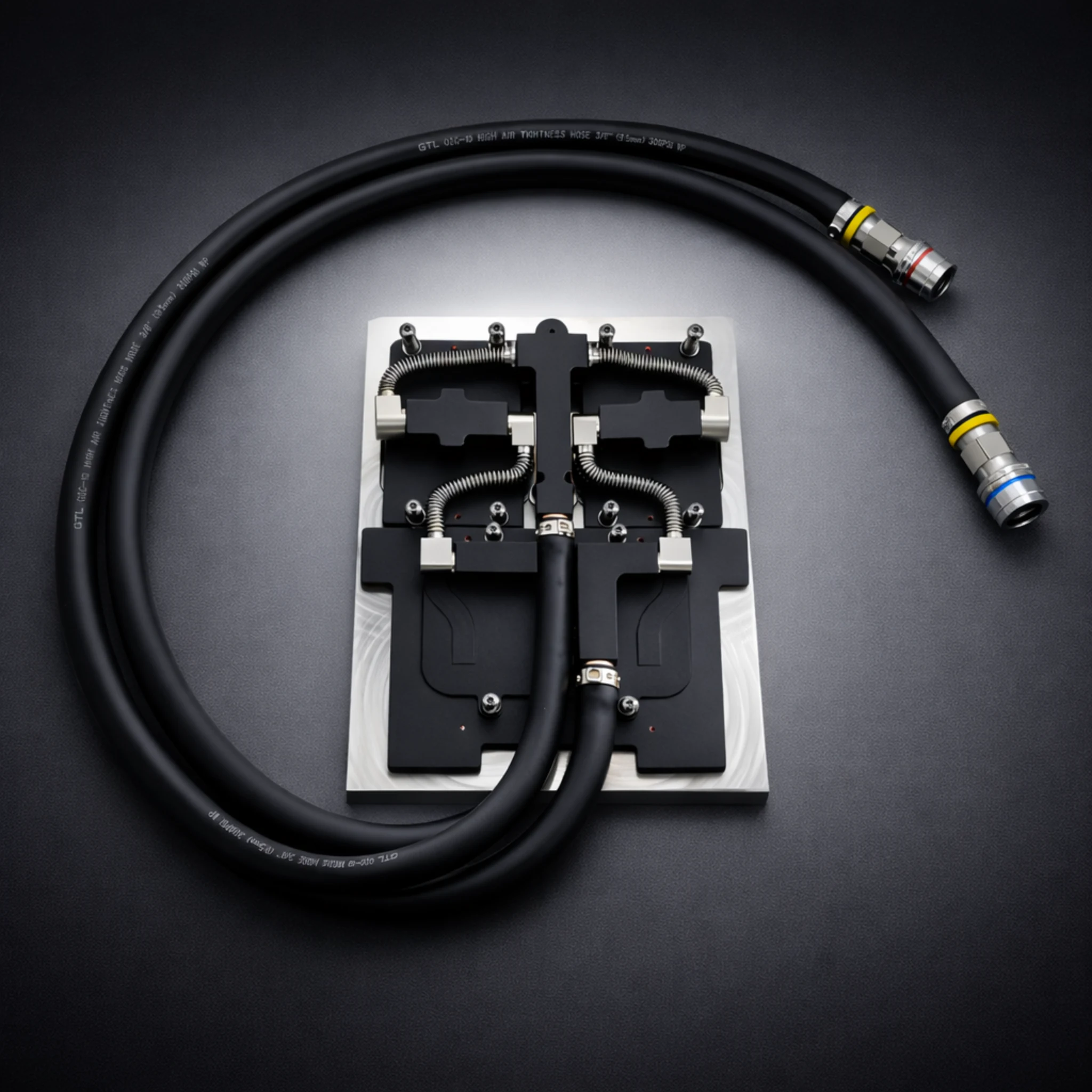
1,300″ src=”https://tonecooling.com/wp-content/uploads/2026/03/tonecooling-australia-gpu-cpu-cold-plate-branded.png” alt=”ToneCooling intel sapphire rapids cold plate — Intel Sapphire Rapids Cold Plate: >1,300″ width=”1200″ />
The Intel Sapphire Rapids cold plate delivers over 1,300 W thermal dissipation using a unique dual-inlet flow architecture, achieving less than 12 kPa pressure drop at 5.0 LPM with 25% EGW coolant. ToneCooling’s dual-inlet design splits coolant across two independent micro-channel zones within a single cold plate, providing uniform junction temperature distribution across the processor die — a critical advantage for high-TDP Sapphire Rapids HBM and multi-die SKUs in dual-socket server configurations.
“Sapphire Rapids HBM processors combine CPU cores with high-bandwidth memory stacks on a single package, creating a non-uniform heat flux map that conventional single-inlet cold plates struggle to cool evenly,” explains Dr. Kelvin Chen, Chief Thermal Engineer at ToneCooling. “Our dual-inlet architecture routes coolant to both sides of the die simultaneously, cutting the effective flow path in half and reducing thermal gradients by over 40% compared to single-inlet designs.”
Intel Sapphire Rapids Cold Plate — Complete Specifications
| Parameter | Specification |
| Cooling Capacity | >1,300 W |
| Cold Plate Material | Purple Copper T2 (C1100, 391 W/m·K) |
| Flow Architecture | Dual-inlet, dual micro-channel zone |
| Pressure Drop | <12 kPa @ 5.0 LPM |
| Nominal Flow Rate | 5.0 LPM |
| Coolant | 25% Ethylene Glycol-Water (EGW) |
| Maximum Operating Pressure | 0.6 MPa |
| Leak Testing | 100% helium leak test at 0.6 MPa |
| Socket Compatibility | Intel LGA 4677 (Sapphire Rapids) |
| Configuration | Optimized for dual-socket servers |
Intel Sapphire Rapids — High-TDP Platform Challenge
Intel Sapphire Rapids represents Intel’s 4th Generation Xeon Scalable processor family, with high-performance SKUs and HBM-equipped variants pushing TDP beyond 350 W per socket. In dual-socket configurations — the standard for AI training and HPC simulation workloads — combined CPU power exceeds 1,300 W, placing these platforms firmly in the liquid-cooling-required category.
Sapphire Rapids HBM variants present a particularly challenging thermal design problem: the integrated HBM memory stacks create localized heat sources at the package periphery, while CPU cores generate concentrated heat at the package center. This non-uniform heat flux distribution requires a cold plate design that provides both high average cooling capacity and excellent spatial uniformity.
Dual-Inlet Flow Architecture — Design Innovation
ToneCooling’s dual-inlet design is the defining innovation of the Sapphire Rapids cold plate. Unlike conventional single-inlet cold plates that route all coolant from one side to the other, the dual-inlet architecture splits the cold plate into two independent micro-channel zones, each with its own inlet and outlet:
Zone 1 covers the left half of the processor package, with coolant flowing from left inlet to center outlet. Zone 2 covers the right half, flowing from right inlet to center outlet. Both zones share a common outlet manifold at the cold plate center.
This architecture provides three key advantages:
- Halved flow path length — Each zone’s coolant path is half the total cold plate width, reducing frictional pressure losses and coolant temperature rise along the flow direction. This keeps the outlet temperature closer to the inlet temperature, reducing thermal gradients across the processor.
- Reduced pressure drop — The parallel dual-zone topology splits the total 5.0 LPM flow into two 2.5 LPM paths, each with lower velocity and lower pressure drop than a single-path design at 5.0 LPM. The result is <12 kPa total system pressure drop.
- Uniform temperature distribution — Both halves of the processor receive “fresh” inlet-temperature coolant simultaneously, eliminating the thermal penalty where downstream regions of a single-inlet design receive pre-heated coolant. This reduces peak-to-minimum junction temperature spread by over 40%.
Dual-Socket Server Optimization
Sapphire Rapids servers are predominantly deployed in dual-socket configurations for AI training and HPC workloads. ToneCooling’s cold plate system is specifically optimized for this use case:
Shared CDU manifold compatibility: Both CPU sockets connect to a single rack-level manifold through the cold plates’ dual-inlet ports. The hydraulic design ensures balanced flow distribution between the two sockets, preventing one CPU from being thermally favored over the other.
Symmetrical hose routing: The dual-inlet design uses symmetrical port positions that simplify hose routing in dual-socket motherboard layouts. Equal-length hose paths between the manifold and each cold plate port maintain consistent flow balance.
Combined thermal budget: At >1,300 W total dual-socket power, the cooling system maintains both CPUs within Intel’s thermal specification simultaneously, even during sustained all-core workloads that maximize power consumption.
Pressure Drop Analysis: <12 kPa at 5.0 LPM
The dual-inlet architecture achieves <12 kPa total pressure drop at 5.0 LPM through the parallel flow topology. This is a critical specification for dual-socket systems where both cold plates share a common manifold branch:
- Per-zone flow: 2.5 LPM per zone (5.0 LPM total split across two zones)
- Per-zone pressure drop: Approximately 6 kPa per zone at 2.5 LPM
- System total: <12 kPa including manifold and fitting losses
This low per-node impedance allows CDU systems to serve large numbers of dual-socket Sapphire Rapids servers without exceeding pump capacity. For a 100-node cluster, the total cold plate pressure drop contribution remains manageable within standard CDU hydraulic budgets.
25% EGW Coolant — Year-Round Operation
The Sapphire Rapids cold plate uses 25% ethylene glycol-water coolant, consistent with ToneCooling’s CPU platform standard. This provides freeze protection to approximately -12 °C for facilities with outdoor CDU systems or cold-climate installations.
At 5.0 LPM flow rate, the EGW coolant provides adequate thermal performance for the >1,300 W thermal load. The dual-inlet architecture compensates for EGW’s lower thermal conductivity (compared to pure water) by halving the flow path length, which reduces coolant temperature rise and maintains low thermal resistance.
Quality Validation
- Helium leak testing — 100% production units at 0.6 MPa, with dual-inlet ports tested independently and simultaneously
- Flow balance verification — Both inlet zones verified for ±5% flow balance at nominal 5.0 LPM total flow
- Thermal performance mapping — Temperature uniformity validated across full processor contact area using 64-point thermocouple array
- Pressure-drop confirmation — Flow-bench testing at 3.0, 5.0, and 7.0 LPM confirms <12 kPa at nominal flow
- Thermal cycling endurance — 200+ hours, 25 °C to 80 °C, with special attention to dual-manifold brazed joint integrity
- Burst pressure testing — Lot samples at 1.2 MPa (2× operating pressure)
Applications
ToneCooling’s Sapphire Rapids dual-inlet cold plate serves three primary deployment categories:
AI training clusters: Dual-socket Sapphire Rapids servers with GPU accelerators (via PCIe) require efficient CPU cooling that does not consume excessive CDU capacity needed for GPU cold plates. The low <12 kPa pressure drop leaves hydraulic budget for co-located GPU cooling.
HPC simulation: Engineering simulation, weather modeling, and financial risk analysis workloads drive sustained all-core utilization at maximum power. The dual-inlet architecture’s superior temperature uniformity prevents hotspot-induced throttling during these demanding workloads.
Data center air-to-liquid transitions: Organizations upgrading from air-cooled to liquid-cooled Sapphire Rapids infrastructure benefit from the cold plate’s drop-in compatibility with Intel’s mechanical specifications and standard CDU interfaces.
Ordering and OEM Support
- Engineering samples: Available within 15 business days (dual-inlet complexity requires additional manufacturing steps)
- Volume production: Monthly capacity supporting 6,000+ dual-inlet cold plate assemblies
- Custom development: Modified designs for non-standard socket orientations, alternative manifold configurations, and custom TIM solutions
Contact ToneCooling at tonecooling.com/contact to request Sapphire Rapids cold plate samples or discuss your dual-socket liquid cooling requirements.
Frequently Asked Questions
What is a dual-inlet cold plate and why does Sapphire Rapids need it?
A dual-inlet cold plate has two separate coolant inlets that feed independent micro-channel zones within a single cold plate body. Sapphire Rapids HBM processors have non-uniform heat distributions that benefit from dual-inlet cooling: both halves of the processor receive fresh inlet-temperature coolant simultaneously, reducing thermal gradients by over 40% compared to single-inlet designs.
What is the total cooling capacity?
The cold plate system delivers over 1,300 W cooling capacity, sufficient for dual-socket Sapphire Rapids configurations running at maximum TDP. This covers both standard and HBM-equipped Sapphire Rapids SKUs.
How does the dual-inlet design achieve low pressure drop?
The 5.0 LPM total flow is split into two parallel 2.5 LPM paths. Each path has half the flow rate and half the flow path length of a single-inlet equivalent, resulting in significantly lower pressure drop. The combined system achieves <12 kPa — competitive with single-inlet designs running at much lower flow rates.
Is the Sapphire Rapids cold plate compatible with GPU co-cooling?
Yes. The low <12 kPa pressure drop leaves substantial hydraulic budget within the CDU system for co-located GPU cold plates. This is important for AI training servers that combine Sapphire Rapids CPUs with PCIe-attached GPU accelerators.
Can this design be adapted for future Intel platforms?
The dual-inlet architecture is platform-adaptable. ToneCooling can modify the cold plate dimensions, mounting interface, and channel geometry for future Intel sockets while retaining the dual-inlet flow topology. Contact our engineering team to discuss platform adaptation requirements.
Related Articles
- AI Server Liquid Cooling Kits: Complete Platform Guide
- NVIDIA GB200 Liquid Cooling Kit
- NVIDIA H200 Liquid Cooling Cold Plate
- AMD EPYC SP5 Liquid Cooling Kit
- Intel Birch Stream Cold Plate
- Custom Liquid Cold Plates: Engineering Guide
Intel Sapphire Rapids Cold Plate is a high-performance thermal management solution engineered by ToneCooling for demanding applications.
For industry standards and best practices, refer to ASHRAE thermal guidelines.
Industry References & Standards
Need a Custom Liquid Cold Plate?
ToneCooling engineers design thermal solutions for your specific requirements. Get an engineering RFQ review based on your uploaded requirements.
Why Choose ToneCooling for Intel Sapphire Rapids Cold Plate
ToneCooling has manufactured over 50,000 intel sapphire rapids cold plate units for global OEM customers. Our intel sapphire rapids cold plate production features vacuum brazing furnaces below 10⁻⁴ mbar, FSW machines with ≤0.02mm flatness, and helium leak detection at 10⁻⁸ mbar·L/s. Every intel sapphire rapids cold plate undergoes 100% pressure testing at 25 bar.
Our engineering team provides free intel sapphire rapids cold plate design consultation, CFD simulation, and rapid prototyping in 7-14 days. Production intel sapphire rapids cold plate orders ship in 4-6 weeks under ISO 9001:2015 quality management.
Need a Custom Liquid Cold Plate?
ToneCooling engineers design thermal solutions for your requirements. Response within 24-48 hours.
Last Updated: 2026-04-08