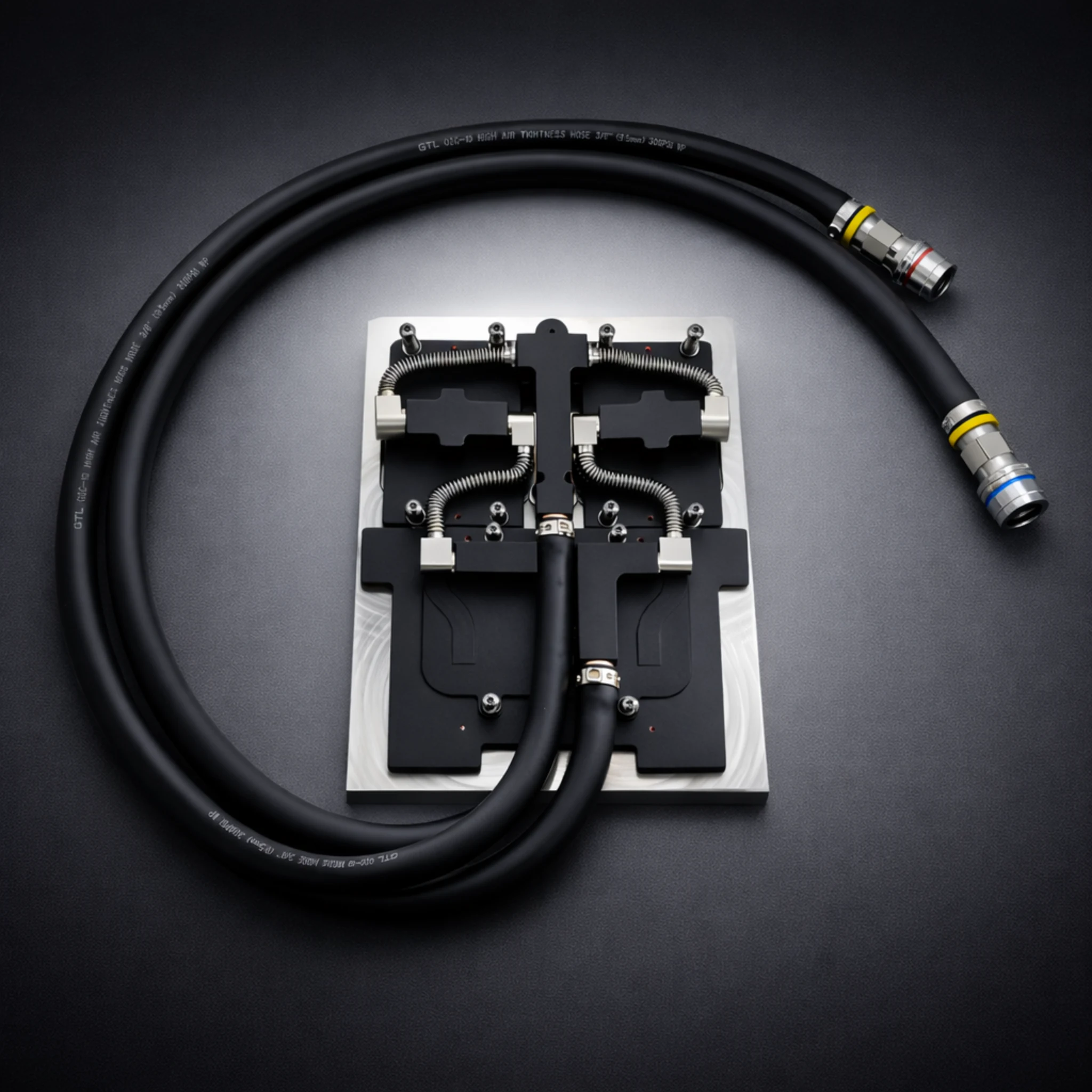
AI server liquid cooling kits deliver precise thermal control for GPU and CPU platforms operating at 500 W to 7,200 W thermal design power. As AI inference and training workloads push processor power envelopes beyond air-cooling limits, direct-to-chip liquid cooling has become the standard thermal architecture for hyperscale data centers. ToneCooling engineers turnkey cold plate kits — each matched to a specific processor socket, validated to OEM thermal and hydraulic specifications, and ready for rack-level integration.
“Every AI accelerator platform has a unique thermal fingerprint — socket geometry, TDP range, pressure-drop budget, and coolant chemistry all differ,” explains Dr. Kelvin Chen, Chief Thermal Engineer at ToneCooling. “Our liquid cooling kits are purpose-engineered per platform so system integrators receive a drop-in solution, not a compromise.”
What Is Ai Server Liquid Cooling Kits?
Modern AI accelerators have outpaced traditional air-cooling capacity. The NVIDIA GB200 Grace Blackwell Superchip dissipates 2,700 W per module, while H200 GPU trays exceed 7,200 W per node. Even CPU-only nodes running AMD EPYC SP5 or Intel Birch Stream processors reach 500–1,100 W. At these power densities, liquid cooling delivers 10–50× the heat transfer coefficient of forced air, enabling compact rack designs at 100+ kW per cabinet.
Direct-to-chip liquid cooling provides three critical advantages over air cooling for AI infrastructure:
- Thermal headroom — Junction-to-coolant thermal resistance below 0.05 °C/W ensures processors maintain boost clocks under sustained AI training loads.
- Rack density — Eliminating hot-aisle/cold-aisle spacing allows 2–3× more compute per square meter of data center floor.
- Energy efficiency — Liquid-cooled facilities achieve PUE values of 1.10–1.15 compared to 1.35–1.60 for air-cooled designs, reducing annual cooling energy costs by 30–50%.
AI Liquid Cooling Kit Platform Comparison
The following table compares ToneCooling’s five AI server liquid cooling kits across all critical thermal and hydraulic parameters:
| Parameter | NVIDIA GB200 | NVIDIA H200 | AMD EPYC SP5 | Intel Birch Stream | Intel Sapphire Rapids |
|---|---|---|---|---|---|
| Cooling Capacity (W) | 2,700 | >7,200 | 1,100 | 500 | >1,300 |
| Pressure Drop (kPa) | 35 @ 2.5 LPM | <18 @ 8.0 LPM | <3 @ 1.0 LPM | 5 @ 1.0 LPM | <12 @ 5.0 LPM |
| Flow Rate (LPM) | 2.5 | 8.0 | 1.0 | 1.0 | 5.0 |
| Coolant | Pure Water | Pure Water | 25% EGW | 25% EGW | 25% EGW |
| Max Pressure (MPa) | 0.6 | 0.8 | 0.6 | 1.0 | 0.6 |
| Cold Plate Material | Purple Copper T2 | Purple Copper T2 | Purple Copper T2 | Purple Copper T2 | Purple Copper T2 |
| Cold Plate Size (mm) | 235 × 190 × 30 | Custom OEM | 118 × 92.4 × 25 | 130 × 90 × 25 | Custom Dual-Inlet |
| Key Feature | Micro-channel + QD | Multi-GPU manifold | Low ΔP design | High-pressure rated | Dual-inlet flow |
All kits use Purple Copper T2 cold plates with CNC-machined micro-channel or skived-fin internal geometry. Specifications based on ToneCooling lab validation data.
NVIDIA GB200 Liquid Cooling Kit — 2,700 W Direct-to-Chip Solution

The GB200 Grace Blackwell Superchip represents NVIDIA’s highest-performance AI training platform, and its 2,700 W thermal envelope demands a purpose-built cooling solution. ToneCooling’s GB200 liquid cooling kit features a 235 × 190 × 30 mm Purple Copper T2 cold plate with CNC-machined micro-channel geometry, delivering full thermal dissipation at just 35 kPa pressure drop and 2.5 LPM pure water flow.
The kit includes pre-assembled quick-disconnect fittings, EPDM coolant hoses rated for continuous 80 °C operation, and a mounting bracket matched to the GB200 module socket geometry. Every unit undergoes 100% helium leak testing at 0.6 MPa to ensure zero-leak reliability in production environments.
Target applications: NVIDIA DGX GB200 NVL72 racks, custom GB200 OEM server trays, and hyperscale AI training clusters requiring per-module liquid cooling.
NVIDIA H200 Liquid Cooling Cold Plate — Multi-GPU >7,200 W Solution

NVIDIA H200 GPU nodes pack multiple accelerators into a single tray, pushing total node power beyond 7,200 W. ToneCooling’s H200 liquid cooling cold plate system handles this extreme thermal load with a pressure drop below 18 kPa at 8.0 LPM flow rate — keeping CDU pump power manageable even in large-scale deployments.
The H200 kit uses Purple Copper T2 cold plates with an optimized internal flow path that balances thermal resistance against hydraulic impedance. The system is rated for 0.8 MPa maximum pressure, accommodating high-flow CDU architectures used in hyperscale facilities. Pure water coolant ensures maximum thermal conductivity and eliminates glycol-related fouling in high-temperature GPU applications.
Target applications: NVIDIA HGX H200 8-GPU server trays, DGX H200 systems, and AI inference clusters requiring node-level liquid cooling with minimal pressure-drop penalty.
AMD EPYC SP5 Liquid Cooling Kit — 1,100 W Low-ΔP CPU Solution

AMD EPYC 9004/9005-series processors on the SP5 socket deliver up to 1,100 W TDP in high-core-count configurations. ToneCooling’s AMD SP5 liquid cooling kit provides full thermal dissipation with an ultra-low pressure drop of less than 3 kPa at just 1.0 LPM — the lowest hydraulic impedance in our AI server portfolio.
The compact 118 × 92.4 × 25 mm Purple Copper T2 cold plate is precision-machined to match the SP5 IHS contact area, maximizing thermal interface coverage. The kit uses 25% ethylene glycol-water (EGW) coolant for freeze protection in facilities with outdoor CDU loops, and is pressure-rated to 0.6 MPa.
Target applications: AMD EPYC-powered AI inference servers, HPC compute nodes, dual-socket SP5 platforms, and cloud-scale CPU deployments requiring minimal pump overhead.
Intel Birch Stream Cold Plate — 500 W High-Pressure Solution

Intel’s next-generation Birch Stream Xeon platform targets 500 W TDP for high-performance computing and AI inference workloads. ToneCooling’s Birch Stream cold plate features a 130 × 90 × 25 mm Purple Copper T2 design with 5 kPa pressure drop at 1.0 LPM flow, delivering efficient thermal management with minimal system-level hydraulic impact.
A distinguishing feature of the Birch Stream kit is its 1.0 MPa maximum pressure rating — the highest in our AI server lineup — ensuring compatibility with long-distance CDU piping runs and high-elevation facility installations where system pressure demands are elevated. The kit uses 25% EGW coolant.
Target applications: Intel Birch Stream Xeon servers for AI edge inference, enterprise HPC clusters, and telecom central-office deployments requiring high-pressure liquid cooling loops.
Intel Sapphire Rapids Cold Plate — >1,300 W Dual-Inlet Design
Intel Sapphire Rapids HBM and high-TDP SKUs push CPU power dissipation beyond 1,300 W in dual-socket configurations. ToneCooling’s Sapphire Rapids cold plate addresses this with a unique dual-inlet flow architecture that splits coolant across two independent micro-channel zones, reducing per-channel flow velocity while maintaining uniform junction temperature distribution.
The dual-inlet design achieves less than 12 kPa pressure drop at 5.0 LPM — a critical advantage for platforms where both CPU sockets share a common CDU manifold. The Purple Copper T2 cold plate is rated for 0.6 MPa and uses 25% EGW coolant for year-round outdoor CDU compatibility.
Target applications: Intel Sapphire Rapids dual-socket servers for AI training, HPC simulation workloads, and enterprise data center upgrades from air-cooled to liquid-cooled infrastructure.
Cold Plate Engineering: Material and Manufacturing
All ToneCooling AI server liquid cooling kits share a common engineering foundation built on Purple Copper T2 — the industry-standard material for high-performance liquid cold plates. Purple Copper T2 (C1100/CW004A) delivers 391 W/m·K thermal conductivity, ensuring minimal conductive resistance between the processor die and the coolant stream.
Our cold plates are manufactured using CNC micro-channel machining with channel widths from 0.3 mm to 1.0 mm, depending on the platform’s thermal and hydraulic requirements. Internal fin geometry is optimized per platform using CFD simulation validated against empirical thermal test data. Every cold plate undergoes:
- 100% helium leak testing at rated pressure to ensure zero-leak integrity
- Thermal performance validation against OEM thermal specification documents
- Pressure-drop verification at nominal and maximum flow rates
- Dimensional inspection against socket mounting tolerances (±0.05 mm)
System Integration: From Cold Plate to Rack-Level Cooling
Each liquid cooling kit is designed for plug-and-play integration into rack-level cooling architectures. The kits include all necessary components for direct-to-chip deployment:
- Cold plate assembly — Platform-matched copper cold plate with integrated mounting hardware
- Coolant hoses — EPDM or reinforced silicone hoses with appropriate fittings (barb, quick-disconnect, or manifold port)
- Thermal interface material (TIM) — Pre-applied or supplied indium/graphite TIM matched to IHS flatness specifications
- Mounting kit — Socket-specific brackets, standoffs, and spring-loaded fasteners calibrated to OEM contact pressure specifications
ToneCooling also supplies complementary infrastructure including custom liquid cold plates for non-standard processor layouts, manifold assemblies for multi-node distribution, and CDU-compatible quick-disconnect fittings rated for tool-free maintenance.
Choosing the Right AI Liquid Cooling Kit
Selecting the correct liquid cooling kit depends on four primary parameters:
1. Processor TDP and thermal target. Match the kit cooling capacity to the processor’s maximum sustained power. For GB200 at 2,700 W, only ToneCooling’s GB200-specific kit provides validated thermal performance. For lower-TDP Intel Birch Stream at 500 W, the compact single-inlet design offers the most cost-effective solution.
2. System hydraulic budget. Every CDU has a maximum pressure-drop allocation per node. The AMD SP5 kit at <3 kPa is ideal for systems with tight hydraulic budgets, while the H200 kit at <18 kPa at 8.0 LPM is engineered for high-flow architectures.
3. Coolant chemistry. Pure water delivers 15–20% better thermal performance than glycol mixtures but requires closed-loop systems without freeze risk. GPU-heavy platforms (GB200, H200) typically use pure water; CPU platforms (SP5, Birch Stream, Sapphire Rapids) use 25% EGW for broader facility compatibility.
4. Facility pressure requirements. Standard data center loops operate at 0.4–0.6 MPa. The Birch Stream kit’s 1.0 MPa rating serves edge and telecom installations where longer piping runs create higher system pressures.
OEM Partnership and Custom Development
ToneCooling supports OEM customers from prototype through volume production. Our engineering team provides:
- Thermal-hydraulic simulation — CFD analysis with conjugate heat transfer modeling for custom socket geometries
- Rapid prototyping — First article samples within 15 business days for standard platforms
- Design-for-manufacturing review — Optimizing cold plate geometry for CNC machining yield and cost
- Volume production — Monthly capacity of 10,000+ cold plate assemblies with full traceability
- Compliance documentation — RoHS, REACH, and UL certification support for global OEM customers
For technical consultation or to request a sample kit, contact our thermal engineering team at tonecooling.com/contact or email sales@tonecooling.com.
Frequently Asked Questions
What is a liquid cooling kit for AI servers?
A liquid cooling kit is a complete direct-to-chip thermal solution that includes a copper cold plate, coolant hoses, fittings, mounting hardware, and thermal interface material — everything needed to connect an AI processor to a facility liquid cooling loop. Each kit is engineered for a specific processor platform (GPU or CPU) and validated to the OEM’s thermal and hydraulic specifications.
Why do AI servers need liquid cooling instead of air cooling?
AI accelerators like the NVIDIA GB200 (2,700 W) and H200 (>7,200 W per node) generate heat densities that exceed air cooling capacity. Liquid cooling provides 10–50× higher heat transfer coefficients, enabling compact rack designs at 100+ kW per cabinet while maintaining processor junction temperatures within specification.
What coolant do ToneCooling liquid cooling kits use?
GPU platforms (GB200, H200) use pure deionized water for maximum thermal performance. CPU platforms (AMD SP5, Intel Birch Stream, Sapphire Rapids) use 25% ethylene glycol-water (EGW) mixture for freeze protection in facilities with outdoor CDU loops or cold-climate installations.
What is the pressure drop across ToneCooling cold plates?
Pressure drop varies by platform: GB200 at 35 kPa (2.5 LPM), H200 at <18 kPa (8.0 LPM), AMD SP5 at <3 kPa (1.0 LPM), Birch Stream at 5 kPa (1.0 LPM), and Sapphire Rapids at <12 kPa (5.0 LPM). All values are validated through ToneCooling’s in-house thermal test laboratory.
Can ToneCooling customize liquid cooling kits for non-standard server designs?
Yes. ToneCooling’s engineering team develops custom cold plate geometries, mounting solutions, and manifold configurations for OEM-specific server architectures. We provide CFD simulation, rapid prototyping within 15 business days, and volume production at 10,000+ units per month.
What quality certifications do ToneCooling liquid cooling kits have?
All kits undergo 100% helium leak testing, thermal performance validation against OEM specifications, and dimensional inspection to ±0.05 mm tolerances. ToneCooling supports RoHS, REACH, and UL certification for global OEM customers.
How do I choose between pure water and glycol coolant for my data center?
Pure water provides 15–20% better thermal conductivity and is preferred for indoor data centers with controlled environments. EGW mixture (25%) is recommended for facilities with outdoor cooling distribution units, cold-climate locations, or mixed CPU/GPU deployments where freeze protection is required.
Related Articles
- NVIDIA GB200 Liquid Cooling Kit — 2,700 W Thermal Solution
- NVIDIA H200 Liquid Cooling Cold Plate — Multi-GPU Cooling System
- AMD EPYC SP5 Liquid Cooling Kit — Low-ΔP CPU Solution
- Intel Birch Stream Cold Plate — 500 W Liquid Cooling
- Intel Sapphire Rapids Cold Plate — Dual-Inlet Design
- Custom Liquid Cold Plates: Complete Engineering Guide
- Cold Plate vs Heat Sink: Engineering Comparison Guide
- Direct Liquid Cooling for AI Data Centers
For industry standards and best practices, refer to ASHRAE thermal guidelines.
Industry References & Standards
Need a Custom Liquid Cold Plate?
Ai Server Liquid Cooling Kits is a high-performance thermal management solution engineered by ToneCooling for demanding applications.
ToneCooling engineers design thermal solutions for your specific requirements. Get an engineering RFQ review based on your uploaded requirements.
Ai Server Liquid Cooling Solution is a critical component in modern thermal management. ToneCooling engineers this solution for AI servers, data centers, EV batteries, and power electronics requiring high-performance liquid cooling.
Ai Server Liquid Cooling Solution: Key Specifications
When evaluating ai server liquid cooling solution, engineers consider thermal resistance, pressure drop, flow rate, and material compatibility. ToneCooling provides detailed specs for every ai server liquid cooling solution design, backed by CFD simulation and testing.
Why Choose ToneCooling for Ai Server Liquid Cooling Solution
ToneCooling has manufactured over 50,000 ai server liquid cooling solution units for global OEM customers. Our ai server liquid cooling solution production features vacuum brazing furnaces below 10⁻⁴ mbar, FSW machines with ≤0.02mm flatness, and helium leak detection at 10⁻⁸ mbar·L/s. Every ai server liquid cooling solution undergoes 100% pressure testing at 25 bar.
Our engineering team provides free ai server liquid cooling solution design consultation, CFD simulation, and rapid prototyping in 7-14 days. Production ai server liquid cooling solution orders ship in 4-6 weeks under ISO 9001:2015 quality management.
Need a Custom Liquid Cold Plate?
ToneCooling engineers design thermal solutions for your requirements. Response within 24-48 hours.
Last Updated: 2026-04-08