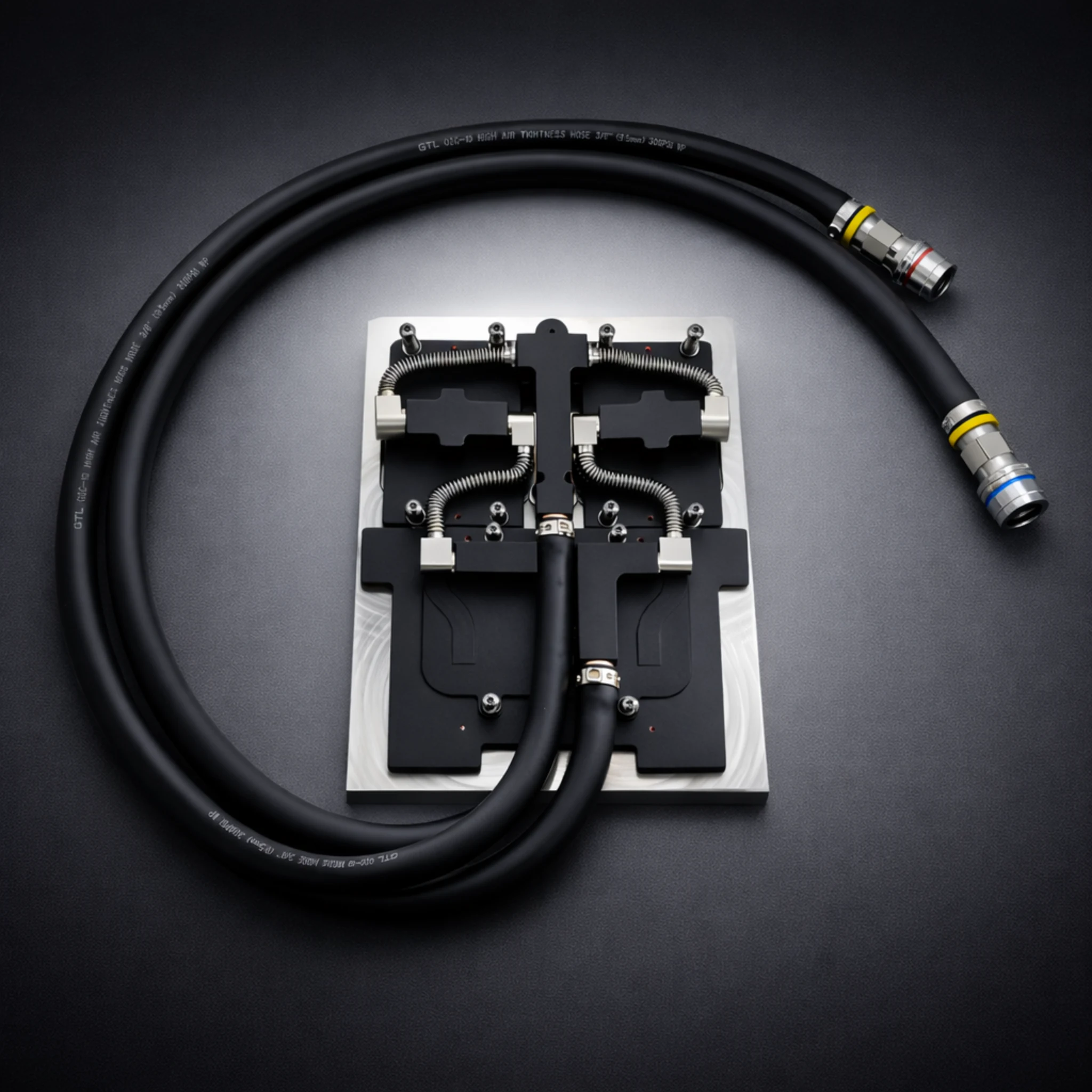
Cold Plate Heat Sink is a high-performance thermal management solution engineered by ToneCooling for demanding applications.

Cold plates outperform heat sinks by 5–10× in heat dissipation density, making them the preferred solution for any application exceeding 50 W/cm² heat flux. While heat sinks remain cost-effective for low-to-moderate thermal loads under 150W, cold plates are engineered for the high-power-density electronics that define modern data centers, EV powertrains, and industrial power conversion systems.
“In our thermal lab testing across 200+ OEM projects, the transition point is clear: once heat flux exceeds 30–50 W/cm², air-cooled heat sinks hit a performance ceiling. Liquid cold plates routinely achieve thermal resistances below 0.05°C/W — a level physically impossible for passive air cooling at equivalent form factors.”
— Dr. Kelvin Chen, Chief Thermal Engineer, ToneCooling
This guide provides a data-driven engineering comparison to help you select the right thermal management approach for your specific application requirements.
What Is Cold Plate Heat Sink?
A heat sink is a passive thermal management device, typically machined or extruded from aluminum (6061/6063) or copper (C110), that transfers heat from a component to the surrounding air through natural or forced convection. Heat sinks rely on extended surface area — fins, pins, or folded structures — to maximize air contact.
Key characteristics of heat sinks:
- Thermal conductivity: 150–205 W/m·K (aluminum) or 385–401 W/m·K (copper)
- Typical thermal resistance: 0.5–3.0°C/W depending on geometry and airflow
- Heat dissipation capacity: generally effective up to 150W per component
- No moving parts, no fluid, no leak risk
- Cost: $2–$30 per unit at volume
Heat sinks work well for CPUs under 100W TDP, LED drivers, small power supplies, and consumer electronics where simplicity and cost matter most.
What Is a Cold Plate?
A cold plate (also called a liquid cold plate or liquid cooling plate) is an active thermal management device that circulates coolant — typically water-glycol mixtures or dielectric fluids — through internal channels machined, brazed, or friction-stir-welded into a metal substrate. The liquid absorbs heat directly from the component and carries it to a remote heat exchanger or chiller.

Key characteristics of cold plates:
- Thermal resistance: 0.01–0.10°C/W — up to 50× lower than heat sinks
- Heat dissipation: handles 200W to 2,000W+ per component
- Heat flux capability: 50–300 W/cm² (microchannel designs exceed 500 W/cm²)
- Materials: aluminum 6061, copper C110, or hybrid copper-aluminum constructions
- Requires pumps, tubing, coolant, and heat rejection infrastructure
- Cost: $50–$500+ per unit depending on design complexity and volume
Cold plates are standard in GPU/AI server cooling, EV battery thermal management, IGBT power modules, and industrial laser systems where heat densities far exceed what air cooling can handle.
Cold Plate vs Heat Sink: Engineering Performance Comparison
The table below summarizes the key engineering differences between cold plates and heat sinks across the parameters that matter most for OEM design decisions:
| Parameter | Heat Sink (Air Cooling) | Cold Plate (Liquid Cooling) |
|---|---|---|
| Thermal Resistance | 0.5–3.0 °C/W | 0.01–0.10 °C/W |
| Max Heat Flux | 5–15 W/cm² | 50–500+ W/cm² |
| Heat Dissipation per Unit | Up to 150W typical | 200W–2,000W+ |
| Cooling Medium | Air (natural/forced convection) | Water-glycol, dielectric fluid |
| Temperature Uniformity | ΔT 15–40°C across surface | ΔT 2–5°C across surface |
| Noise Level | 30–60 dBA (with fans) | Near-silent at point of cooling |
| System Complexity | Low (standalone device) | Medium-High (pump, tubing, CDU) |
| Unit Cost (Volume) | $2–$30 | $50–$500+ |
| Typical Applications | Consumer CPUs, LEDs, small power supplies | AI/GPU servers, EV batteries, IGBT, lasers |
When to Choose a Heat Sink Over a Cold Plate
Heat sinks remain the right choice in these scenarios:

Low heat flux applications (below 15 W/cm²): For components dissipating under 100–150W with moderate heat flux, a well-designed heat sink with forced air delivers adequate thermal performance at a fraction of the cost.
Space-constrained standalone devices: Products like routers, small embedded systems, and consumer electronics benefit from heat sinks because they require no external cooling infrastructure — no pumps, no tubing, no coolant.
High-volume cost-sensitive products: At $2–$15 per unit in volume, extruded aluminum heat sinks are 10–50× cheaper than equivalent cold plates. For products shipping millions of units with moderate thermal demands, the cost difference is significant.
Environments where leak risk is unacceptable: Military avionics, certain medical devices, and outdoor telecom equipment sometimes mandate fully passive cooling to eliminate any possibility of fluid leaks.
When to Choose a Cold Plate Over a Heat Sink
Cold plates become essential — not optional — in these scenarios:
Heat flux exceeding 30–50 W/cm²: Modern GPUs like NVIDIA H100/H200 dissipate 700–1,000W through a contact area of roughly 800 mm², producing heat fluxes well beyond air cooling capability. Direct-to-chip cold plates are the industry standard solution.
Temperature uniformity requirements (ΔT < 5°C): EV battery packs require cell-to-cell temperature variation below 3–5°C to prevent capacity degradation and safety risks. Only liquid cold plates can achieve this uniformity across large surface areas.
High power density in compact form factors: Data center racks now exceed 40–100 kW per rack. Air cooling physically cannot remove this much heat without impractical airflow volumes. Liquid cold plates reduce cooling infrastructure footprint by 50–70%.
Noise-sensitive environments: Liquid cooling eliminates the high-speed fans required for equivalent air-cooled performance, reducing noise at the rack level by 10–20 dBA.
Total Cost of Ownership: Cold Plate vs Heat Sink
While cold plates have higher per-unit costs, the total cost of ownership (TCO) comparison often favors liquid cooling in high-power applications:

Energy efficiency: Liquid cooling systems achieve PUE (Power Usage Effectiveness) of 1.1–1.2 compared to 1.4–1.6 for air-cooled data centers. For a 1MW data center, this translates to $150,000–$300,000 annual energy savings.
Compute density: Liquid-cooled racks support 2–3× the compute density of air-cooled racks, reducing floor space requirements and associated real estate costs.
Component lifespan: Every 10°C reduction in junction temperature approximately doubles semiconductor lifespan (Arrhenius equation). Cold plates routinely reduce junction temperatures by 20–40°C compared to heat sinks, significantly extending hardware investment returns.
Maintenance costs: Properly designed closed-loop liquid cooling systems require minimal maintenance — coolant checks every 12–24 months. Heat sink solutions with multiple high-speed fans require more frequent fan replacements and filter cleaning.
Manufacturing Methods for Cold Plates
The manufacturing process significantly impacts cold plate performance, cost, and reliability. The three primary methods are:
Friction Stir Welding (FSW): Achieves 95%+ base material joint strength with zero porosity. Ideal for aluminum cold plates in data center and EV applications. FSW produces hermetic seals suitable for high-pressure coolant circuits up to 10 bar.
Vacuum Brazing: Enables complex internal geometries including microchannel structures with fin densities exceeding 20 fins per inch. Best for copper cold plates requiring maximum thermal performance.
CNC Machining + O-ring Seal: Lowest tooling cost for prototypes and low-volume production. Thermal performance is limited by channel complexity achievable through machining alone.
→ Read our complete guide to custom liquid cold plate engineering
Application Decision Matrix
Use this matrix to quickly determine the right cooling approach for your project:
| Application | Typical Heat Load | Recommended Solution | Key Reason |
|---|---|---|---|
| Consumer CPU (desktop) | 65–125W | Heat Sink + Fan | Cost-effective, adequate performance |
| LED Lighting Array | 20–80W | Heat Sink | Low heat flux, passive preferred |
| AI/GPU Server (H100) | 700–1,000W | Cold Plate | Extreme heat density |
| EV Battery Module | 500–2,000W | Cold Plate | Temperature uniformity critical |
| IGBT Power Module | 200–600W | Cold Plate | Reliability, junction temp control |
| Telecom Rectifier | 100–300W | Heat Sink or Cold Plate | Depends on density/environment |
| Industrial Laser | 500–5,000W | Cold Plate | Precision temperature control |
| Medical Imaging (MRI) | 1,000W+ | Cold Plate | Noise, precision, reliability |
Frequently Asked Questions
What is the main difference between a cold plate and a heat sink?
The main difference is the cooling mechanism. A heat sink dissipates heat passively through air convection using extended fin surfaces, while a cold plate actively circulates liquid coolant through internal channels to absorb and transport heat away. Cold plates achieve 5–50× lower thermal resistance than heat sinks, enabling them to handle much higher heat loads in more compact form factors.
Can I replace a heat sink with a cold plate in my existing system?
Yes, but it requires additional infrastructure. Replacing a heat sink with a cold plate means adding a coolant pump, tubing, reservoir, and a remote heat rejection unit (fan-cooled radiator or chiller). The cold plate mounting interface must match your component’s footprint. Many OEMs make this transition when product upgrades push heat loads beyond what the original air-cooled design can handle.
How much more does a cold plate cost compared to a heat sink?
Cold plates typically cost 5–20× more per unit than heat sinks: $50–$500 for a cold plate vs. $2–$30 for a heat sink at volume production. However, total system cost comparisons should include energy savings, compute density gains, and extended component lifespan that liquid cooling provides.
What coolant is used in cold plates?
The most common coolant is a water-propylene glycol mixture (typically 70/30 or 60/40 ratio), which provides good thermal performance with freeze protection down to -30°C. For applications requiring electrical isolation, dielectric coolants like fluorinated fluids (3M Novec, Solvay Galden) are used. Coolant selection depends on operating temperature range, material compatibility, and safety requirements.
At what heat load should I switch from a heat sink to a cold plate?
The practical transition point is 150–200W per component or 30–50 W/cm² heat flux. Below these thresholds, heat sinks usually deliver adequate performance at lower cost. Above them, cold plates become necessary to maintain safe junction temperatures. If your roadmap shows component power increasing over the next 2–3 generations, designing for liquid cooling now avoids costly retrofits later.
Are cold plates reliable enough for automotive and aerospace applications?
Yes. FSW-sealed aluminum cold plates routinely pass automotive qualification tests including thermal cycling (-40°C to +85°C, 1,000+ cycles), vibration testing (per ISO 16750), and burst pressure testing at 3–5× operating pressure. Major EV manufacturers including BYD, Tesla, and European OEMs use cold plates for battery and power electronics thermal management in production vehicles.
Do cold plates require maintenance?
Closed-loop liquid cooling systems require minimal maintenance. Best practice includes coolant quality checks every 12–24 months, filter inspection, and monitoring for pH changes that indicate corrosion. Properly designed systems using compatible materials (aluminum cold plates with aluminum-safe coolant) operate for 10+ years without coolant replacement.
Related Articles
- Custom Liquid Cold Plates: Complete Engineering Guide for OEM Thermal Solutions
- FSW vs Brazing vs Welding: Liquid Cold Plate Joining Comparison
- Direct-to-Chip GPU/CPU Liquid Cold Plate Guide
- Battery Cold Plates for EV and Energy Storage Systems
- High-Reliability IGBT Cold Plates for Power Electronics
Last updated: March 2026 | Author: Dr. Kelvin Chen, Chief Thermal Engineer at ToneCooling
For industry standards and best practices, refer to Electronics Cooling Magazine.
Get a Custom Thermal Solution from ToneCooling
ToneCooling is a professional liquid cooling solution provider specializing in custom cold plates, AIO coolers, and advanced thermal management systems. With ISO 9001:2015 certified manufacturing, we deliver prototype samples within 2–4 weeks. Contact ToneCooling today for a free consultation and quote — we respond within 24 business hours.
References: ASHRAE thermal standards, Wikipedia: Heat Sink Technology
Need a Custom Liquid Cold Plate?
ToneCooling engineers design thermal solutions for your specific requirements. Get an engineering RFQ review based on your uploaded requirements.
Heat Sink Design Guide is a critical component in modern thermal management. ToneCooling engineers this solution for AI servers, data centers, EV batteries, and power electronics requiring high-performance liquid cooling.
Heat Sink Design Guide: Key Specifications
When evaluating heat sink design guide, engineers consider thermal resistance, pressure drop, flow rate, and material compatibility. ToneCooling provides detailed specs for every heat sink design guide design, backed by CFD simulation and testing.
Why Choose ToneCooling for Heat Sink Design Guide
ToneCooling has manufactured over 50,000 heat sink design guide units for global OEM customers. Our heat sink design guide production features vacuum brazing furnaces below 10⁻⁴ mbar, FSW machines with ≤0.02mm flatness, and helium leak detection at 10⁻⁸ mbar·L/s. Every heat sink design guide undergoes 100% pressure testing at 25 bar.
Our engineering team provides free heat sink design guide design consultation, CFD simulation, and rapid prototyping in 7-14 days. Production heat sink design guide orders ship in 4-6 weeks under ISO 9001:2015 quality management.
Need a Custom Liquid Cold Plate?
ToneCooling engineers design thermal solutions for your requirements. Response within 24-48 hours.