

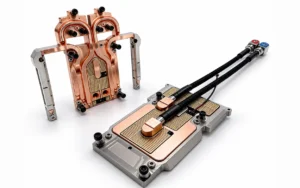
Battery Cold Plates is a precision-engineered thermal management component designed for high-power electronics cooling. ToneCooling provides battery cold plates solutions validated for AI server, data center, EV battery, and power electronics applications.
Battery Cold Plates for EV and Energy Storage Systems | ToneCooling
Custom battery cold plates and liquid cooling plates for EV packs and energy storage systems. ToneCooling designs aluminum and copper cold plates for prismatic, pouch and cylindrical cells, including high-temperature desert applications.
Battery Cold Plates for EV and Energy Storage Systems
Electric vehicles (EVs), commercial vehicles and energy storage systems (ESS) require stable and reliable battery temperatures to achieve long cycle life, safety and performance. As power and energy density increase, liquid-cooled battery cold plates have become a key technology in modern battery thermal management.
ToneCooling designs and manufactures custom battery cold plates for EV battery packs, commercial vehicles, stationary storage and backup power systems. We support prismatic, pouch and cylindrical cell formats and can adapt to different pack architectures.
Why Battery Packs Need Liquid Cooling
Battery cells are sensitive to temperature and temperature imbalance. Poor thermal management can cause:
Reduced capacity and shorter cycle life
Increased internal resistance and power limitation
Higher risk of thermal runaway in extreme conditions
Key challenges include:
High ambient temperatures
In some regions, ambient can reach 45–55°C in summer
Packs installed in enclosures, vehicles or roadside cabinets
Uneven heat generation
Different cells and modules in a pack may dissipate different amounts of heat
Cells in the center may run hotter than cells near the edges
Long-term reliability targets
8–10+ years of operation for ESS and backup systems
Warranty conditions requiring tight temperature control
Liquid-cooled battery cold plates help keep cell temperatures within a narrow and safe band, improving both performance and lifetime.
ToneCooling Battery Cold Plate Solutions
We offer custom cold plate solutions for different battery formats and pack designs:
Prismatic cell cold plates
Flat or contoured cold plates mounted under or between prismatic cells
Channels arranged to provide uniform cooling across the entire cell surface
Suitable for EV packs and stationary battery modules
Pouch cell cold plates
Plate designs adapted to pouch cell stack arrangements
Cooling surfaces contacting both sides of the cell stack (if required)
Options for integrated manifolds to minimize external piping
Cylindrical cell cold plates and baseplates
Cold plates integrated into modular trays for cylindrical cell assemblies
Can be combined with aluminum extrusions or cast structures
Suitable for high-capacity packs and commercial vehicles
We can also discuss hybrid solutions combining cold plates + PCM (phase change materials) for specific applications that require both passive and active thermal control.
Liquid Cooling for ESS and Backup Power Systems
In energy storage and backup power systems, battery packs often operate in harsh or confined environments:
Roadside cabinets for telecom and smart-city equipment
Desert or coastal regions with high ambient temperatures
Indoor or containerized ESS with limited natural airflow
ToneCooling designs battery cold plates that:
Work with water-glycol loops or dedicated chillers
Handle elevated ambient conditions and temperature cycling
Allow easy integration into modular ESS racks or cabinets
We can help you balance thermal performance, cost, and complexity for ESS applications, whether you are working on small backup systems or utility-scale storage.
Design Options and Material Choices
Our battery cold plates are typically built with:
Aluminum alloys (e.g. 6061-T6)
Lightweight and cost-effective
Good thermal conductivity and corrosion resistance with proper coolant treatment
Copper (for special high-performance sections)
Used when higher local thermal performance is required
Often combined with aluminum structures where appropriate
Internal flow paths can be:
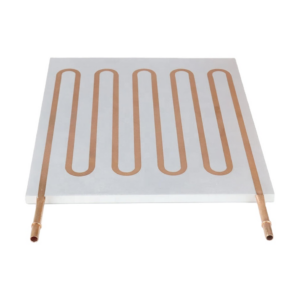
Serpentine channels
Simple, robust and effective for many battery modules
Multi-channel or microchannel layouts
Used when more uniform temperature or higher heat transfer is needed
We design the cold plate according to your requirements on:
Coolant type (water-glycol ratio, deionized water, etc.)
Inlet temperature and expected flow rate
Allowable pressure drop
Target cell surface temperature and maximum temperature difference
Manufacturing and Quality Control
As a dedicated thermal management manufacturer, we use mature processes to produce reliable battery cold plates:
CNC machining of channels and interfaces
Vacuum brazing of complex channel structures and covers
Friction Stir Welding (FSW) for aluminum plate assemblies
Surface finishing and corrosion protection where required
Quality and testing options include:
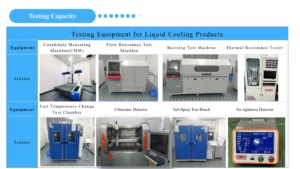
100% pressure and leak tests at agreed conditions
Dimensional checks and flatness control
Cleanliness measures appropriate for closed coolant loops
For projects with stricter requirements, we can define customized test plans and documentation in the early stage.
How to Start a Battery Cold Plate Project with ToneCooling
To evaluate a battery cold plate solution, you can begin by sharing:
Battery type and format (prismatic, pouch, cylindrical)
Module and pack voltage/capacity (e.g. 48V / 400Ah)
Maximum charge/discharge power and duty cycle
Ambient conditions (e.g. up to 55°C in desert climates)
Coolant type, inlet temperature and available flow rate
Mechanical layout (module arrangement, available space and interfaces)
Target lifetime and temperature limits (e.g. ≤30°C average cell surface)
Based on this information, we can:
Propose a suitable cold plate concept and layout
Provide an initial estimation of thermal performance feasibility
Issue a quotation for prototypes and mass production
Please contact sales@tonecooling.com with your project brief and drawings (2D/3D) so that our engineering team can give a focused response.
FAQ – Battery Cold Plates for EV and ESS
Q1: Which battery chemistries can your cold plates support?
Our cold plates are chemistry-agnostic. They can be used with various lithium-ion chemistries (LFP, NMC, etc.) and other cell types, as long as the mechanical and thermal requirements are defined.
Q2: Do you only support prismatic cells?
No. We support prismatic, pouch and cylindrical cells. The cold plate design will differ depending on how the cells are arranged in your module or pack.
Q3: What coolant do you recommend for battery cold plates?
Water-glycol mixtures are commonly used due to good thermal performance and freeze protection. The exact ratio and coolant specification should be defined according to your system design.
Q4: Can your cold plates operate in high ambient temperatures, such as 50–55°C?
Yes, we can design cold plates for high ambient conditions, provided that the coolant inlet temperature and flow rate are sufficient. We recommend discussing your exact boundary conditions so we can check feasibility.
Q5: Do you provide thermal simulations?
We can support basic thermal evaluation and cooperate with your in-house or third-party simulation teams. The typical process is to use combined engineering judgment, testing and simulations to refine the design.
Q6: What is the typical lead time for prototypes?
Prototype lead time depends on design complexity and process selection, but we generally aim for a reasonable turnaround after the design is frozen and commercial terms are agreed.
Ready to improve your EV or ESS battery thermal design?
Share your pack layout, power profile and coolant specs with us at info@tonecooling.com and our engineers will propose a custom battery cold plate solution.


What Is Battery Cold Plates?
Does ToneCooling offer OEM and ODM services?
Yes. ToneCooling provides full OEM and ODM services including custom design, prototyping, thermal simulation, and volume production. We serve customers in North America, Europe, and Asia-Pacific with engineering support and samples within 6–8 weeks.
What materials are used in ToneCooling liquid cold plates?
ToneCooling manufactures cold plates in aluminum (6061/6063), copper (C1100/C1020), and stainless steel. Aluminum FSW cold plates are ideal for high-volume EV and industrial applications, while copper brazed cold plates provide maximum thermal conductivity (398 W/m·K) for high heat flux electronics.
What is the typical lead time for custom cold plates?
Prototype samples are delivered within 6–8 weeks. Production orders typically ship within 4–6 weeks after sample approval. ToneCooling responds to all quote requests within 24 business hours.
Get a Custom Thermal Solution from ToneCooling
ToneCooling is a professional liquid cooling solution provider specializing in custom cold plates, AIO coolers, and advanced thermal management systems. With ISO 9001:2015 certified manufacturing, we deliver prototype samples within 6–8 weeks. Contact ToneCooling today for a free consultation and quote — we respond within 24 business hours.
For industry standards and best practices, refer to SAE International.
Need a Custom Liquid Cold Plate?
ToneCooling engineers design thermal solutions for your specific requirements. Get an engineering RFQ review based on your uploaded requirements.
Battery Cold Plate Manufacturer: Key Specifications
| Parameter | ToneCooling Specification |
|---|---|
| Material | Copper T2 / 6061 aluminum |
| Welding method | Transient liquid phase diffusion welding |
| Test pressure | 1 MPa (helium leak + nitrogen hold) |
| Working medium | PG25 (25% propylene glycol) |
| Custom design | Yes — DXF/STEP input accepted |
Why Choose ToneCooling for Battery Cold Plate Manufacturer
Engineering review and prototype planning are based on the project requirements. Custom prototype lead time is normally 6–8 weeks after drawing approval and order confirmation; confirm the production schedule in the quotation.
Need a Custom Liquid Cold Plate?
ToneCooling engineers design thermal solutions for your requirements. Response within 24-48 hours.
Last Updated: 2026-04-08
Related articles




.jpg.webp)

