Overview
With the rapid rise of AI computing, GPU clusters, and high-power chips, heat dissipation has become a critical barrier to performance and reliability. Even when two systems use liquid cooling, one may maintain stable performance under heavy loads while the other overheats — why?
The answer lies within the flow channel design.
The internal flow channel determines how efficiently the coolant absorbs and carries away heat. It defines flow distribution, pressure drop, and heat exchange efficiency, making it the true “soul” of every liquid cold plate.
In this guide, we will demystify the engineering process behind flow channel design — from fundamental concepts to advanced optimization techniques. Whether you’re a thermal engineer or a procurement specialist, this article will help you understand how the flow channel influences cooling efficiency, cost, and system reliability.
Keywords: liquid cold plate design, chip heat dissipation, high-power cooling solution, thermal performance optimization.
II. Step 1: Understanding the Basics – The Liquid Cooling Loop Concept — Liquid cold plate flow

2.1 What Is a Liquid Cooling Loop? — Liquid cold plate flow
A typical liquid cooling loop forms a closed circuit that continuously transfers heat from the source to the ambient environment. The circulation path usually includes:
Cold plate → Pump → Heat exchanger (radiator) → Reservoir → Cold plate
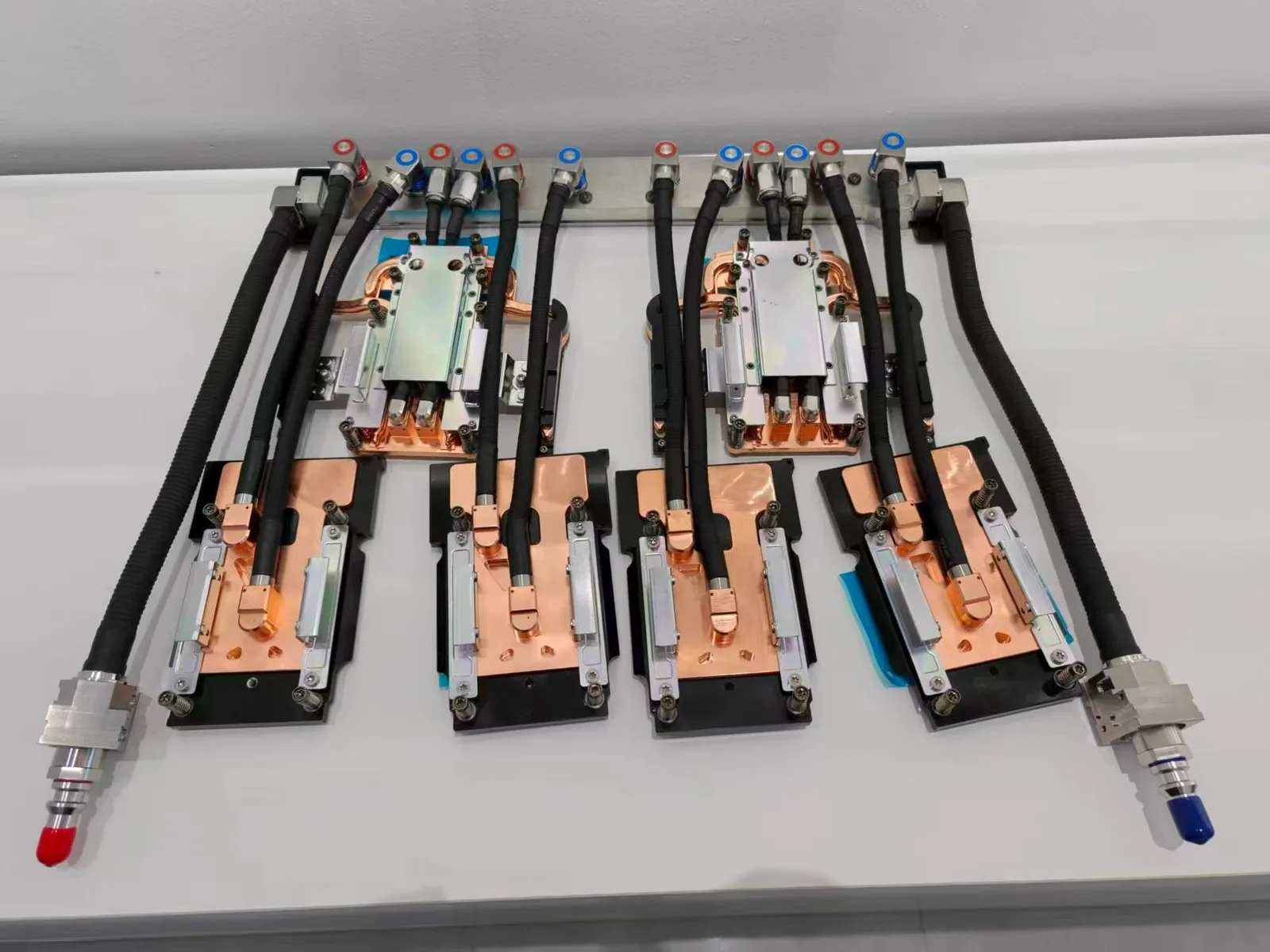
Among these components, the liquid cold plate plays the most crucial role — it directly interfaces with the heat-generating surface (such as CPU, GPU, or IGBT) and ensures fast thermal transfer to the coolant.
2.2 The Core Role of Flow Channels
The flow channel inside the cold plate determines how effectively the coolant contacts and removes heat from the base plate. A well-designed channel:
- Maximizes heat transfer area between coolant and metal.
- Ensures even flow distribution across the entire heat zone.
- Minimizes pressure drop, maintaining pump efficiency and system reliability.
Good flow channel design balances heat transfer, pumping power, and manufacturability.
III. Step 2: Building the Foundation – Choosing the Right Material
3.1 Common Materials and Their Characteristics
Below is a concise comparison of common materials used for cold plates:
| Material | Advantages | Limitations | Typical Use |
|---|---|---|---|
| Aluminum Alloy | Lightweight, cost-effective, easy to machine (CNC, die casting) | Lower thermal conductivity; some coolant compatibility issues | Consumer electronics, mid-power cooling |
| Copper | Excellent thermal conductivity, superior cooling performance | Heavy, expensive, more difficult to machine | Data center servers, high-power IGBTs |
| Stainless Steel | Corrosion-resistant, high mechanical strength | Lower thermal conductivity, heavier, costly | Harsh environments, chemical systems |
3.2 The Five Key Factors for Material Selection
- Thermal conductivity — determines how quickly heat moves from the base to coolant.
- Coolant compatibility — prevents corrosion or precipitation that could block channels (e.g., aluminum with untreated deionized water).
- Machinability — supports internal microchannel manufacturing (CNC, vacuum brazing, additive manufacturing).
- Cost optimization — balance between performance and budget.
- Density and strength — affects mechanical stability and overall weight.
Practical note: For many high-flux applications, copper or copper-based alloys are preferred despite higher cost. For cost-sensitive or weight-sensitive designs, aluminum alloys may be chosen with protective coatings or compatible coolant formulations.
IV. Step 3: The Core Design – Flow Channel Topologies and Structures
4.1 Common Flow Channel Types and Applications
Flow channel topology dramatically affects heat transfer performance and hydraulic behavior. Below are mainstream types and typical use cases:
- Straight Channel: Simple linear path. Advantages: low pressure drop, easy manufacturing. Limitation: poor temperature uniformity. Best for long strip heat sources.

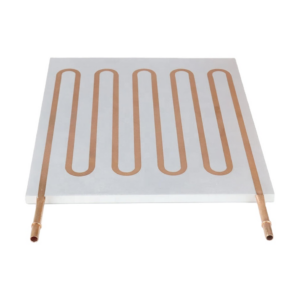
- Serpentine (Snake) Channel: Extended path with many turns. Advantages: longer residence time and higher heat exchange. Limitation: higher pressure drop. Suited for square/compact hot zones.

- Parallel Channels: Multiple branches in parallel. Advantages: lower pressure drop and potential for uniform distribution. Limitation: risk of maldistribution if resistances differ.

- Pin-Fin / Micro-Fin Matrix: Dense matrix of pins or microfins to increase surface area. Advantages: very high heat transfer. Limitation: very high pressure drop and manufacturing complexity.

- Bionic Flow Path: Mimics natural vascular systems (leaf veins, blood vessels) for optimized distribution. Advantages: balanced flow and low resistance. Limitation: complex to design and produce.

4.2 Key Geometric Parameters
Several geometric dimensions control hydraulic and thermal performance:
- Hydraulic diameter — influences flow regime (laminar vs turbulent) and convective heat transfer coefficient.
- Aspect ratio (width/depth) — affects mechanical strength and heat transfer area.
- Rib/wall thickness — balances rigidity and thermal resistance; too thin walls may deform under pressure.
Effective designs aim to maintain near-uniform coolant velocity across hot areas and minimize local temperature gradients (hot spots).
Design tip: Start with a simplified geometry for manufacturability and use iterative CFD tuning to refine local channel features.
V. Step 4: Simulation-Driven Optimization — CFD in Thermal Design
In modern engineering, Computational Fluid Dynamics (CFD) is essential for predicting and improving cold plate performance before physical prototyping.
CFD Analysis Workflow
- 3D Modeling & Meshing: Build a detailed CAD model and generate a high-quality computational mesh (local refinement near walls and small channels).
- Boundary Conditions: Specify inlet flow rate and temperature, heat flux distribution over the chip, material thermal properties, and outlet conditions.
- Solving Process: Use appropriate turbulence models (e.g., k-ω SST for transitional/turbulent flows) and coupled heat transfer solvers.
- Result Analysis: Examine temperature contours, pressure fields, velocity vectors, and identify hot spots or recirculation zones.
- Iterative Optimization: Modify geometry (channel spacing, depth, manifold shape), re-mesh, and repeat until performance targets are met.
CFD tools commonly used include ANSYS Fluent, Star-CCM+, and SolidWorks Flow Simulation. CFD shortens the design cycle and reduces prototyping costs.
Industry practice: Engineers at ToneCooling use advanced CFD coupled with experimental validation to ensure simulation predictions match lab thermal tests, ensuring real-world reliability.
VI. Step 5: Engineering Considerations Beyond the Model
Flow channel design goes beyond simulation — it must work reliably under manufacturing and operational constraints.
6.1 Thermal Performance Considerations
- Define target overall thermal resistance (°C/W) and allowable temperature rise.
- Control hotspots and manage transient thermal responses during power cycling.
6.2 Fluid Dynamics Considerations
- Ensure system total pressure drop is compatible with chosen pump sizing.
- Design for flow uniformity in parallel branches.
- Avoid cavitation by maintaining sufficient NPSH (net positive suction head) margins.
6.3 Reliability Factors
- Structural integrity under working pressure and thermal cycling.
- Material corrosion, fouling, and long-term aging.
- Leak prevention: proper sealing, high-quality brazing or diffusion bonding.
6.4 Manufacturability and Cost
Design must consider available fabrication methods — vacuum brazing, friction stir welding, CNC machining, or additive manufacturing (for complex geometries). The choice affects unit cost, lead time, and achievable tolerances.
Practical note: ToneCooling balances performance and manufacturing feasibility using proven bonding methods (e.g., vacuum brazing, transient liquid phase diffusion bonding) to achieve reliable seals and high thermal conductance.
VII. Step 6: Avoiding Common Design Pitfalls
Q1: Flow Dead Zones
Symptom: Extremely low velocity in localized areas causing overheating.
Solution: Use CFD streamlines to locate dead zones; redesign manifolds, avoid abrupt expansions/contractions, and smooth internal transitions.
Q2: Uneven Flow Distribution
Symptom: Some parallel branches carry more flow than others, causing temperature imbalance.
Solution: Balance flow resistances by geometry design or add calibrated flow restrictors to ensure uniform distribution.
Q3: Excessive Pressure Drop
Symptom: High pumping power required; increased energy cost.
Solution: Reduce sharp bends, increase channel cross-section where feasible, and optimize aspect ratio to lower hydraulic losses.
Q4: Air Trapping (Gas Pockets)
Symptom: Residual gas pockets block flow and reduce cooling efficiency.
Solution: Design venting features and filling procedures to purge trapped air during commissioning; ensure pump placement and reservoir design favor complete filling.
VIII. Conclusion and Future Trends
Summary: Flow channel design for liquid cold plates is a multi-objective optimization problem that balances thermal performance, hydraulic loss, manufacturability, cost, and reliability. An optimized channel can significantly improve thermal control, reduce energy consumption, and extend equipment life.
Future Trends
- Additive Manufacturing (3D Printing): Enables complex, high-performance bionic channels that were previously impossible to machine.
- AI-Driven Topology Optimization: Machine learning and evolutionary algorithms produce flow channel shapes that minimize pressure drop while maximizing heat transfer.
- System Integration: Integration of pumps, valves, and sensors directly with cold plates for compact, modular solutions.
With its 20+ years of R&D experience and in-house manufacturing processes, ToneCooling Technology Co., Ltd continues to lead in customized liquid cold plate design, delivering tailored solutions for data centers, GPUs, power electronics and 5G equipment.
IX. FAQ: Common Questions in Flow Channel Design
1. What’s the difference between serpentine and parallel channels?
Serpentine channels offer better heat transfer due to longer residence time but have higher pressure drop. Parallel channels reduce pressure drop but require careful balancing to avoid maldistribution. Choice depends on pump power availability and heat flux density.
2. How does CFD help in cold plate design?
CFD predicts temperature, velocity, and pressure distributions, allowing iteration on geometry before prototyping — saving time and cost while increasing design confidence.
3. What coolant is most commonly used?
Deionized water or water-glycol mixtures are common. In some applications (e.g., where electrical isolation is needed), dielectric fluids (e.g., engineered fluorinated fluids) are used. Coolant selection must consider material compatibility.
4. Why is material compatibility important?
Mismatched materials and fluids can cause corrosion, galvanic reactions, or precipitation — leading to clogged channels, leaks, and system failure. Proper material selection and surface treatments prevent these issues.
5. Can ToneCooling customize liquid cold plates?
Yes. ToneCooling specializes in customized, high-performance liquid cold plates for servers, GPUs, power electronics, and telecommunications equipment, combining CFD, precision manufacturing, and advanced bonding technologies.
X. Contact ToneCooling for Custom Liquid Cold Plate Design Solutions
Need a tailored liquid cold plate solution?
ToneCooling Technology Co., Ltd offers custom thermal design, CFD validation, prototyping, and scalable manufacturing. Our team includes PhDs and senior engineers with decades of thermal management expertise.
For industry standards and best practices, refer to ASHRAE thermal guidelines.
Frequently Asked Questions
Does ToneCooling offer OEM and ODM services?
Yes. ToneCooling provides full OEM and ODM services including custom design, prototyping, thermal simulation, and volume production. We serve customers in North America, Europe, and Asia-Pacific with engineering support and samples within 4–6 weeks.
What materials are used in ToneCooling liquid cold plates?
ToneCooling manufactures cold plates in aluminum (6061/6063), copper (C1100/C1020), and stainless steel. Aluminum FSW cold plates are ideal for high-volume EV and industrial applications, while copper brazed cold plates provide maximum thermal conductivity (398 W/m·K) for high heat flux electronics.
What is the typical lead time for custom cold plates?
Prototype samples are delivered within 4–6 weeks. Production orders typically ship within 6–8 weeks after sample approval. ToneCooling engineers review all quote requests and reply with clear next steps.
Get a Custom Thermal Solution from ToneCooling
ToneCooling is a professional liquid cooling solution provider specializing in custom cold plates, AIO coolers, and advanced thermal management systems. With ISO 9001:2015 certified manufacturing, we deliver prototype samples within 4–6 weeks. Contact ToneCooling today for a free consultation and quote.
Related ToneCooling Resources
Industry References & Standards
Need a Custom Liquid Cold Plate?
ToneCooling engineers design thermal solutions for your specific requirements. Get an engineering RFQ review based on your uploaded requirements.
Last Updated: 2026-04-08