Liquid Cold Plate vs Heat Pipe: Complete Comparison Guide for Engineers
Choosing the right thermal management technology is one of the most consequential decisions in power electronics and server design. Both liquid cold plates and heat pipes are widely used — but they serve fundamentally different power regimes and application requirements. This guide provides a definitive, engineer-focused comparison to help you select the correct solution for your project.
1. What Is a Liquid Cold Plate?
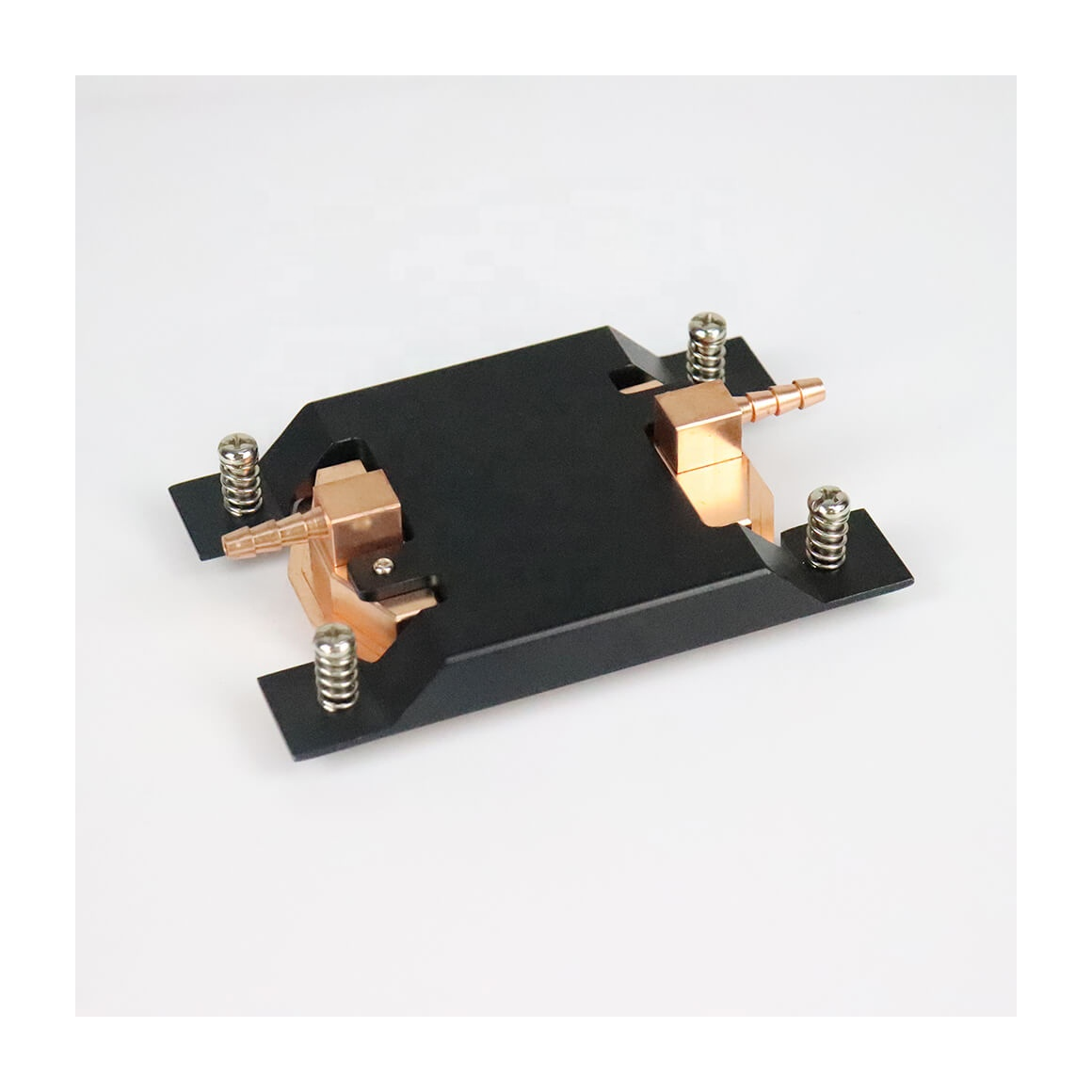
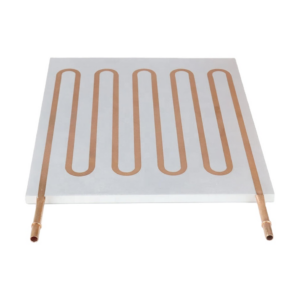
A liquid cold plate (also called a water cooling plate or cold block) is a metal plate — typically copper or aluminum — with internal channels through which liquid coolant is actively pumped. The plate is mounted directly against the heat-generating component (GPU die, IGBT module, EV battery cell face), and coolant continuously absorbs and carries away heat to a remote radiator or heat exchanger.
Key characteristics:
- Active system — requires pump, coolant loop, and heat exchanger
- Handles very high heat fluxes: 50–500+ W/cm²
- Orientation-independent — works in any mounting position
- Scalable to rack-level and system-level cooling architectures
- Materials: Copper (C1100, C1020) or aluminum alloy (6061, 6063)
- Manufacturing: vacuum brazing, friction stir welding, diffusion bonding
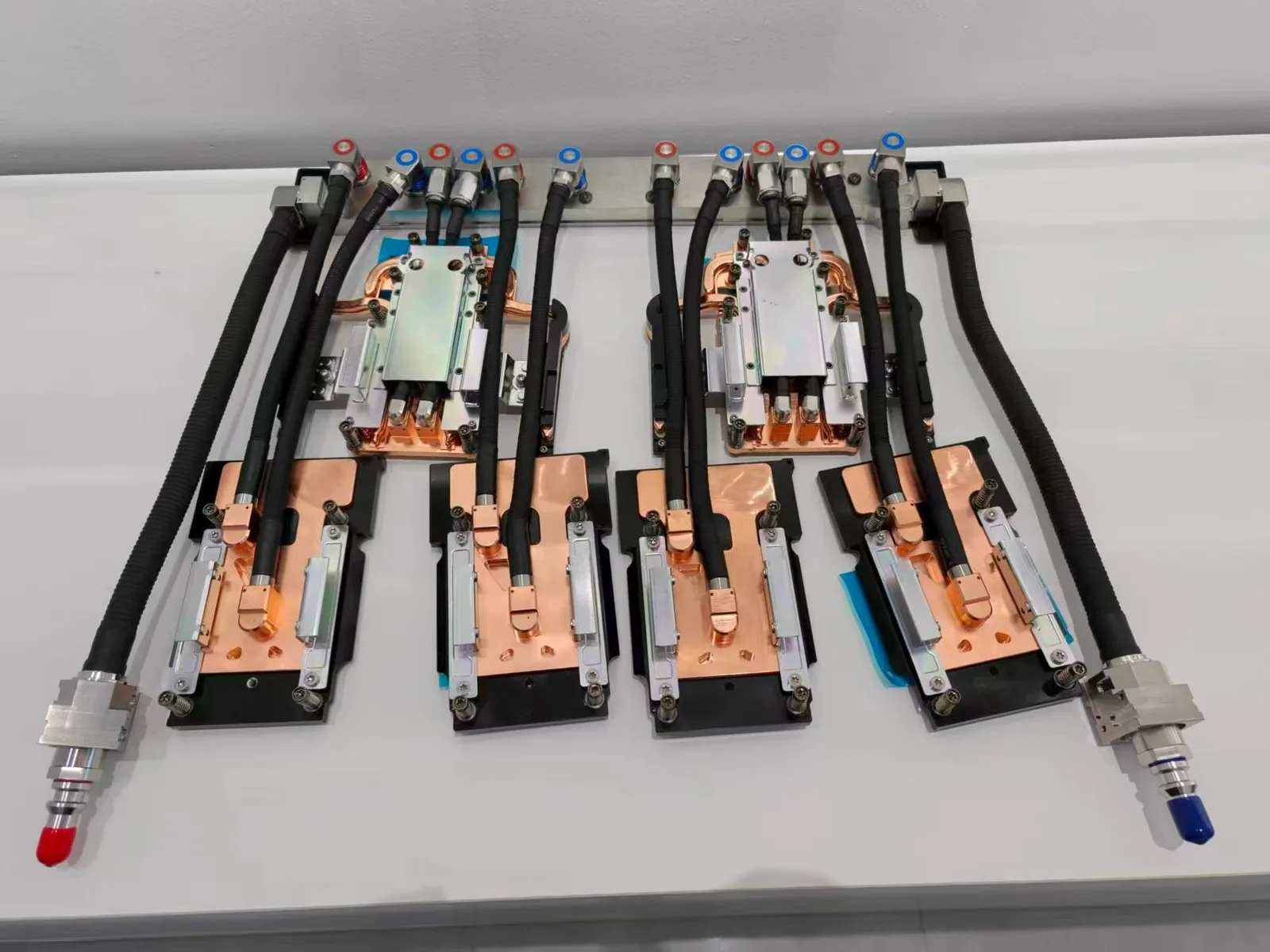
Liquid cold plates are the standard thermal solution for AI GPU servers (NVIDIA GB200, H200), IGBT power electronics, and EV battery thermal management.
2. What Is a Heat Pipe?
ToneCooling reviews heat pipe capability against vapor chambers and liquid cold plates for every custom thermal design. A heat pipe is a sealed, passive thermal device that transfers heat via the phase change of a working fluid (typically water, ammonia, or acetone). Heat is absorbed at the evaporator end (hot side), vaporizes the fluid, travels as vapor to the condenser end (cold side), releases heat, and the condensed liquid wicks back via a porous wick structure.
Key characteristics:
- Passive system — no pump required, self-contained
- Effective heat flux: typically 10–100 W/cm² (vapor chambers up to 200 W/cm²)
- Orientation-sensitive — gravity-assisted heat pipes work best vertically
- Limited total heat transport capacity per pipe (5W–250W typical)
- Materials: copper pipe with sintered powder or grooved wick
- Common formats: round heat pipes, flat vapor chambers
Heat pipes are widely used in consumer electronics (laptop cooling, LED lighting), telecom equipment, and moderate-power industrial applications under 200W per device.
3. Head-to-Head Comparison Table
ToneCooling manufactures both liquid cold plates and vapor chambers; the table below summarizes when each technology, including heat pipes, is the right engineering choice.
| Parameter | Liquid Cold Plate | Heat Pipe / Vapor Chamber |
|---|---|---|
| Cooling Mechanism | Forced convection via liquid coolant | Passive phase-change (evaporation/condensation) |
| Max Heat Capacity | 100W to 20kW+ per plate | 5W–250W per pipe; VC up to ~600W |
| Thermal Resistance (Rth) | 0.02–0.05 °C/W (design dependent) | 0.1–0.3 °C/W (assembly dependent) |
| Heat Flux Capability | 50–500+ W/cm² | 10–200 W/cm² |
| System Complexity | High — requires pump, CDU, plumbing | Low — self-contained, no moving parts |
| Orientation Sensitivity | None — orientation independent | Yes — gravity-dependent (gravity-assist preferred) |
| Sub-Ambient Cooling | Yes — with chiller integration | No — limited to ambient delta |
| Scalability | Excellent — manifold systems scale to full rack | Limited — each pipe handles one zone |
| Best For | AI servers, IGBT, EV batteries, data centers | Consumer electronics, LED, telecom <200W |
| Typical Unit Cost | Higher (precision machined/brazed) | Lower (high-volume manufacturing) |
| Maintenance | Coolant quality monitoring required | Zero maintenance (sealed system) |
4. When to Choose Each Technology
Choose a Liquid Cold Plate When:
- Your heat source exceeds 150–200W per device
- Heat flux is above 50 W/cm² at the component surface
- The system orientation cannot be controlled or changes in operation (e.g., vehicle-mounted inverters)
- You need sustained, continuous cooling without thermal saturation
- Your application requires rack-scale or system-level thermal architecture
- You need sub-ambient cooling via chiller integration
- The design must scale from prototype to production volume (OEM programs)
Application examples: NVIDIA GB200 / H200 GPU servers, IGBT traction inverters, EV battery cold plates, power conversion modules, data center direct-to-chip cooling.
Choose a Heat Pipe When:
- Your heat load is under 150W per device
- System must be passively cooled with no moving parts
- Weight and form factor are critical constraints (e.g., laptops, aerospace)
- The application is cost-sensitive and high-volume consumer electronics
- Orientation is fixed and gravity-assisted operation is achievable
Application examples: Laptop CPU cooling, LED street lighting, telecom base station amplifiers, satellite thermal management.
5. Industry Trend: Why Liquid Cooling Is Winning in High-Power Applications
The thermal management industry is undergoing a decisive shift toward liquid cooling, driven by three concurrent trends:
1. AI GPU power density explosion. NVIDIA’s roadmap has GPU TDP increasing from 400W (A100) to 700W (H100) to 1200W+ (GB200). No air or heat pipe system can handle this — direct-to-chip data center liquid cold plates are mandatory.
2. EV powertrain thermal requirements. EV battery packs and SiC inverters demand precise temperature uniformity (±2°C cell-to-cell) and fast thermal response — neither is achievable with passive heat pipe solutions.
3. Rack density economics. Air cooling tops out at 8–25kW per rack. Direct liquid cooling enables 80–120kW+ per rack, slashing data center footprint and PUE. Hyperscalers including Meta, Google, and Microsoft are mandating liquid-cooled server deployments.
Heat pipes and vapor chambers remain excellent solutions in their optimal range — but for any application above 200W per device or requiring rack-scale thermal architecture, liquid cold plates are the engineering answer.
6. How ToneCooling Can Help
ToneCooling is a specialized manufacturer of custom liquid cold plates for high-power applications. Our engineering team works directly with OEMs, system integrators, and R&D teams to design and manufacture cold plates optimized for specific thermal, mechanical, and coolant requirements.
Our capabilities include:
- CFD thermal simulation for flow distribution and thermal performance validation
- Vacuum-brazed copper and aluminum cold plates (micro-channel and turbulator designs)
- Prototype delivery in 4–6 weeks, prototypes from 1 piece
- Production-grade manufacturing with ISO 9001 quality management
- Platform-specific designs for NVIDIA GB200, IGBT modules, and EV battery systems
- OEM qualification support including PPAP documentation
References & Further Reading
Liquid Cold Plate vs Heat Pipe: Key Performance Differences
When comparing a liquid cold plate vs heat pipe, the most critical factor is thermal resistance at high heat flux. Liquid cold plates consistently outperform heat pipes above 150W/cm² heat flux density. Below this threshold, heat pipes may offer simpler integration with comparable performance. ToneCooling engineers recommend liquid cold plates for any application exceeding 200W total dissipation with constrained mounting area.
The liquid cold plate vs heat pipe decision also depends on orientation sensitivity. Heat pipes rely on gravity-assisted condensate return in many configurations, while liquid cold plates operate identically in any orientation — a critical advantage for rack-mounted servers, aerospace systems, and EV battery packs where orientation varies.
For projects requiring a liquid cold plate, request a quote from ToneCooling with your thermal specifications.
Frequently Asked Questions
Need a Custom Liquid Cold Plate?
ToneCooling designs and manufactures precision liquid cold plates for AI servers, IGBT modules, EV batteries, and power electronics. Prototype in 4–6 weeks. prototypes from 1 piece.