Guangdong, China
Global Engineering RFQ Review

Sunway Processor Liquid Cooling Guide

Table of Contents

Sunway processor liquid cooling is the thermal management approach used to cool Sunway (申威) SW26010 and SW26010-Pro many-core processors in China’s national supercomputer systems, where each chip generates 250–300W across 260+ cores and must operate continuously at 100% load for days or weeks during scientific simulations. Unlike standard server CPUs with commercial socket designs, Sunway processors use proprietary BGA packaging requiring custom-engineered direct-to-chip liquid cooling plates with tailored mounting brackets, optimized micro-channel layouts matching the processor’s unique heat map, and leak-proof construction rated for 24/7 HPC operation. ToneCooling manufactures custom Sunway liquid cooling plates achieving thermal resistance of 0.05°C/W at 1.5 LPM coolant flow.

Last Updated: 2026-04-10 | Author: ToneCooling Thermal Engineering Team

Sunway processor liquid cooling plate by ToneCooling for SW26010 supercomputer
ToneCooling Sunway processor liquid cooling plate — custom direct-to-chip design for SW26010 HPC supercomputer

Sunway SW26010 Processor Thermal Profile

The Sunway SW26010 is a 260-core many-core processor developed by China’s National High Performance IC Design Center (NHPIDC). Understanding its thermal characteristics is essential for designing an effective liquid cooling solution:

ParameterSW26010SW26010-Pro (est.)
Core count260 (4 CGs x 65 CPEs)390+ cores
ArchitectureAlpha (custom RISC)Enhanced Alpha
Clock frequency1.45 GHz~1.6 GHz
TDP250W~300W
Die area (approx.)~540mm²~650mm²
Heat flux (avg.)~46 W/cm²~46 W/cm²
Tj,max85°C85°C
Package typeProprietary BGAProprietary BGA
Nodes in TaihuLight40,960TBD (next-gen)
Cooling methodDirect liquid coolingDirect liquid cooling

With 40,960 nodes in Sunway TaihuLight alone, each requiring an individual liquid cooling plate, this represents one of the largest single-processor cold plate deployments in the world — per the TOP500 supercomputer database.

Liquid Cooling Plate Design for Sunway Processors

Designing a liquid cooling plate for Sunway processors differs significantly from standard Intel/AMD server cold plates:

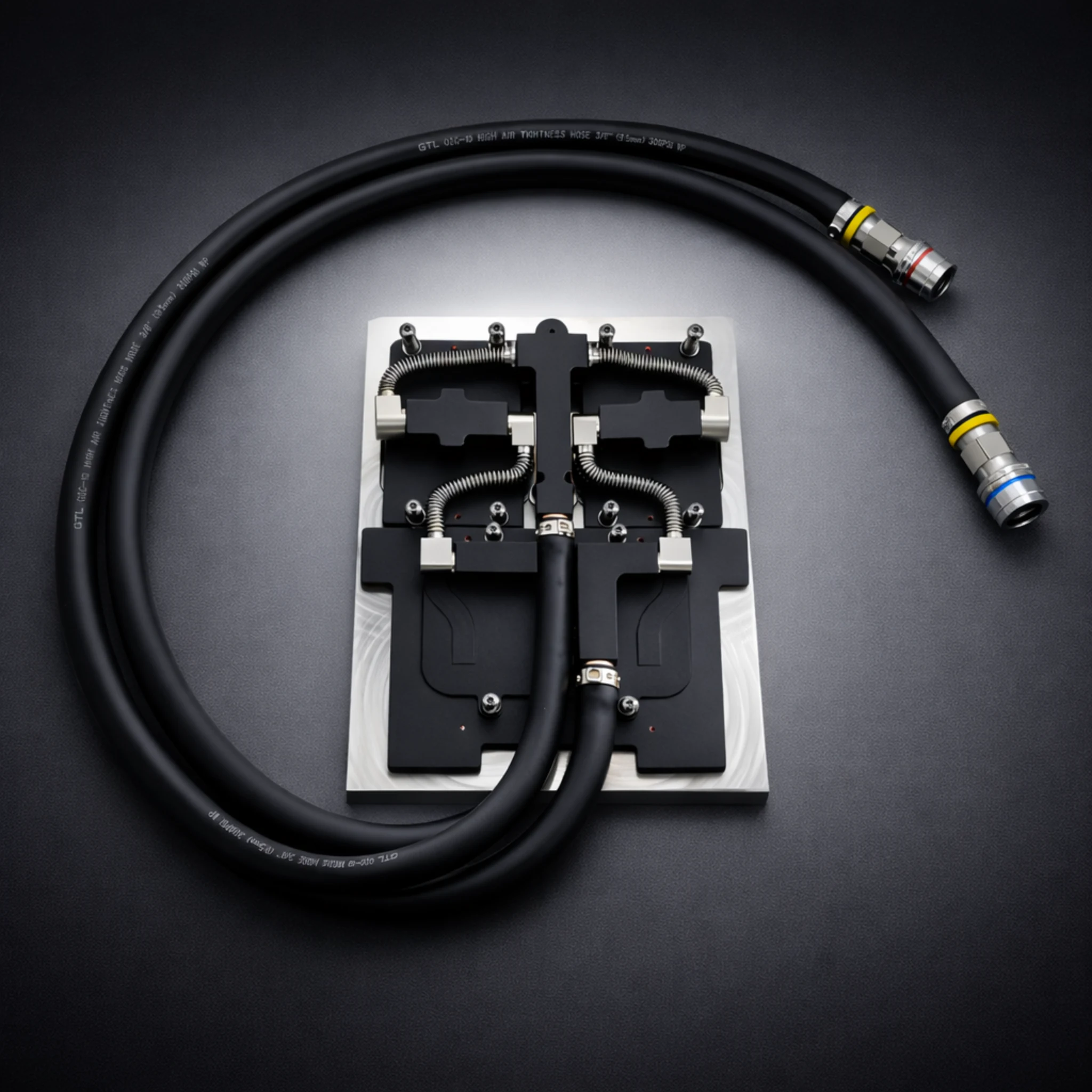
ToneCooling dual-channel liquid cooling plate for Sunway and domestic HPC processors
ToneCooling precision CNC machined dual-channel cold plate — adaptable to Sunway’s proprietary BGA mounting
  1. Custom mounting bracket: Sunway’s proprietary BGA socket has no standard retention mechanism. ToneCooling reverse-engineers the mounting hole pattern from processor samples and designs custom spring-loaded or screw-mounted brackets.
  2. Heat map optimization: Sunway’s 4-CG (Core Group) architecture creates a non-uniform heat distribution different from Intel/AMD. Cold plate micro-channels must be denser over the management processing element (MPE) area where heat flux is highest.
  3. Flow balance: Parallel micro-channels must deliver uniform flow distribution to prevent hot spots. ToneCooling validates flow balance with ANSYS Fluent CFD simulation (included free with every project).
  4. Leak-proof construction: 24/7 HPC operation demands zero-leak reliability. ToneCooling uses helium mass spectrometry leak testing (10⁻&sup9; Pa·m³/s sensitivity) for all Sunway cold plates.
  5. Coolant compatibility: 50/50 ethylene glycol-water per ASHRAE W55 water quality guidelines. Materials must resist corrosion over 10+ year operational life.

Sunway Liquid Cooling vs Other Chinese HPC Platforms

PlatformTDPPackageCold Plate MountingToneCooling Support
Sunway SW26010250WCustom BGACustom bracket requiredYes — custom design
MetaX C500~350WCustom BGACustom bracket requiredYes — custom design
Biren BR100~300WOAM moduleOAM-compatibleYes — OAM cold plate
Hygon DCU~300WCustomCustom bracketYes — custom design
Phytium FT-2000100WLGAStandard retentionYes — standard + custom
ToneCooling 500W server cold plate for Sunway and HPC processor liquid cooling
ToneCooling 500W-rated server cold plate — supporting Sunway, MetaX, and international HPC processor platforms

ToneCooling Sunway Cooling Capabilities

  • Prototype: CNC machined aluminum, MOQ 5 pcs, 7–15 days delivery
  • Production: Vacuum brazed copper for maximum performance, MOQ 50 pcs, 3–6 weeks
  • Free CFD simulation: ANSYS Fluent analysis of temperature, flow, pressure drop optimized for Sunway’s heat profile
  • Quality: ISO 9001 certified. Helium leak testing on every unit. Flatness <0.03mm.
  • Tsinghua-validated: Our precision manufacturing was selected by Tsinghua University for research-grade thermal components

Request Sunway Liquid Cooling Quote

➔ Get Sunway Cooling Quote (48h Response)  |  info@tonecooling.com  |  US: +1 (832) 720-7542

Frequently Asked Questions

What is Sunway processor liquid cooling?

Direct-to-chip liquid cooling for Sunway SW26010/Pro HPC processors (250–300W, 260+ cores). Custom cold plates circulate coolant through micro-channels to maintain junction temperature below 85°C during sustained supercomputer workloads.

Why can’t standard cold plates cool Sunway processors?

Sunway uses proprietary BGA packaging with non-standard die layout (4 Core Groups) and unique mounting holes. Standard Intel/AMD cold plates don’t fit physically or thermally. Custom bracket design and heat-map-optimized channels are required.

How many Sunway cold plates does TaihuLight use?

Sunway TaihuLight has 40,960 compute nodes, each with one SW26010 processor requiring an individual liquid cooling plate — totaling over 40,000 cold plates in a single supercomputer installation.

What thermal resistance does a Sunway cold plate achieve?

ToneCooling’s copper vacuum brazed Sunway cold plate: 0.05°C/W at 1.5 LPM. Aluminum CNC: 0.08°C/W. Both maintain Tj below 75°C at full 250W load with 35°C inlet coolant.

Does ToneCooling support next-generation Sunway processors?

Yes. ToneCooling’s custom design process accommodates any new Sunway processor variant. Submit processor sample or package drawing and we deliver custom cold plate design within 48 hours.


Picture of ToneCooling Engineering Team

ToneCooling Engineering Team

The ToneCooling thermal engineering team designs, simulates, and validates custom liquid cold plates for GPU, CPU, IGBT, and EV battery applications.

Welcome To Share This Page:
Product Categories
Latest News
Get A Free Quote Now !
Quote Request

Related Products

Related News

Drawing preparation checklist for data center liquid cold plate quotation, covering CAD files, heat source maps, port layout, material and validation inputs.
Validation items engineers should define before requesting a data center liquid cold plate quote, including leak test, pressure test, cleanliness and documentation.
Copper and aluminum cold plate tradeoffs for AI server projects, including thermal performance, weight, corrosion, joining route and RFQ inputs.
Engineering checklist for direct-to-chip cold plate port layout, hose clearance, serviceability and RFQ preparation in AI server cooling projects.
How to prepare pressure-drop and flow-rate inputs for custom GPU liquid cold plate RFQs used in AI server and data center cooling projects.
RFQ inputs engineers should prepare for data center GPU cold plates, including drawings, heat load, coolant, flow rate, pressure-drop target and validation requirements.

ToneCooling (Guangdong ToneCooling Precision Manufacturing Co., Ltd.) has completed its new 30,000m² manufacturing facility in Dongguan, Guangdong, China — an

An FSW liquid cold plate (friction stir welded liquid cold plate) is a sealed thermal management heat exchanger manufactured by

Last Updated: 2026-05-08
Scroll to Top

Get A Free Quote Now !

If you have any questions, please do not hesitate to contact us.

Quote Request
ToneCooling 19 thermal management
(function () { 'use strict'; if (window.tcDataCenterV14TrackingLoaded) return; window.tcDataCenterV14TrackingLoaded = true;var SITE_MARKET = 'global'; var TARGET_SEGMENT = 'data_center_gpu_cpu'; var TRACKED_FORM_IDS = ['3', '4']; var PAGE_PATH = '/liquid-cold-plates/data-center-liquid-cold-plate/'; var THANK_YOU_PATH = '/thank-you/data-center-cold-plate-rfq/'; var DEBUG = /(?:\?|&)tc_debug=1(?:&|$)/.test(window.location.search); var formStarted = false; var formSubmitted = false;function cleanPath() { return window.location.pathname || '/'; }function matchedFormId(form) { var idStr = String((form && (form.getAttribute('data-form_id') || form.id)) || ''); for (var i = 0; i < TRACKED_FORM_IDS.length; i++) { if (idStr.indexOf(TRACKED_FORM_IDS[i]) !== -1) return TRACKED_FORM_IDS[i]; } if (form && form.querySelector('[name="gpu_cpu_footprint"]')) return '4'; return null; }function pushEvent(name, payload) { payload = payload || {}; payload.site_market = SITE_MARKET; payload.target_segment = TARGET_SEGMENT; payload.form_id = payload.form_id || '4'; payload.page_path = payload.page_path || (isThankYouPath() ? THANK_YOU_PATH : cleanPath()); if (DEBUG) payload.debug_mode = true; if (typeof window.gtag === 'function') { window.gtag('event', name, payload); } else { window.dataLayer = window.dataLayer || []; window.dataLayer.push(Object.assign({ event: name }, payload)); } try { window.dispatchEvent(new CustomEvent('tc_inquiry_tracking_event', { detail: { name: name, payload: payload } })); } catch (err) {} if (DEBUG && window.console && window.console.info) { window.console.info('[TC Data Center V1.4 Tracking]', name, payload); } }function closest(el, selector) { while (el && el.nodeType === 1) { if (el.matches && el.matches(selector)) return el; el = el.parentElement; } return null; }function isThankYouPath() { var path = cleanPath(); var search = window.location.search || ''; return path.indexOf('/thank-you') === 0 || /(?:\?|&)page_id=9601(?:&|$)/.test(search); }function fileTypeCategory(file) { var name = file && file.name ? String(file.name).toLowerCase() : ''; var ext = (name.match(/\.([a-z0-9]+)$/) || [])[1] || ''; if (['step', 'stp', 'igs', 'iges', 'x_t', 'x_b', 'sldprt', 'sldasm', 'stl'].indexOf(ext) !== -1) return 'cad'; if (['dwg', 'dxf'].indexOf(ext) !== -1) return 'cad'; if (ext === 'pdf') return 'pdf'; if (['jpg', 'jpeg', 'png', 'webp'].indexOf(ext) !== -1) return 'image'; if (['xls', 'xlsx', 'csv'].indexOf(ext) !== -1) return 'spreadsheet'; return 'other'; }function valueExists(form, name) { var field = form ? form.querySelector('[name="' + name + '"]') : null; return !!(field && String(field.value || '').trim()); }function qualityBand(form) { var score = 0; var fileInput = form ? form.querySelector('input[type="file"]') : null; if (valueExists(form, 'company') && valueExists(form, 'email')) score += 25; if (valueExists(form, 'application')) score += 20; if (fileInput && fileInput.files && fileInput.files.length) score += 20; if (valueExists(form, 'heat_load') || valueExists(form, 'coolant_type') || valueExists(form, 'flow_target') || valueExists(form, 'pressure_drop_limit')) score += 15; if (valueExists(form, 'prototype_quantity') || valueExists(form, 'annual_volume')) score += 10; if (valueExists(form, 'target_schedule') || valueExists(form, 'country_region')) score += 10; if (score < 40) return '0-39'; if (score < 60) return '40-59'; if (score < 80) return '60-79'; return '80-100'; }document.addEventListener('click', function (event) { var link = closest(event.target, 'a[data-event="cta_click"], a[data-cta-label], .tc-data-center-hero a'); if (!link) return; pushEvent('cta_click', { cta_label: link.getAttribute('data-cta-label') || (link.textContent || '').replace(/\s+/g, ' ').trim() || 'data_center_cta' }); }, true);document.addEventListener('focusin', function (event) { var form = closest(event.target, 'form'); if (!form || formStarted) return; var fid = matchedFormId(form); if (!fid) return; formStarted = true; pushEvent('form_start', { form_id: fid }); }, true);document.addEventListener('change', function (event) { var input = event.target; var form = closest(input, 'form'); if (!input || input.type !== 'file' || !form || !input.files || !input.files.length) return; pushEvent('file_upload', { upload_used: 'yes', file_type_category: fileTypeCategory(input.files[0]) }); }, true);document.addEventListener('submit', function (event) { var form = closest(event.target, 'form'); if (!form || formSubmitted) return; var fid = matchedFormId(form); if (!fid) return; formSubmitted = true; pushEvent('form_submit', { form_id: fid, rfq_quality_score_band: qualityBand(form) }); }, true);if (isThankYouPath()) { pushEvent('thank_you_page_view', { page_path: THANK_YOU_PATH }); } }());