NVIDIA GB200 NVL72 Cooling Requirements: What OEMs Need to Know
The NVIDIA GB200 Grace Blackwell Superchip represents a step-change in AI compute density — and a step-change in thermal management requirements. For server OEMs, system integrators, and data center operators designing GB200 NVL72 deployments, understanding the cooling architecture is not optional. This guide covers everything you need to know about GB200 thermal specifications, why liquid cooling is mandatory, and what to demand from your cold plate supplier.
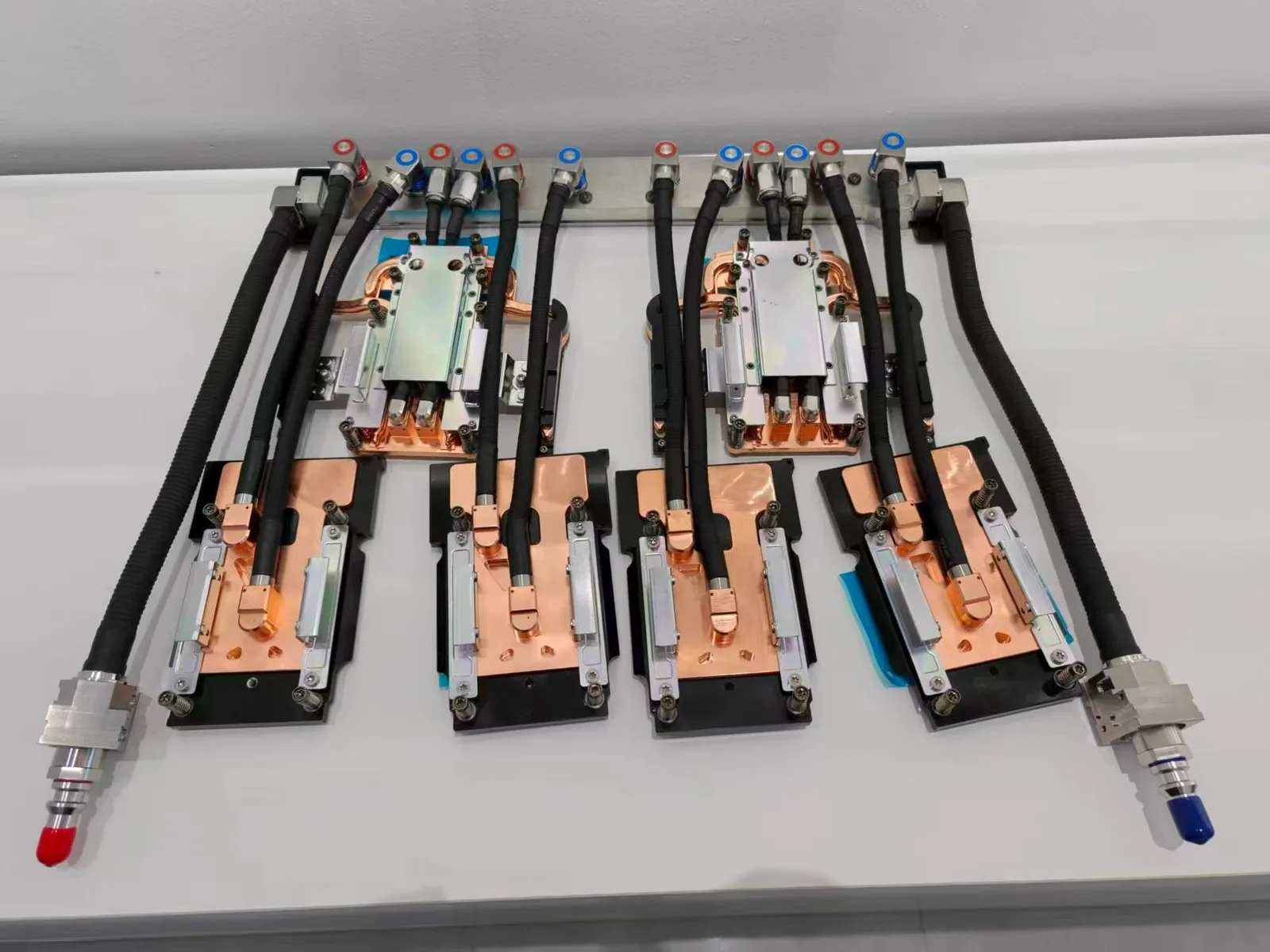
Short answer: GB200 NVL72 cooling requires a direct-to-chip liquid cold plate on every GB200 compute tray, a rack manifold with balanced flow, and a coolant distribution unit (CDU). ToneCooling supplies a GB200 platform-compatible cold plate kit (TC-BZP-GB200-01A), tested at 1,200 + 1,200 + 300 W with 2.5 L/min of 25 ± 2 °C water, and can supply the matching CDU as one package.
1. GB200 Thermal Specifications
The NVIDIA GB200 Grace Blackwell Superchip integrates two Blackwell B200 GPU dies and one Grace CPU on a single module via NVLink-C2C. The combined thermal output sets a new benchmark for data center cooling requirements:
| Component | TDP (W) | Die Area (mm²) | Peak Heat Flux (W/cm²) | Cooling Requirement |
|---|---|---|---|---|
| B200 GPU (×2 per module) | ~500W each | ~814 mm² | ~600 W/cm² | Direct-to-chip liquid cold plate mandatory |
| Grace CPU | ~200W | ~600 mm² | ~330 W/cm² | Integrated into GPU cold plate assembly |
| GB200 Module Total | 1200 W + 1200 W + 300 W (ToneCooling TC-BZP-GB200-01A rating) | Combined | Peak: 600+ W/cm² | Liquid cooling only |
| NVL72 Rack (72 GPUs) | 120kW+ | 36 modules | Rack-level | Liquid-cooled rack with CDU mandatory |
2. Why Air Cooling Cannot Work for GB200
The physics of air cooling impose hard limits that no fan or airflow optimization can overcome at GB200 power densities:
- Air cooling rack limit: Even with high-CFM fans and optimized airflow, air cooling is limited to 8–25kW per standard server rack. The GB200 NVL72 generates 120kW+ — 5× to 15× beyond this physical ceiling.
- Die heat flux: Air cooling heatsinks top out at 5–15 W/cm² effective heat flux. The GB200 GPU die operates at 500–600 W/cm² — 40–100× beyond air cooling capability.
- Thermal resistance: Air-cooled heatsinks achieve Rth of 0.1–0.3 °C/W. At the 1200 W per-GPU rating of ToneCooling’s GB200 cold plate, that would mean 120–360 °C above ambient (calculated: 1200 W × 0.1–0.3 °C/W) — far beyond any chip junction limit.
- Fan noise and power: Even if air cooling were thermally possible, the fan power required to move sufficient airflow through a 120kW rack would consume 20–30% of the rack’s compute power and generate 90+ dB of noise.
NVIDIA has officially confirmed that GB200 NVL72 requires liquid cooling. This is not a design preference — it is a mandatory architectural requirement.
3. Cold Plate Design Requirements for GB200
Designing a cold plate for the GB200 demands precision across thermal, mechanical, and materials domains:
Thermal Design Requirements
- ToneCooling’s GB200 cold plate, TC-BZP-GB200-01A, is rated for 1200 W + 1200 W + 300 W (two GPUs + Grace CPU) at 25 ±2 °C pure-water inlet and 2.5 L/min, with 35 ±5 kPa flow resistance and 0.6 MPa maximum working pressure
- Thermal resistance target: set per project from your TDP, inlet temperature, and TIM, and confirmed by CFD at quotation (DFM review)
- Micro-channel or turbulator internal fin design to maximize heat transfer coefficient
- CFD simulation required to validate flow distribution uniformity across the die footprint
- Coolant flow: the ToneCooling GB200 kit is specified at 2.5 L/min with a 35 ± 5 kPa pressure drop (datasheet); confirm the rack-level flow budget with your integrator
Mechanical & Interface Requirements
- Contact surface flatness: ≤0.05 mm over the die contact area
- Surface roughness: Ra ≤ 0.8 μm to ensure minimal thermal interface material (TIM) bond-line variation
- Must accommodate NVIDIA’s specified mounting hole pattern and torque specifications (±10% clamping force)
- Manifold port configuration must align with NVL72 rack plumbing architecture
- Pressure rating: 0.6 MPa for the ToneCooling GB200 kit (datasheet); every unit is pressure- and leak-tested before shipment
Material Requirements
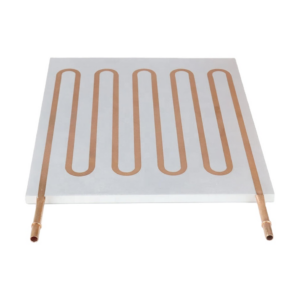
- T2 copper: Used in the ToneCooling GB200 kit for high thermal conductivity at the die interface. Nitrogen-protected brazing plus laser welding.
- All wetted surfaces must be compatible with 50/50 EGW coolant per ASHRAE W55 water quality standards
- RoHS compliance required for all materials
4. NVL72 Rack-Level Cooling Architecture
The GB200 NVL72 rack is not just a collection of servers — it is a tightly integrated compute fabric with a unified cooling architecture:
- 36 GB200 compute trays: Each tray contains one GB200 module (2× B200 GPU + 1× Grace CPU). Each tray has a dedicated cold plate assembly.
- Rack manifold system: All 36 cold plates connect to a common supply and return manifold within the rack. Manifold design must ensure balanced flow distribution (±5% flow rate per branch).
- Coolant Distribution Unit (CDU): Rack-external CDU supplies coolant at controlled temperature and flow. ToneCooling supplies CDUs from 6 kW to 2 MW (see our coolant distribution unit range) and can package them with GB200 cold plates, or match the cold plates to a CDU you have already selected.
- Secondary cooling loop: CDU connects to building chilled water or evaporative cooling tower. Water-cooled CDUs offer best PUE (Power Usage Effectiveness).
- NVLink switch modules: Additional cooling required for NVLink switch ASICs. Air cooling is typically used for switch modules; some OEM designs integrate water cooling.
5. What OEMs Need from Cold Plate Suppliers
OEMs designing GB200 NVL72 servers need more than a component — they need a thermal engineering partner. Here’s what to require from your cold plate manufacturer:
| Requirement | Why It Matters | ToneCooling Capability |
|---|---|---|
| CFD thermal simulation | Validate thermal performance before cutting tooling | Yes — full CFD flow and thermal analysis |
| 4–6 weeks sample / prototype lead time | Program milestones require fast iteration cycles | Yes — samples typically 4–6 weeks; production normally 6–8 weeks, confirmed at quotation |
| Brazed and laser-welded copper construction | Maximum thermal conductivity and void-free bond | Yes — T2 copper, nitrogen-protected brazing plus laser welding (GB200 kit) |
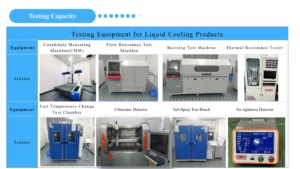
| Pressure and leak testing | Coolant leak in a live rack is catastrophic | Yes — every unit pressure- and leak-tested before shipment |
| PPAP Level 3 documentation | Required for OEM supplier qualification programs | Yes — full PPAP package available |
| Manifold integration support | Rack manifold must balance flow to all 36 cold plates | Yes — custom manifold design and co-engineering |
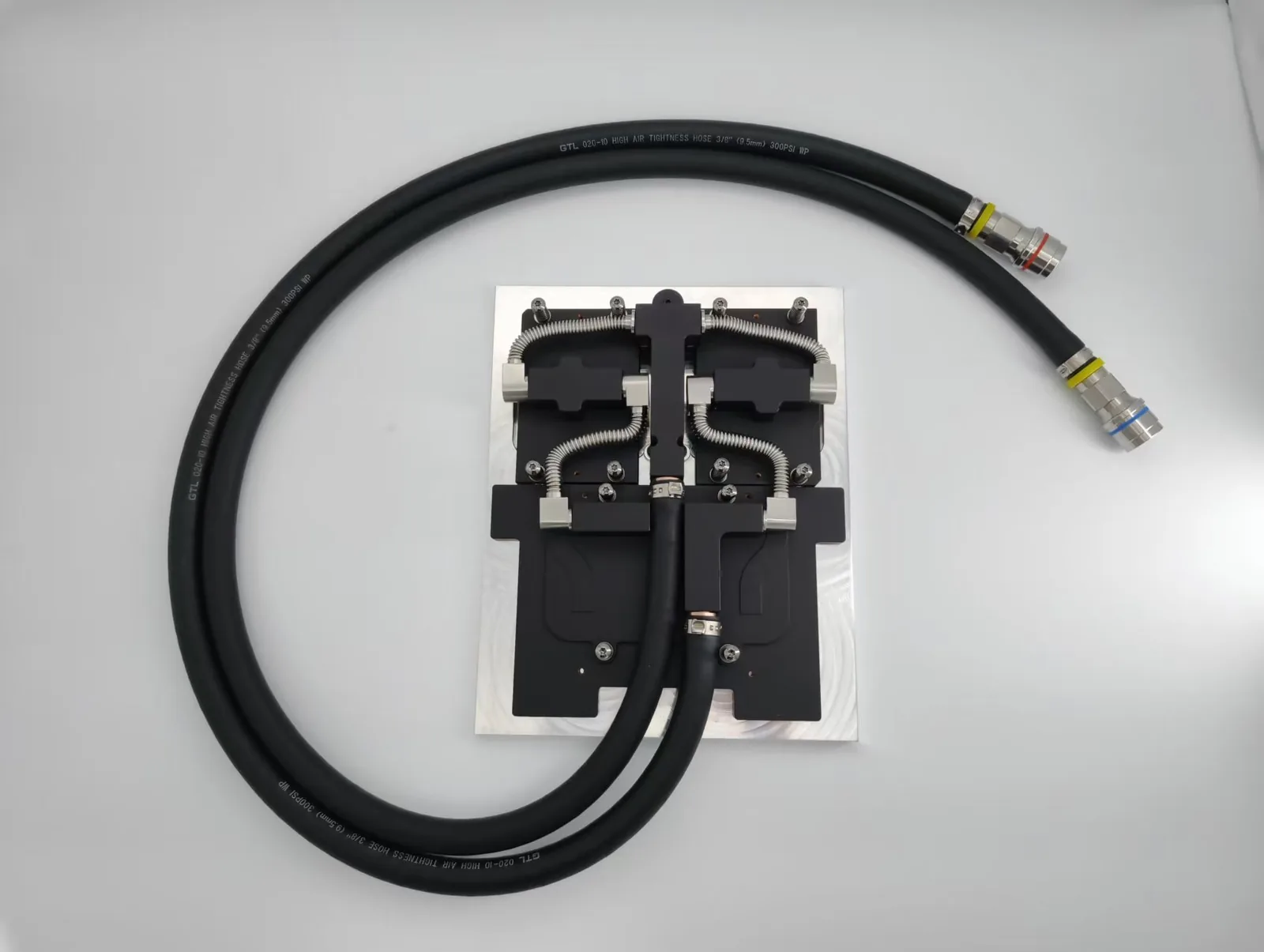
ToneCooling’s GB200 platform-compatible cold plate kit is a standard product supplied to its datasheet. See the GB200 liquid cooling plate product page, compare it with the GB300 4G+2C cold plate, or send your GB200 RFQ. Related reading: our NVIDIA GB200 Liquid Cold Plate product page, or explore our complete AI Server Liquid Cooling solutions.
References & Further Reading
- NVIDIA — GB200 NVL72 Platform Overview
- Open Compute Project — Liquid Cooling Design Guide for Data Centers
- ASHRAE TC 9.9 — Datacom Series (liquid cooling guidelines)
GB200 NVL72 Cooling Requirements: What Buyers Should Line Up
Meeting NVIDIA GB200 NVL72 cooling requirements comes down to three matched parts: a direct-to-chip cold plate on every compute tray, a rack manifold that balances flow across all trays, and a CDU sized to the rack heat load. NVIDIA describes the NVL72 as a liquid-cooled, rack-scale system, so the cold plate, manifold, and CDU should be specified together.
For the cold plate, ToneCooling’s GB200 kit (TC-BZP-GB200-01A) is a standard product with published datasheet values: 1,200 + 1,200 + 300 W, 2.5 L/min, 35 ± 5 kPa, 0.6 MPa, T2 copper with nitrogen-protected brazing plus laser welding. Sample and prototype lead time is typically 4–6 weeks, and custom samples are available from a single piece; production lead time is normally 6–8 weeks, confirmed at quotation. An engineer reviews every RFQ and replies by email with next steps — request a GB200 cold plate quote.
Frequently Asked Questions
Building a GB200 NVL72 Server? Talk to Our Engineers.
ToneCooling manufactures direct-to-chip liquid cold plates for NVIDIA GB200, GB300, H200, and AMD SP5 platforms. CFD simulation, samples typically in 4–6 weeks, built in our own manufacturing facility in Huizhou. ISO 9001.
Request the GB200 Cold Plate STEP Model or Test Report
Engineers evaluating the GB200 cold plate kit (TC-BZP-GB200-01A) can request the 3D STEP model, the test report, or both. Select GB200 in the form below; an engineer reviews every request and replies by email with next steps.
Related guides
- GB200 cold plate kit — TC-BZP-GB200-01A datasheet values
- GB200 cold plate RFQ inputs — pressure-drop budget and boundary conditions
- GB200 liquid cooling guide — deployment notes
- GPU cold plates — GB300, GB200, H200 and H100