When specifying a liquid cold plate for a thermal management application, the joining method is one of the most consequential manufacturing decisions you will make. The joining process determines pressure integrity, leak rate, joint strength under thermal cycling, material compatibility, and ultimately unit cost.
Two processes dominate modern cold plate manufacturing for high-performance applications: vacuum brazing and friction stir welding (FSW). Each has distinct strengths, and understanding the differences allows engineers and procurement teams to select the right approach for each application.
This guide compares both processes in depth — covering how they work, their advantages and limitations, cost profiles, and which applications each is best suited for.
Why the Joining Method Matters
A liquid cold plate is essentially a sealed pressure vessel with internal flow channels. The integrity of the joints between the cover plate and base determines:
- Hermeticity — Can it hold coolant without leaking at operating pressure?
- Thermal resistance — Does the joint introduce additional thermal resistance between the heat source and the coolant path?
- Structural integrity — Will it survive thermal cycling, vibration, and pressure surges over the product lifetime?
- Material compatibility — Does the process work with copper, aluminum, or both?
- Cost and scalability — What is the unit cost at prototype and production volumes?
Getting this decision wrong can mean field leaks, thermal derating, or rework costs that far exceed any savings from choosing the cheaper option upfront.
Vacuum Brazing: Process and Advantages
How Vacuum Brazing Works
Vacuum brazing is a furnace-based process in which components are assembled with a filler metal (braze alloy) placed at the joint interfaces. The assembled part is loaded into a high-vacuum furnace (typically 10⁻⁵ to 10⁻⁶ mbar) and heated to a temperature above the liquidus of the filler metal but below the solidus of the base material.
Under vacuum, the filler metal melts and flows by capillary action into the joint gaps, forming a metallurgical bond throughout the interface. When the furnace cools, the braze alloy solidifies, creating a hermetic, full-contact joint with essentially zero porosity.
For copper cold plates with micro-channel internal structure, vacuum brazing is typically the process of choice. Common filler metals for copper include silver-copper-phosphorus alloys (BCuP series) and copper-silver alloys (BAg series).
Key Advantages of Vacuum Brazing
- True hermetic sealing — Capillary flow of braze alloy fills all gaps, creating fully sealed joints that can achieve leak rates below 1×10⁻⁹ mbar·l/s.
- Micro-channel compatibility — Brazing allows internal micro-fins and complex channel geometries that would be impossible to FSW.
- High thermal conductivity — Copper base material (C1100, C1020) with copper-based braze alloys maintains excellent thermal conductivity across the joint.
- Multiple joints in one furnace cycle — A vacuum braze run can join dozens or hundreds of assemblies simultaneously, reducing per-unit fixed cost at moderate volumes.
- Suitable for complex assemblies — Headers, manifolds, fins, and cover plates can all be brazed in a single furnace run.
Limitations of Vacuum Brazing
- Not suitable for aluminum alloys with high magnesium content (Mg volatilizes under vacuum, inhibiting braze flow).
- Requires tight dimensional tolerances on joint gaps (typically 0.05–0.15 mm) for proper capillary action.
- Furnace cycle time means batch production rather than continuous flow — lead times can be 1–2 days per furnace run.
- Filler metal cost adds to material cost, particularly for silver-bearing alloys.
ToneCooling application: Our vacuum-brazed copper micro-channel cold plates for NVIDIA GB200 and IGBT power modules use a proprietary braze cycle optimized for uniform fin-to-plate bonding across the full active area, achieving thermal resistance uniformity within ±3%.
Friction Stir Welding: Process and Advantages
How Friction Stir Welding Works
Friction stir welding is a solid-state joining process invented by The Welding Institute (TWI) in 1991. A rotating, non-consumable tool — consisting of a shoulder and a pin — is plunged into the joint line between two workpieces and traversed along the weld path.
The frictional heat generated by the rotating shoulder softens the material around the pin into a plasticized state (without melting it). The rotating pin mechanically stirs this plasticized material across the joint interface and forges it together as the tool advances. The result is a solid-state weld with no filler metal, no fusion zone, and no solidification-related defects.
For aluminum cold plates, FSW is now the dominant joining method in automotive, EV, and high-volume industrial applications. The process works best with aluminum alloys 6061, 6063, and 3003.
Key Advantages of Friction Stir Welding
- No filler metal required — Lower material cost and no risk of braze alloy incompatibility with coolant.
- High joint mechanical strength — FSW joints in aluminum 6061 achieve 80–90% of base metal tensile strength, significantly higher than MIG or TIG welds.
- Excellent fatigue resistance — The solid-state microstructure produced by FSW has superior fatigue performance compared to fusion welds — critical for EV applications with thermal cycling and vibration.
- High production speed — Modern CNC FSW machines can complete a full cold plate weld in 30–120 seconds, enabling high-volume throughput.
- Low distortion — Lower heat input than fusion welding minimizes distortion, improving dimensional accuracy on large plates.
- No porosity or solidification cracking — Solid-state process eliminates the most common defects in aluminum fusion welding.
Limitations of Friction Stir Welding
- Requires a backing fixture (anvil) under the joint — not suitable for closed-cavity or highly complex internal geometries.
- Keyhole defect at tool exit point requires post-process management (run-off tabs or plugging).
- Not suitable for copper base materials due to extreme tool wear.
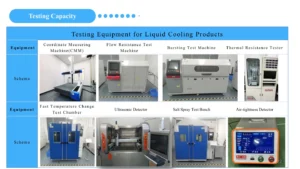
ToneCooling application: Our FSW aluminum cold plates for EV battery packs use a two-pass FSW sequence — one pass per side — to ensure complete channel sealing. All plates undergo 100% helium leak testing at 5 bar before shipment.
Head-to-Head Comparison
| Criterion | Vacuum Brazing | Friction Stir Welding |
|---|---|---|
| Primary materials | Copper (C1100, C1020), some aluminum alloys | Aluminum (6061, 6063, 3003) |
| Hermeticity | Excellent — full-area capillary fill | Excellent — with proper tool parameters |
| Joint strength | High — metallurgical bond | Very high — 80–90% base metal strength |
| Filler metal | Required (braze alloy) | Not required |
| Internal geometry complexity | Excellent — micro-channels, fins possible | Moderate — simple channels only |
| Thermal cycling durability | High for copper | High for aluminum (excellent fatigue) |
| Production speed | Batch (furnace cycle) | High (continuous, 30–120 sec/part) |
| Prototype unit cost | Moderate | Moderate (high fixture cost offset by speed) |
| High-volume unit cost | Moderate | Lower (no filler, high throughput) |
| Typical applications | GPU/CPU cold plates, IGBT coolers, AI server cooling | EV battery plates, industrial inverters, large format aluminum plates |
When to Choose Vacuum Brazing
Vacuum brazing is the right choice when:
- Material is copper — Copper base material offers thermal conductivity (~390 W/m·K) that aluminum cannot match. For high heat flux applications like NVIDIA GB200, IGBT modules, and laser diode cooling, copper vacuum-brazed cold plates are the standard.
- Micro-channel geometry is required — Internal fin arrays with channel widths below 1 mm require vacuum brazing. FSW cannot join pre-formed micro-fin structures.
- Maximum hermeticity is needed — Safety-critical or high-pressure applications where leak integrity must be validated to below 10⁻⁸ mbar·l/s.
- Complex manifold integration — Multiple inlet/outlet headers and internal baffles brazed in a single furnace cycle.
When to Choose Friction Stir Welding
Friction stir welding is the right choice when:
- Material is aluminum — EV battery plates, industrial servo drive coolers, and large-format plates for power conversion are overwhelmingly aluminum FSW.
- Volume is high — FSW’s fast cycle time and no-consumable process delivers the lowest per-unit cost at production volumes of 500+ pieces per month.
- Automotive qualification is required — The automotive industry has standardized on FSW for aluminum battery and inverter cooling due to its traceable process parameters, excellent fatigue life, and compatibility with PPAP qualification.
- Large plate dimensions — FSW handles plates up to 2,000 mm × 1,000 mm with consistent weld quality. Vacuum brazing large plates risks uneven braze flow.
How ToneCooling Uses Both Processes
At ToneCooling, we operate both vacuum brazing and friction stir welding production lines, allowing us to match the manufacturing process precisely to application requirements rather than constraining designs to a single joining method.
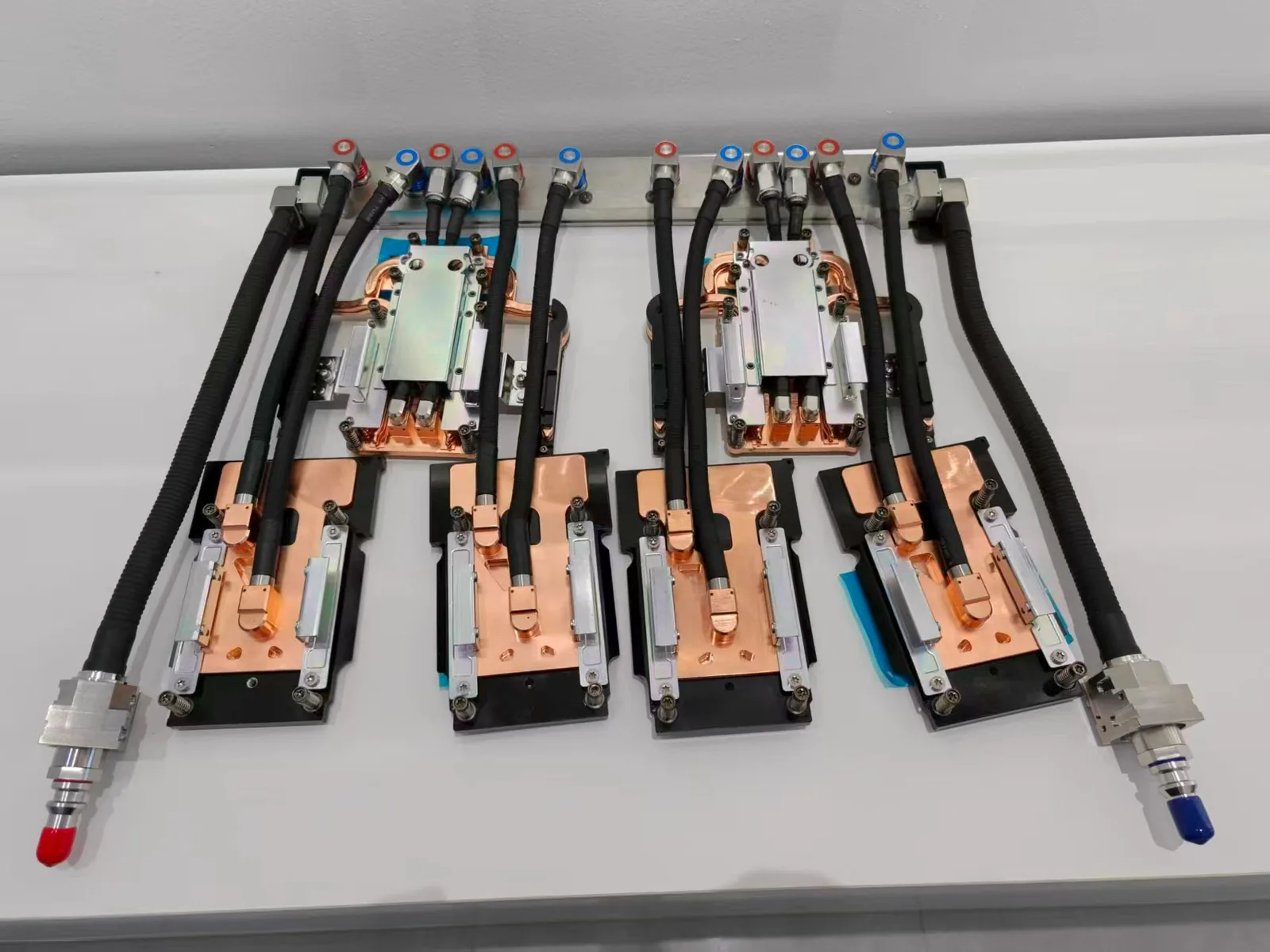
Our vacuum brazing capability handles copper micro-channel cold plates for data center GPU cooling, IGBT power module coolers, and NVIDIA GB200 liquid cold plates — where the thermal demands of 600W–1200W heat loads require copper’s superior conductivity and hermetic micro-channel construction.
Our FSW capability serves EV battery liquid cooling and aluminum industrial cold plate programs where volume, fatigue durability, and automotive-grade process traceability are the governing requirements.
For every new project, our application engineering team evaluates heat flux density, material preference, target cost, volume, and qualification requirements before recommending a joining process. We provide CFD simulation and thermal analysis as part of our standard pre-production engineering service.
Selecting the Right Process: A Decision Framework
Use the following questions to guide process selection:
- Is the base material copper or aluminum? → Copper → vacuum brazing; Aluminum → consider FSW
- Are internal micro-channels or fin arrays required? → Yes → vacuum brazing
- What is the target production volume? → Below 200 pcs/month → vacuum brazing or machined; Above 500 pcs/month → FSW for aluminum
- Is automotive/EV qualification (PPAP, VDA) required? → Yes, aluminum → FSW strongly preferred
- What is the operating pressure? → Above 10 bar → validate hermeticity for either process; copper vacuum brazing typically preferred
Need help selecting the right joining process and material for your cold plate application? ToneCooling’s engineering team provides free application consultation and CFD thermal analysis.
Summary
Both vacuum brazing and friction stir welding are mature, high-performance joining technologies for liquid cold plates. The right choice depends on base material, geometry complexity, volume, and application environment — not on process familiarity alone.
Vacuum brazing excels for copper micro-channel cold plates in high heat flux electronics cooling. Friction stir welding excels for aluminum plates in EV, automotive, and high-volume industrial applications.
Explore ToneCooling’s full range of liquid cold plates and thermal management solutions, or contact our team to discuss your specific joining process and design requirements.
Vacuum Brazing vs Friction Stir Welding Cold Plate: Process Comparison
The choice between vacuum brazing vs friction stir welding cold plate manufacturing depends on material, geometry, and production volume. Vacuum brazing excels for copper micro-channel designs requiring complex internal fin structures, while FSW is preferred for aluminum plates with simpler channel geometries.
In the vacuum brazing vs friction stir welding cold plate comparison, thermal performance is the key differentiator. ToneCooling production data shows vacuum-brazed copper plates achieve 15% lower thermal resistance than comparable FSW aluminum designs due to superior fin-to-wall metallurgical bonding and copper’s higher thermal conductivity.
Need help choosing? Contact ToneCooling engineers for a process recommendation based on your application.
References & Further Reading
- American Welding Society (AWS) — Specification for Furnace Brazing
- TWI Global — What is Friction Stir Welding?