Battery thermal management is one of the most critical engineering challenges in modern electric vehicle design. The performance, longevity, and safety of a lithium-ion battery pack depend directly on how effectively heat is managed during charge and discharge cycles.
Liquid cooling using cold plates has become the dominant thermal management approach for high-performance EV battery packs — replacing passive air cooling in nearly all new passenger vehicle and commercial EV platforms. This guide covers the complete design engineering picture: why thermal management matters, how different cell formats influence cold plate design, material selection, manufacturing processes, coolant compatibility, and the OEM qualification process.
Why Battery Thermal Management Is Critical
Temperature and Battery Performance
Lithium-ion cells operate optimally between 15°C and 35°C. Outside this range, performance and lifespan degrade significantly:
- Below 0°C — Lithium plating risk during fast charging. Electrolyte viscosity increases, reducing ionic conductivity and available power.
- Above 45°C — Accelerated electrolyte decomposition, SEI layer growth, capacity fade, and reduced cycle life.
- Above 60°C — Thermal runaway risk. Exothermic reactions can self-sustain, leading to cell venting, fire, or explosion.
Beyond absolute temperature, temperature uniformity across a module is equally critical. Research consistently shows that temperature gradients above ±5°C cause differential aging — cells running hotter degrade faster, creating capacity imbalance that limits the entire pack to the weakest cell’s state of charge.
Best-practice EV thermal management design targets ±2°C cell-to-cell temperature uniformity at maximum continuous discharge rate. Achieving this with air cooling at the power densities of modern EV packs is practically impossible — which is why liquid cold plates are now standard.
Engineering target: Maximum cell surface temperature ≤ 40°C at 2C continuous discharge. Temperature delta across module ≤ ±2°C. Coolant inlet temperature: 20–25°C.
Heat Generation in EV Battery Packs
Heat is generated in lithium-ion cells by two primary mechanisms:
- Joule heating (I²R) — Resistive heating from current flow through internal cell resistance. Dominates during high-rate charge and discharge.
- Entropic heating — Thermodynamic heat from electrode reactions. Can be exothermic or endothermic depending on state of charge and cell chemistry.
A 100 kWh NMC pack at 2C discharge generates approximately 2–5 kW of heat depending on cell internal resistance. At DC fast charging (350 kW), instantaneous heat generation can exceed 15–20 kW. The cold plate system must handle peak heat loads without allowing any cell to exceed the maximum temperature limit.
Cold Plate Designs for Different Cell Formats
Prismatic Cell Cooling
Prismatic cells (hard-case aluminum or steel can) are the dominant format for automotive EV battery packs, used by BMW, Mercedes-Benz, CATL-supplied platforms, and many others.
Cold plates for prismatic cells are typically positioned at the bottom of the module, with cells standing upright on the plate surface. Heat conducts through the cell base into the cold plate.
Design considerations for prismatic cell cold plates:
- Flat contact surface with controlled flatness tolerance (typically ≤ 0.2 mm over the plate area) to ensure uniform thermal contact
- Thermal interface material (TIM) — typically thermal gap filler pad at 50–200 μm — between cell base and plate surface to fill surface irregularities
- Flow channel layout optimized for inlet-to-outlet temperature rise ≤ 3°C at maximum flow rate
- Plate width matched to cell module width; standard prismatic modules range from 100 mm to 300 mm wide
Pouch Cell Cooling
Pouch cells are used by LG Energy Solution, SK On, and Panasonic in platforms including Volkswagen MEB and some Ford and GM applications. Their flexible laminated packaging requires different mechanical and thermal design approaches.
Pouch cells are commonly cooled by sandwiching cold plates between cell layers — either one plate between every cell, or one plate between every two cells depending on heat load. This “bipolar” arrangement achieves excellent temperature uniformity but increases system complexity and weight.
Design considerations for pouch cell cold plates:
- Thin plate profile (typically 3–6 mm total thickness) to minimize volume penalty when plates are interspersed between cells
- Manifold integration at plate ends to distribute flow across all plates in parallel without excessive pressure drop
- Mechanical compliance — pouch cells expand 3–5% volumetrically during charging; plate mechanical design must not constrain this swelling or cause stress concentration
Cylindrical Cell Cooling
Cylindrical cells (18650, 21700, 4680 format) as used in Tesla vehicles present a different cooling geometry. The cylindrical format limits direct large-area contact with flat cold plates.
Cylindrical cell modules use cold plates at the bottom or top of cell arrays, with cells in thermal contact via their end caps. Tesla’s 4680 tabless design improves heat flow from cell core to end cap, improving cold plate cooling effectiveness. Alternative approaches include thermally conductive potting compound encapsulating cells and contacting the cold plate.
Material Selection for EV Battery Cold Plates
| Material | Thermal Conductivity | Weight | Corrosion Resistance (EGW) | Typical Application |
|---|---|---|---|---|
| Aluminum 3003 | 155 W/m·K | Low (2.73 g/cc) | Excellent | Most EV battery cold plates |
| Aluminum 6061 | 167 W/m·K | Low (2.70 g/cc) | Very good | Structural cold plate housings |
| Aluminum 6063 | 200 W/m·K | Low (2.70 g/cc) | Very good | Extruded channel profiles |
| Copper C1100 | 391 W/m·K | High (8.94 g/cc) | Excellent | High heat flux IGBT coolers (not typical battery) |
For EV battery applications, aluminum 3003 is the standard selection due to its combination of adequate thermal conductivity, low weight, excellent corrosion resistance with ethylene glycol-water (EGW) coolant, and compatibility with both CAB brazing and FSW processes.
Copper is rarely used for battery cold plates due to its weight penalty (3.3× heavier than aluminum) and higher cost, despite its superior thermal conductivity.
Manufacturing Processes: CAB Brazing vs Friction Stir Welding
Controlled Atmosphere Brazing (CAB)
CAB brazing uses a flux (typically NOCOLOK® flux) and a clad aluminum filler metal (typically 4343 or 4047 alloy) to join aluminum plates in a continuous nitrogen atmosphere furnace at approximately 600°C. The flux removes the oxide layer from the aluminum surface, allowing the filler metal to wet and flow into joint gaps.
CAB is well-suited for multi-layer assemblies with complex internal channel geometries — including turbulators, baffles, and integrated manifolds. Automotive heat exchanger manufacturers have used CAB for decades with proven quality and high throughput.
Friction Stir Welding (FSW)
As detailed in our companion article on vacuum brazing vs FSW, friction stir welding produces solid-state joints with higher mechanical strength and fatigue resistance than CAB brazed joints. FSW is increasingly the preferred process for EV battery cold plates in automotive programs where PPAP qualification and high-cycle fatigue performance are required.
At ToneCooling, we operate both CAB brazing and FSW lines. Selection depends on geometry complexity, volume, and qualification requirements.
Coolant Compatibility and System Design
The standard coolant for EV battery thermal management is 50/50 ethylene glycol-water (EGW), consistent with the broader vehicle coolant system. Key compatibility requirements for cold plate design include:
- pH range: EGW coolant pH typically 7–9. Aluminum cold plates are compatible throughout this range.
- Corrosion inhibitors: OEM coolant specifications include corrosion inhibitor packages (typically silicate or organic acid technology). Cold plate material and joining process must be compatible with the specified inhibitor chemistry.
- Electrical conductivity: Battery pack cooling loops require low-conductivity coolant (below 5 μS/cm) to prevent galvanic coupling between high-voltage components and the vehicle chassis. Deionized water blends or specific low-conductivity glycol formulations are used.
- Operating pressure: EV cooling loops typically operate at 0.5–3 bar. Cold plates must be burst-tested to 2× operating pressure minimum.
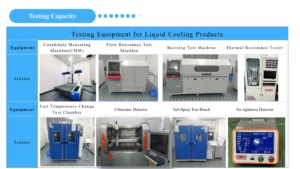
All ToneCooling EV battery cold plates undergo 100% helium leak testing at 5 bar before shipment, and batch pressure burst testing to verify manufacturing quality.
Pressure Drop and Flow Rate Optimization
Cold plate hydraulic design must balance thermal performance against pump energy and system pressure limits. Narrower, deeper channels increase heat transfer coefficient but raise pressure drop significantly. Wider, shallower channels reduce pressure drop but decrease thermal performance.
ToneCooling uses CFD simulation (ANSYS Fluent) to optimize flow channel geometry for each application. Typical design targets for EV battery cold plates:
| Parameter | Typical Target |
|---|---|
| Coolant inlet-to-outlet temperature rise (ΔT coolant) | ≤ 3°C at max flow |
| Cell-to-cell temperature uniformity | ±2°C |
| Cold plate pressure drop | ≤ 20 kPa at design flow rate |
| Thermal resistance (plate-to-coolant) | ≤ 0.05 K·cm²/W |
| Operating pressure rating | 5 bar (test), 2.5 bar (operating) |
OEM Qualification: PPAP and Process Documentation
Automotive OEM programs require suppliers to complete a Production Part Approval Process (PPAP) before production parts can be shipped. For EV battery cold plates, PPAP documentation typically includes:
- Design Records — Engineering drawings with all dimensions and tolerances
- DFMEA — Design Failure Mode and Effects Analysis
- Process Flow Diagram — Manufacturing routing from raw material to shipment
- Process FMEA — Manufacturing process risk analysis
- Control Plan — Inspection checkpoints and control methods
- Measurement System Analysis (MSA) — Gauge R&R studies for critical dimensions
- Initial Process Capability Study (Cpk) — Statistical process capability for critical dimensions
- Part Submission Warrant (PSW) — Formal approval document
- Dimensional Results — Full dimensional report on sample parts
- Material Test Reports — Chemical and mechanical property certifications
ToneCooling provides PPAP Level 3 documentation and supports both AIAG PPAP and VDA-aligned qualification processes for European automotive programs. Our quality team has direct experience supporting qualification programs for Tier 1 automotive suppliers in North America, Germany, and South Korea.
ToneCooling EV Battery Cold Plate Capabilities
Our EV battery liquid cooling cold plate program offers:
- Aluminum 3003, 6061, and 6063 base materials
- CAB brazing and friction stir welding joining processes
- Plate dimensions up to 1,200 mm × 600 mm
- 100% helium leak testing at 5 bar
- CFD thermal and flow simulation included in NRE
- PPAP Level 3 documentation support
- prototypes from 1 piece | Lead time: 4–6 weeks
- Production volume: 50 pcs | Lead time: 6–8 weeks
Explore our full liquid cold plate product range or thermal management solutions for other applications including AI server cooling and industrial power electronics.
Ready to discuss your EV battery thermal management cold plate requirements? Our application engineering team will review your cell format, heat load, and volume targets and provide a detailed proposal.
EV Battery Thermal Management Cold Plate: Design Principles
Effective EV battery thermal management cold plate design must balance three competing objectives: thermal uniformity across all cells, minimal pressure drop for pump efficiency, and lightweight construction for vehicle range optimization.
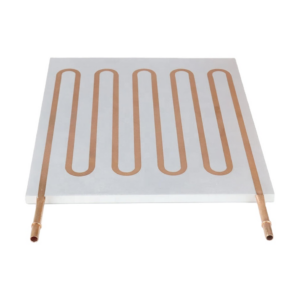
The EV battery thermal management cold plate must maintain cell-to-cell temperature variation within ±2°C during fast charging to prevent accelerated degradation of hotter cells. ToneCooling’s multi-pass serpentine designs achieve ±1.5°C uniformity across 96-cell modules — exceeding typical OEM requirements.
For EV battery thermal management cold plate quotation, submit your RFQ to ToneCooling — we support PPAP Level 3 documentation for automotive OEM programs.
References & Further Reading
- SAE International — J2464: EV Battery Abuse Testing Standard
- Battery University — What Causes Capacity Loss in Lithium-ion Batteries
Related guides
- What is a battery cold plate — types, design and integration
- Custom battery cold plates — EV and BESS projects
- Stamping and brazing for EV battery cold plates — high-volume construction
- EV battery cold plate CFD — four fin designs compared