
Last updated: November 2, 2026 · ToneCooling Engineering Team
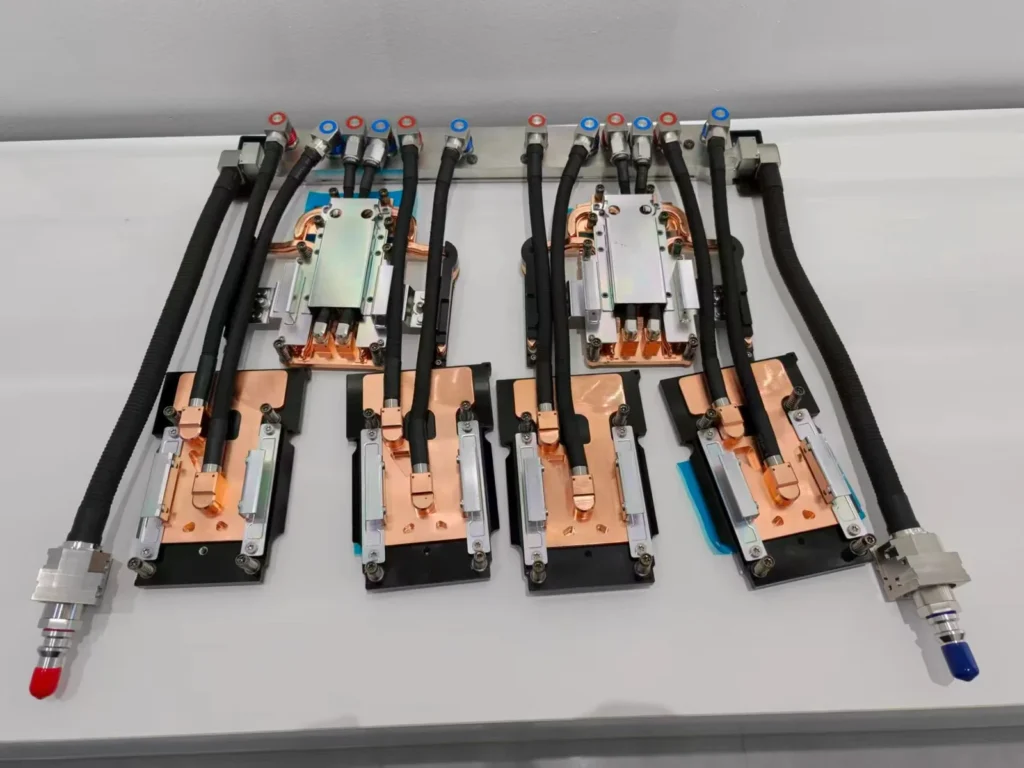
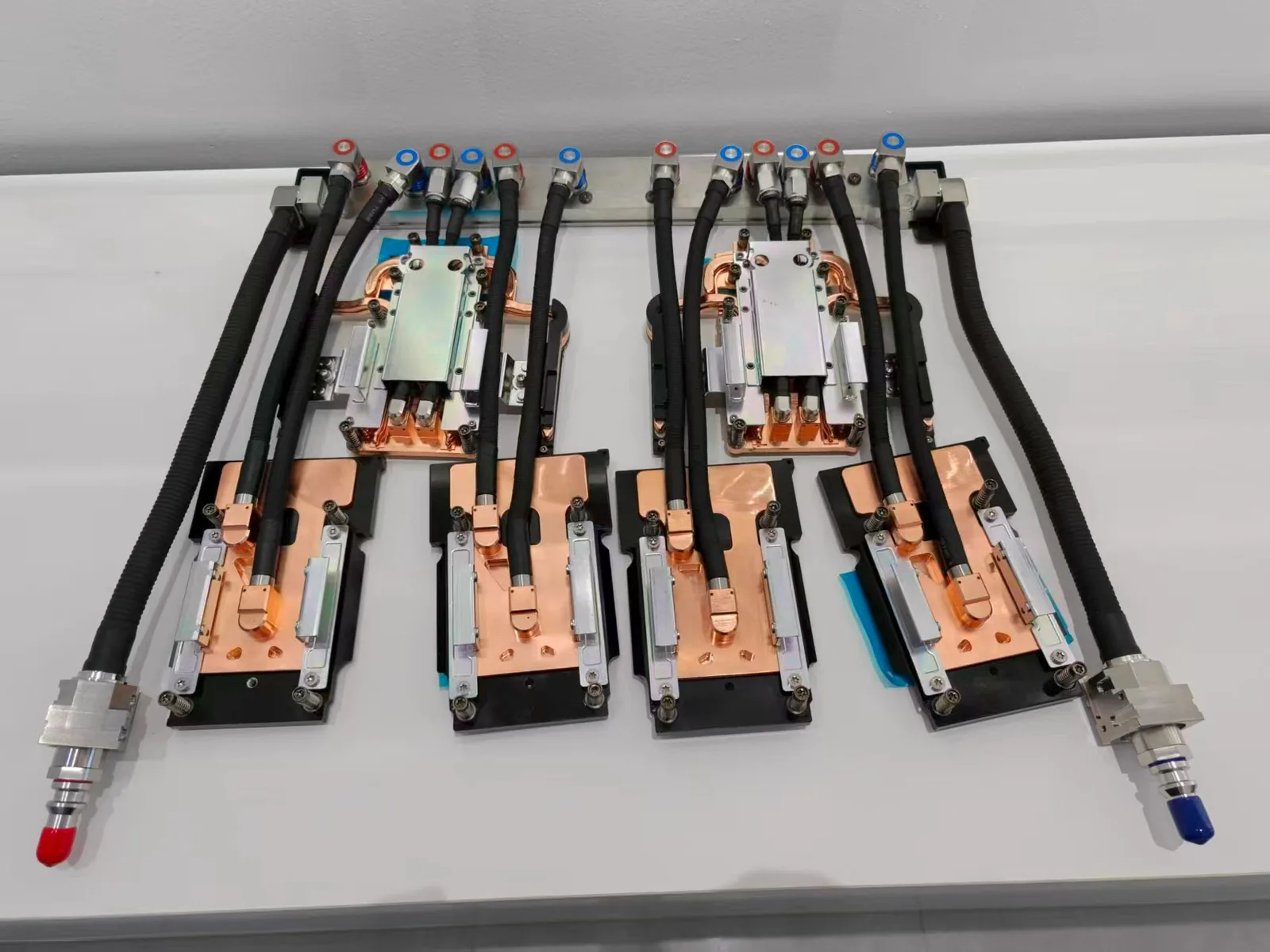
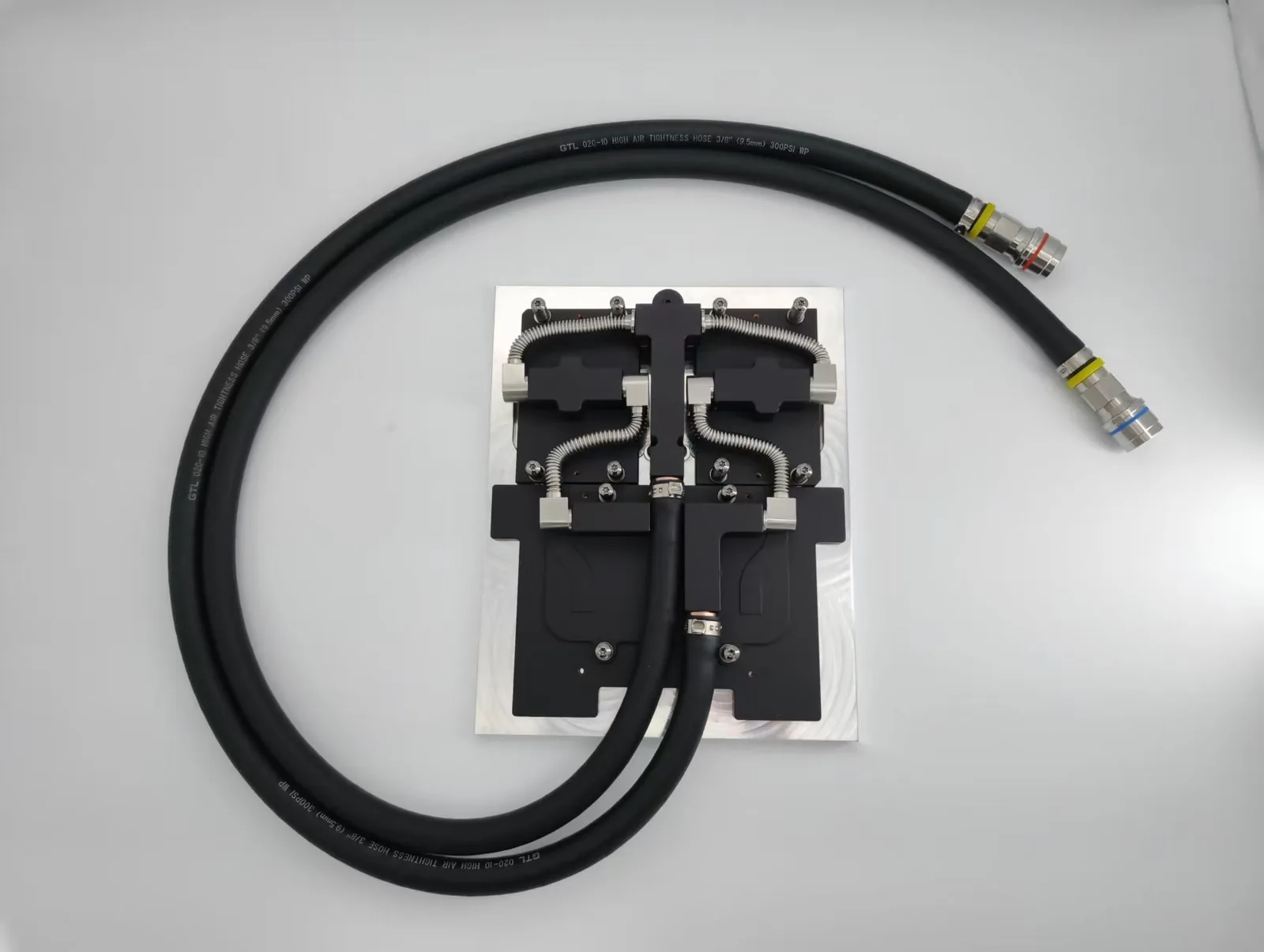
GB300 vs GB200 cold plates: the ToneCooling GB300 4G+2C kit (TC-BZP-GB300-01A) uses six separate cold plates per tray — four GPU and two CPU — while the GB200 kit (TC-BZP-GB200-01A) uses three T2 copper cold plates, two GPU and one Grace CPU, on one manifold, rated 1,200 W + 1,200 W + 300 W. The two kits are not interchangeable. This page compares both datasheets line by line so you can choose the right kit and send a complete RFQ.
Request RFQGB300 Datasheet (PDF)GB200 Datasheet (PDF)
What Is the Difference Between GB300 and GB200 Cold Plates?
The main difference is the cold plate layout. A GB300 4G+2C tray is cooled by six individual plates, one per GPU and one per CPU, joined by a manifold, hoses and quick disconnects. A GB200 kit cools one GB200 superchip with three plates, two GPU and one Grace CPU, joined by one manifold. The plate footprints differ, and so do the flow path, the number of connections, the pressure drop you design for and how you service the tray.
Both kits are standard ToneCooling products supplied to a published datasheet, made in our own manufacturing facility in Huizhou, China. Both are GB300 / GB200 platform-compatible designs; ToneCooling is an independent manufacturer.
GB300 vs GB200 Cold Plate Specifications
| Item | GB300 4G+2C kit (TC-BZP-GB300-01A, Rev B) | GB200 kit (TC-BZP-GB200-01A, Rev A) |
|---|---|---|
| Configuration | 4 GPU + 2 CPU, six separate cold plates | 2 GPU + 1 Grace CPU, three separate cold plates on one manifold |
| Kit contents | 4 GPU cold plates, 2 CPU cold plates, 1 manifold, 2 quick disconnects, 10 hoses / tubes | 2 GPU cold plates, 1 CPU cold plate, 1 manifold, hoses and quick disconnects, mounting hardware, recommended TIM and torque spec, leak-test report |
| Heat load (W) | Measured 1,066.94 W per GPU plate; 485.46 W per CPU plate | Rated 1,200 W + 1,200 W + 300 W |
| Flow rate (L/min) | 1.7 per GPU plate, 0.7 per CPU plate (test); 2–4 per plate (design envelope) | 2.5 |
| Pressure drop (kPa) | 12.06 per GPU plate, 10.39 per CPU plate (test); < 40 at 3 L/min (design target) | 35 ± 5 |
| Inlet temperature (°C) | 19.9 GPU / 23.6 CPU (test); 20–30 (design envelope) | 25 ± 2 |
| Thermal result | 0.0130–0.0133 °C/W per GPU plate; 0.0220 °C/W per CPU plate | Cold plate surface below 43 °C; thermal resistance validated per project by CFD |
| Coolant | Pure water (test); pure water or PG25 (design envelope) | Pure water |
| Pressure rating | Working pressure ≤ 3 bar | 0.6 MPa |
| Material and joining | Copper micro-channel GPU plates; joining confirmed at quotation (DFM review) | T2 copper; nitrogen protection brazing + laser welding |
| Dimensions (mm) | Per drawing / STEP model on request | 235 × 190 × 30 |
| Thermal interface material | TC-5888 thermal paste (test) | Recommended TIM supplied with the kit |
Source: ToneCooling datasheets TC-BZP-GB300-01A Rev B (steady-state test with pure water, 2026-03-20) and TC-BZP-GB200-01A Rev A (rated working condition). The two documents use different test conditions, so compare each kit against your own tray conditions rather than against each other.
When Should You Choose the GB300 Kit or the GB200 Kit?
Choose by the compute tray you are building, not by the higher number. The kits follow two different board layouts, and each one is qualified only for its own platform.
Choose the GB300 4G+2C kit when
- Your tray carries four GPUs and two CPUs and needs one cold plate per device.
- You want each GPU plate on its own flow branch, with a published per-plate result: 1,066.94 W at 1.7 L/min and 12.06 kPa.
- Your loop runs pure water or PG25 at a 20–30 °C inlet, within 3 bar working pressure.
Choose the GB200 kit when
- Your design is built on GB200 superchips: two GPUs plus one Grace CPU per kit.
- You design the loop around 2.5 L/min at 25 ± 2 °C inlet and a 35 ± 5 kPa flow resistance.
- You need a 0.6 MPa pressure rating and a fixed 235 × 190 × 30 mm envelope.
Not sure which applies? Send the tray drawing or STEP file with your RFQ and an engineer will confirm the matching kit.
How Does the Change From GB200 to GB300 Affect the Cooling Loop?
Moving to GB300 adds connections and changes how flow is shared inside each tray. With six plates per tray, the manifold has to balance flow across more branches, so check the pressure drop of each branch at your design flow and confirm your CDU can supply the total tray flow. The GB300 kit ships with its own manifold, hoses and color-coded quick disconnects, which makes it a matched set rather than loose parts.
ToneCooling also supplies coolant distribution units (CDUs) from 6 kW to 2 MW, so cold plates and CDU can be quoted as one package, or the kit can work with the CDU you have already selected.
How Are Both Kits Tested Before Shipment?
Every GB300 and GB200 kit goes through 100% helium leak testing, with acceptance criteria set per project. Thermal resistance, leak and flatness test reports are available on request, and both datasheets download without a form. Our quality system is IATF 16949-aligned.
Example GB200 results from a July 2026 production batch (5 sets): helium leak 1.2 × 10⁻¹¹ Pa·m³/s at 0.6 MPa against a ≤ 5 × 10⁻⁶ Pa·m³/s requirement; 12-hour nitrogen hold at 0.4 MPa with a 4–6 kPa drop (limit 10 kPa); outlet flush water 14.9 ppm TDS (limit 30 ppm); internal humidity 8.2% (limit 10%).
Example GB300 results from a production kit shipped in October 2026: helium leak 1.2 × 10⁻¹¹ Pa·m³/s at 0.6 MPa against a ≤ 1 × 10⁻⁷ Pa·m³/s requirement; 12-hour nitrogen hold at 0.6 MPa with a 4 kPa drop (limit 40 kPa); kit flow resistance 33.03 kPa at 8.2 L/min; outlet flush water 12.9 ppm TDS.

What Should a GB300 or GB200 Cold Plate RFQ Include?
- Platform and kit: GB300 4G+2C (TC-BZP-GB300-01A) or GB200 (TC-BZP-GB200-01A).
- Quantity and project stage (evaluation, pilot or production).
- Coolant, inlet temperature, available flow per tray and allowed pressure drop.
- Fitting type and port position, with a STEP or PDF of the tray if position matters.
- Test documents you need: helium leak, thermal resistance, flatness.
Custom samples are available from a single piece. An engineer reviews every RFQ and replies by email with next steps.
Request RFQGB300 4G+2C Quotation Page
Need the STEP model or a test report first? Choose the product and the document below.
GB300 vs GB200 Cold Plate FAQ
Can I reuse GB200 cold plates on a GB300 tray?
No. The GB200 kit uses three plates for two GPUs and one Grace CPU, while the GB300 4G+2C kit uses six plates for four GPUs and two CPUs; the plate footprints, flow path and connections are different. Order the kit that matches your tray.
Which kit handles more heat per GPU?
The GB200 kit is rated 1,200 W per GPU at 2.5 L/min and 25 ± 2 °C inlet, and the GB300 GPU plate measured 1,066.94 W at 1.7 L/min and 19.9 °C inlet. The test conditions differ, so check each datasheet against your own heat load, flow and inlet temperature.
Which has the lower pressure drop?
Each GB300 GPU plate measured 12.06 kPa at 1.7 L/min, and the GB200 kit is rated 35 ± 5 kPa at 2.5 L/min. Because GB300 splits flow across six plates, size the tray loop by the total flow your CDU delivers.
Are GB300 and GB200 cold plates standard products?
Yes. Both are ToneCooling standard kits supplied to published datasheets: TC-BZP-GB300-01A Rev B and TC-BZP-GB200-01A Rev A. Fittings and port positions can be set per drawing.
Can I get samples and STEP models for both kits?
Yes. Custom samples are available from a single piece, and STEP models and test reports are available on request through the form above. Both datasheets download without a form.
Related pages: GB300 4G+2C liquid cold plate · GB200 liquid cooling plate · GB200 NVL72 cooling requirements · GB300 liquid cooling requirements · datasheet center · liquid cold plates
Measured and rated values are taken from the ToneCooling datasheets named above. Final thermal and hydraulic performance depends on system integration, flow distribution, coolant, clamping force, TIM and rack cooling architecture. GB300 / GB200 platform-compatible; NVIDIA, GB300 and GB200 are trademarks of NVIDIA Corporation and no affiliation or endorsement is implied. Platform references: NVIDIA GB300 NVL72, NVIDIA GB200 NVL72.

