NVIDIA’s GB300 represents the next major leap in AI accelerator performance — and thermal design complexity. With projected TDP reaching 1400W per GPU module and rack-scale configurations demanding 150+ kW per rack, the GB300 pushes liquid cooling requirements significantly beyond what the current GB200 generation demands. This article analyzes what thermal engineers and data center architects need to prepare for.

What Are the GB300 Liquid Cooling Requirements?
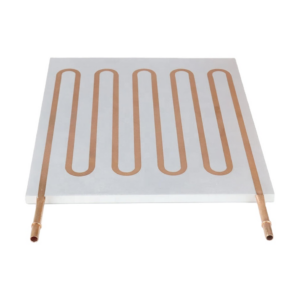
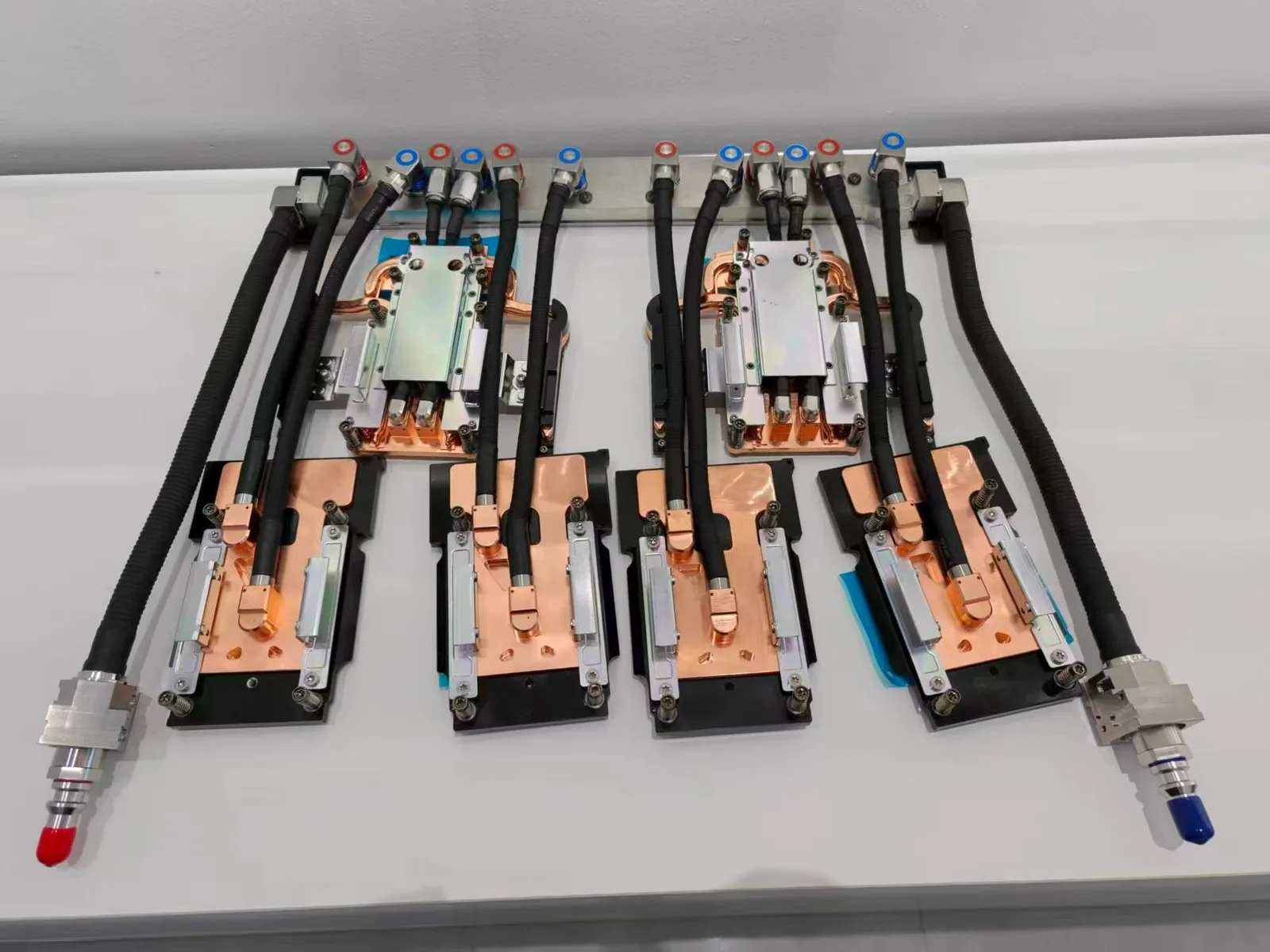
GB300 NVL72 racks require direct-to-chip liquid cooling: each compute tray carries copper cold plates on its GPUs and Grace CPUs, fed from a rack manifold and a CDU. In ToneCooling’s datasheet test, one GB300 GPU cold plate removed 1,066.94 W at 1.7 L/min with a 12.06 kPa pressure drop. The platform comparison below is based on publicly available information and industry analysis:
| Specification | GB200 (Current) | GB300 (2025-2026) | Change |
|---|---|---|---|
| GPU TDP | 1000W | ~1400W (estimated) | +40% |
| GPU architecture | Blackwell B200 | Blackwell Ultra B300 | Enhanced |
| HBM specification | HBM3e, 192GB | HBM3e, 288GB (expected) | +50% capacity |
| Memory bandwidth | 8 TB/s | ~12 TB/s (expected) | +50% |
| NVLink bandwidth | 1.8 TB/s | >2.0 TB/s (expected) | +11%+ |
| Rack configuration | NVL72 (72 GPUs) | NVL72/NVL144 | Higher density |
| Rack power | ~120 kW | ~150-200 kW (estimated) | +25-67% |
| Cooling requirement | Liquid only | Liquid only | More demanding |
Liquid Cold Plate Requirements for GB300
1. Higher Thermal Capacity
The jump from 1000W (GB200) to ~1400W (GB300) requires cold plates with approximately 40% more heat dissipation capacity. Key implications:
- Lower thermal resistance target — From 0.020 C/W (GB200) to approximately 0.015 C/W (GB300) to maintain junction temperatures below 83C
- Denser micro-channel geometry — Channel widths may need to decrease from 0.3mm to 0.2mm or smaller
- Higher flow rates — Per-GPU flow rate likely increases from 1.0-1.5 LPM to 1.5-2.5 LPM
- Increased coolant temperature delta — Higher heat loads drive larger coolant temperature rise, requiring CDU recalculation

2. Rack-Scale Cooling Architecture
GB300 NVL72 and potential NVL144 configurations create rack-level thermal challenges:
| Parameter | GB200 NVL72 | GB300 NVL72 (Est.) | GB300 NVL144 (Est.) |
|---|---|---|---|
| Total GPU power | 72 kW | ~100 kW | ~200 kW |
| Total rack power (incl. CPU, network) | ~120 kW | ~150 kW | ~250 kW |
| Coolant flow per rack | 36-72 LPM | 54-108 LPM | 108-216 LPM |
| CDU capacity | 120+ kW | 160+ kW | 280+ kW |
| Supply/return pipe size | 1.5-2 inch | 2-2.5 inch | 2.5-3 inch |
3. Manifold Design Evolution
Higher flow rates and more GPU positions per rack demand redesigned coolant distribution:
- Larger manifold cross-sections — To reduce pressure drop at higher flow rates while maintaining uniform distribution
- Advanced flow balancing — CFD-optimized manifold geometry to ensure each GPU receives equal coolant flow within +/- 5%
- Quick-connect fittings — Blind-mate connections for GPU tray serviceability without draining the rack loop
- Leak containment — Enhanced drip tray and leak detection sensor integration at every connection point

Data Center Infrastructure Impact
The GB300 generation drives significant facility-level changes:
- CDU capacity increase — Existing CDUs sized for 120 kW/rack will not support 150-200 kW racks. New CDU procurement or upgrades required.
- Piping infrastructure — Supply and return piping diameter may need to increase to handle 50-100% more coolant flow
- Facility water loop — Chiller and cooling tower capacity must scale with total IT load increases
- Electrical infrastructure — 150+ kW per rack requires higher amperage power distribution (some facilities may need bus duct upgrades)
- Floor loading — Higher-density racks may exceed structural floor load limits in older facilities
What to Do Now: Preparation Checklist
- Audit current CDU capacity and plan for 50%+ increase in per-rack cooling demand
- Evaluate piping infrastructure for higher flow rates
- Begin cold plate design collaboration with manufacturer for GB300 thermal requirements
- Plan electrical infrastructure upgrades for 150+ kW per rack
- Review facility floor load ratings for higher-density deployments
- Establish cold plate testing protocols for 1400W+ TDP validation

Which Cold Plate Kit Is Available for GB300?
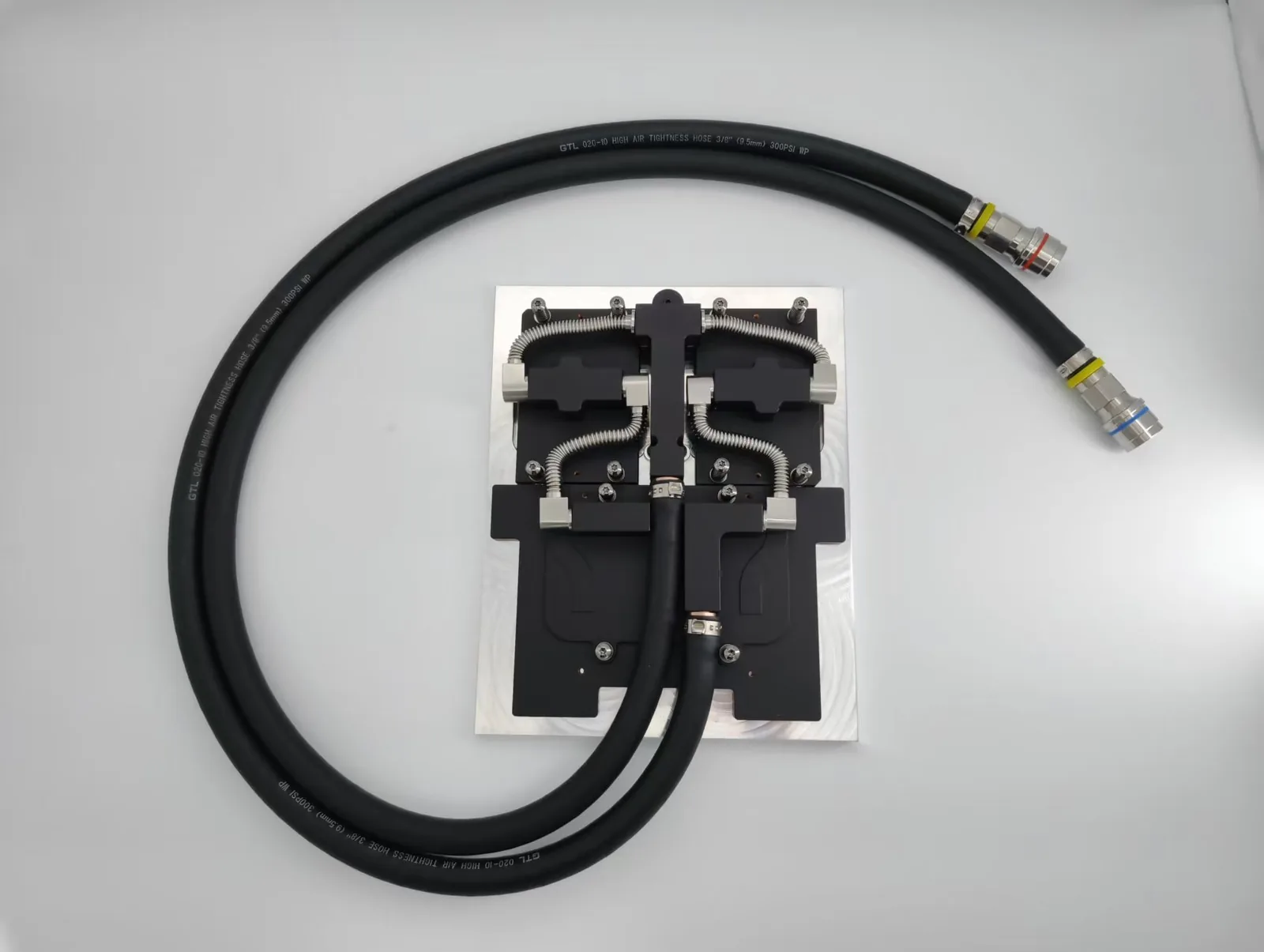
ToneCooling supplies the GB300 4G+2C liquid cold plate kit, part number TC-BZP-GB300-01A, as a standard product: four GPU cold plates and two CPU cold plates per compute tray, with a manifold, hoses and quick disconnects. The values below are measured in a steady-state test with pure water (2026-03-20).
| Parameter | GPU cold plate | CPU cold plate |
|---|---|---|
| Flow rate (L/min) | 1.7 | 0.7 |
| Heat load (W) | 1,066.94 | 485.46 |
| Inlet / outlet temperature (°C) | 19.9 / 27.3 | 23.6 / 31.5 |
| Pressure drop (kPa) | 12.06 | 10.39 |
| Thermal resistance (°C/W) | 0.0130–0.0133 | 0.0220 |
| Thermal interface material | TC-5888 | TC-5888 |
Source: ToneCooling TC-BZP-GB300-01A datasheet, Rev B. Download the GB300 datasheet (PDF, no form required), or see the full kit contents on the GB300 cold plate specs page.
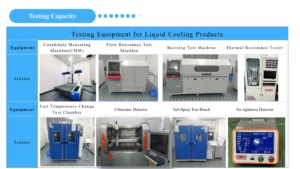
- 100% helium leak testing on every kit, with acceptance criteria set per project
- Thermal resistance, leak and flatness test reports available on request
- Samples typically 4–6 weeks; production normally 6–8 weeks, confirmed at quotation
- Made in our own manufacturing facility in Huizhou, China
Planning a GB300 deployment? Request a GB300 cold plate quote with your quantity, coolant, inlet temperature, flow per tray, allowed pressure drop and connector type. An engineer reviews every RFQ and replies by email with next steps.
Request the GB300 STEP Model or Test Report
Evaluating the kit? Ask for the STEP model, test report, or both.
Frequently Asked Questions
Is the GB300 a Blackwell GPU?
Yes. GB300 pairs NVIDIA Blackwell Ultra GPUs with NVIDIA Grace CPUs, and a GB300 NVL72 rack links 72 Blackwell Ultra GPUs and 36 Grace CPUs in a fully liquid-cooled design, according to NVIDIA.
Can existing GB200 cold plates be used for GB300?
Do not assume so. The ToneCooling GB200 kit (TC-BZP-GB200-01A) is rated 1,200 W + 1,200 W + 300 W for two GPUs and one Grace CPU, while the GB300 4G+2C kit (TC-BZP-GB300-01A) uses separate cold plates for four GPUs and two CPUs per tray. Compare the GB200 cold plate kit with the GB300 cold plate specs before reusing any hardware.
What rack power density should I plan for?
Use the rack power figure your server vendor publishes for your exact GB300 configuration, then size the CDU, piping and electrical capacity to it with margin. At cold plate level, the ToneCooling GB300 datasheet lists 1.7 L/min per GPU plate and 0.7 L/min per CPU plate as the measured test flow.
Industry References & Standards
Why Choose ToneCooling for GB300 Cold Plates?
ToneCooling supplies the GB300 4G+2C kit to a published datasheet with measured values, from our own manufacturing facility in Huizhou, China. Samples are typically available in 4–6 weeks, including design review, and custom samples are available from a single piece; production lead time is normally 6–8 weeks and is confirmed in the quotation. An engineer reviews every RFQ and replies by email with next steps.
Last Updated: 2026-10-12 · ToneCooling Engineering Team
Related guides
- GB300 cold plate specs — TC-BZP-GB300-01A kit and datasheet
- Request a GB300 cold plate quote — 4 GPU + 2 CPU system
- GPU cold plates — GB300, GB200, H200 and H100