

Last updated: October 2, 2026 · ToneCooling Engineering Team
Liquid Cold Plates: Custom and Standard Designs from Our Own Factory
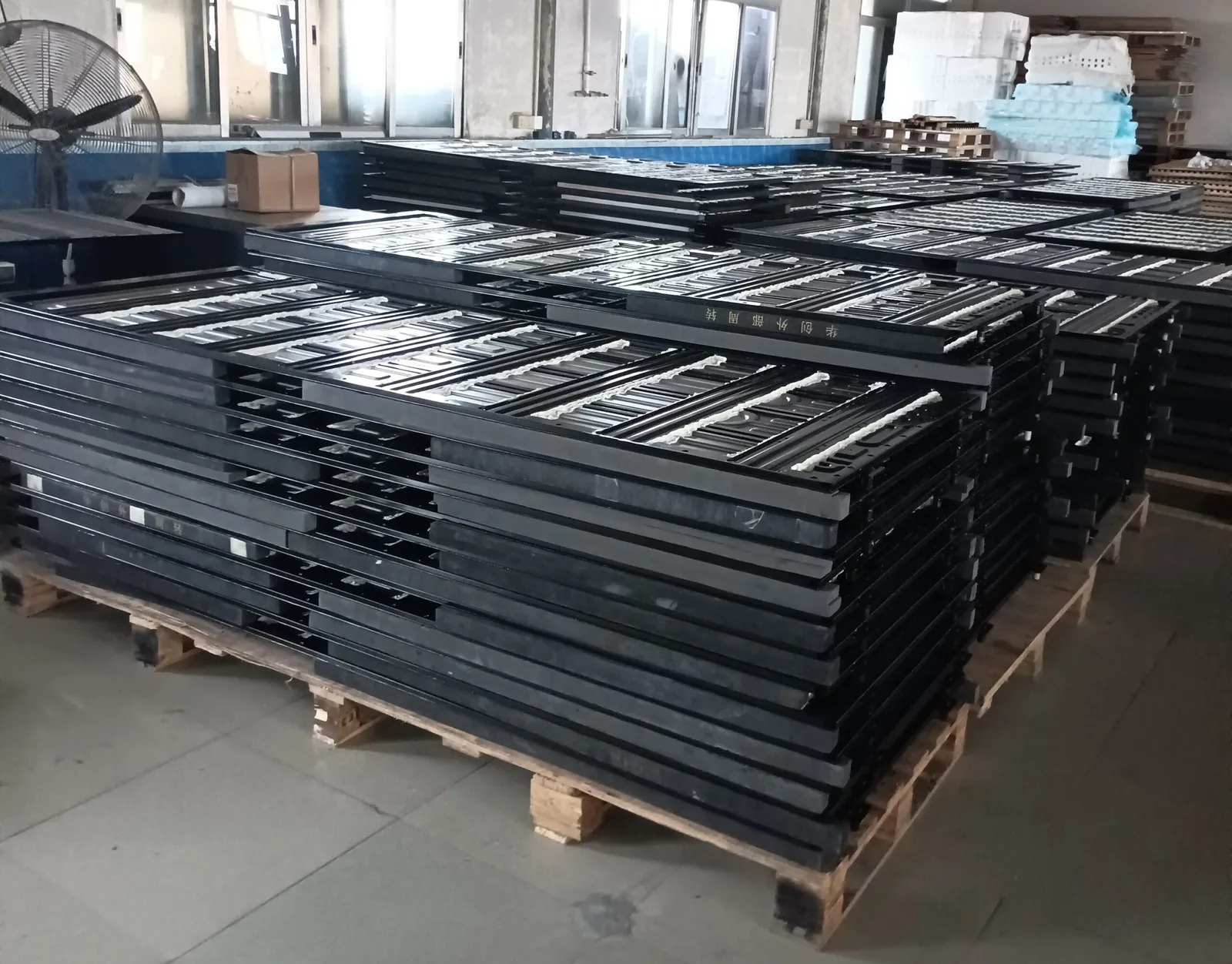
A liquid cold plate is a metal plate with internal coolant channels that pulls heat directly from a chip, power module, or battery into a flowing liquid. ToneCooling designs and builds liquid cold plates in our own manufacturing facility in Huizhou, China — about 1,000,000 cold plates per year — including four standard AI server kits and fully custom designs.
Request RFQGet a STEP Model or Test Report
Standard Liquid Cold Plate Kits for AI Servers
Four AI server cold plate kits are standard products supplied to published datasheets. Every other platform is a custom design.
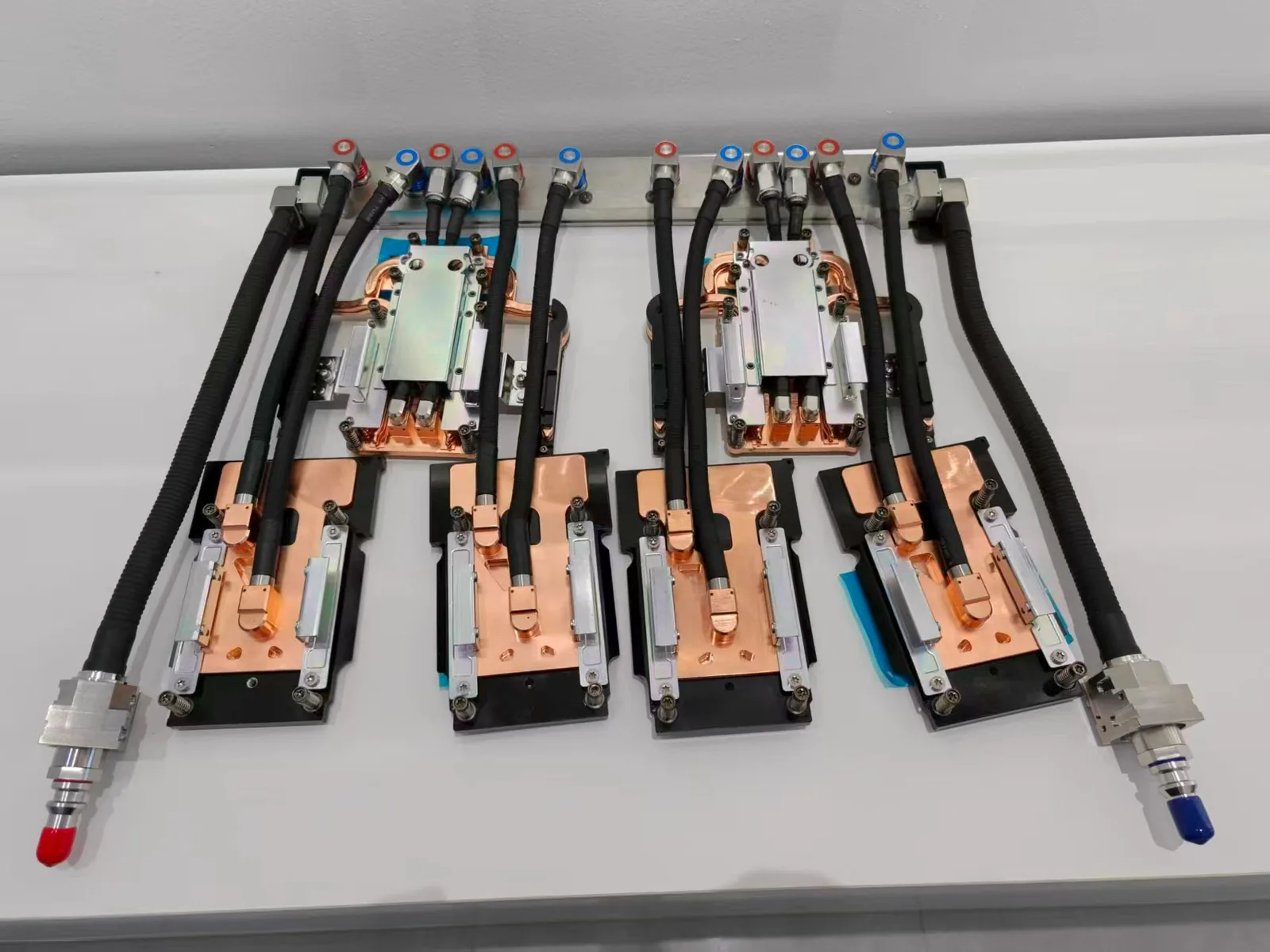
GB300 4G+2C Cold Plate Kit
TC-BZP-GB300-01A · 4 GPU + 2 CPU cold plates, manifold and quick disconnects. Measured GPU plate: 1,066.94 W at 1.7 L/min, 12.06 kPa, 0.0130–0.0133 °C/W.
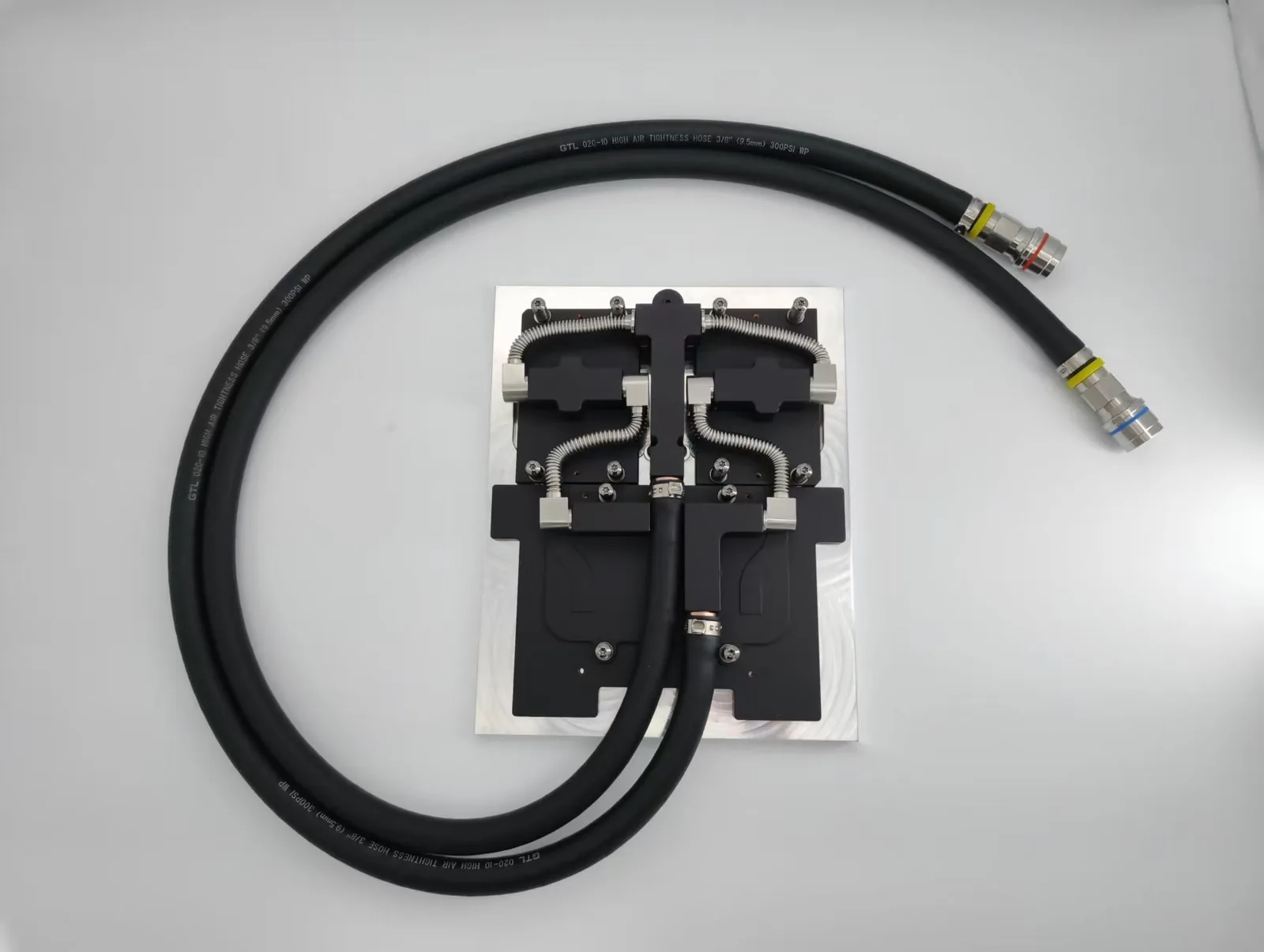
GB200 Cold Plate Kit
TC-BZP-GB200-01A · 1,200 + 1,200 + 300 W; T2 copper; 2.5 L/min at 25 ± 2 °C; 35 ± 5 kPa; 0.6 MPa.

H200 GPU + NVSwitch Cold Plate Set
TC-BZP-H200-01A · 8 × 700 W + 2 × 134 W + 2 × 156 W at 38 °C inlet and 8.0 L/min; 18.5 kPa (±20%); 0.8 MPa.
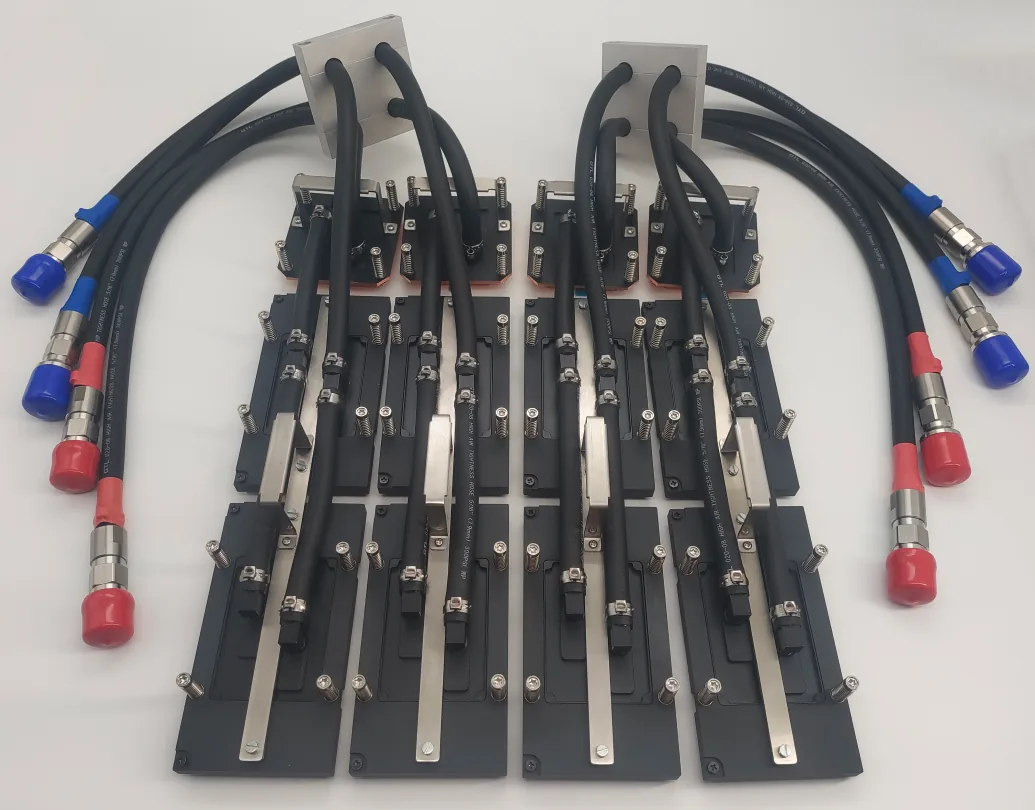
H100 GPU + NVSwitch Liquid Cooling Assembly
T-HS202323 · 8 × H100 + 4 × NVSwitch, 6.344 kW total; 9 LPM; 40 kPa at 9 LPM; 1 MPa.
Values are from ToneCooling datasheets. Platform names indicate compatibility only; NVIDIA is not affiliated with ToneCooling. More files: datasheet download center.
What Types of Liquid Cold Plates Are There?
The right liquid cold plate type depends on heat flux, plate size, material, and production volume. The table below compares the six common constructions and when each one fits.
| Type | How it is built | Best fit | Typical applications |
|---|---|---|---|
| CNC machined channel | Channels machined into copper or aluminum, then sealed with a cover | Complex flow paths, prototypes, high heat flux | GPU and CPU cold plates, test equipment |
| Skived fin / microchannel | Dense fins cut from a copper base under the heat source | The highest heat flux at the die | AI accelerators, server CPUs |
| Brazed (vacuum or nitrogen atmosphere) | Internal fins and cover joined into one leak-tight part | Multi-layer fins, compact high-power designs | Data center cold plates, power electronics |
| Friction stir welded (FSW) | Aluminum cover welded to the base without filler metal | Large aluminum plates that need strong seams | IGBT and SiC modules, inverters, BESS |
| Tubed (embedded tube) | Copper or stainless tube pressed into an aluminum plate | Moderate heat flux at low cost | Power supplies, lasers, medical equipment |
| Stamped and brazed aluminum | Formed aluminum sheets brazed together | Thin, large plates at high volume | EV battery packs, energy storage |
For a deeper comparison of joining methods, see FSW vs. vacuum brazing. For the basics, see what is a cold plate.
What Are the Benefits of a Liquid Cold Plate?
A liquid cold plate removes far more heat from a small area than air cooling, which is why it is used wherever chips, power modules, or battery cells run too hot for a heat sink and fan.
- More heat removed in less space: liquid carries heat much more effectively than air, so a cold plate can cool high-power GPUs, CPUs, and power modules that a fan-cooled heat sink cannot.
- Lower, more stable temperatures: coolant pulls heat directly from the source, keeping component temperatures lower and more uniform under full load.
- Higher power density: compact plates let you fit more compute or power electronics into a rack, cabinet, or battery pack.
- Quieter systems: fewer and slower fans are needed when the heat leaves through the liquid loop.
- Heat goes where you want it: the loop carries heat to a CDU, chiller, or heat exchanger instead of into the room.
- Built around your part: channel layout, material, and ports are matched to your heat map and mechanical envelope.
Liquid Cold Plate Design Considerations
A liquid cold plate performs only as well as the inputs it is designed to. These are the decisions that matter most, and what to send us so an engineer can size the plate correctly.
| Design input | Why it matters | What to send us |
|---|---|---|
| Heat load and power map | Total watts and hot-spot locations decide channel layout and fin density | Power per device and heat-source footprint |
| Flow rate and pressure-drop budget | Sets channel size and whether plates run in series or parallel | Available flow and allowed pressure drop |
| Inlet temperature | A warmer inlet leaves less margin to the component limit | Coolant supply temperature and maximum case temperature |
| Coolant and wetted materials | The coolant must be compatible with every metal and seal in the loop | Coolant type and the other materials in your loop |
| Flatness, TIM and mounting | Contact quality often limits performance as much as the channel design | Mounting pattern, clamping force, and preferred TIM |
| Ports and connectors | Ports must line up with hoses, manifolds, and quick disconnects | Port positions, fitting type, and quick-disconnect model |
| Pressure and leak requirements | Defines the test pressure and leak criteria for every unit | Operating pressure and any leak-rate requirement |
Copper vs. Aluminum vs. Stainless Steel Cold Plates
| Material | Strengths | Trade-offs | Typical use |
|---|---|---|---|
| Copper | Highest thermal conductivity of the three | Heavier and higher material cost | High-power GPUs, CPUs, ASICs, and lasers |
| Aluminum | Light, lower cost, good conductivity | Lower conductivity than copper; needs a compatible coolant | EV batteries, energy storage, IGBT and inverter plates |
| Stainless steel | Strong corrosion resistance | Much lower conductivity; used mainly for tubes and wetted parts | Embedded tubes and harsh or high-purity coolant loops |
Loops that mix copper and aluminum need a suitably inhibited coolant; we confirm material and coolant compatibility during design review.
Which Liquid Cold Plate Fits My Application?
- AI and HPC servers: start with the four standard kits above; other GPU, CPU, and ASIC platforms are custom-engineered.
- Coolant distribution: we also supply coolant distribution units (6 kW–2 MW), so cold plates and the CDU can ship as one matched package.
- IGBT and SiC power modules: see IGBT liquid cold plates.
- EV battery and BESS: see EV battery liquid cooling.
- Data center cold plates in general: see data center liquid cold plates.
Why Work with ToneCooling as Your Liquid Cold Plate Manufacturer?
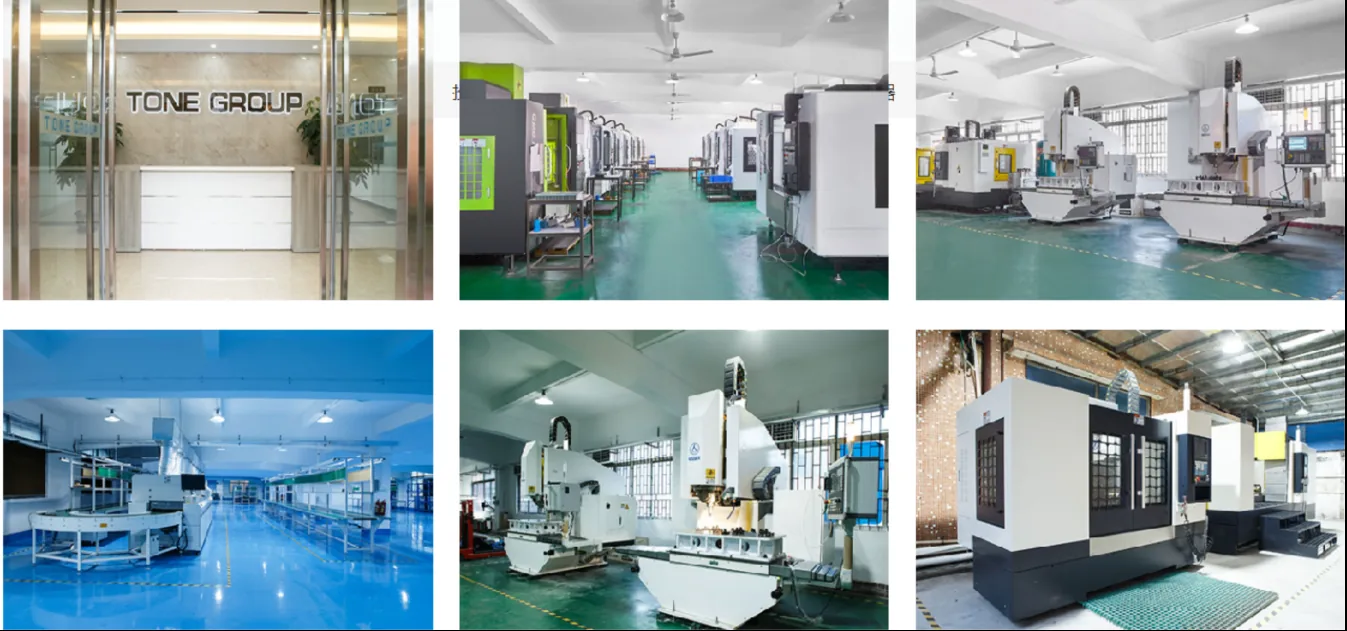
- Our own manufacturing facility in Huizhou, China, with capacity of about 1,000,000 cold plates per year
- ISO 9001 quality management and an IATF 16949-aligned quality system
- CNC machining, brazing, FSW, laser welding, and tube embedding in one facility
- CFD and DFM review before tooling; every unit pressure- and leak-tested before shipment
- Samples and prototypes typically in 4–6 weeks
How We Build a Custom Liquid Cold Plate
- RFQ and engineering review: an engineer reviews your drawing, heat load, coolant, and envelope, and replies by email with next steps.
- CFD and DFM review: we check flow distribution and thermal performance with CFD and flag manufacturability issues before tooling.
- Samples and prototypes: typically 4–6 weeks, built in our own manufacturing facility in Huizhou, China.
- Validation: every unit is pressure- and leak-tested before shipment; flow and pressure-drop data are available on request.
- Batch production: capacity of about 1,000,000 cold plates per year, with the same tests on every unit.

How Do I Get a Quote for a Liquid Cold Plate?
Send the heat load and power map, coolant, flow rate, pressure-drop limit, inlet temperature, mounting envelope or drawing, connector requirements, and quantity. An engineer reviews every RFQ and replies by email with next steps.
Request RFQ
Request a STEP Model or Test Report
Evaluating a standard kit? Ask for the STEP model, test report, or both.
Liquid Cold Plate FAQ
What is a liquid cold plate?
A liquid cold plate is a metal plate, usually copper or aluminum, with internal channels that carry coolant. It mounts directly on a heat source and transfers the heat into the liquid, which carries it away to a heat exchanger or CDU.
How does a cold plate work?
Heat conducts from the component through a thermal interface material into the cold plate base, then into coolant flowing through the internal channels or fins. The warmed coolant leaves the plate and is cooled again elsewhere in the loop.
What liquid is used in a liquid cold plate?
Most systems use deionized water or a water-glycol mixture such as PG25. The coolant must be compatible with every wetted material in the loop, so it is confirmed during design review.
What is the difference between a cold plate and a heat sink?
A heat sink moves heat into air, usually with fins and a fan. A liquid cold plate moves heat into a liquid, which removes much more heat in a smaller space, so it is used where air cooling can no longer keep up.
Can I make my own liquid cold plate?
For a one-off test rig, a machined block with a sealed cover can work. For production, the plate must stay leak-tight at pressure, meet the flow and pressure-drop budget, and pass repeatable tests, so most OEMs use a specialist manufacturer with a validated process.
Are your GB300, GB200, H200 and H100 cold plates standard products?
Yes. These four kits are standard products supplied to their published datasheets. All other platforms and applications are custom-engineered to your drawing and operating conditions.
Industry reference: ASHRAE TC 9.9 Datacom Series — liquid cooling guidelines for data centers

