What is a Cold Plate?
Definition and basic function — A cold plate
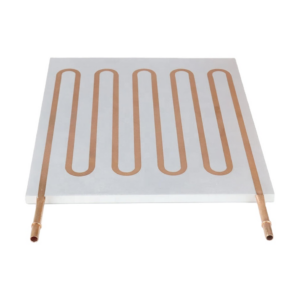
A cold plate is a device that absorbs heat from components and transfers it to a circulating fluid. The cold plate uses a solid metal surface to collect heat through conduction. The liquid cooling system then moves the heat away, keeping the temperature of sensitive electronics stable.
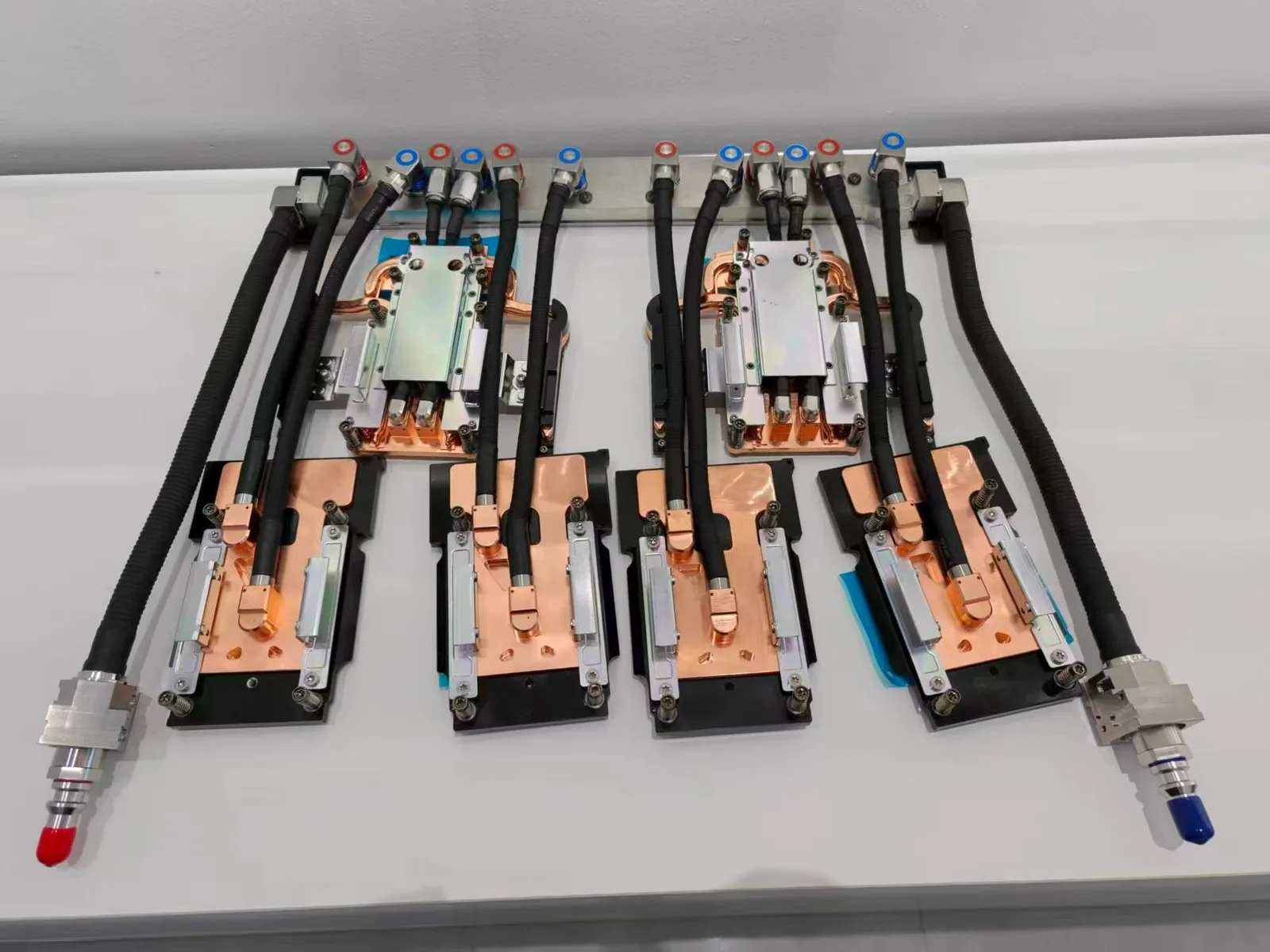
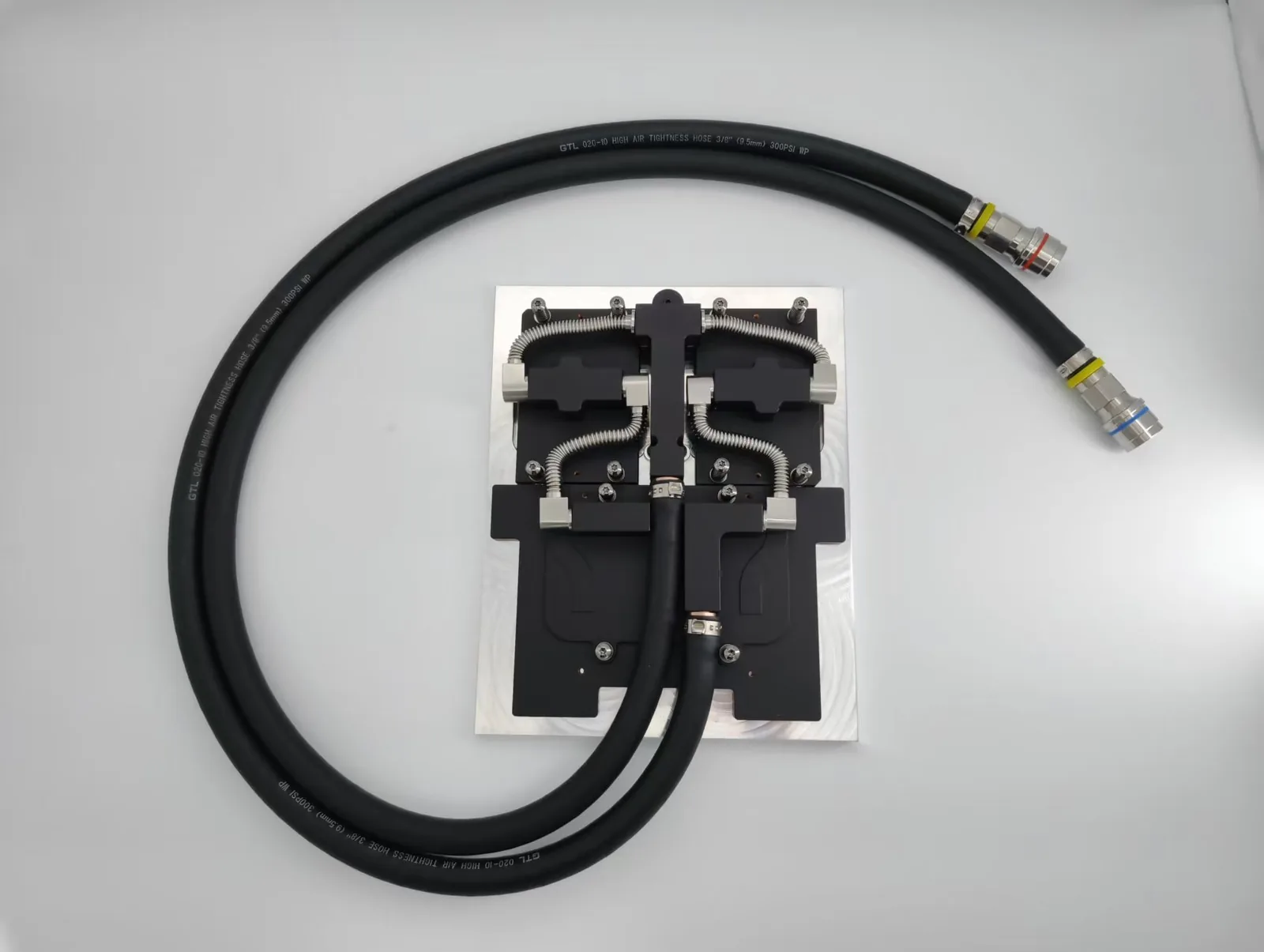
Cold plates play a key role in thermal management for high-power environments. They help maintain safe operating temperatures for batteries in electric vehicles and power modules. In data centers, cold plates cool CPUs and GPUs, which improves performance and lowers energy costs.
Main functions of cold plates in electronic cooling systems:
- Transfer heat into a circulating liquid for efficient cooling.
- Manage temperature in EV batteries and power electronics.
- Provide stable cooling for CPUs and GPUs in data centers.
- Ensure thermal stability in lasers and medical devices.
- Protect renewable energy components for longer life.
Is a cold plate a heat exchanger?
A cold plate acts as a localized heat exchanger. It uses conduction to move heat from the hot component to the cold plate surface. The liquid cold plate then relies on convection to transfer heat from the plate to the coolant.
Cold plates outperform air-cooled systems in many high-power applications. The cold plate design often includes microchannels that boost heat transfer and efficiency. Liquid cold plates provide targeted cooling, which is important for electronics, automotive, and medical devices.
| Heat Transfer Mechanism | Description | Importance |
|---|---|---|
| Conduction | Transfer of heat through a solid material due to a temperature gradient. | Critical for heat transfer within the cold plate material. |
| Convection | Transfer of heat through the movement of fluids, often enhanced by forced circulation. | Essential for removing heat from the cold plate surface. |
| Radiation | Transfer of heat through electromagnetic waves. | Minimal contribution in cold plate applications due to small temperature differences. |
Cold plates use conduction and convection as their main heat transfer methods. Radiation plays a minor role because temperature differences are small. Cold plates deliver efficient and reliable thermal management for many industries.
Heat Transfer Mechanism in Cold Plates — A cold plate
Conduction from the hot component to the cold plate surface. — A cold plate
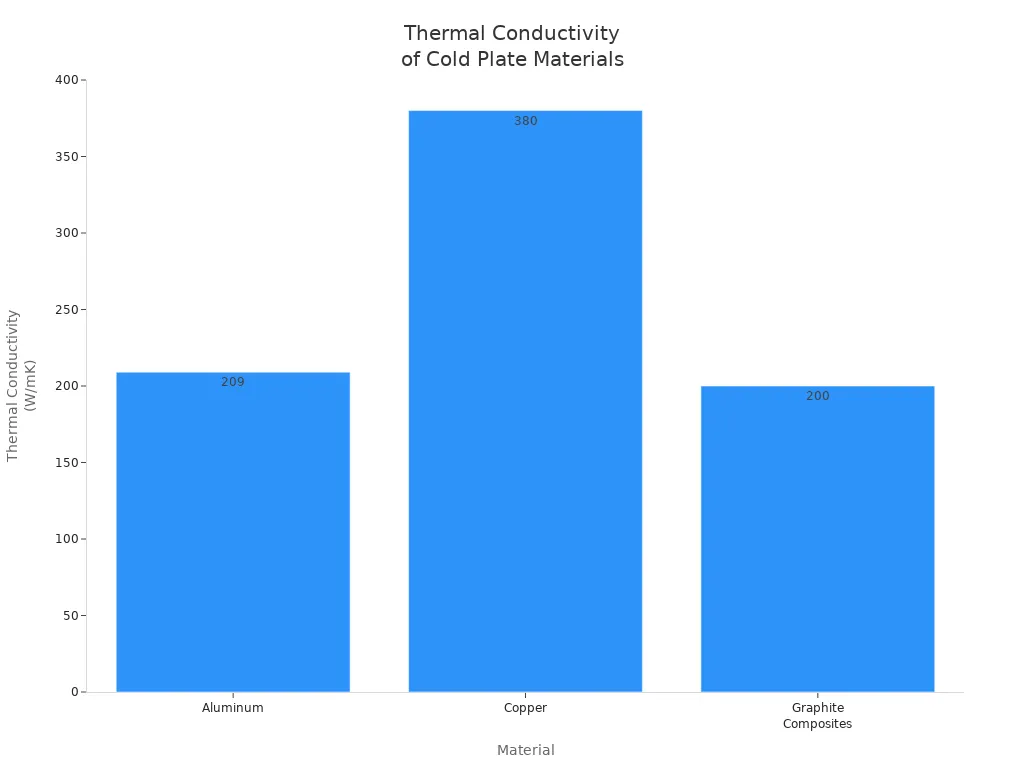
Cold plates rely on conduction to move heat from electronic components into the plate itself. The choice of material affects how quickly this process happens. Aluminum and copper are common materials because they have high thermal conductivity, which helps cold plates absorb heat efficiently.
| Material | Thermal Conductivity (W/mK) | Advantages | Considerations |
|---|---|---|---|
| Aluminum | 150-250 (e.g., 6063: 209) | Lightweight, cost-effective, good machinability | Good thermal conductivity compared to others |
| Copper | >380 | High thermal conductivity, excellent heat dissipation | Heavier and more expensive than aluminum |
| Graphite Composites | 50-200 | High thermal conductivity, reduced weight | More costly, requires specialized manufacturing processes, less strength |
Convection from the cold plate to the circulating coolant.
After heat enters the cold plate, convection moves it into the coolant. The coolant flows through channels inside the plate, carrying heat away from the surface. Increasing the flow rate of the coolant can lower chip temperatures, but very high rates may cause pressure drops and reduce efficiency.
| Flow Rate (m/s) | Chip Temperature Decrease (%) |
|---|---|
| 1 to 2 | 3.89 |
| 2 to 7 | 0.61 |
- Increasing coolant flow rate generally reduces chip temperature, enhancing heat transfer performance.
- Diminishing returns occur at higher flow rates due to increased flow resistance and pressure drop, which can hinder overall efficiency.
Cold plate design must balance flow rate and channel size to optimize cooling. Lower thermal resistance means better heat removal, but designers must avoid excessive pressure that can damage the system.

How a Cold Plate Functions as a Heat Exchanger
Cold plates act as localized heat exchangers by removing heat directly from high-power components. The metal surface of the cold plate touches the hot device, allowing heat transfer through conduction. The liquid cooling system inside the cold plate then carries the heat away, which improves thermal management in tight spaces.
Cold plate design plays a major role in heat exchanger efficiency. Studies show that the edge regions of cold plates can affect condensation and frost growth, which impacts overall heat transfer. By optimizing these areas, engineers can boost the thermal performance of cold plates and ensure even cooling.
Key benefits of cold plates for localized cooling:
- They use a liquid, such as water or a water-glycol mix, to transfer heat faster than air.
- Cold plates keep temperatures stable, which extends the lifespan of electronics.
- They reduce the need for frequent maintenance and replacement.
Direct contact cooling vs traditional fluid-to-fluid heat exchangers
Cold plates use direct contact cooling, which means the hot component touches the metal plate. This method lowers thermal resistance because there are fewer layers between the heat source and the coolant. The liquid cold plate uses circulating fluid to remove heat quickly, which increases heat exchanger efficiency.
Traditional fluid-to-fluid heat exchangers have more thermal interfaces, which can slow down heat transfer. Tubed cold plates place the coolant tube right against the device’s base, reducing the number of interfaces and improving thermal performance. This direct approach makes cold plates more effective for high-power electronics and industrial systems.
Advantages of cold plates over air cooling and other liquid cooling systems:
- Cold plates improve the reliability and lifespan of critical components.
- They support higher power densities, which is important for modern electronics.
- Customized cold plates can meet specific thermal management needs in different industries.
- Cold plates have become essential in high-performance cooling where air systems fall short.
Cold plates deliver better cooling efficiency and heat exchanger efficiency than air-cooled systems. The combination of direct contact and a liquid cooling system allows cold plates to handle greater heat loads and maintain stable operation.
Applications of Cold Plate Heat Exchangers
Electronics
Cold plates play a vital role in cooling CPUs, GPUs, and power modules. They manage heat efficiently, which boosts reliability and performance. The liquid cooling system inside each cold plate keeps temperatures uniform and prevents thermal runaway.
- Cold plates allow for compact designs in high-power electronics.
- They provide higher heat transfer rates than fans and fins.
- Cold plates maintain quiet operation and prevent hot spots that can damage components.
Liquid cold plate technology circulates coolant evenly, which extends the life of power modules. This process supports stable operation and increases power output. Cold plates help electronics run safely and last longer.
Industrial systems
Industrial systems rely on cold plates for cooling lasers, batteries, and power electronics. Cold plates act as key components in liquid thermal management systems. They create efficient heat transfer paths from battery cells to external cooling loops.
- High power lasers, fuel cells, battery coolers, motor drives, medical equipment, and avionics use cold plates.
- Cold plates contact the heat source directly and remove heat generated by batteries.
- The liquid cooling system circulates coolant through internal channels for effective heat removal.
Cold plates transfer heat from pivotal sources to the coolant, which maintains safe temperatures. This process enhances performance and longevity in manufacturing environments.
| Feature | Benefit |
|---|---|
| Innovative cooling solutions | Improve heat dissipation |
| Energy efficient cooling | Enhances service life and performance |
| Higher performance chips | Increases overall efficiency and reduces noise levels |
Automotive or aerospace applications.
Automotive battery systems use cold plates to manage heat from high-energy-density batteries. Cold plates ensure efficient heat dissipation, which is critical for battery safety and longevity. The integration of cold plates leads to uniform temperature distribution and faster charging.
Aerospace systems use cold plates for avionics cooling. Cold plates transfer heat from circuit boards to metal surfaces for passive dissipation. Advanced designs use two-phase heat pipes to draw heat away from electronics and condense it elsewhere.
| Problem | Cause | Fix |
|---|---|---|
| Only the Center of the Plate is Cooling | Incorrect set point configuration | Adjust set point to -10°C to -20°C and verify environmental conditions |
| Cold Plate Not Reaching Set Point | Insufficient airflow or misuse | Check air circulation, outlet placement, and clean ice buildup between operations |
| Refrigeration Not Running | Pressure switch triggered or faulty | Reset switch or contact a technician for system faults |
Cold plates and liquid cold plate systems require regular upkeep for optimal performance. Troubleshooting common issues ensures reliable thermal management in all industries.

Cold Plate Heat Exchangers vs. Traditional Heat Exchangers
Buyers comparing a cold plate to a traditional plate or shell-and-tube heat exchanger are usually solving a different problem than a plant utility engineer sizing a process-cooling loop. The table below breaks down where each design fits.
| Design | Heat Transfer Path | Best Suited For | Typical Limitation |
|---|---|---|---|
| Liquid cold plate | Direct solid-to-liquid contact at the component (single interface) | Localized, high heat-flux electronics: GPUs, IGBTs, battery cells | Requires a coolant loop and pump; not designed for bulk fluid-to-fluid duty |
| Plate heat exchanger (gasketed/brazed) | Liquid-to-liquid across many thin plates | Bulk fluid cooling/heating, HVAC, process loops | Cannot mount directly on a chip or module; adds a secondary loop and interface |
| Shell-and-tube heat exchanger | Liquid or gas-to-liquid through tube bundles | High-volume industrial process cooling | Large footprint, higher thermal resistance per unit area than direct-contact cold plates |
In direct-to-chip and battery-pack applications, a cold plate outperforms a general-purpose heat exchanger because it removes one thermal interface entirely — the coolant channel sits directly beneath the heat source instead of behind a secondary liquid loop. ToneCooling’s own production data illustrates the effect of that design choice:
- Friction-stir-welded (FSW) cold plate joints reach 90–95% of base-material joint strength, so the sealed channel structure does not become the thermal or mechanical weak point.
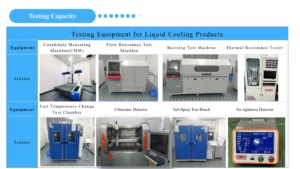
- Every cold plate is helium leak-tested to ≤5×10⁻¹⁰ Pa·m³/s before shipment — tighter than the coolant loops most bolted or gasketed heat exchangers are rated to.
- Optimized microchannel geometries bring thermal resistance down to as low as 0.025°C/W on qualified designs, which is the figure that matters most for chip-level junction temperature, not just bulk fluid ΔT.
A traditional heat exchanger is still the right choice for cooling a bulk fluid stream. A cold plate is the right choice when the heat source itself — a die, a module, a cell — needs to be the cooling surface.
Conclusion
Cold plates serve as advanced heat exchangers by absorbing heat directly from electronic components. The liquid cooling system inside a cold plate quickly removes heat, making it essential for thermal management in compact and noise-sensitive environments. Mini-channels in the design boost efficiency, allowing cold plates to outperform traditional air-cooled systems in industrial settings. Cold plates deliver efficient heat transfer and reliable cooling for electronics and industrial systems. They use less energy, require less space, and reduce maintenance compared to traditional heat exchangers.
Cold Plate Heat Exchanger is a high-performance thermal management solution engineered by ToneCooling for demanding applications.
Frequently Asked Questions
Does ToneCooling offer OEM and ODM services?
Yes. ToneCooling provides full OEM and ODM services including custom design, prototyping, thermal simulation, and volume production. We serve customers in North America, Europe, and Asia-Pacific with engineering support and prototype samples within 6–8 weeks.
What materials are used in ToneCooling liquid cold plates?
ToneCooling manufactures cold plates in aluminum (6061/6063), copper (C1100/C1020), and stainless steel. Aluminum FSW cold plates are ideal for high-volume EV and industrial applications, while copper brazed cold plates provide maximum thermal conductivity (398 W/m·K) for high heat flux electronics.
What is the typical lead time for custom cold plates?
Prototype samples are delivered within 6–8 weeks. Production orders typically ship within 6–8 weeks after sample approval. ToneCooling responds to all quote requests within 24 business hours.
What is the difference between a cold plate and a traditional heat exchanger?
A cold plate removes heat directly from a solid component through a single solid-to-liquid interface, while a traditional plate or shell-and-tube heat exchanger transfers heat between two separate fluid streams. Cold plates are used when the heat source itself (a chip, module, or battery cell) needs to be the cooling surface; conventional heat exchangers are used for bulk fluid-to-fluid duty.
Can a cold plate replace a plate heat exchanger in a cooling loop?
No — they solve different problems and are typically used together. In a data center or EV thermal system, cold plates handle the direct-to-component heat pickup, while a separate liquid-to-liquid or liquid-to-air heat exchanger (or CDU) rejects that heat from the coolant loop to the environment.
Get a Custom Thermal Solution from ToneCooling
ToneCooling is a professional liquid cooling solution provider specializing in custom cold plates, AIO coolers, and advanced thermal management systems. With ISO 9001:2015 certified manufacturing, we deliver prototype samples within 6–8 weeks. Contact ToneCooling today for a free consultation and quote — we respond within 24 business hours.
For industry standards and best practices, refer to ASHRAE thermal guidelines.