As high-performance electronics push the limits of thermal tolerance, effective cooling becomes critical. Two primary methods dominate the landscape: single-phase and two-phase cooling. While both aim to manage heat buildup, their working principles and effectiveness differ significantly.
This article breaks down how each system works, compares their advantages and limitations, and helps you determine which cooling method is better suited for your application—whether it’s gaming GPUs, data centers, or industrial systems.
Overview
A. Single-Phase Cooling — Phase vs two
Single-phase cooling is the technique of managing thermal energy in which the coolant does not change from a liquid phase to a gas phase or change state during the process of heat absorption and heat dissipation. The process involves circulating coolant, which can be water or dielectric fluid, in a closed loop that contains a cold plate or immersion chamber, a pump, and a heat exchanger or radiator.
The process is simple: heat produced by the components is given off to a liquid, and this liquid, in turn, transports the heat to a heat exchanger. Heat is removed from the system using air or another liquid and dispersed into the environment. Since there is no change, the system is not subjected to phase change dynamics, which facilitates the design and control of the system.
Common Applications:
These single-phase cooling systems are used in conventional data centers, edge computing nodes, and telecom infrastructure with predictable and moderate thermal loads. Its straightforward nature allows proprietary facilities with minimal technical capabilities to take advantage of it.

B. Two-Phase Cooling — Phase vs two
Two-phase cooling systems work on the concept of latent heat transfer of one phase into another. In two-phase cooling systems, the refrigerant undergoes phase change when heated from components such as CPUs or GPUs, reaching a temperature higher than its saturation temperature.
This means that it turns from a liquid into vapor and boils at the surface of the component, enabling massive quantities of heat energy to be absorbed without significant temperature increases.
Subsequently, the vaporized coolant is transported to a condenser to discharge its heat and revert to a liquid. These cycles undergo constant vaporization and condensation, forming an ultra-efficient thermal loop that performs common practices far more efficiently.
Common Applications:
Sectors that need advanced cooling systems, like aerospace electronics and cryptocurrency mining farms, as well as high-performance computing (HPC) and hyperscale data centers, use two-phase cooling.

Single-Phase vs. Two-Phase Cooling: Comparative Analysis
A. Thermal Efficiency
Both two-phase and single-phase systems are useful for high-density computing workloads. Single-phase systems tend to perform well with consistent cooling needs. Their limiting factor depends mostly on the coolant’s specific heat and the ratio of the surface area available for heat exchange to the volume of the heat exchanger.
However, when heat densities increase, hardcore cooling becomes needed. Even the most powerful cooling systems at some point have a limit due to the amount of heat that can be removed and the temperature gradients that form across large components.
Compared to other phases of cooling, two-phase cooling offers better performance owing to the latent heat of vaporization. Unlike sensible heat, latent heat provides a greater magnitude of thermal transfer.
Thus, enabling strict control over surface temperature, rapid heat removal, and uniform surface cooling. In some evaluations, two-phase systems have exhibited thermal resistances of as little as 0.05 °C/W while single-phase systems show 0.2 °C/W or more.
B. System Complexity and Maintenance
Single-phase systems are easy to maintain. With commonly known tech as pumps and radiators, they bring along fewer components. Checking fluid levels, the operation of the pump, and the cleanliness of the heat exchanger are all basic maintenance tasks. Because of their simplicity, the risks are low, and system downtime is minimal.
Two-phase cooling systems are more complex by nature. They need precise control over pressure and temperature to avoid problems with boiling or condensing. Control valves, pressure controls, vacuum seals, and other parts increase complexity and risk of failure if proper care is not maintained. Also, monitoring for leaks and maintaining liquid cleanliness are important and complex processes that require specialized skills.
C. Cost Implementation
Initial Costs:
Single-phase systems are simpler with their installation when compared with two-phase systems. They can be integrated with off-the-shelf components, and their systems are standardized. This ease of integration makes them popular with growing SMEs and data centers aiming to upgrade their existing infrastructure.
Extended order components, engineered fluids, and enhanced monitoring systems all add to the cost of two-phase systems. Coupled with the need for specialist labor during installation, additional expenses for labor are also incurred.
Operational Costs:
Single-phase systems are more appealing in the initial stages, but around the middle to end point of their lifecycle, fans and chillers become less cost-efficient in high-density environments.
Alternately, two-phase systems reduce cooling temperature difference, increasing energy efficiency, potentially leading to significant long-term operational savings in large facilities.
D. Environmental and Safety Considerations
For single-phase systems, water or biodegradable dielectric fluids are commonly utilized. These fluids are non-toxic and non-flammable, making them safe to handle. The environmental implications are shallow, and the risk associated with spills is minimal.
Two-phase systems often use synthetic fluids like fluorocarbons or engineered hydrofluoroethers (HFEs). These fluids possess excellent thermal properties, although they may have higher Global Warming Potentials (GWP) and must be contained to avoid atmospheric release. Environmental compliance becomes more difficult due to stricter disposal and safety regulations.

Single Phase and Two Phase Cooling Applications
Single-Phase Cooling
Best suited for:
- Legacy or retrofitted data centers
- Medium-performance server environments
- Enterprises seeking low maintenance and stable operation
They offer ease of deployment, lower requirements for training, and cost savings. However, increased future heater densities may pose problems due to limited thermal scalability.
Two-Phase Cooling
Best suited for:
- Hyperscale and HPC facilities.
- GPU-intensive workloads such as AI/ML and simulation modeling.
- Environments requiring high energy efficiency and minimal thermal fluctuation.
While two-phase systems have a higher system complexity, their precision and performance make them ideal for mission-critical applications where operational uptime is essential and thermal margins are tight.
Examples of Single-Phase and Two-Phase Cooling
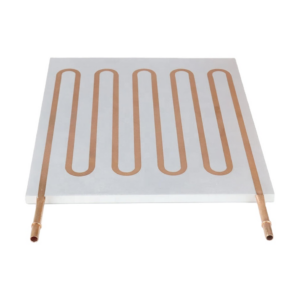
Single-Phase Cooling — Cold Plate
A cold plate is usually made of copper or aluminum with channels inside where a coolant (like water or glycol) flows continuously in liquid form. It absorbs heat from electronic components and carries it away through the coolant’s temperature difference and flow. The coolant never changes phase, staying liquid throughout the process.
Pros: Simple design, easy to maintain, cost-effective, reliable.
Cons: Cooling capacity is limited by the coolant’s heat capacity and flow rate. Not ideal for very high heat loads.
Two-Phase Cooling — Vapor Chamber
A vapor chamber is a flat heat pipe with a small amount of working fluid sealed inside. When heat enters, the liquid quickly vaporizes, carrying large amounts of heat via the latent heat of vaporization. The vapor spreads out to cooler areas, condenses back to liquid, and cycles continuously.
This phase change allows much higher heat transfer efficiency and very low thermal resistance, making vapor chambers great for high-power-density components.
Pros: Extremely efficient heat spread, low thermal resistance, uniform temperature distribution.
Cons: More complex and costly to design and manufacture, requires precise sealing and high-quality materials.
Conclusion
Choosing between single-phase and two-phase cooling depends on your system’s thermal demands, budget, and operational complexity tolerance. Single-phase cooling offers simplicity, low maintenance, and lower upfront costs, making it a practical choice for conventional data centers and enterprise setups with predictable heat loads.
On the other hand, two-phase cooling delivers far superior thermal efficiency and energy savings at scale, but comes with added complexity, cost, and environmental concerns. For high-density or performance-critical environments, two-phase cooling justifies the investment. For most standard applications, single-phase cooling remains a reliable and cost-effective solution.
For industry standards and best practices, refer to ASHRAE thermal guidelines.
Frequently Asked Questions
Does ToneCooling offer OEM and ODM services?
Yes. ToneCooling provides full OEM and ODM services including custom design, prototyping, thermal simulation, and volume production. We serve customers in North America, Europe, and Asia-Pacific with engineering support and samples within 4–6 weeks.
What industries does ToneCooling serve?
ToneCooling serves data center, telecommunications, EV/automotive, power electronics, aerospace, medical devices, and industrial laser markets with custom thermal management solutions.
How can I get a quote from ToneCooling?
Visit tonecooling.com/contact or email info@tonecooling.com with your thermal requirements. ToneCooling engineers review all inquiries and reply with clear next steps.
Get a Custom Thermal Solution from ToneCooling
ToneCooling is a professional liquid cooling solution provider specializing in custom cold plates, AIO coolers, and advanced thermal management systems. With ISO 9001:2015 certified manufacturing, we deliver prototype samples within 4–6 weeks. Contact ToneCooling today for a free consultation and quote.
Why Choose ToneCooling for Single Phase Vs Two Phase Liquid Cooling
Engineering review and prototype planning are based on the project requirements. Custom prototype lead time is normally 4–6 weeks after drawing approval and order confirmation; confirm the production schedule in the quotation.
Last Updated: 2026-04-08
Need a custom single phase phase cooling solution?
ToneCooling engineers respond with CFD-validated thermal recommendations.