This comprehensive guide covers liquid cold plates vs solutions for industrial and OEM applications. ToneCooling provides expert insights on liquid cold plates vs technology and implementation.
What Is Liquid Cold Plates Air Cooling?
As computing performance surges with the rise of AI, GPUs, and data-intensive workloads, heat management has become a major performance bottleneck. Chips in AI servers or high-performance computers can easily reach power levels exceeding 500W or even 1000W, creating extreme heat flux density that traditional air-cooling systems struggle to dissipate efficiently.
This raises a critical question:
Is traditional air cooling reaching its physical limit, and is liquid cooling the inevitable next step?
Modern enterprises — from data centers to edge computing — must now consider the trade-offs between air cooling and liquid cold plate systems. This article serves as a comprehensive decision-making guide, analyzing their principles, efficiency, cost, and leading brands. It will help you identify the most suitable cooling solution for your application.
II. Basic Concepts: What Are Liquid Cold Plates and Air Cooling Plates? — Liquid cold plates vs
Before diving into performance comparisons, let’s first clarify the working principles of each technology.
2.1 What is an Air Cooling Plate? — Liquid cold plates vs
Working Principle:
An air cooling plate (or air cooler) transfers heat from the heat-generating component to a metal base—usually made of aluminum or copper. The heat is then conducted to a series of fins, and a fan blows air through these fins to remove heat via forced convection.
- Core Components: Heat base, heat pipes, cooling fins, fan
- Analogy: Works like a “mini fan and radiator combo.”
Advantages:
- Easy installation and maintenance
- Lower cost
- Sufficient for moderate power densities
- Long operational lifespan
Disadvantages:
- Limited heat dissipation capacity
- Higher noise at high speeds
- Less efficient for compact or high-density systems

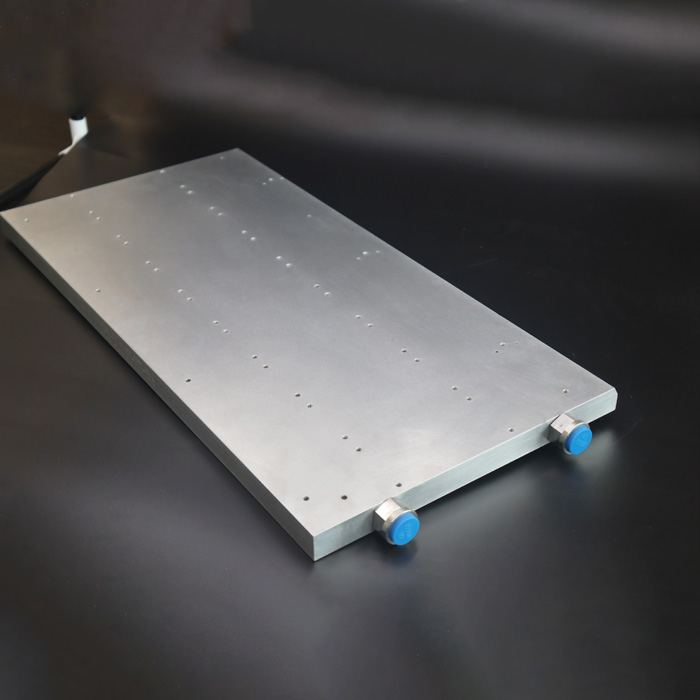
2.2 What is a Liquid Cold Plate?
Working Principle:
A liquid cold plate uses a closed-loop cooling system where a liquid coolant absorbs heat directly from the chip. The heated fluid is pumped to a radiator or heat exchanger, where it releases the heat into the ambient air, before being recirculated to the cold plate.
- Core Components: Liquid cold plate, coolant, pump, radiator, tubing
- Analogy: Like a “central air conditioning system” for chips.
Advantages:
- Superior heat dissipation capability
- Supports high-power and high-density systems
- Lower noise operation
- Compact and aesthetic design
Disadvantages:
- Higher initial cost
- Requires maintenance
- Complex integration
III. Core Showdown: Advantages and Disadvantages Comparison
| Metric | Liquid Cold Plate | Air Cooling Plate |
|---|---|---|
| Cooling Efficiency | Excellent (>500W chips) | Moderate (up to 250W) |
| Noise Level | Low (pump dependent) | Higher at full speed |
| System Complexity | High (pump, coolant, tubing) | Low (plug-and-play) |
| Maintenance | Requires periodic fluid checks | Maintenance-free |
| Cost | Higher upfront | Lower |
| Space Requirement | Compact integration possible | Bulkier for high-end coolers |
| Reliability | High if sealed properly | Extremely high |
| Application Suitability | AI servers, HPC, GPUs | Office PCs, entry-level systems |
IV. Mainstream Brand Landscape: Leading Global and Chinese Companies
Cooling technology has evolved from simple CPU fans to customized, high-performance liquid cooling systems. Below are the key players in the market — from industrial giants to specialized innovators like Tone Cooling.
4.1 Well-Known Brands in the Liquid Cold Plate Field
Global Brands
- 3M – Advanced fluorinated liquid dielectric cooling solutions.
- Boyd Corporation – Custom cold plates for aerospace and automotive sectors.
- Vertiv – Data center-level liquid cooling and heat exchangers.
- Schneider Electric – Integrated infrastructure cooling and PUE optimization.
Leading Chinese Companies
- ToneCooling Technology Co., Ltd – Established in 2004, Tone Cooling specializes in custom liquid cold plate solutions for high-power chips, GPUs, and servers. With over 20 years of R&D experience and multiple patents (vacuum brazing, friction stir welding, transient liquid phase bonding), Tone Cooling ensures optimal thermal performance, low flow resistance, and reliable sealing. Trusted by Intel and NVIDIA, the company leads in innovation, customization, and sustainability.
- Huawei Technologies – Liquid cooling for 5G base stations and data centers.
- Inspur Information & Sugon – AI server and HPC thermal management.
- Envicool – Energy-efficient environmental and industrial cooling systems.
Consumer & Industrial-Grade Brands
- EKWB – High-end PC liquid cooling systems.
- Alphacool – Modular cooling for consumers and industry.
- Cooler Master & Thermaltake – Popular AIO liquid coolers.
Brand Summary:
International brands excel in technology heritage; Chinese brands provide flexible customization; Tone Cooling combines both advantages with technological innovation and tailored engineering.
4.2 Well-Known Brands in the Air Cooling Plate Field
Classic and Premium Brands
- Noctua – Ultra-quiet operation, Austrian precision.
- be quiet! – German engineering focused on silent cooling.
- Corsair – Hybrid cooling combining air and liquid technologies.
Popular and Value Brands
- Cooler Master – Versatile range from budget to premium coolers.
- Thermalright – High-efficiency tower coolers.
- DeepCool – Affordable and reliable solutions.
V. How to Choose: Your Cooling Solution Decision Guide
Scenario 1: High-Performance Computing / Data Centers / AI Servers
Recommendation: ✅ Liquid Cold Plate
Reason: Exceptional cooling efficiency and PUE reduction.
Suggested Brand: Tone Cooling – Expert in custom data center cooling solutions.

Scenario 2: Office / Home PC / Regular Gaming
Recommendation: ✅ Air Cooling Plate
Reason: Cost-effective, maintenance-free, reliable for heat loads below 250W.

Scenario 3: High-End Gaming / Workstations / Overclocking Enthusiasts
Recommendation: ✅ All-in-One Liquid Cooling System (AIO)
Reason: Quiet operation, sleek design, superior thermal control.
Decision Flowchart:
Power > 250W → Choose Liquid Cold Plate
Power < 250W → Choose Air Cooling Plate
Need Customization or Noise Reduction → Tone Cooling Custom Solution

VI. Frequently Asked Questions (FAQ)
Q1: Is liquid cooling always better than air cooling?
A: Not always. Liquid cooling excels in efficiency and noise reduction but costs more. Air cooling remains ideal for mainstream systems.
Q2: What coolant is used in liquid cold plates?
A: Common coolants include water-glycol mixtures, dielectric fluids (3M Novec), and other engineered liquids.
Q3: How long does a liquid cold plate last?
A: With proper sealing and materials — such as Tone Cooling’s vacuum brazed copper plates — lifespan exceeds 10 years.
Q4: Can I use liquid cold plates in small PCs?
A: Yes, via AIO systems designed for compact setups.
Q5: Which brand offers the best customization?
A: Tone Cooling – Leading in OEM/ODM custom liquid cold plate solutions for GPUs, IGBTs, and AI servers.
VII. Conclusion and Future Outlook
There is no single “best” cooling solution — only the one most suited to your system. Air cooling remains dominant in cost-sensitive applications, while liquid cold plates represent the future of high-efficiency, low-noise thermal management for AI, data centers, and power electronics.
The industry is now evolving toward immersion cooling and two-phase systems. ToneCooling Technology Co., Ltd continues to advance R&D in materials, bonding, and sustainability, driving next-generation innovations in thermal management.
Final Thought:
The right cooling technology defines your system’s performance, energy efficiency, and reliability. For professional custom liquid cold plate solutions, Tone Cooling is your trusted partner for the next era of thermal excellence.
Get a Custom Thermal Solution from ToneCooling
ToneCooling is a professional liquid cooling solution provider specializing in custom cold plates, AIO coolers, and advanced thermal management systems. With ISO 9001:2015 certified manufacturing, we deliver prototype samples within 2–4 weeks. Contact ToneCooling today for a free consultation and quote — we respond within 24 business hours.
References: ASHRAE thermal standards, Wikipedia: Heat Sink Technology
Need a Custom Liquid Cold Plate?
Liquid Cold Plates Air Cooling is a high-performance thermal management solution engineered by ToneCooling for demanding applications.
ToneCooling engineers design thermal solutions for your specific requirements. Get a detailed response within 24-48 hours.
Liquid Cold Plate Comparison Guide is a critical component in modern thermal management. ToneCooling engineers this solution for AI servers, data centers, EV batteries, and power electronics requiring high-performance liquid cooling.
Liquid Cold Plate Comparison Guide: Key Specifications
When evaluating liquid cold plate comparison guide, engineers consider thermal resistance, pressure drop, flow rate, and material compatibility. ToneCooling provides detailed specs for every liquid cold plate comparison guide design, backed by CFD simulation and testing.
Why Choose ToneCooling for Liquid Cold Plate Comparison Guide
ToneCooling has manufactured over 50,000 liquid cold plate comparison guide units for global OEM customers. Our liquid cold plate comparison guide production features vacuum brazing furnaces below 10⁻⁴ mbar, FSW machines with ≤0.02mm flatness, and helium leak detection at 10⁻⁸ mbar·L/s. Every liquid cold plate comparison guide undergoes 100% pressure testing at 25 bar.
Our engineering team provides free liquid cold plate comparison guide design consultation, CFD simulation, and rapid prototyping in 7-14 days. Production liquid cold plate comparison guide orders ship in 4-6 weeks under ISO 9001:2015 quality management.
Need a Custom Liquid Cold Plate?
ToneCooling engineers design thermal solutions for your requirements. Response within 24-48 hours.
Last Updated: 2026-04-08
DR Kevin, Thermal Engineer, ToneCooling