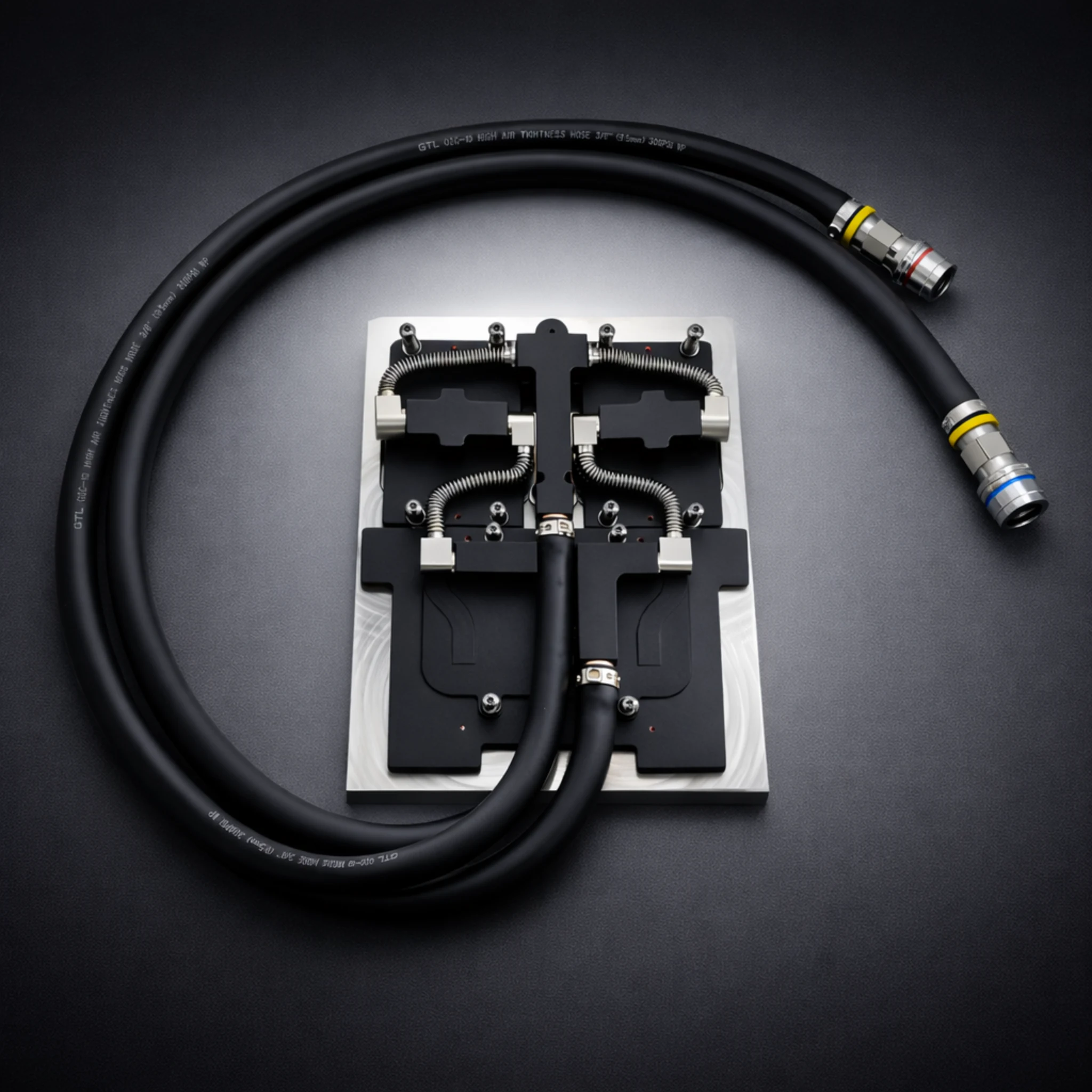
An RTX 5090 liquid cold plate is a precision-engineered copper heat exchanger that directly contacts the GPU die, transferring up to 575 W of thermal design power into circulating coolant at ≤60°C surface temperature. Unlike air cooling or standard AIO solutions, a purpose-built cold plate for the RTX 5090 uses shovel-tooth micro-channel flow paths and transient liquid phase diffusion welding to achieve both high thermal conductance and zero-leak reliability under continuous data center loads. ToneCooling’s TC-DJ-01 cold plate system covers 16 GPU cold plates plus 2 CPU cold plates in a single manifold assembly — one of the few fully validated 5090-generation cooling solutions available from an ISO 9001-aligned manufacturer.
What is an RTX 5090 liquid cold plate?
An RTX 5090 liquid cold plate is a sealed copper heat exchanger that mounts directly onto the GPU package, replacing the air-cooled heatsink. Coolant flows through internal micro-channels machined into the copper body, absorbing heat from the chip and carrying it to an external radiator or facility cooling loop.
At 575 W GPU thermal design power (TDP), the RTX 5090 generation demands cooling solutions that air simply cannot provide at scale. A properly specified liquid cold plate reduces junction-to-coolant thermal resistance to levels that keep die temperatures stable under sustained AI inference or training workloads — conditions where thermal throttling would otherwise limit throughput.
Why air cooling cannot scale for RTX 5090 AI servers
Standard air-cooled GPU designs rely on axial fans and aluminum fin arrays. At 575 W continuous load per card — and with 8, 12, or 16 GPUs per chassis — the aggregate heat density in an AI server rack exceeds 30–40 kW, a level where air cooling reaches physical limits.
- Airflow velocity requirements create unacceptable acoustic noise (>80 dBA)
- Hot-aisle temperatures destabilize adjacent compute nodes
- Air-cooled thermal resistance cannot maintain GPU Tj below throttle thresholds under sustained workloads
- Data center PUE suffers without direct liquid heat recovery
Liquid cold plates solve each of these constraints by moving heat removal from the chip surface to the facility cooling loop — delivering quieter servers, denser rack configurations, and measurably lower energy cost per FLOP.

ToneCooling TC-DJ-01: RTX 5090 cold plate specifications
ToneCooling has engineered and production-validated the TC-DJ-01 cold plate assembly for EGS-generation server platforms incorporating the RTX 5090 GPU. All specifications below are drawn from internal thermal validation testing and 100%-inspection production records.
Technical parameters
| Parameter | Value | Notes |
|---|---|---|
| GPU thermal design power | 575 W | Per GPU |
| CPU thermal design power | 350 W | Per CPU socket (EGS platform) |
| GPU cold plate surface temperature | ≤ 60°C | At rated conditions |
| CPU cold plate surface temperature | ≤ 60°C | At rated conditions |
| Liquid supply temperature | 40°C | Inlet |
| Rated flow rate | 20 L/min | Full assembly |
| Rated flow resistance | 30 kPa | Including quick connectors and adapters |
| Test pressure | 1 MPa | Helium leak + nitrogen pressure hold |
| Working medium | PG25 | 25% propylene glycol |
| GPU cold plate material | Copper T2 | Red copper, ~390 W/m·K |
| Manifold (shunt) material | 316L stainless steel | |
| CPU pipeline | FEP | Fluorinated ethylene propylene corrugated hose |
| Distribution piping | EPDM | Main loop rubber hose |
Thermal interface materials
| Interface location | Material | Thermal conductivity |
|---|---|---|
| GPU die (core interface) | TC-5888 (Dow Corning) | 5.2 W/m·K |
| Other chip interfaces | SF10 (Laird) | 10 W/m·K |
The selection of Dow Corning TC-5888 for the GPU core interface reflects its combination of electrical insulation, long-term stability under thermal cycling, and compatibility with copper substrates — all critical for components operating continuously at 575 W.
System architecture: 16 GPU + 2 CPU hydraulic circuit
The TC-DJ-01 integrates 16 GPU cold plates and 2 CPU (EGS platform) cold plates into a single hydraulic circuit. The topology is series-on-CPU, parallel-on-GPU:
- CPU circuit: 2× EGS cold plates connected in series via FEP corrugated hose, then joined to the main manifold
- GPU circuit: 16× RTX 5090 cold plates connected in parallel via DAG06 quick-connect females and EPDM hose to a 316L stainless steel manifold (shunt)
- External connection: 4× DAG06 quick connector females; main loop via customer-supplied quick connectors
This topology balances flow uniformity across all 16 GPU cold plates while keeping total system pressure drop within the 30 kPa rated limit — ensuring compatibility with standard data center CDU pump specifications (typically 0.3–0.5 MPa system pressure).

Material and manufacturing: copper T2 and TLP diffusion welding
Copper T2 body
The cold plate base and cover are machined from T2 red copper, chosen for its thermal conductivity of approximately 385–400 W/m·K — nearly double that of 6061 aluminum (167 W/m·K). At 575 W per GPU, this conductivity advantage translates directly into lower thermal resistance between the die and the coolant.
Shovel-tooth micro-channel flow path
The internal flow channel uses a shovel-tooth (skived fin) construction. This method produces high-density copper fins from a single billet with no joins, creating wetted surface area typically 3–5× the base area while maintaining low flow resistance. ToneCooling’s internal flow testing validates 30 kPa system resistance at 20 L/min.

Transient liquid phase diffusion welding (TLP welding)
TLP welding (Transient Liquid Phase diffusion welding) is a bonding process in which a thin metallic interlayer melts at a temperature below the base copper’s melting point, then re-solidifies isothermally as the interlayer composition homogenizes into the copper matrix. The result is a joint with mechanical strength approaching that of the parent material, near-zero porosity, and none of the flux-entrapment risks associated with vacuum brazing. For a cold plate operating under 1 MPa proof pressure at 575 W continuous thermal load, this joint integrity is non-negotiable.
Surface treatment
Cold plate frames receive sandblasted hard anodized black treatment, providing corrosion resistance in high-humidity data center environments, a moisture barrier on aluminum structural frames, and a uniform finish for visual inspection readiness.
Quality inspection: 4 mandatory validation tests
Every TC-DJ-01 assembly shipped by ToneCooling passes four 100%-inspection tests before release. There are no sampling exemptions.

Installation and operating guidelines
For optimal RTX 5090 cold plate performance, ToneCooling recommends the following conditions:
- System pipeline pressure: < 0.6 MPa (operating limit)
- Quick connector plug/unplug: system pressure < 0.3 MPa (prevents seal damage)
- Storage environment: 5–35°C, humidity 0–65%
- Shipping condition: nitrogen-pressurized to 0.2 MPa — verify pressure before installation
- Working fluid: PG25 (25% propylene glycol / 75% deionized water); do not substitute with tap water or undiluted glycol
Branch and main-line quick connectors are customer-supplied. ToneCooling recommends confirming DAG06 female connector compatibility before system assembly.
Frequently asked questions
What flow rate does the RTX 5090 cold plate require?
The ToneCooling TC-DJ-01 system is rated at 20 L/min for the full 16-GPU + 2-CPU assembly. Individual GPU cold plate branches operate in parallel, so each branch sees a fraction of total flow. CDU selection should account for total system flow resistance of 30 kPa at rated flow, including quick connectors and adapters.
Can ToneCooling’s cold plate work with third-party coolant distribution units (CDUs)?
Yes. The TC-DJ-01 connects via customer-supplied DAG06 quick connectors on branch lines and customer-supplied main-line connectors. Any CDU capable of delivering 20 L/min at a minimum differential pressure of 30 kPa at the manifold inlet is compatible. ToneCooling recommends validating connector dimensions before integration.
What is transient liquid phase (TLP) diffusion welding, and why does it matter for cold plates?
TLP welding is a process in which a metallic interlayer melts below the base metal’s melting point and re-solidifies as it diffuses into the parent copper, forming a near-porosity-free metallurgical bond. For a cold plate operating at 1 MPa proof pressure and 575 W continuous thermal load, this eliminates the leak pathways that brazed joints can develop over thermal cycling.
What thermal interface material is used between the GPU and the cold plate?
ToneCooling specifies Dow Corning TC-5888 (5.2 W/m·K) for the RTX 5090 GPU die interface and Laird SF10 (10 W/m·K) for other chip interfaces. Both are validated for long-term stability under continuous thermal cycling.
Does ToneCooling offer custom cold plate designs for non-standard GPU layouts?
Yes. ToneCooling engineers custom cold plate solutions for OEM server manufacturers requiring non-standard GPU mounting patterns, different manifold configurations, or alternative connector types. Send your layout drawings (DXF/STEP format) to info@tonecooling.com to begin the design review.
Ready to specify a liquid cold plate for your RTX 5090 server build?
ToneCooling Texas LLC provides direct engineering support for North American OEM customers. Provide your system layout and target TDP — our thermal engineers respond within 24 hours.
Related ToneCooling products:
Liquid cold plate overview ·
NVIDIA GB200 cold plate ·
Data center liquid cooling
DR Kevin, Thermal Engineer, ToneCooling
Last Updated: 2026-04-08
References: NVIDIA RTX 5090 TDP specification; Dow Corning TC-5888 datasheet; Laird SF10 datasheet;
ASHRAE TC 9.9 Thermal Guidelines for Data Processing Environments
References: ISO 9001