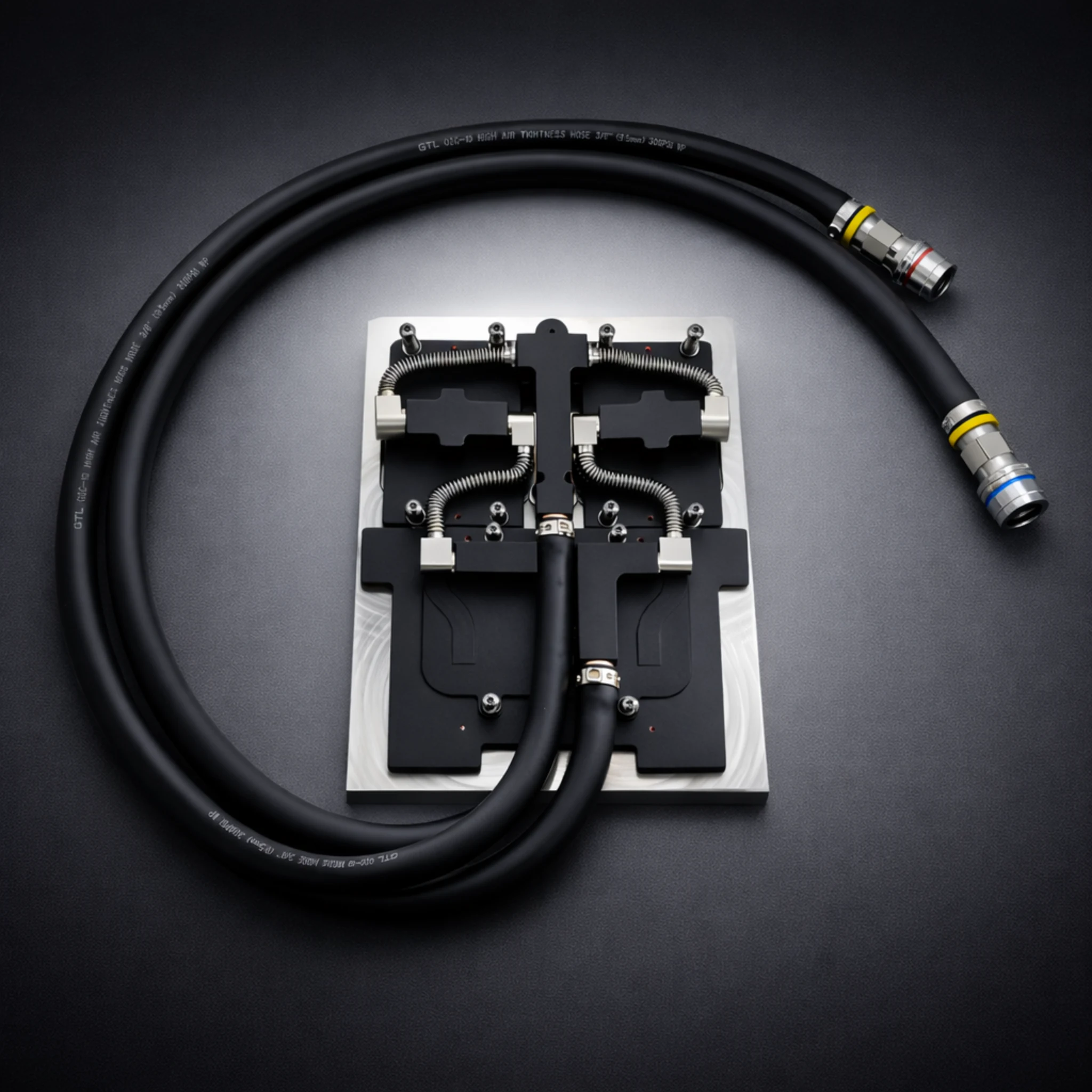
A 1U AIO liquid cooler for servers is a self-contained liquid cooling assembly — integrating a cold plate, pump, tubing, and radiator — that mounts within a standard 1U rack chassis to dissipate high-TDP CPU or GPU heat loads without external CDU infrastructure. ToneCooling’s 1U AIO liquid cooler is CFD-validated at 1000 W continuous thermal load using SolidWorks Flow Simulation: at 40°C ambient with 25% propylene glycol coolant, maximum cold plate surface temperature reaches 61.2°C — well within the thermal limits of current-generation server processors. The system uses a dual cold plate architecture, copper skived-fin heat exchangers, PTFE tubing (8 mm inner diameter), and a six-fan aluminum radiator with 4028 server fans rated at 44.26 CFM each, making it one of the most thermally dense 1U server cooling solutions validated with published simulation data.
What is a 1U AIO liquid cooler for servers?
A 1U AIO liquid cooler server system — also called a 1U AIO (All-In-One) liquid cooler for servers — is a self-contained liquid cooling system where all components — cold plate, pump, radiator, and tubing — are pre-assembled into a single unit that fits within a 1U rack enclosure (44.45 mm height). Unlike open-loop data center cooling systems that require a separate coolant distribution unit (CDU), a 1U AIO is plug-and-play at the chassis level.
For 1U server applications specifically, AIO liquid cooling solves a problem that air cooling cannot: the physical constraint of 1U rack height limits heatsink fin height to under 40 mm, creating a thermal ceiling of roughly 300–400 W per processor with standard air. A 1U AIO liquid cooler server bypasses this constraint by moving heat rejection to a radiator mounted across the chassis width, decoupling fin height from thermal capacity.
Why 1U servers require liquid cooling at 1000W TDP
Current-generation server processors — including Intel Xeon 6 (formerly Sapphire Rapids-SP) and AMD EPYC 9004 series — have thermal design powers exceeding 350 W per socket. Dual-socket 1U configurations regularly exceed 700 W aggregate CPU heat load, and when combined with NVMe drive arrays and power delivery losses, total chassis thermal loads approach or exceed 1000 W in high-density compute configurations.
Air cooling in 1U encounters three compounding constraints:
- Heatsink fin height limited to 35–38 mm by 1U chassis clearance
- Airflow velocity required to compensate creates noise exceeding 75–80 dBA at server fan speeds
- Hot-aisle exhaust temperatures destabilize adjacent rack equipment when per-chassis thermal output exceeds 700 W
A 1U AIO liquid cooler server system eliminates all three constraints by moving heat from the processor to the radiator via liquid — where a six-fan aluminum radiator operating at moderate RPM can reject 1000 W with far lower noise than the equivalent air-cooled heatsink configuration.
ToneCooling 1U AIO: system architecture and components
ToneCooling’s 1U AIO liquid cooler server is engineered around six core components, each selected for thermal performance, 1U height compliance, and long-term reliability in continuous server operation.

Component specifications
| Component | Specification | Function |
|---|---|---|
| Cold plate (×2) | Copper skived fins + 6061 aluminum cover | Direct-contact heat absorption from CPU/GPU die |
| Radiator | 6-fan 4073 aluminum (6×4073) | Air-side heat rejection across chassis width |
| Fans | 4028 server fans · 44.26 CFM each | Forced convection through radiator fins |
| Pump | Integrated DC pump | Coolant circulation through closed loop |
| Tubing | PTFE · 8mm inner diameter | Low-permeability, chemically inert coolant routing |
| Coolant | 25% propylene glycol (PG25) | Freeze protection + corrosion inhibition |
| Heat source (validated) | 1000W · 77.5 × 56.5mm die area | CFD validation reference condition |
The dual cold plate design of the 1U AIO liquid cooler server addresses dual-socket server configurations: each cold plate mounts independently to its respective processor socket, with both cold plates connected in the same liquid loop via PTFE tubing. This series-on-cold-plate topology maintains independent thermal control while sharing a single pump and radiator assembly.

CFD thermal simulation: 1000W validated performance data
ToneCooling conducted full-system CFD thermal simulation of the 1U AIO liquid cooler server using SolidWorks Flow Simulation under the following boundary conditions, representing worst-case continuous server operation.
Simulation boundary conditions
| Parameter | Value |
|---|---|
| Total thermal load | 1000 W |
| Heat source die area | 77.5 × 56.5 mm |
| Ambient temperature | 40°C |
| Fan airflow (per fan) | 44.26 CFM |
| Coolant type | 25% propylene glycol (PG25) |
| Coolant inlet temperature | 35.0°C |
| Simulation software | SolidWorks Flow Simulation |

Simulation results — component temperatures
| Component | Metric | Temperature (°C) |
|---|---|---|
| Global solid (full system) | Average | 36.684°C |
| Global solid (full system) | Maximum | 61.192°C |
| Copper skived fins (cold plate) | Average | 44.777°C |
| 6061 aluminum cover (cold plate) | Average | 43.936°C |
| Aluminum radiator (6×4073) | Average | 37.599°C |
| Radiator fins (average, 6 fans) | Average | 36.4–36.8°C range |
| Copper skived fins (cold plate) | Maximum | 61.138°C |
| 6061 aluminum cover (cold plate) | Maximum | 60.573°C |
| Global fluid temperature | Average | 35.235°C |
| Fluid outlet temperature | Average | 37.611°C |
| Total heat transfer (verified) | — | 999.93 W |


CFD simulation conclusion
The 1U AIO liquid cooler server radiator fin temperatures averaging 36.4–36.8°C across all six fan sections indicate highly uniform heat distribution — no single fan zone is thermally overloaded, which extends radiator service life and maintains consistent airflow resistance across the 1U chassis.
Design decisions: why copper fins, PTFE tubing, and 4073 radiator
Copper skived fins for cold plate heat absorption
The cold plate uses copper skived-fin (shovel-tooth) construction, producing a high-density fin array from a single copper billet. Copper’s thermal conductivity of ~390 W/m·K — versus ~167 W/m·K for aluminum — reduces the temperature gradient between the processor die and the coolant, which is the primary driver of maximum junction temperature. At 1000 W with a 77.5 × 56.5 mm die area (equivalent heat flux: ~22.8 W/cm²), copper is necessary to keep the die-to-coolant ΔT within acceptable limits.
PTFE tubing at 8mm inner diameter
PTFE (polytetrafluoroethylene) is chosen over silicone or EPDM rubber for the coolant loop because of its near-zero gas permeability. Silicone tubing allows oxygen diffusion into the coolant over time, accelerating corrosion of aluminum radiator components. In a closed 1U AIO system where the coolant cannot be monitored as easily as in an open facility loop, PTFE’s impermeability significantly extends maintenance intervals. The 8 mm inner diameter is sized to maintain adequate flow velocity without requiring an oversized pump that would consume excessive 1U power budget.
6-fan 4073 radiator with 4028 server fans
The 4073 (40×73 mm) radiator fan format is a server-specific form factor that provides high static pressure suitable for pushing air through dense aluminum fin arrays. At 44.26 CFM per fan with six fans in parallel, total radiator airflow of approximately 265 CFM is sufficient to reject 1000 W with a fluid-to-air temperature differential of only 1–2°C above ambient — confirmed by the simulation showing average radiator fin temperatures of 36.4–36.8°C at 40°C ambient.
1U AIO liquid cooling vs. 1U air cooling: performance comparison
| Metric | 1U air cooling (heatsink) | ToneCooling 1U AIO liquid |
|---|---|---|
| Max sustained TDP per socket | ~350W (fin height limited) | 500W+ per cold plate |
| Dual-socket total TDP | ~600W (thermal ceiling) | 1000W (CFD validated) |
| Max cold plate surface temp at 1000W | Not achievable (throttle) | 61.2°C |
| Acoustic noise (full load) | 75–85 dBA | Lower (moderate fan RPM) |
| CDU / facility loop required | No | No (self-contained AIO) |
| Installation complexity | Low | Low (drop-in replacement) |
| Coolant maintenance | None | Annual PG25 check |
Air cooling reference based on standard 1U 40mm heatsink configurations. ToneCooling 1U AIO data from SolidWorks Flow Simulation internal report, 2026.
Frequently asked questions
What is the maximum TDP the ToneCooling 1U AIO liquid cooler can handle?
ToneCooling’s 1U AIO liquid cooler server is CFD-validated to 1000 W total thermal load with a maximum cold plate surface temperature of 61.2°C at 40°C ambient. The system uses a dual cold plate design, making it suitable for dual-socket server configurations with up to 500 W TDP per processor socket.
Does the 1U AIO liquid cooler require an external coolant distribution unit (CDU)?
No. The ToneCooling 1U AIO liquid cooler server is a fully self-contained system — the pump, reservoir, cold plates, radiator, and tubing are all integrated within the 1U assembly. No external CDU, facility cooling loop, or chilled water supply is required. It operates like a standard 1U server component.
What coolant does ToneCooling’s 1U AIO use, and how often does it need changing?
The system uses 25% propylene glycol solution (PG25) as validated in CFD simulation. PTFE tubing minimizes coolant oxidation by preventing gas permeation into the loop. ToneCooling recommends annual coolant condition checks; in typical server environments with stable thermal cycling, coolant service intervals of 2–3 years are achievable.
What fan type is used, and what is the airflow per fan?
The 1U AIO uses 4028 server fans (40×28 mm) rated at 44.26 CFM each. Six fans are arrayed across the 4073 aluminum radiator, delivering approximately 265 CFM total airflow through the radiator fin array. This configuration achieved average radiator fin temperatures of 36.4–36.8°C in CFD simulation — only 1–2°C above 40°C ambient — confirming efficient radiator heat rejection.
Is the 1U AIO compatible with standard server chassis?
The ToneCooling 1U AIO liquid cooler server is designed for standard 1U rackmount server enclosures. Cold plate mounting patterns are configurable to match Intel LGA4710 / LGA4789 and AMD SP5 / SP6 socket layouts. For non-standard socket configurations or custom chassis requirements, contact ToneCooling engineering with your chassis drawings in DXF or STEP format.
ToneCooling’s 1U AIO liquid cooler server solution is backed by full CFD simulation data.
Specifying a 1U AIO liquid cooler for your server build?
ToneCooling’s thermal engineers can validate your specific TDP requirements, socket configuration, and chassis constraints — with CFD simulation data provided before production commitment.
Related ToneCooling products and resources:
1U & 2U AIO liquid coolers ·
Liquid cold plate overview ·
Data center liquid cooling
DR Kevin, Thermal Engineer, ToneCooling
Last Updated: 2026-04-08
References: ToneCooling internal CFD simulation report — 1U 4710 AIO (SolidWorks Flow Simulation, 2026);
ASHRAE TC 9.9 Thermal Guidelines for Data Processing Environments;
SolidWorks Flow Simulation documentation