Server liquid cooling simulation uses CFD to predict CPU and GPU temperatures, flow distribution and pressure drop before hardware is built, so cold plates and manifolds can be sized correctly. ToneCooling runs CFD for every custom server cold plate design.
1. Core Thermal Challenges: High Power Dissipation and Space Constraints
In the fields of high-performance computing and data centers, Thermal Management Engineers are facing unprecedented challenges:
- Continuously Rising CPU Power: Single CPU power exceeding 400W has become a trend.
- Compact Space: The limited space within servers places extremely high demands on heatsink efficiency and structure.
- Reliability Requirements: It is essential to ensure the junction and case temperatures of core components remain within safe limits under prolonged high load.
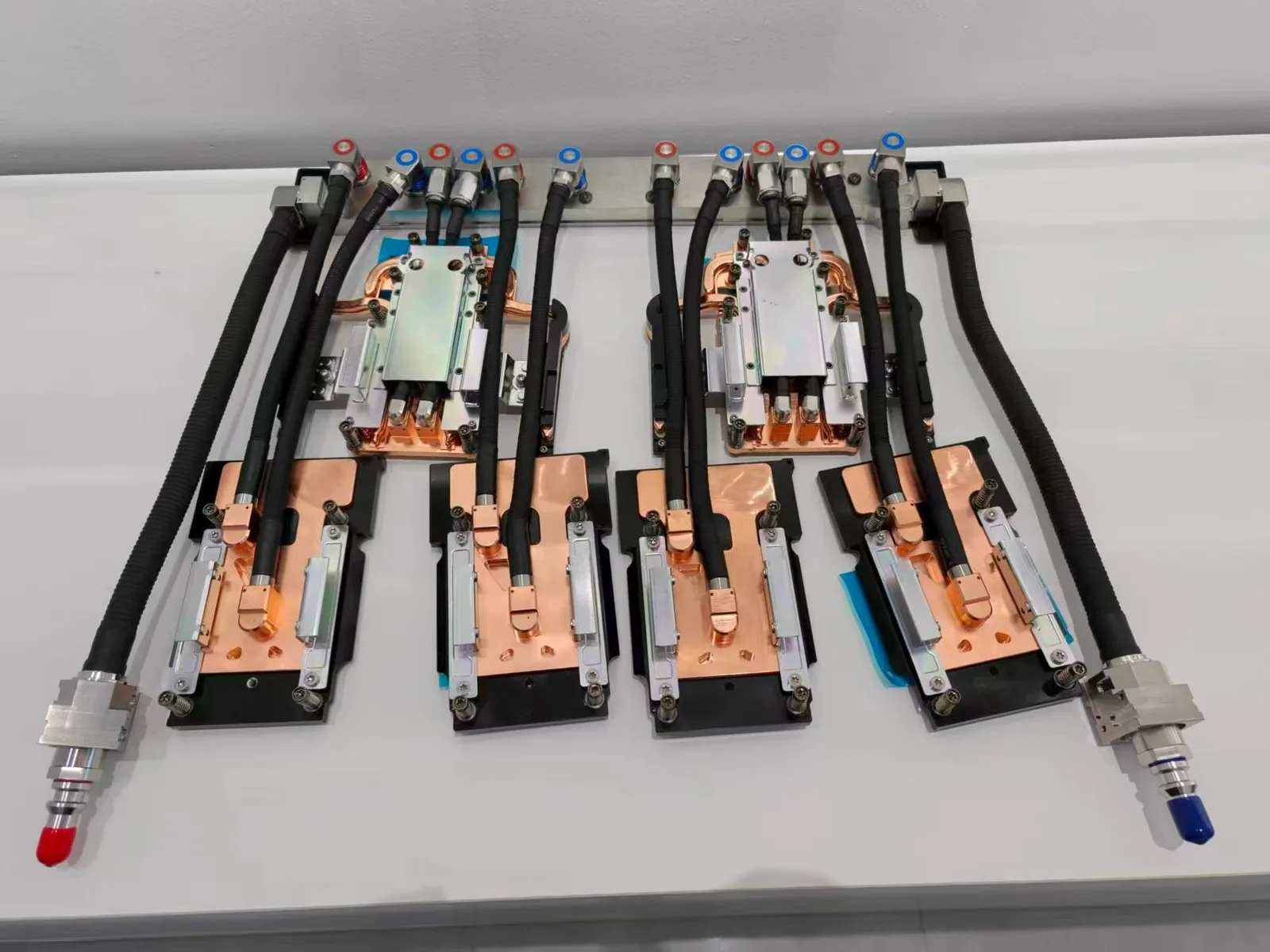
This simulation solution targets a server equipped with two high-power CPUs (70*50mm size), aiming to address all the above pain points through a Liquid Cooling System.

2. Key Simulation Inputs: Building an Accurate Model
A reliable simulation starts with the precise modeling of real-world conditions. The core input parameters of this solution provide a clear modeling reference for Thermal Design Engineers:
- Cooling Type: Water/Liquid Cooling System (Closed Loop)
- Ambient Temperature: 40°C (Simulating typical data center operating conditions)
- Coolant: 20% Ethylene Glycol Solution, Inlet Temperature 40°C
- System Flow Rate: 0.8 L/MIN
- Heat Source: 2 CPUs, Power Dissipation: 300W / 350W / 400W (Multi-scenario testing)
- Core Process: Brazing + Skiving (Ensuring high thermal conductivity and structural strength of the cold plate)
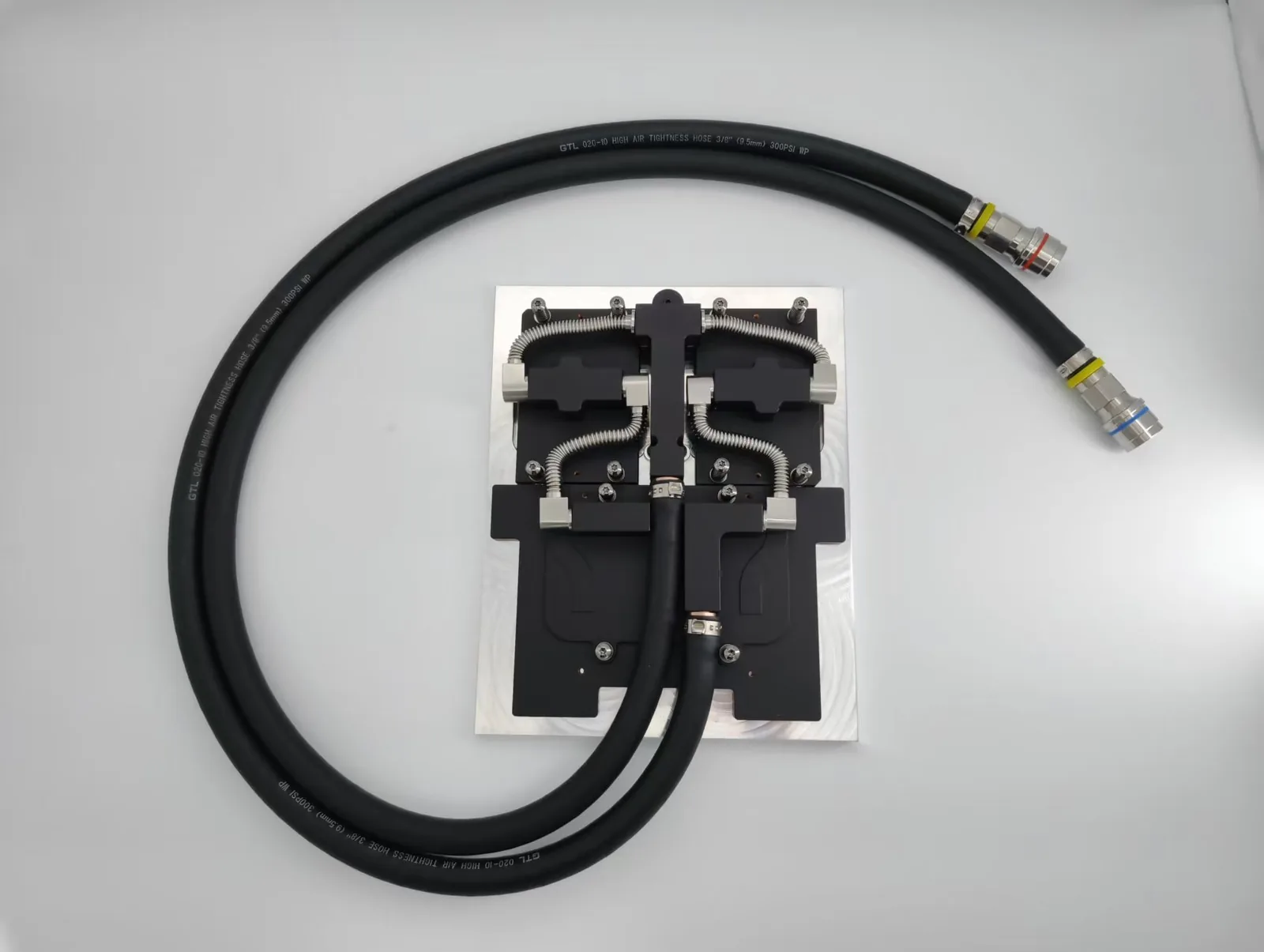
- Connection Method: Hose connection for the entire liquid cooling system

3. In-Depth Analysis of Simulation Results: Verifying Performance with Data
The simulation results comprehensively verify the effectiveness of this liquid cooling solution from three dimensions: Temperature Control, Flow Resistance Characteristics, and Velocity Distribution.
3.1 Temperature Control: Excellent Performance Under Multiple Power Scenarios
Temperature is the most critical indicator for Thermal Management Engineers. The performance of this solution under three power levels is as follows:
Power Scenario | Max Fluid Temp | ΔT (Inlet-Outlet) | CPU-1 Temp | CPU-2 Temp |
|---|---|---|---|---|
300W | 57.2°C | 11.2°C | 53.9°C | 59.6°C |
350W | 60.0°C | 13.0°C | – | 62.8°C |
400W | 62.9°C | 22.9°C | 58.6°C | 66.1°C |
Key Conclusion: Even under the most demanding 400W dual-CPU condition, the system successfully suppresses the maximum CPU temperature to 66.1°C, demonstrating the extreme efficiency of the liquid cooling path design.
3.2 Flow Resistance & Pressure Distribution: Key to System Energy Consumption
- System Max Pressure Drop: Pmax = 8.7 Kpa
- Analysis: The low flow resistance implies lower power requirements for the pump, helping to reduce the energy consumption and operating noise of the entire cooling system, which is crucial for optimizing the PUE (Power Usage Effectiveness) of data centers.
3.3 Velocity Distribution: Ensuring Uniform Heat Dissipation
- Max Velocity inside Cold Plate: ~1.06 m/s
- Analysis: The velocity contour shows the coolant is evenly distributed within the flow channels without dead zones, ensuring temperature uniformity on the cold plate surface and avoiding local hot spots.
4. Summary: Value and Insights for Thermal Design Engineers
This simulation report fully demonstrates that this Server Liquid Cooling Solution can efficiently handle high heat flux densities up to the 400W level at a 40°C ambient temperature, with low system flow resistance and reliable performance.
For your project, the value of this case study lies in:
- Solution Feasibility Verification: Provides solid data backing for applying cost-effective, high-efficiency liquid cooling solutions in high-power servers.
- Design Reference: Detailed parameters (e.g., ethylene glycol concentration, flow rate, process selection) provide key inputs for your preliminary design.
- Decision Support: Comparative data from multiple power scenarios helps you evaluate the system’s thermal performance under different loads and optimize product planning.
- Risk Mitigation: Predicting system pressure drop and temperature distribution in advance through simulation avoids costly design modifications and hardware damage risks later.

If you are looking for reliable solutions for the thermal management challenges of your next-generation servers, high-performance computing equipment, or industrial computers, our professional team can provide you with the same level of professional thermal simulation services and customized liquid cooling solutions.
Take Action Now, Let Our Professional Team Safeguard Your Product’s Thermal Performance!
👉 [Click to Contact Our Thermal Expert for a Free Technical Consultation]
👉 [Click to Download More Server Cooling Success Cases & Technical White Papers]
For industry standards and best practices, refer to ASHRAE thermal guidelines.
Overview
Does ToneCooling offer OEM and ODM services?
Yes. ToneCooling provides full OEM and ODM services including custom design, prototyping, thermal simulation, and volume production. We serve customers in North America, Europe, and Asia-Pacific with engineering support and samples within 4–6 weeks.
What materials are used in ToneCooling liquid cold plates?
ToneCooling manufactures cold plates in aluminum (6061/6063), copper (C1100/C1020), and stainless steel. Aluminum FSW cold plates are ideal for high-volume EV and industrial applications, while copper cold plates provide the highest thermal conductivity for high heat flux electronics.
What is the typical lead time for custom cold plates?
Prototype samples are delivered within 4–6 weeks. Production orders typically ship within 6–8 weeks after sample approval. An engineer reviews every RFQ and replies by email with next steps.
Get a Custom Thermal Solution from ToneCooling
ToneCooling is a professional liquid cooling solution provider specializing in custom cold plates, AIO coolers, and advanced thermal management systems. With ISO 9001 quality management and our own manufacturing facility in Huizhou, China, we deliver prototype samples typically within 4–6 weeks. Contact ToneCooling today for a free consultation and quote. An engineer reviews every RFQ and replies by email with next steps.
Related ToneCooling Resources
Industry References & Standards
Why Choose ToneCooling for Analysis Server Liquid Cooling
Engineering review and prototype planning are based on the project requirements. Custom prototype lead time is normally 4–6 weeks after drawing approval and order confirmation; confirm the production schedule in the quotation.
Building AI servers? See our standard GB300 4G+2C cold plate kit and GB200 cold plate kit, both supplied to published datasheets.
Need a Custom Liquid Cold Plate?
ToneCooling engineers review your drawings and requirements and reply by email with next steps.
Last updated: 2026-10-02