Abstract: In the journey toward building a resilient and smart power grid, the Insulated Gate Bipolar Transistor (IGBT), serving as the “heart” of power conversion and control, sees its heat dissipation efficiency directly determining the entire system’s reliability and efficiency. This article focuses intensely on the Cold Plate as a core thermal management component. It systematically elaborates on its application background, working principles, product characteristics, core value, and specific application scenarios within high-power IGBT equipment, revealing how it serves as a key enabling technology supporting the development of future power grid technologies through efficient thermal management.
Chapter 1: Introduction – The Thermal Challenge in Power Grid Technology and IGBT’s “Temperature Shackles”
With the advancement of the “Dual Carbon” goals and the deepening energy revolution, modern power systems are undergoing unprecedented changes. The rapid development of Power Grid Technologies such as High-Voltage Direct Current (HVDC) transmission, Flexible AC Transmission Systems (FACTS), large-scale integration of new energy sources, and electric vehicle fast-charging networks, all place demands for higher power, higher density, and higher efficiency – the “Three Highs” – on core power electronic equipment.
In this context, the IGBT, as the core switching device for power conversion, plays an irreplaceable role. However, IGBTs generate significant power losses during conduction and switching, almost all of which convert into heat. A stark reality is: The performance boundary of an IGBT is often determined not by its semiconductor characteristics, but by its heat dissipation capability.
If heat cannot be dissipated timely and efficiently, it will lead to:
- Junction Temperature Exceedance: Chip temperature (Tj) exceeding the critical value of 150°C-175°C, causing instantaneous thermal breakdown and permanent device failure.
- Performance Degradation: Rising temperature increases the conduction resistance, creating a vicious cycle of “increased heat generation → higher resistance → even more heat generation,” known as thermal runaway.
- Lifetime Reduction: Long-term operation at high temperatures, especially with frequent temperature cycling, causes mechanical failures like bond wire lift-off and solder layer fatigue due to mismatched coefficients of thermal expansion, leading to an exponential decrease in equipment lifespan.
Traditional air cooling technology has become inadequate in such applications with high heat flux density (often exceeding 100 W/cm²), as its cooling efficiency, noise, and volume have become bottlenecks. Consequently, Cold Plate Technology has emerged, breaking the “temperature shackles” of IGBTs with its revolutionary cooling efficiency and laying a solid foundation for the next leap in power grid technology.
Chapter 2: The Core Principle of Cold Plates for IGBT Cooling – The Science and Art of Active Heat Guidance
The essence of a Cold Plate is to construct a low thermal resistance, high-efficiency “superhighway” for the heat from the IGBT chip to the external environment. Its working principle is not passive absorption but active guidance and transportation of heat. The entire process can be refined into three core stages:
1. Heat Conduction: The “Capture” and “Collection” of Heat
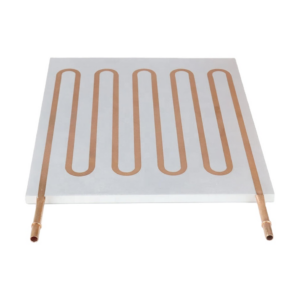
- First, the Cold Plate (typically made of high thermal conductivity materials like copper or aluminum alloy) achieves tight physical contact with the metal baseplate (typically a Direct Bonded Copper, DBC, substrate) of the IGBT module via thermal grease, gap pads, or direct soldering.
- The heat generated by the IGBT chip during operation is rapidly conducted through the DBC substrate and solder layers to the colder base of the cold plate. The cold plate acts as a “heat sink,” rapidly spreading the heat from point sources laterally, initially achieving temperature uniformity.
2. Convective Heat Transfer: The “Efficient Transport” of Heat
This is the of Cold Plate cooling technology and the key to its efficiency surpassing air cooling.
- Inside the cold plate, a series of complex microchannels or pin-fin structures are formed through precision machining (e.g., friction stir welding, brazing, etching).
- A coolant (typically a mixture of deionized water and ethylene glycol) is driven by an external circulation pump to undergo forced convection within these channels.
- As the low-temperature coolant flows past the channel walls heated by the cold plate base, the walls continuously transfer the captured heat to the coolant, raising its temperature.
- Because the liquid is forced to flow at high speed, there is always a fresh, cool coolant ready to “take over” the heat exchange, thereby achieving continuous, highly efficient “flushing” and “transportation” of heat. This forced convection-based heat transfer efficiency is orders of magnitude higher than relying solely on natural air convection or forced air cooling.
3. Heat Exchange: The “Final Release” of Heat
- The heated coolant, now carrying the heat from the IGBT chips, is pumped via tubing to the next component of the system – the Heat Exchanger.
- In the heat exchanger, the hot coolant transfers its heat to a secondary cooling medium (typically water or air), is cooled down itself, turns back into a cool liquid, and is driven by the pump back to the Cold Plate to start the next cycle.
- Ultimately, the heat is discharged into the atmosphere at the heat exchanger, completing the full thermal management cycle: “IGBT Chip → Cold Plate → Coolant → Heat Exchanger → Environment”.
Schematic of Principle Process:
[IGBT Chip Generates Heat] → (Heat Conduction) → [Cold Plate Base & Channel Walls] → (Convective Heat Transfer) → [Internal Coolant Heats Up] → (Pumped Out via Forced Circulation) → [External Heat Exchanger Releases Heat] → [Coolant Cools Down & Returns] → (Cycle Repeats)
Chapter 3: Product Characteristics of Cold Plates – The Embodiment of Superior Performance in Engineering
A high-performance Cold Plate is the physical embodiment that realizes the aforementioned efficient cooling principles. Its characteristics directly determine the system’s final performance.
1. Extremely High Heat Dissipation Efficiency and Thermal Conductivity
- Cold Plates use metal materials with thermal conductivity as high as 380 W/m·K (copper) or 200 W/m·K (aluminum), providing an excellent pathway for heat transfer.
- The internal microchannel design vastly increases the heat exchange area. Combined with high-flow-rate coolant, it can steadily handle extreme heat flux densities of 500 W/cm² or even higher, fully meeting the cooling demands of the latest generation SiC IGBTs.
2. Excellent Temperature Uniformity and Thermal Resistance Control
- The large-area metal baseplate can rapidly distribute heat generated by multiple chips within an IGBT module, eliminating “local hot spots” and controlling the surface temperature difference within a very small range (e.g., ±5°C).
- Through optimized structural design and interface materials, the Cold Plate can achieve very low thermal resistance from the chip junction to the coolant (Rth_j-c), which is the direct parameter ensuring the junction temperature does not exceed limits.
3. Compact Structure and High Integrability
- Cold Plates can be custom-designed according to the shape and size of the IGBT module, enabling compact fitting. This is highly suitable for high-power-density integrated equipment, such as converter cabinets and vehicle inverters where space is limited.
4. High Reliability and Long Service Life
- The use of integral molding, vacuum brazing, and other processes ensures channel sealing and eliminates leakage risks.
- The internal channels possess excellent corrosion resistance and anti-electrolysis capabilities, enabling adaptation to long-term, harsh industrial environments. Their lifespan matches or even exceeds that of the IGBT modules themselves.
Chapter 4: The Core Value of Applying Cold Plates in IGBT Equipment – Translating Technical Parameters into Business Benefits
Integrating advanced Cold Plate cooling solutions into IGBT equipment delivers value across the board.
1. Value One: Ultimate Reliability, Safeguarding the Power Grid Lifeline
- By enabling precise temperature control, Cold Plates ensure IGBT chips always operate within safe junction temperatures, fundamentally preventing sudden failures due to overheating.
- For critical infrastructure like the power grid, the value lies in significantly improving the system’s Mean Time Between Failures (MTBF), preventing regional power outages caused by failures in core conversion equipment, which carries enormous social and economic value.
2. Value Two: Unleashing Potential, Increasing Equipment Power Density
- The powerful cooling capacity allows designers to confidently operate IGBTs at higher working points or use smaller IGBT modules for the same power rating.
- This directly drives converters, inverters, and other equipment toward miniaturization, lightweight design, and higher efficiency, saving equipment footprint and reducing material costs.
3. Value Three: Cost Reduction and Efficiency Improvement, Optimizing Total Cost of Ownership
- By lowering the operating temperature of core components, Cold Plates can extend their service life multiple times, greatly reducing the frequency and cost of equipment maintenance and replacement.
- Although the initial investment might be higher than air cooling, the Total Cost of Ownership over a lifespan of ten or even twenty years is significantly lower. Simultaneously, improved system operating efficiency leads to continuous energy savings.
4. Value Four: Quiet Operation, Improving the Working Environment
- Compared to the significant noise generated by high-speed fans, the main noise sources in a Cold Plate system – the pump and radiator fans – are easier to control and isolate. This enables low-noise equipment operation, particularly suitable for environmentally sensitive locations like urban substations and indoor server rooms.
Chapter 5: Specific Application Scenarios of Cold Plates in Power Grid IGBT Equipment
Cold Plate technology is already widely applied across all stages of the power grid: “Generation, Transmission, Transformation, Distribution, and Utilization.”
1. Core Application: HVDC Converter Valves
- This is the crown jewel of Cold Plate technology. A converter valve station consists of thousands of stacked IGBT submodules with massive total power loss. Direct liquid cooling using Cold Plates is the only technology that can meet its heat dissipation requirements, ensuring the efficient transmission of electricity across vast distances.
2. Key Application: High-Power Converters for New Energy Generation
- In offshore wind farms and large-scale photovoltaic power stations, Cold Plates are widely used for cooling IGBTs in high-power wind turbine converters and PV inverters, guaranteeing stable grid integration and maximizing power generation efficiency.
3. Growing Application: High-Power Fast Charging Stations for Electric Vehicles
- As charging power moves toward 480kW and beyond, heat dissipation in charging modules becomes a bottleneck. The Cold Plate solution ensures IGBT power devices remain “cool” under ultra-high current output, serving as a key technological guarantee for achieving the user experience of “400 km of range in 5-10 minutes of charging.”
4. Foundational Application: Static Var Generators (SVG) and Active Power Filters (APF)
- The core IGBT power modules in these devices, used for improving power quality, also require Cold Plates to ensure reliability and lifespan during frequent, rapid reactive power compensation.
Chapter 6: Conclusion and Outlook
In summary, the Cold Plate is far more than a simple mechanical component; it is a systems engineering feat integrating materials science, fluid dynamics, precision manufacturing, and thermal management. Through the principles of efficient heat conduction and convective heat transfer, it actively provides “physical cooling” for the core checkpoint – the IGBT chip – on this “power superhighway,” breaking the performance and reliability constraints imposed by temperature.
In terms of value, the superior product characteristics of the Cold Plate directly translate into higher reliability, greater power density, lower lifecycle costs, and a better user experience for power grid equipment. From high-voltage transmission to new energy integration, and down to end-user fast charging, the application of Cold Plates is an inevitable choice and a key support for the evolution of power grid technology to higher levels.
Future Outlook: With the adoption of wide-bandgap semiconductors (like Silicon Carbide, SiC), the demands on heat dissipation will become even more stringent. Future Cold Plate technology will continue evolving toward integration with chip packaging, biomimetic channel design, functionalization of materials (e.g., high thermal conductivity composites), and system intelligence (integrating sensors and AI for predictive thermal management). It can be unequivocally stated that investing deeply in Cold Plate technology is tantamount to building a stronger and more durable “heart” for the future smart grid and energy intern
Ready to Unlock the Full Potential of Your Power Electronics?
The future of grid technology demands relentless performance and unwavering reliability. Don’t let thermal limitations be the bottleneck in your next-generation HVDC, renewable energy, or fast-charging projects.
Embrace the power of advanced Cold Plate technology.
Our cutting-edge cooling solutions are engineered to deliver the ultimate thermal performance your IGBTs demand, ensuring maximum power density, extended lifespan, and unparalleled system reliability.
Take the Next Step Today!
- Consult with Our Experts: Get a personalized analysis of your thermal challenges.
- Discover Our Products: Explore our range of high-performance cold plates designed for the most demanding applications.
- Download the Whitepaper: Dive deeper into the technical specifications and case studies.
Visit our website or contact us now to transform your thermal management strategy and build a cooler, more powerful future.
ToneCooling- Engineered for Excellence. Powered by Innovation.
For industry standards and best practices, refer to ASHRAE thermal guidelines.
| Parameter | ToneCooling Specification |
|---|---|
| Material | Copper T2 / 6061 aluminum |
| Welding method | Transient liquid phase diffusion welding |
| Test pressure | 1 MPa (helium leak + nitrogen hold) |
| Working medium | PG25 (25% propylene glycol) |
| Custom design | Yes — DXF/STEP input accepted |
Frequently Asked Questions — Igbt chip cooling
Does ToneCooling offer OEM and ODM services? — Igbt chip cooling
Yes. ToneCooling provides full OEM and ODM services including custom design, prototyping, thermal simulation, and volume production. We serve customers in North America, Europe, and Asia-Pacific with engineering support and samples within 4–6 weeks.
What materials are used in ToneCooling liquid cold plates? — Igbt chip cooling
ToneCooling manufactures cold plates in aluminum (6061/6063), copper (C1100/C1020), and stainless steel. Aluminum FSW cold plates are ideal for high-volume EV and industrial applications, while copper brazed cold plates provide maximum thermal conductivity (398 W/m·K) for high heat flux electronics.
What is the typical lead time for custom cold plates?
Prototype samples are delivered within 4–6 weeks. Production orders typically ship within 6–8 weeks after sample approval. ToneCooling engineers review all quote requests and reply with clear next steps.
Get a Custom Thermal Solution from ToneCooling
ToneCooling is a professional liquid cooling solution provider specializing in custom cold plates, AIO coolers, and advanced thermal management systems. With ISO 9001:2015 certified manufacturing, we deliver prototype samples within 4–6 weeks. Contact ToneCooling today for a free consultation and quote.
Industry References & Standards
Why Choose ToneCooling for Igbt Liquid Cold Plate Manufacturer
Engineering review and prototype planning are based on the project requirements. Custom prototype lead time is normally 4–6 weeks after drawing approval and order confirmation; confirm the production schedule in the quotation.
Last Updated: 2026-04-08
Need a custom igbt chip cooling solution?
ToneCooling engineers respond with CFD-validated thermal recommendations.
Related guides
- IGBT heat sink selection — air-cooled vs liquid cold plate
- IGBT pin fin heat sinks — selection guide
- IGBT liquid cold plates — custom power electronics cooling
- IGBT and SiC cold plates for industrial power — inverters and drives