Vapor Chamber Heat Pipe is a high-performance thermal management solution engineered by ToneCooling for demanding applications.
This comprehensive guide covers vapor chamber vs heat solutions for industrial and OEM applications. ToneCooling provides expert insights on vapor chamber vs heat technology and implementation.
Thermal management is key for modern electronics such as smartphones and laptops. Gaming consoles are also used for optimal performance and to avoid overheating-related damage. Vapor chambers and heat pipes are among the most innovative solutions and are two-phase devices that transfer heat efficiently.
Vapor chambers are extraordinary at spreading heat evenly across a flat, wide base plate, making them great for a vapor chamber CPU cooler (which deals with a large heat source). Heat pipes use heat copper to direct heat along a cylindrical axis to dissipate heat effectively to areas such as heat sinks.
This article compares vapor chamber cooling and heat pipe technology. The best systems and performance characteristics of each technology will be discussed. Understanding how these solutions move heat and deal with heat sources will help you determine the best thermal management solution.
What Is Vapor Chamber Heat Pipe?
The heat pipe is an innovative thermal management component that employs two-phase heat transfer by evaporation and condensation. In a heat pipe, latent heat is absorbed by the working fluid at the evaporator, vaporized, and then transported to the condenser. When heat must be moved from a heat source to a remote heat sink.
The vapor releases heat as it is being condensed into liquid and writes back to the evaporator to get the process started again. This continuous process protects the system from heat transport and ensures efficient temperature regulation.
Key Components
- Envelope: Typically a sealed and vacuum-tight outer casing made of high thermal conductivity materials.
- Wick Structure: It facilitates fluid return from the condenser to the evaporator.
- Working Fluid: Absorbs and dissipates heat via phase changes.
- Heat Input/Output: Enables heat transfer directly with heat source and sinks.
Typical Materials Used
- Superior thermal conductivity of copper for pipe structure.
- Better heat transport capacity with de-ionized water as the working fluid.
- Ammonia or acetone is liked for specific temperature ranges.
What are Vapor Chambers?
A vapor chamber is just a flat heat pipe with better heat spreading. Primarily they are aimed at dealing with multiple heat sources.
Vapor chambers allow for effective and uniform heat distribution across a flat surface. Producing uniform heat dissipation and interaction with a heat spreader when placed in direct contact with the heat source.
Structure and Materials
- Structural integrity and high thermal conductivity copper plates.
- A capillary circulation internal wick structure.
- Heat absorbing and transfer phase working fluid.
- Compact and space-saving designs through integrated thin vapor chambers.

What is the Difference between Heat Pipes and Voper Chambers?
Advanced cooling technologies like heat pipes and vapor chambers are used in electronics to manage heat. Each uses a phase change cooling mechanism but utilizes different heat transfer and the correct application.
Heat pipes carry heat from a localized hot spot to a surface over long distances. Vapor chambers spread heat from localized hot spots over a surface area. Because of these differences, they are suitable for various cooling demands including Vapor chamber CPU coolers and heat sinks for electronics cooling.
Heat Transfer Direction
- Heat Pipes: Because of this, they can transfer heat from one point to another but in only in one direction making them ideal for linear heat transfer setups. For example, they are used to transport heat from the far end of a heat pipe and to a remote heat sink.
- Vapor Chambers: Provides two or more directions of spreading heat over a surface area. To meet the problem of high power densities, a single vapor chamber is designed to distribute heat evenly, for example, in vapor chamber CPU coolers.
Distance
- Heat Pipes: Efficient at long distances (beyond 50 mm or ~2 inches). Their performance in applications where heat must be removed from a heat source is excellent.
- Vapor Chambers: Directly mounted to the heat source and operated to spread heat locally, without transportation over great distances.
Applications
- Heat Pipes: Appropriate for applications with power densities below 25 W cm^-2, as is typical in less severe electronics cooling.
- Vapor Chambers: A prime use is in applications with power densities up to 50 W/cm2, such as high-performance electronics or CPUs.
How Heat Pipes and Vapor Chambers Differ in Performance?
The performance difference between heat pipes and vapor chambers is quite evident, and both are extremely efficient at heat transfer and have complementary advantages. The efficiency of heat pipes is better utilized in smaller, localized applications. When a particular heat source needs high thermal conductance.
Vapor chambers shine when you are trying to spread the heat out over a larger area, thus resulting in excellent heat diffusion and higher heat-carrying capacity. The application-specific requirements, like heat load, area of heat source, and desired thermal efficiency, define the choice between a heat pipe or vapor chamber.
1. Heat Pipe Performance
- High Conductance: Heat pipes are known for their high thermal conductivity, ensuring rapid heat transfer from the heat source to the heat sink.
- Flexible Design: Heat pipes can be adapted to various forms and sizes, making them a versatile option for different cooling needs.
Drawbacks:
- Thickness Dependency: The performance of heat pipes can be compromised if the design requires significant thickness.
- Reduced Efficiency with High Heat Sources: Heat transfer efficiency decreases when the heat source is exceptionally high.
- Limited Diffusion Area: Heat pipes are less effective at diffusing heat over larger areas than vapor chambers.
2. Vapor Chamber Performance
- Superior Heat Distribution: Vapor chambers are designed to spread heat uniformly over a large area, making them ideal for cooling larger heat sources.
- Thin Profile: Unlike heat pipes, vapor chambers can be manufactured with a thin profile, making them more compact and lightweight.
- Effective with High Heat Load: Vapor chambers maintain excellent efficiency even when subjected to high heat inputs.
Drawbacks:
- Higher Cost: Vapor chambers are more expensive than heat pipes due to their complex manufacturing process.
- Limited Design Shape: Their design is generally restricted to a planar shape, which may limit their adaptability in some use cases.
3. Performance Comparison
- Heat Carrying Capacity: Vapor chambers can manage a much higher heat load than heat pipes. A vapor chamber designed for cooling can handle up to 450 watts of power. The most robust heat pipes max out at around 125 watts in horizontal configurations.
- Isothermality: Vapor chambers maintain a consistent temperature across the heat sink, reducing temperature variation and ensuring better isothermal performance than heat pipes.
Practical Comparison: Vapor Chamber vs Heat Pipe
1. Thermal Conductivity
- Heat pipes are highly efficient in transporting heat along their axis, making them the choice when heat needs to be moved over distances.
- Vapor chambers, designed for planar applications, provide effective heat spreading, minimizing thermal gradients. For tasks like vapor chamber cooling they perform better in scenarios requiring uniform heat dissipation across compact or high-density components.
2. Design Flexibility
Heat pipes can be bent and installed in almost any direction, giving them high design flexibility. This allows them to be used alone, in groups, or in various positions, making them well-suited for systems where heat must travel through complex or non-linear paths. This flexibility is especially valuable when direct heat transfer from the heat source is difficult.
In contrast, vapor chambers are mainly limited to flat layouts due to their structure formed by two stamped plates. However, Their adaptability depends more on tailored dimensions than on physical bending. They offer flexibility through custom sizing and shaping to fit the available space. Overall, heat pipes remain more versatile in directional flexibility, while vapor chambers rely on customization to accommodate different layouts.
- Heat pipes are made to adapt to curved or complex pathways, ideal for irregular or non-linear designs.
- Vapor chambers are limited to flat structures but excel in large-area cooling applications, such as a single vapor chamber designed for processors.
3. Size
From a size perspective, vapor chambers offer a distinct structural advantage over heat pipes. Heat pipes are typically tubular and can be flattened to some extent, but their internal structure limits how thin and wide they can become.
Bending heat pipes to cover a larger surface can further restrict internal fluid flow, reducing thermal efficiency. Using multiple bent heat pipes not only increases the overall thickness but also makes it difficult to achieve uniform heat spreading.
In contrast, vapor chambers are specifically designed to be both ultra-thin and wide. Their flat, plate-like structure allows efficient, even heat distribution across large surfaces without adding bulk. This makes vapor chambers the preferred solution in compact systems where low profile and broad thermal coverage are essential.
Vapor chambers are clearly better suited than heat pipes for creating ultra-thin, wide-area thermal designs.

4. Durability and Reliability
- Heat pipes are robust in dynamic environments where the heat to a remote heat sink must be transported across varying orientations.
- Compared to vapor chambers, they are less sensitive to external pressure. Vapor chambers, however, provide consistent performance under high heat loads, even when embedded heat is intense.
5. Cost
Heat pipes are generally the most economical choice, particularly when a single tube can meet the thermal requirement, thanks to their simple, well-established manufacturing process.
By contrast, a vapor chamber is built from two precision-machined copper or aluminum plates that must be perfectly aligned, bonded, and hermetically sealed. Inside, a sintered or mesh wick adds further complexity. These steps raise drive up overall manufacturing cost.
Although recent one-piece vapor chamber designs have narrowed the price gap, heat pipes still offer the lowest cost in most mainstream applications.
- Due to simpler manufacturing, heat pipes are more cost-effective for basic thermal needs.
- Vapor chambers, while pricier, are justified for high-performance systems requiring vapor chamber heat solutions to handle intense workloads efficiently.
Vapor Chamber vs Heat Pipe: Applications
Heat pipes and vapor chambers are both important enablers of thermal management across industries, solving different design needs within the constraints of performance requirements.
They are used in applications from consumer electronics to aerospace, where efficient heat transfer and dissipation are guaranteed in such disparate situations.
1. Consumer Electronics
Heat pipes and vapor chambers are crucial to keep performing in devices like smartphones, laptops, and gaming consoles. Vapor (two phase) chamber cooling spreads the heat to the copper heat spreader and distributes it evenly, especially in compact designs.
For instance, a vapor chamber CPU cooler can qualify for high thermal loads, followed by a heat sink design with a larger surface area to dissipate more heat into the air.g performance. Vapor chamber cooling efficiently spreads heat across the copper heat spreaders, ensuring even dissipation, particularly in compact designs.
For example, a vapor chamber CPU cooler can handle high thermal loads, spreading heat across larger heat sink designs. Heat pipes transport heat from hotspots such as CPUs and GPUs with a more directed approach to heat sinks.
2. Industrial Equipment
Vapor chambers and heat pipes are the basis of data centers and power electronics for managing large heat loads. Heat removal from densely packed components is typically achieved using a multiple heat pipe configuration.
Vapor chambers are used instead to spread heat uniformly across the high-performance server processors while maximizing effective heat dissipation and minimizing hot spots. Remove heat from densely packed components.
Meanwhile, vapor chambers generally spread heat uniformly across high-performance server processors, optimizing effective heat dissipation and minimizing hot spots.
3. Wearable Devices
Thin Vapor chambers are mainly used in AR devices, fitness trackers, and other portable wearables due to their efficient heat transfer and superior comfort in limited spaces.
Vapur chambers outperform heat pipes. Unlike heat pipes, vapor chambers are not flexible, which provides consistent performance regardless of the position of the cooling device.
4. Aerospace and Automotive
Heat pipes are critical to aerospace and automotive systems as they perform complex thermal challenges within shell volumes.
Their flexibility guarantees that they can be shaped to fit a car’s or an aircraft’s design. Pipes transfer heat from the critical parts like avionics or EV batteries where needed, thus maintaining dependability.

Conclusion
Bothr chambers and heat pipes are effective in thermal management, alb to a certain extenteit differing in their respective particulars. Because of their simplicity and ease of use, heat pipes are remarkably effective in transferring heat over moderate distances.
However, vapor chamber cooling technology offer unparalleled temperature moderation as they can be used when the temperature must be dispersed evenly throughout. The balance between these technologies is solely based on the thermal needs of your application to determine the geometry, heat load, and space limitations.
With ongoing advancements in technology, the suggestion is that the evolution of thermal solutions is bound to bring forth new innovative techniques to manage heat across several industries.
If you’re seeking high-performance cooling solutions, Tone Cooling provides both standard and custom vapor chambers designed for efficient heat spreading in space-constrained applications. Contact us today to discuss your thermal management needs.
For industry standards and best practices, refer to Electronics Cooling.
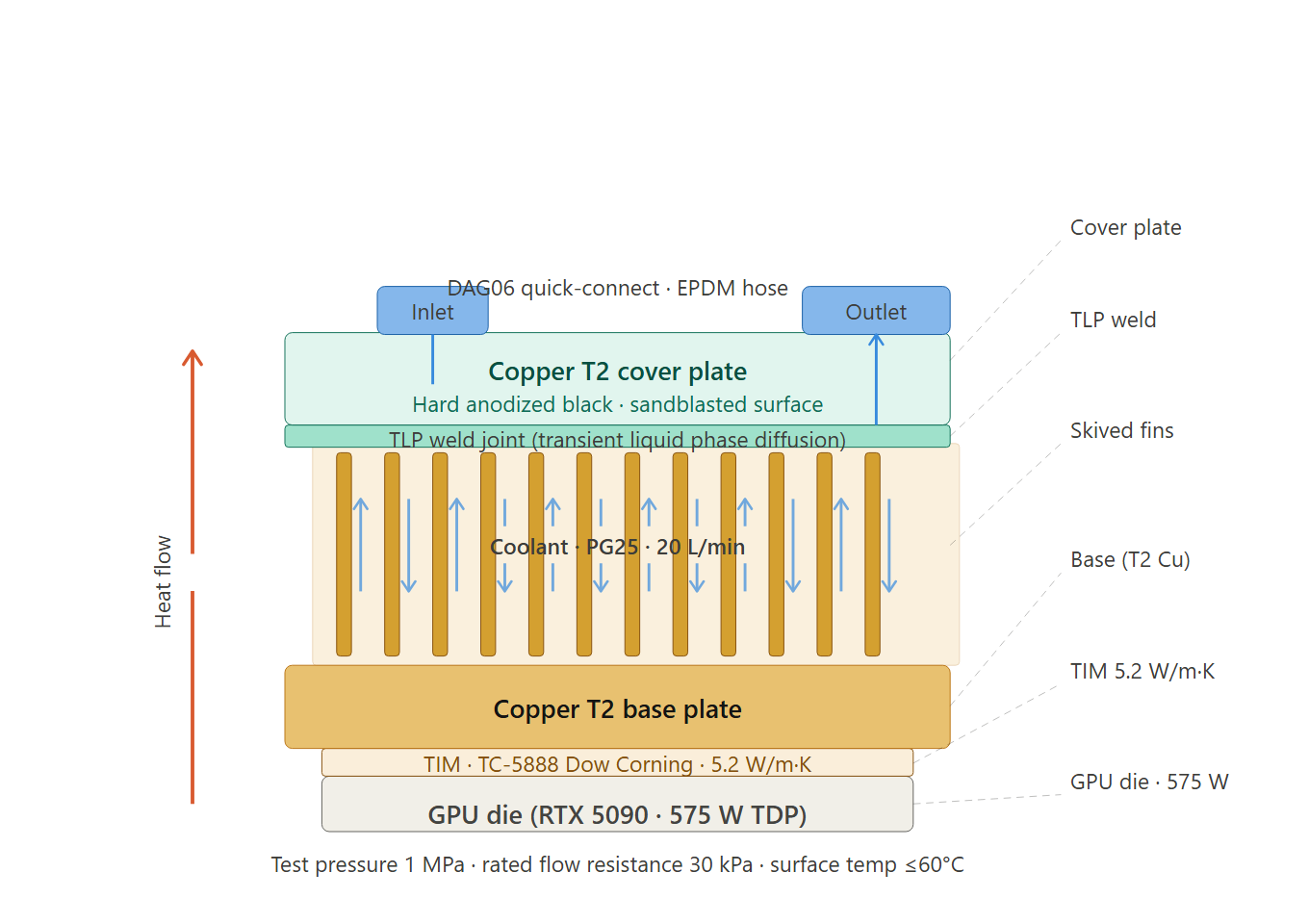
| Parameter | ToneCooling Specification |
|---|---|
| Material | Copper T2 / 6061 aluminum |
| Welding | TLP diffusion welding |
| Test pressure | 1 MPa (He leak + N₂ hold) |
| Coolant | PG25 (25% propylene glycol) |
| Custom design | Yes — DXF/STEP accepted |
Frequently Asked Questions
Does ToneCooling offer OEM and ODM services?
Yes. ToneCooling provides full OEM and ODM services including custom design, prototyping, thermal simulation, and volume production. We serve customers in North America, Europe, and Asia-Pacific with engineering support and samples within 2–4 weeks.
How does a vapor chamber differ from a heat pipe?
A vapor chamber spreads heat in two dimensions across a flat surface, while a heat pipe transfers heat along a single axis. Vapor chambers are ideal for high heat flux applications like GPU cooling where uniform heat spreading is critical.
What is the maximum heat flux a vapor chamber can handle?
ToneCooling vapor chambers handle heat fluxes up to 100 W/cm² with effective thermal conductivity exceeding 10,000 W/m·K. Performance depends on wick structure, working fluid, and chamber geometry.
Get a Custom Thermal Solution from ToneCooling
ToneCooling is a professional liquid cooling solution provider specializing in custom cold plates, AIO coolers, and advanced thermal management systems. With ISO 9001:2015 certified manufacturing, we deliver prototype samples within 2–4 weeks. Contact ToneCooling today for a free consultation and quote — we respond within 24 business hours.
References: ASHRAE thermal standards, Wikipedia: Heat Sink Technology
Vapor Chamber Vs Heat Pipe is a critical component in modern thermal management. ToneCooling engineers this solution for AI servers, data centers, EV batteries, and power electronics requiring high-performance liquid cooling.
Why Choose ToneCooling for Vapor Chamber Vs Heat Pipe
ToneCooling has manufactured over 50,000 vapor chamber vs heat pipe units for global OEM customers. Our vapor chamber vs heat pipe production features vacuum brazing furnaces below 10⁻⁴ mbar, FSW machines with ≤0.02mm flatness, and helium leak detection at 10⁻⁸ mbar·L/s. Every vapor chamber vs heat pipe undergoes 100% pressure testing at 25 bar.
Our engineering team provides free vapor chamber vs heat pipe design consultation, CFD simulation, and rapid prototyping in 7-14 days. Production vapor chamber vs heat pipe orders ship in 4-6 weeks under ISO 9001:2015 quality management.
Last Updated: 2026-04-08
DR Kevin, Thermal Engineer, ToneCooling
Need a custom vapor chamber heat pipe solution?
ToneCooling engineers respond within 24 hours with CFD-validated thermal recommendations.