Guangdong, China
Global Engineering RFQ Review

Custom Copper Heatsink Design Guide: CNC vs Skived vs Brazed (2026)

Table of Contents

A custom copper heatsink is a purpose-engineered thermal management component machined or fabricated from copper alloys to match the exact thermal, dimensional, and mounting requirements of a specific electronic component or system. Unlike off-the-shelf copper heatsinks with fixed dimensions, custom designs are tailored for optimal thermal resistance in the available space envelope – achieving 0.15–0.50°C/W depending on geometry, airflow, and manufacturing process. ToneCooling manufactures custom copper heatsinks via CNC machining (prototype MOQ 5 pcs, 5–10 days), skiving (production MOQ 500 pcs), and vacuum brazing (micro-channel cold plates MOQ 50 pcs), all under ISO 9001 certified quality.

Last Updated: 2026-04-09 | Author: ToneCooling Thermal Engineering Team

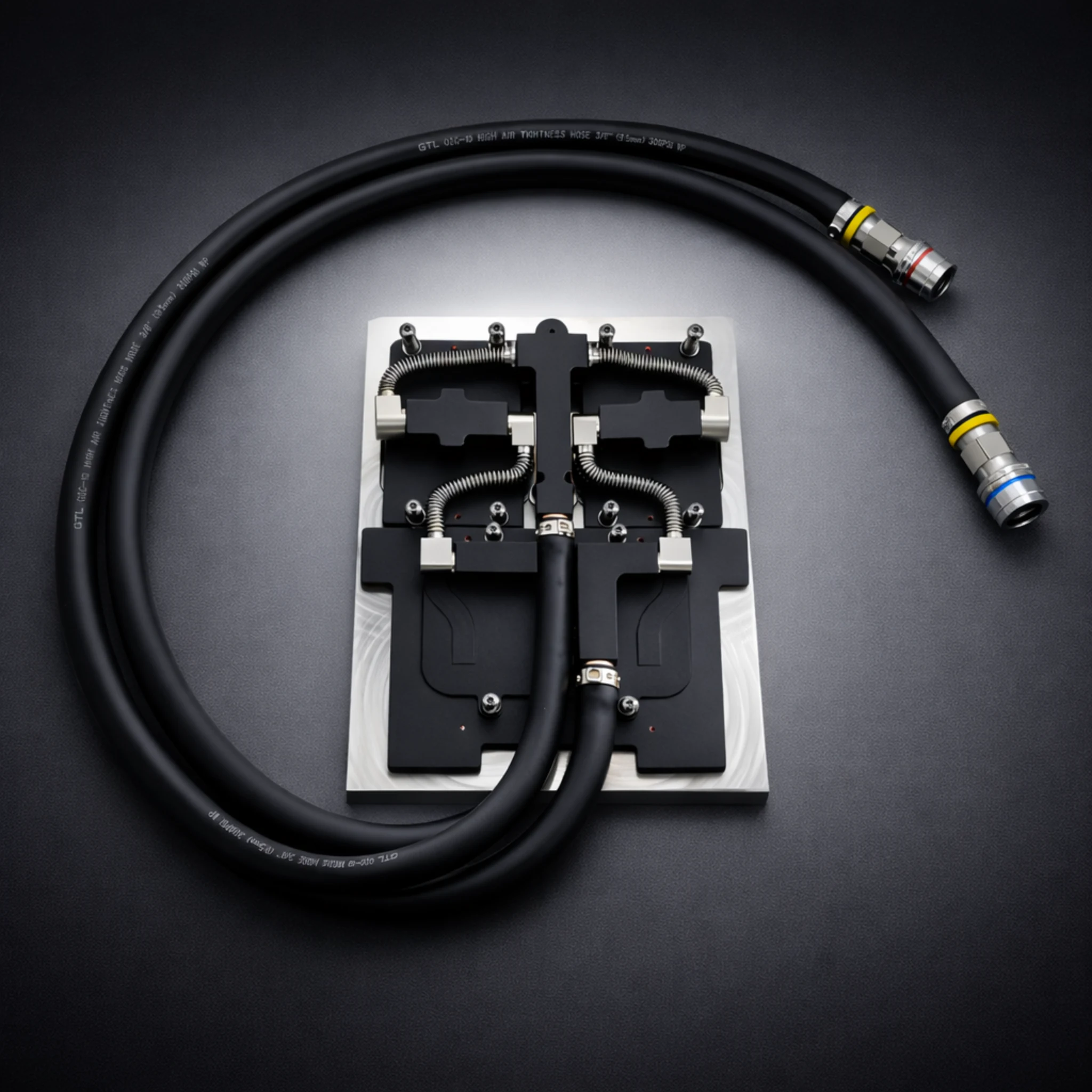
Custom copper heatsink liquid cold plate manufactured by ToneCooling
Custom copper heatsink: vacuum-brazed micro-channel liquid cold plate by ToneCooling for IGBT power module cooling

When Do You Need a Custom Copper Heatsink?

Standard catalog heatsinks work for common applications, but custom copper designs become necessary when:

  • Non-standard component footprint: Proprietary ASIC, FPGA, or multi-chip module layout that no catalog product fits
  • Extreme thermal requirements: Heat flux >50 W/cm² or thermal resistance <0.2°C/W where aluminum cannot perform
  • Height or weight constraints: Ultra-compact enclosures (1U servers, handheld devices) where every mm of height matters
  • Integration requirements: Heat sink must incorporate mounting hardware, fluid ports, or electrical isolation into a single component
  • OEM branding: Custom surface finish, logo engraving, or color for retail product differentiation

3 Manufacturing Processes for Custom Copper Heatsinks

Process 1: CNC Machining – Best for Prototypes and Complex Geometry

CNC machining cuts copper heatsink features directly from solid billet using 3-axis or 5-axis milling. ToneCooling CNC specifications:

ParameterSpecification
MaterialC1100, C1020, C1220
Tolerance±0.02mm
Min fin thickness0.5mm
Max fin aspect ratio8:1
Surface finishRa 0.8–3.2 μm
MOQ5 pieces
Lead time5–10 business days
Cost range$20–100/unit
CNC machined custom copper heatsink vs aluminum comparison
CNC machined copper (left) vs aluminum (right) heatsink – copper achieves lower thermal resistance in identical geometry

Process 2: Skiving – Best for High-Density Fins in Production Volume

Skiving peels ultra-thin fins from a solid copper block using a precision blade, creating monolithic fin arrays with aspect ratios up to 30:1 – impossible to achieve with CNC machining. ToneCooling skiving specs:

  • Fin thickness: 0.2–0.5mm (vs CNC minimum 0.5mm)
  • Fin height: up to 60mm
  • Fin pitch: 1.0–3.0mm
  • Thermal performance: 20–30% better than CNC equivalent (more surface area)
  • MOQ: 500 pieces, 3–4 weeks
  • Best for: Server CPU coolers, GPU heatsinks, telecom equipment

Process 3: Vacuum Brazing – Best for Micro-Channel and Liquid Cooling

Vacuum brazing joins multiple copper layers into sealed micro-channel structures for liquid cold plates and embedded heat pipe assemblies. ToneCooling vacuum brazing:

  • Furnace vacuum: 10⁻&sup4; Pa
  • Channel width: 0.15–2.0mm
  • Alloy: C1020 OFC required (oxygen content <10 ppm)
  • Leak testing: Helium mass spectrometry, 10⁻&sup9; Pa·m³/s
  • MOQ: 50 pieces, 2–3 weeks
  • Best for: IGBT liquid cold plates, laser diode coolers, vapor chambers

Custom Copper Heatsink Design Workflow at ToneCooling

  1. Submit requirements: Component datasheet, power dissipation, ambient temperature, space envelope, airflow conditions
  2. ToneCooling thermal analysis (free): CFD simulation to determine optimal fin geometry, base thickness, and cooling approach
  3. Design review: 3D model and thermal report delivered within 48 hours for your review
  4. Prototype: CNC machined copper prototype delivered in 5–10 days (MOQ 5 pcs)
  5. Validation: Thermal testing with IR imaging and thermocouple measurements
  6. Production: Transition to skiving or brazing for volume. Tooling cost: $500–3,000 depending on complexity
Custom copper and AlSiC heatsink for IGBT modules by ToneCooling
ToneCooling custom copper and AlSiC thermal solutions for IGBT power electronics

Custom Copper Heatsink Surface Finish Options

FinishThicknessPurposeEmissivity
Electroless Nickel5–15 μmCorrosion protection, solderability0.05
Electrolytic Nickel10–25 μmHeavy-duty corrosion protection0.05
Black Nickel5–10 μmImproved radiation + appearance0.75
Tin Plating5–15 μmSolderability for reflow assembly0.05
Gold Plating0.5–2 μmWire bonding, high-reliability contacts0.02
Bare Copper (passivated)N/AMaximum thermal contact (temporary)0.05

About ToneCoolingCooling

ToneCooling (Guangdong ToneCooling Precision Manufacturing Co., Ltd.) is a National High-Tech Enterprise founded in 2004 in Dongguan, China. New 30,000m² factory (RMB 80M investment) with 80+ CNC machines, 3 FSW systems, vacuum brazing furnaces including 1.2M×68M tunnel brazing line. 200+ employees (40%% technical), 46 patents (14 invention + 32 utility). Certified: ISO 9001 + ISO 14001 + IATF 16949. R&D partnerships with Tsinghua University, NUDT, HUST. Global: ToneCooling Texas LLC (USA), ToneCooling Australia Pty Ltd.

Request Custom Copper Heatsink Quote

Send your thermal challenge to ToneCooling. Free CFD simulation + design recommendation within 48 hours. From 5-piece prototypes to 50,000+ production.

➔ Get Custom Copper Heatsink Quote (48h)  |  info@tonecooling.com  |  US: +1 (832) 720-7542

References: Copper Development Association | ISO 9001:2015 Quality Management

Frequently Asked Questions: Custom Copper Heatsink

How long does it take to get a custom copper heatsink prototype?

ToneCooling delivers CNC machined copper prototypes in 5–10 business days at MOQ 5 pieces. This includes nickel plating and dimensional inspection. Express 3-day delivery available for urgent projects.

What is the thinnest fin achievable in a copper heatsink?

CNC machining: minimum 0.5mm fin thickness. Skiving: 0.2mm fin thickness at aspect ratios up to 30:1. Vacuum-brazed micro-channels: 0.15mm wall thickness. ToneCooling offers all three processes.

Is a custom copper heatsink worth the cost vs aluminum?

Yes, when heat flux exceeds 30 W/cm² or space is severely constrained. Copper achieves equivalent cooling in 40–60% less volume than aluminum. The 3–4x higher material cost is offset by reduced system size, fewer fans, and higher reliability.

Can copper heatsinks be used with liquid cooling?

Yes. Vacuum-brazed copper micro-channel cold plates achieve thermal resistance below 0.05°C/W for the most demanding applications. ToneCooling manufactures copper liquid cold plates for IGBT, GPU, CPU, and laser cooling.

What copper alloy is best for custom heatsinks?

C1100 (ETP copper, 391 W/m·K) for 90% of applications. C1020 (OFC, 394 W/m·K) for vacuum brazing and vapor chambers. C1220 (DHP) for plumbing-grade heat exchangers. ToneCooling recommends based on your specific requirements.


Picture of ToneCooling Engineering Team

ToneCooling Engineering Team

The ToneCooling thermal engineering team designs, simulates, and validates custom liquid cold plates for GPU, CPU, IGBT, and EV battery applications.

Welcome To Share This Page:
Product Categories
Latest News
Get A Free Quote Now !
Quote Request

Related Products

Related News

Drawing preparation checklist for data center liquid cold plate quotation, covering CAD files, heat source maps, port layout, material and validation inputs.
Validation items engineers should define before requesting a data center liquid cold plate quote, including leak test, pressure test, cleanliness and documentation.
Copper and aluminum cold plate tradeoffs for AI server projects, including thermal performance, weight, corrosion, joining route and RFQ inputs.
Engineering checklist for direct-to-chip cold plate port layout, hose clearance, serviceability and RFQ preparation in AI server cooling projects.
How to prepare pressure-drop and flow-rate inputs for custom GPU liquid cold plate RFQs used in AI server and data center cooling projects.
RFQ inputs engineers should prepare for data center GPU cold plates, including drawings, heat load, coolant, flow rate, pressure-drop target and validation requirements.

ToneCooling (Guangdong ToneCooling Precision Manufacturing Co., Ltd.) has completed its new 30,000m² manufacturing facility in Dongguan, Guangdong, China — an

An FSW liquid cold plate (friction stir welded liquid cold plate) is a sealed thermal management heat exchanger manufactured by

Scroll to Top

Get A Free Quote Now !

If you have any questions, please do not hesitate to contact us.

Quote Request
ToneCooling 19 thermal management
(function () { 'use strict'; if (window.tcDataCenterV14TrackingLoaded) return; window.tcDataCenterV14TrackingLoaded = true;var SITE_MARKET = 'global'; var TARGET_SEGMENT = 'data_center_gpu_cpu'; var TRACKED_FORM_IDS = ['3', '4']; var PAGE_PATH = '/liquid-cold-plates/data-center-liquid-cold-plate/'; var THANK_YOU_PATH = '/thank-you/data-center-cold-plate-rfq/'; var DEBUG = /(?:\?|&)tc_debug=1(?:&|$)/.test(window.location.search); var formStarted = false; var formSubmitted = false;function cleanPath() { return window.location.pathname || '/'; }function matchedFormId(form) { var idStr = String((form && (form.getAttribute('data-form_id') || form.id)) || ''); for (var i = 0; i < TRACKED_FORM_IDS.length; i++) { if (idStr.indexOf(TRACKED_FORM_IDS[i]) !== -1) return TRACKED_FORM_IDS[i]; } if (form && form.querySelector('[name="gpu_cpu_footprint"]')) return '4'; return null; }function pushEvent(name, payload) { payload = payload || {}; payload.site_market = SITE_MARKET; payload.target_segment = TARGET_SEGMENT; payload.form_id = payload.form_id || '4'; payload.page_path = payload.page_path || (isThankYouPath() ? THANK_YOU_PATH : cleanPath()); if (DEBUG) payload.debug_mode = true; if (typeof window.gtag === 'function') { window.gtag('event', name, payload); } else { window.dataLayer = window.dataLayer || []; window.dataLayer.push(Object.assign({ event: name }, payload)); } try { window.dispatchEvent(new CustomEvent('tc_inquiry_tracking_event', { detail: { name: name, payload: payload } })); } catch (err) {} if (DEBUG && window.console && window.console.info) { window.console.info('[TC Data Center V1.4 Tracking]', name, payload); } }function closest(el, selector) { while (el && el.nodeType === 1) { if (el.matches && el.matches(selector)) return el; el = el.parentElement; } return null; }function isThankYouPath() { var path = cleanPath(); var search = window.location.search || ''; return path.indexOf('/thank-you') === 0 || /(?:\?|&)page_id=9601(?:&|$)/.test(search); }function fileTypeCategory(file) { var name = file && file.name ? String(file.name).toLowerCase() : ''; var ext = (name.match(/\.([a-z0-9]+)$/) || [])[1] || ''; if (['step', 'stp', 'igs', 'iges', 'x_t', 'x_b', 'sldprt', 'sldasm', 'stl'].indexOf(ext) !== -1) return 'cad'; if (['dwg', 'dxf'].indexOf(ext) !== -1) return 'cad'; if (ext === 'pdf') return 'pdf'; if (['jpg', 'jpeg', 'png', 'webp'].indexOf(ext) !== -1) return 'image'; if (['xls', 'xlsx', 'csv'].indexOf(ext) !== -1) return 'spreadsheet'; return 'other'; }function valueExists(form, name) { var field = form ? form.querySelector('[name="' + name + '"]') : null; return !!(field && String(field.value || '').trim()); }function qualityBand(form) { var score = 0; var fileInput = form ? form.querySelector('input[type="file"]') : null; if (valueExists(form, 'company') && valueExists(form, 'email')) score += 25; if (valueExists(form, 'application')) score += 20; if (fileInput && fileInput.files && fileInput.files.length) score += 20; if (valueExists(form, 'heat_load') || valueExists(form, 'coolant_type') || valueExists(form, 'flow_target') || valueExists(form, 'pressure_drop_limit')) score += 15; if (valueExists(form, 'prototype_quantity') || valueExists(form, 'annual_volume')) score += 10; if (valueExists(form, 'target_schedule') || valueExists(form, 'country_region')) score += 10; if (score < 40) return '0-39'; if (score < 60) return '40-59'; if (score < 80) return '60-79'; return '80-100'; }document.addEventListener('click', function (event) { var link = closest(event.target, 'a[data-event="cta_click"], a[data-cta-label], .tc-data-center-hero a'); if (!link) return; pushEvent('cta_click', { cta_label: link.getAttribute('data-cta-label') || (link.textContent || '').replace(/\s+/g, ' ').trim() || 'data_center_cta' }); }, true);document.addEventListener('focusin', function (event) { var form = closest(event.target, 'form'); if (!form || formStarted) return; var fid = matchedFormId(form); if (!fid) return; formStarted = true; pushEvent('form_start', { form_id: fid }); }, true);document.addEventListener('change', function (event) { var input = event.target; var form = closest(input, 'form'); if (!input || input.type !== 'file' || !form || !input.files || !input.files.length) return; pushEvent('file_upload', { upload_used: 'yes', file_type_category: fileTypeCategory(input.files[0]) }); }, true);document.addEventListener('submit', function (event) { var form = closest(event.target, 'form'); if (!form || formSubmitted) return; var fid = matchedFormId(form); if (!fid) return; formSubmitted = true; pushEvent('form_submit', { form_id: fid, rfq_quality_score_band: qualityBand(form) }); }, true);if (isThankYouPath()) { pushEvent('thank_you_page_view', { page_path: THANK_YOU_PATH }); } }());