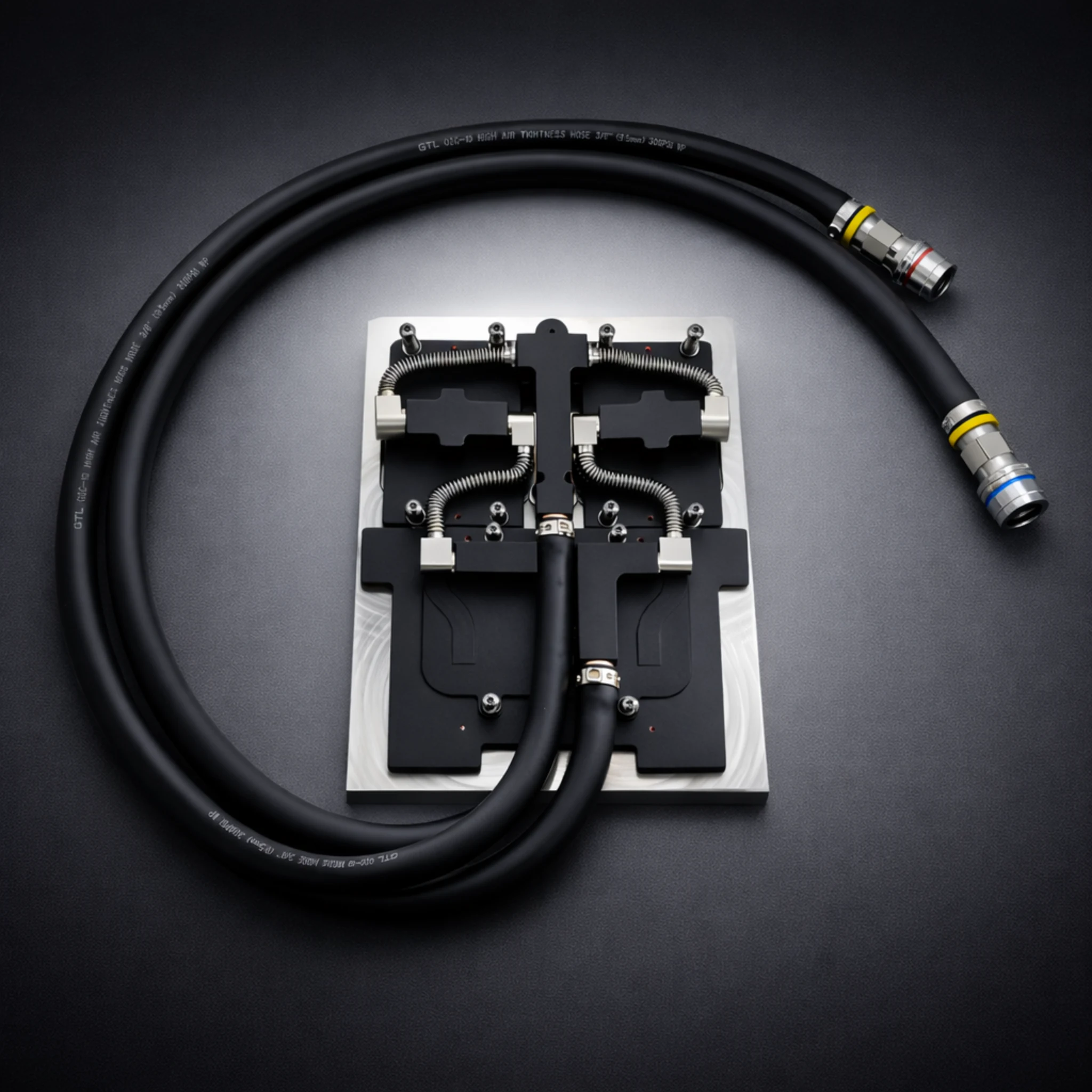
Choose Liquid Cold Plate Manufacturer is a high-performance thermal management solution engineered by ToneCooling for demanding applications.
Choosing a liquid cold plate manufacturer is a decision that affects your product’s thermal performance, production timeline, and total cost for years. Whether you’re sourcing cold plates for AI GPU servers, EV battery packs, or IGBT power modules, these 7 criteria separate reliable suppliers from the ones that will cause schedule delays and quality escapes.
The 7 Criteria That Matter Most
1. In-House Manufacturing Capability
The most important question: does the manufacturer actually make cold plates, or do they outsource machining and brazing to subcontractors? Outsourced manufacturing means:
- Longer lead times (add 1–2 weeks for subcontractor scheduling)
- Less quality control (the “manufacturer” is really a trading company)
- Higher costs (middleman markup on every process step)
What to verify: Ask for factory photos showing CNC machining centers, vacuum brazing furnaces, and FSW equipment. Request a virtual factory tour. If they can’t show their own equipment, they’re likely outsourcing.
2. ISO 9001 / IATF 16949 Certification
ISO 9001 is the minimum quality management standard. For automotive applications (EV battery cold plates, inverter cooling), IATF 16949 is required by most Tier 1 suppliers. If the manufacturer doesn’t have ISO 9001, walk away — quality systems are non-negotiable for precision thermal components.
3. CFD Simulation and Thermal Design Support
A manufacturer that can run computational fluid dynamics (CFD) simulation saves you iteration cycles. Instead of building 3 prototypes to optimize flow distribution, a CFD-capable manufacturer validates the design digitally before cutting metal. This reduces prototype costs by 40–60% and compresses your development timeline.
What to ask: “Can you run CFD on my cold plate design and provide a thermal performance report before prototyping?” If the answer is no, you’ll be doing all the thermal engineering yourself.
4. Prototype Lead Time
Prototype speed is a proxy for manufacturing capability. Industry benchmarks:
- Good: 7–15 business days (complete RFQ to parts shipped)
- Average: 15–25 business days
- Red flag: >4 weeks for a CNC+brazed prototype
If a manufacturer can’t deliver a prototype in under 3 weeks, their production lead times will be proportionally longer — and schedule delays will cascade through your program.
5. Process Versatility
Different applications need different joining processes. A one-process shop limits your design options:
| Process | Best Application | Why It Matters |
|---|---|---|
| Vacuum Brazing | Micro-channel GPU cold plates | Highest fin density, best for high heat flux (>15 W/cm²) |
| Friction Stir Welding (FSW) | Large EV battery cold plates | No filler metal, excellent fatigue life under thermal cycling |
| Controlled Atmosphere Brazing (CAB) | High-volume stamped plates | Lowest unit cost at 1000+ volumes |
| Diffusion Bonding | Aerospace / high-pressure | Hermetic seal, no brazing flux residue |
A manufacturer with in-house vacuum brazing, FSW, and CAB capability can recommend the optimal process for your application — not just the one process they happen to own.
6. PPAP and Documentation Capability
For automotive OEM programs, your cold plate supplier must provide PPAP (Production Part Approval Process) Level 3 documentation including:
- Dimensional inspection reports (CMM data)
- Material certifications and test reports
- Process flow diagrams and control plans
- Leak test and burst pressure test certificates
- FMEA (Failure Mode and Effects Analysis)
Even for non-automotive applications, a supplier that can produce PPAP documentation demonstrates mature quality systems. If they can’t generate an inspection report, they’re probably not inspecting.
7. Communication Response Time
This criterion is often overlooked but highly predictive of overall supplier performance. Test it during the RFQ process:
- Good: Responds to technical questions within 4–8 hours
- Average: 24–48 hours
- Red flag: >48 hours or no response without follow-up
If a supplier is slow during the sales process (when they’re trying to win your business), they’ll be slower during production (when they already have your money).
Supplier Evaluation Checklist
| Criterion | Minimum Requirement | ToneCooling |
|---|---|---|
| In-house manufacturing | CNC + brazing on-site | ✅ Full in-house CNC, vacuum brazing, FSW, CAB |
| Quality certification | ISO 9001 | ✅ ISO 9001 certified |
| CFD simulation | Available | ✅ In-house CFD team |
| Prototype lead time | <20 business days | ✅ 7–15 business days |
| Process versatility | ≥2 joining processes | ✅ 4 processes (VB, FSW, CAB, diffusion) |
| PPAP capability | Level 3 | ✅ PPAP Level 3 standard |
| Response time | <24 hours | ✅ <8 hours typical |
How to Run a Structured Supplier Evaluation
- Shortlist 3–5 manufacturers based on the criteria above
- Send the same RFQ to all — compare pricing, lead time, and technical feedback side by side
- Request a virtual factory tour — verify in-house capability
- Order prototypes from top 2 — evaluate actual quality and delivery performance
- Award production to the winner — based on prototype quality, communication, and total cost
Start Your Supplier Evaluation
Send your RFQ to ToneCooling and get a formal quotation within 24 hours. Compare us against your current suppliers on all 7 criteria.
Email: info@tonecooling.com | MOQ: 5 pcs | Prototype: 7–15 days | ISO 9001
Frequently Asked Questions
How do I know if a cold plate manufacturer is outsourcing production?
Request a virtual factory tour and ask to see their CNC machines, brazing furnace, and quality inspection equipment. If they can’t show their own equipment running, they’re likely outsourcing. Also check if their lead times are unusually long for prototype quantities — this often indicates subcontractor scheduling.
What’s the difference between ISO 9001 and IATF 16949?
ISO 9001 is the general quality management standard applicable to all industries. IATF 16949 adds automotive-specific requirements including PPAP, APQP, and FMEA. If you’re sourcing cold plates for automotive OEM programs (EV battery packs, inverters), your supplier should have or be working toward IATF 16949.
Is it better to source cold plates locally or from China?
It depends on your priorities. Local sourcing offers faster shipping and easier communication but typically costs 30–50% more. Chinese manufacturers like ToneCooling offer competitive pricing with prototype-to-production capability, but shipping adds 5–7 days. Many OEMs use a dual-source strategy: prototype locally for speed, produce in China for cost.
Related ToneCooling Resources
Industry References & Standards
How To Choose Liquid Cold Plate Manufacturer is a critical component in modern thermal management. ToneCooling engineers this solution for AI servers, data centers, EV batteries, and power electronics requiring high-performance liquid cooling.
How To Choose Liquid Cold Plate Manufacturer: Key Specifications
When evaluating how to choose liquid cold plate manufacturer, engineers consider thermal resistance, pressure drop, flow rate, and material compatibility. ToneCooling provides detailed specs for every how to choose liquid cold plate manufacturer design, backed by CFD simulation and testing.
Why Choose ToneCooling for How To Choose Liquid Cold Plate Manufacturer
ToneCooling has manufactured over 50,000 how to choose liquid cold plate manufacturer units for global OEM customers. Our how to choose liquid cold plate manufacturer production features vacuum brazing furnaces below 10⁻⁴ mbar, FSW machines with ≤0.02mm flatness, and helium leak detection at 10⁻⁸ mbar·L/s. Every how to choose liquid cold plate manufacturer undergoes 100% pressure testing at 25 bar.
Our engineering team provides free how to choose liquid cold plate manufacturer design consultation, CFD simulation, and rapid prototyping in 7-14 days. Production how to choose liquid cold plate manufacturer orders ship in 4-6 weeks under ISO 9001:2015 quality management.
Last Updated: 2026-04-08
DR Kevin, Thermal Engineer, ToneCooling