Overview
As server CPU thermal design power (TDP) continues to climb — Intel Xeon processors now exceed 350W, and next-generation platforms target 500W+ — air cooling alone cannot maintain safe junction temperatures in high-density rack environments. Computational Fluid Dynamics (CFD) simulation is the engineering standard for validating liquid cold plate thermal performance before manufacturing.
This article presents verified CFD simulation results from ToneCooling’s dual-CPU server liquid cold plate, demonstrating thermal performance across three power levels (300W, 350W, and 400W per CPU) under realistic data center operating conditions.
Simulation Parameters and Boundary Conditions
The CFD analysis was performed using commercial thermal simulation software with the following validated input parameters:
| Parameter | Value |
|---|---|
| Cooling Type | Liquid cold plate (brazed + skived fin) |
| Ambient Temperature | 40°C |
| Coolant | 20% Ethylene Glycol solution |
| Inlet Temperature | 40°C |
| Flow Rate | 0.8 L/min |
| Heat Load per CPU | 300W / 350W / 400W |
| CPU Footprint | 70 × 50 mm (×2 CPUs) |
| Cold Plate Construction | Vacuum brazed copper + skived aluminum fins |
The coolant properties at 40°C (20% ethylene glycol-water solution) used in simulation: density 1021.83 kg/m³, specific heat 3861 J/(kg·K), thermal conductivity 0.52 W/(m·K), dynamic viscosity 1.06 mPa·s.
CFD Simulation Results: Temperature Distribution

The simulation results across three power levels demonstrate consistent thermal control:
| Power Level | CPU1 Max Temp | CPU2 Max Temp | Fluid ΔT |
|---|---|---|---|
| 300W per CPU | 53.9°C | 59.6°C | 11.2°C |
| 350W per CPU | 56.3°C | 62.8°C | 13.0°C |
| 400W per CPU | 58.6°C | 66.1°C | 22.9°C |
Even at the maximum 400W per CPU configuration, CPU junction temperatures remain well below the 85°C thermal throttling threshold for Intel Xeon and AMD EPYC processors. The 5.7°C temperature difference between CPU1 and CPU2 at 300W is attributed to the serial coolant flow path — the coolant absorbs heat from CPU1 before reaching CPU2.
Pressure Drop Analysis

The total system pressure drop measured at 8.7 kPa (8,776.6 Pa) at 0.8 L/min flow rate. This low pressure drop is critical for data center CDU (Coolant Distribution Unit) compatibility — most facility-level CDU systems operate at 20–50 kPa available differential pressure, leaving substantial margin for manifold and hose losses.
Cold Plate Construction: Brazed + Skived Fin Design

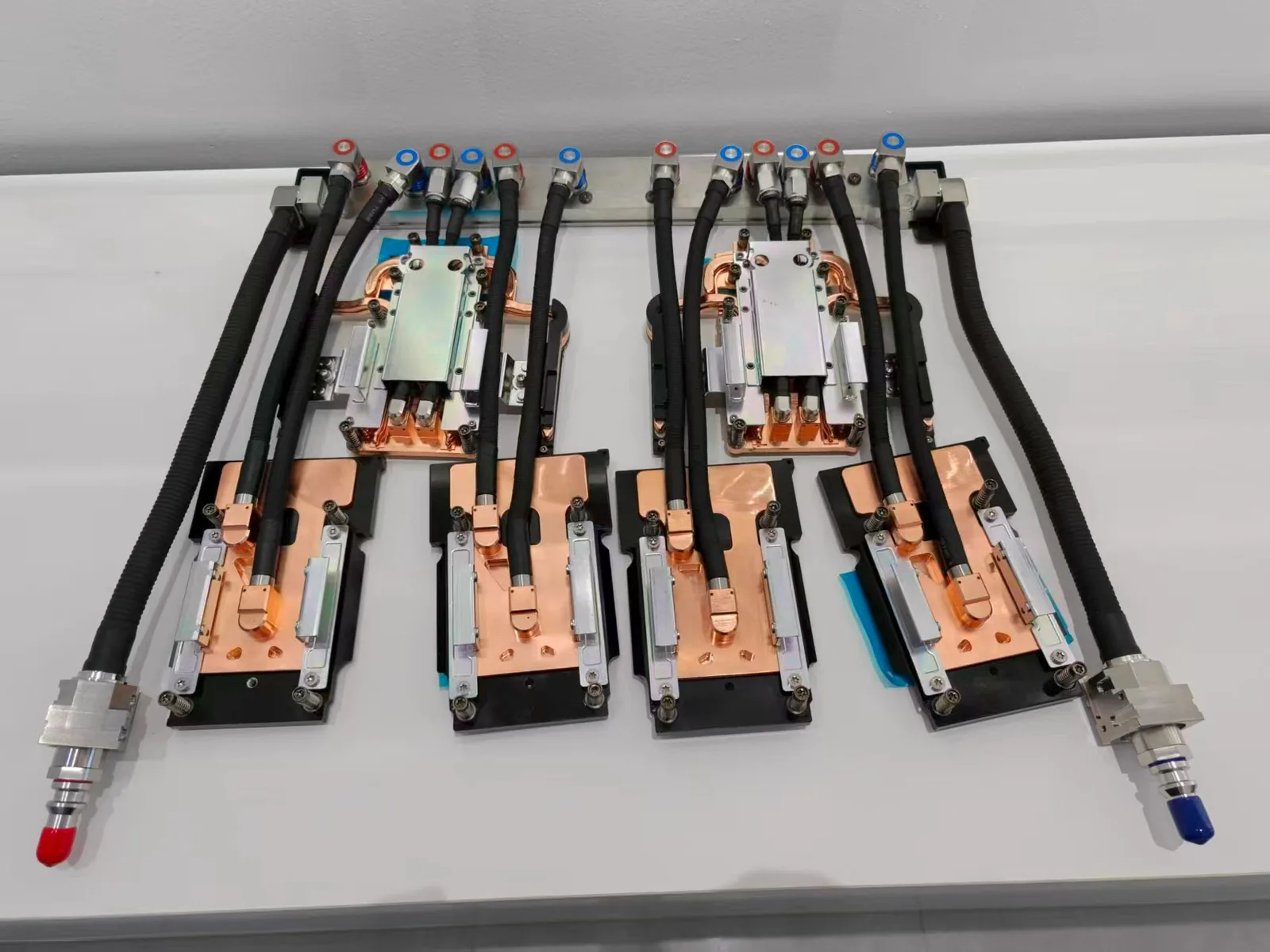
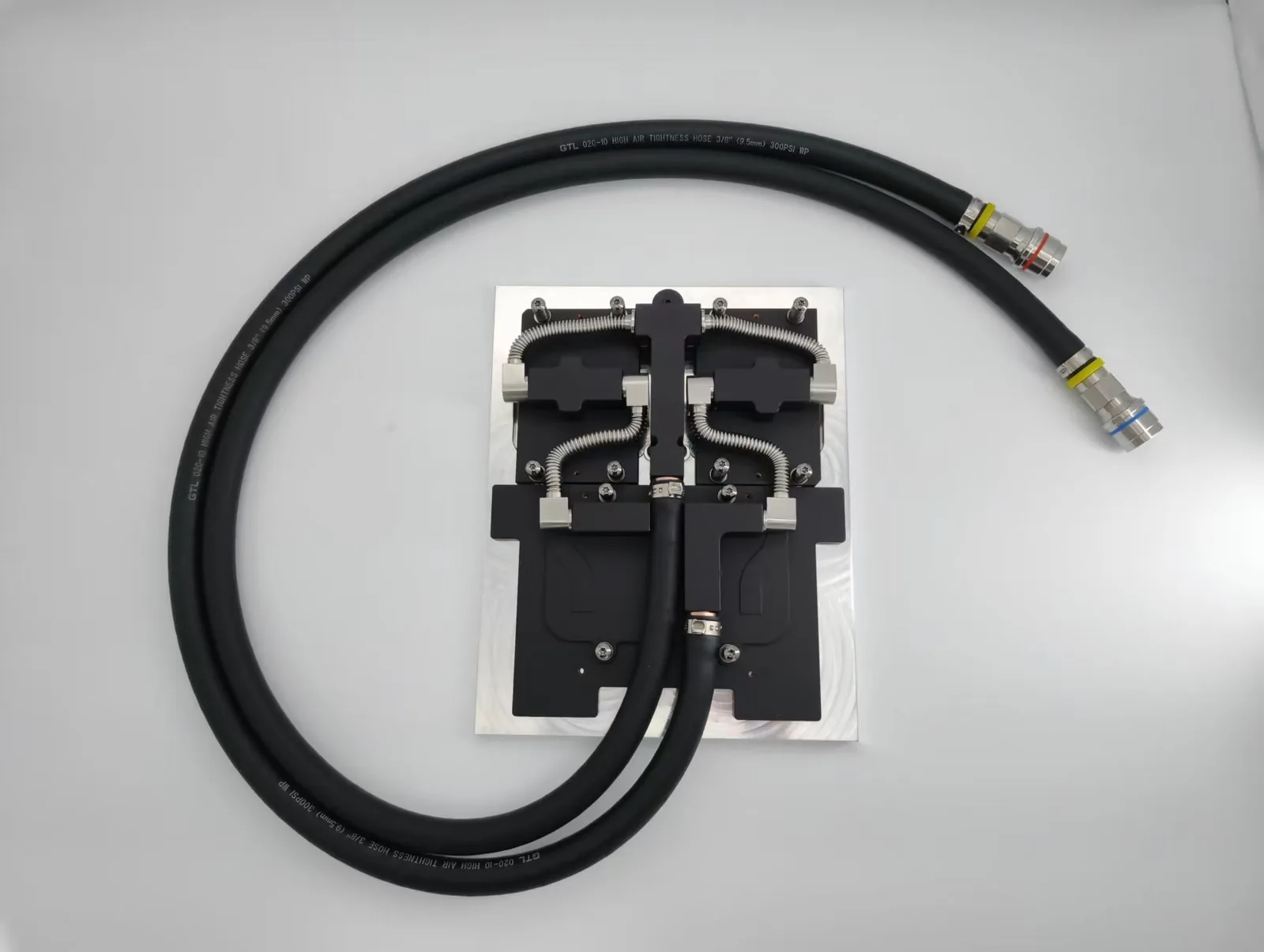
ToneCooling’s server cold plate uses a vacuum-brazed copper base with skived aluminum fin inserts — a hybrid construction that maximizes heat spreading at the CPU interface (copper) while providing high surface area internal channels (skived fins) for efficient coolant heat transfer. The soft hose connection design allows flexible routing within 1U/2U server chassis.
Engineering Takeaways for Data Center Designers
- Thermal headroom: At 400W/CPU, junction temperatures stay below 66°C — providing 19°C margin below the 85°C throttle point
- Low pressure drop: 8.7 kPa enables direct integration with standard CDU infrastructure without booster pumps
- Serial flow path: The 5–7°C offset between CPU1 and CPU2 is predictable and can be factored into server thermal design
- Scalable design: The same cold plate architecture supports 300W through 400W+ CPUs without hardware changes
Frequently Asked Questions
What coolant is used in the server cold plate CFD simulation?
The simulation uses 20% ethylene glycol-water solution at 40°C inlet temperature. This is the standard coolant specification for data center direct-to-chip liquid cooling systems, compliant with ASHRAE W55 water quality guidelines.
Can this cold plate handle next-generation 500W+ CPUs?
Based on the thermal gradient trend observed in simulation (approximately 2.5°C rise per 50W increase), a 500W configuration would produce CPU temperatures around 71°C — still within safe operating limits. For 500W+ designs, ToneCooling recommends increasing flow rate to 1.2 L/min or upgrading to a full-copper micro-channel construction.
What is the minimum flow rate for adequate cooling at 400W?
At 400W per CPU, the minimum recommended flow rate is 0.6 L/min. Below this threshold, the coolant temperature rise exceeds 25°C, reducing thermal margin. The optimal operating range is 0.8–1.5 L/min for dual-socket server configurations.
How does pressure drop change with flow rate?
Pressure drop scales approximately with the square of flow rate. At 0.8 L/min the drop is 8.7 kPa; at 1.2 L/min expect approximately 19 kPa; at 1.6 L/min approximately 34 kPa. ToneCooling provides detailed pressure-flow curves for each cold plate design during the quotation process.
Request CFD Simulation for Your Server Cooling Project
ToneCooling provides complimentary CFD thermal simulation for qualified cold plate projects. Send your thermal requirements — heat load, CPU footprint, flow rate, and coolant specification — and our engineering team will deliver simulation results.
prototypes from 1 piece · Prototype 4–6 weeks · ISO 9001 Certified
Related: Data Center Cold Plates | AI Server Cooling Solutions | Cold Plate Design Guide
Related ToneCooling Resources
Industry References & Standards
Need a Custom Liquid Cold Plate?
ToneCooling engineers design thermal solutions for your specific requirements. Get an engineering RFQ review based on your uploaded requirements.
Last Updated: 2026-04-08