High-Performance Server Optical Modules & Liquid Cooling: The Next-Generation Dual-Core Engine Powering AI & Cloud Computing Servers
When AI cluster computing power is being strangled by thermal bottlenecks, you need more than just standard optical modules; you need an integrated solution for data and thermal management. This article provides an in-depth analysis of how, under extreme 400W heat density, the perfect synergy between high-performance server optical modules and patented liquid cold plate technology enables 100% stable computing power release, lowering PUE and boosting ROI for your AI data center.

I. The Critical Challenge: Is Your AI Server Struggling with “Overheating”? — Liquid cooling solutions
Are you facing any of these pain points?
- Frequent AI training task interruptions? High-speed optical modules throttle due to overheating, causing data transmission errors and slowing down the entire training cycle.
- Unable to increase server rack density? Traditional air cooling can no longer handle the concentrated 400W of heat generated by 16 high-speed optical modules, becoming a physical bottleneck for expansion.
- Data center PUE remains stubbornly high? Air conditioning systems run continuously at high load to cool the “big heat generators” – the optical modules – leading to runaway electricity costs.
- Unexpected rise in equipment failure rates? Long-term high-temperature operation severely shortens the lifespan of expensive optical modules and networking equipment.
If any of these points hit home, what you need to learn about is the deep integration of next-generation server optical modules and liquid cooling technology.
II. The Solution: Perfect Integration of the Data Highway and the “Cool” Core — Liquid cooling solutions
1. The Core Engine: High-Performance Server Optical Modules
- What is a Server Optical Module? It is the core component responsible for high-speed data electro-optical conversion in servers, acting as the “traffic hub” of the internal data center network.
- Why High Performance? AI and cloud computing have driven the need for 400G/800G interconnectivity, ensuring data flows without blockage and with low latency across thousands of servers.
2. The Cool Core: Optical Module Liquid Cold Plate – The Ultimate Answer to High Heat Density
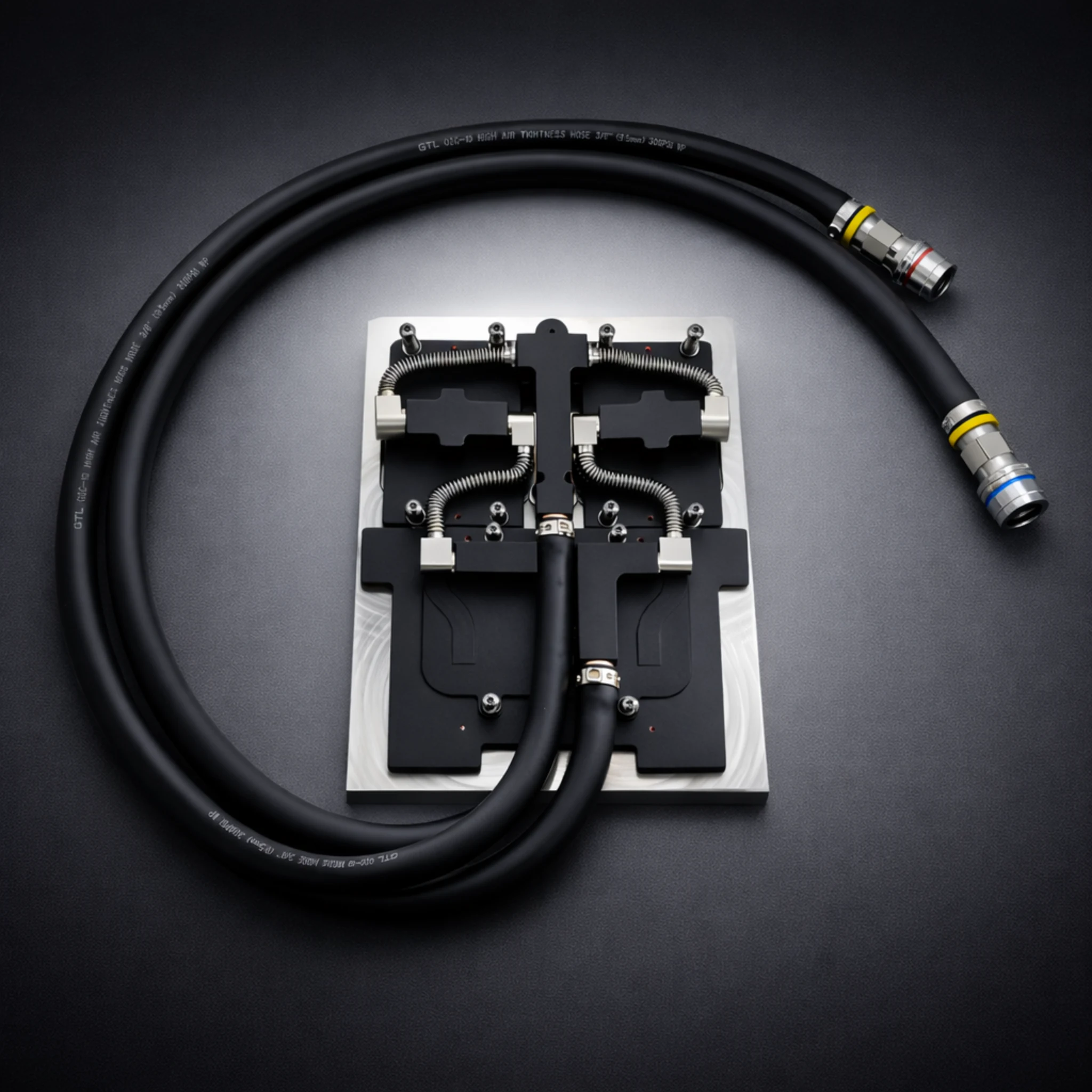
Facing the concentrated heat of 400W generated by 16 clustered optical modules, our newly launched optical module liquid cold plate is a benchmark solution validated by engineering.
Feature | Parameter/Description | Value for You |
|---|---|---|
Superior Thermal Performance | Total Heat Dissipation: 400W (16×25W), Coolant: PG25 | Ensures optical modules operate continuously at full load with a 40℃ inlet water temperature, eliminating thermal throttling. |
Ultra-Low Flow Resistance | Design pressure drop only 7.9Kpa, far below the 25Kpa requirement. | Reduces system pumping power, decreases overall energy consumption, and optimizes TCO. |
Patented & Reliable Process | Ultrasonic Welding, no risk of leakage, longer lifespan. | Significantly enhances system reliability, reduces maintenance intervention and downtime losses. |
Compact & Flexible Layout | Base dimensions: 106*80*12.9mm (holds 4 modules), length is customizable. | Perfectly fits high-density server chassis, flexibly expands with the number of optical modules. |
Excellent Corrosion Resistance | Surface Electroless Nickel Plating (3~7μm). | Compatible with various coolants, ensures long-term stable operation in harsh environments. |
III. FAQ: About Server Optical Modules & Liquid Cooling — Liquid cooling solutions
Q1: Under what circumstances must I consider a liquid cooling solution for optical modules?
A: It is strongly recommended to adopt liquid cooling when any of the following occur:
- Deploying high-rate optical modules like 400G/800G with high port density.
- Total power consumption of optical modules within a single rack exceeds 1kW, and air cooling can no longer maintain intake temperature within specifications.
- Experiencing increased Bit Error Rate or link failures in optical modules due to high temperatures.
- Pursuing ultimate energy efficiency, aiming to reduce data center PUE below 1.2.
Q2: Why does this cold plate use ultrasonic welding? How is it better than traditional processes?
A: Ultrasonic welding is a solid-state welding process that fuses metal molecules through high-frequency vibration. Its advantages are:
- Zero Leak Risk: No solder needed, fundamentally preventing leaks caused by solder corrosion or fatigue.
- High Reliability: High connection strength, withstands thermal shock and long-term vibration, far outlasting brazing.
- Channel Integrity: No risk of solder flow blocking precision channels, ensuring low flow resistance and heat dissipation efficiency.
Q3: What is the specific consideration behind the cold plate material and surface treatment?
A: This combination is designed for long-term reliability:
- Material: Offers good strength and thermal conductivity, while perfectly matching our welding process.
- Electroless Nickel Plating: Provides a uniform, pore-free, and corrosion-resistant barrier, effectively resisting long-term erosion from coolants, ensuring channel cleanliness and long-term thermal performance.
Q4: Is this liquid cooling solution compatible with our existing brand servers?
A: Yes. Our liquid cold plate design is highly flexible. The form factor and mounting method can be customized according to your server model and optical module layout. We provide professional compatibility assessment services to ensure seamless integration into your existing infrastructure.
Q5: Will introducing a liquid cooling system significantly increase operational complexity and TCO?
A: On the contrary. While the initial investment is higher, from a Total Cost of Ownership perspective, liquid cooling is cost-effective:
- Energy Saving: Drastically reduces AC usage, lowers PUE, leading to significant electricity cost reduction.
- Density Increase: Allows deployment of higher density servers, increasing per-rack compute power, saving space costs.
- Stability Maintenance: Greatly reduces equipment failure rates, decreases maintenance intervention and spare parts costs.
Overall, the return on investment is very considerable.
IV. Why Choose Our Integrated Solution?
- Technical Foresight: We are not just optical module suppliers but data center-level thermal experts. Our solutions directly target the cooling needs of the Co-Packaged Optics era.
- Performance Guarantee: Every key parameter, from heat dissipation to pressure drop, is strictly calculated and tested, ensuring a perfect match with real-world application scenarios.
- Cost-Effectiveness: By increasing per-rack compute density and reducing cooling system energy consumption, our solution significantly lowers your Total Cost of Ownership.
- One-Stop Service: From selection consultation and compatibility testing to deployment support, we provide end-to-end professional services to ensure your project’s smooth implementation.
V. Act Now, Unlock Your Computing Potential
The wave of technology surges forward. Liquid cooling has become an inevitable choice in the 800G/1.6T optical module era. Hesitation means missing out in the future competition.
You Have Three Choices:
- Continue enduring the limitations of air cooling, bearing the cost of unstable computing power and high energy consumption.
- Explore liquid cooling solutions on your own, facing the high risks and long cycles of technical integration.
- Contact us now to receive a tailored AI Server Optical Module Liquid Cooling Solution White Paper.
🚀 Limited-Time Offer: The first 20 consulting customers receive a free thermal assessment for your existing server architecture.
For industry standards and best practices, refer to ASHRAE thermal guidelines.
What Is Modules Liquid Cooling Solutions?
Does ToneCooling offer OEM and ODM services?
Yes. ToneCooling provides full OEM and ODM services including custom design, prototyping, thermal simulation, and volume production. We serve customers in North America, Europe, and Asia-Pacific with engineering support and samples within 2–4 weeks.
What materials are used in ToneCooling liquid cold plates?
ToneCooling manufactures cold plates in aluminum (6061/6063), copper (C1100/C1020), and stainless steel. Aluminum FSW cold plates are ideal for high-volume EV and industrial applications, while copper brazed cold plates provide maximum thermal conductivity (398 W/m·K) for high heat flux electronics.
What is the typical lead time for custom cold plates?
Prototype samples are delivered within 2–4 weeks. Production orders typically ship within 4–6 weeks after sample approval. ToneCooling responds to all quote requests within 24 business hours.
Get a Custom Thermal Solution from ToneCooling
ToneCooling is a professional liquid cooling solution provider specializing in custom cold plates, AIO coolers, and advanced thermal management systems. With ISO 9001:2015 certified manufacturing, we deliver prototype samples within 2–4 weeks. Contact ToneCooling today for a free consultation and quote — we respond within 24 business hours.
Industry References & Standards
Modules Liquid Cooling Solutions is a high-performance thermal management solution engineered by ToneCooling for demanding applications.
Optical Module Liquid Cold Plate is a critical component in modern thermal management. ToneCooling engineers this solution for AI servers, data centers, EV batteries, and power electronics requiring high-performance liquid cooling.
Optical Module Liquid Cold Plate: Key Specifications
When evaluating optical module liquid cold plate, engineers consider thermal resistance, pressure drop, flow rate, and material compatibility. ToneCooling provides detailed specs for every optical module liquid cold plate design, backed by CFD simulation and testing.
Why Choose ToneCooling for Optical Module Liquid Cold Plate
ToneCooling has manufactured over 50,000 optical module liquid cold plate units for global OEM customers. Our optical module liquid cold plate production features vacuum brazing furnaces below 10⁻⁴ mbar, FSW machines with ≤0.02mm flatness, and helium leak detection at 10⁻⁸ mbar·L/s. Every optical module liquid cold plate undergoes 100% pressure testing at 25 bar.
Our engineering team provides free optical module liquid cold plate design consultation, CFD simulation, and rapid prototyping in 7-14 days. Production optical module liquid cold plate orders ship in 4-6 weeks under ISO 9001:2015 quality management.
Last Updated: 2026-04-08
DR Kevin, Thermal Engineer, ToneCooling
Need a custom modules liquid cooling solutions solution?
ToneCooling engineers respond within 24 hours with CFD-validated thermal recommendations.