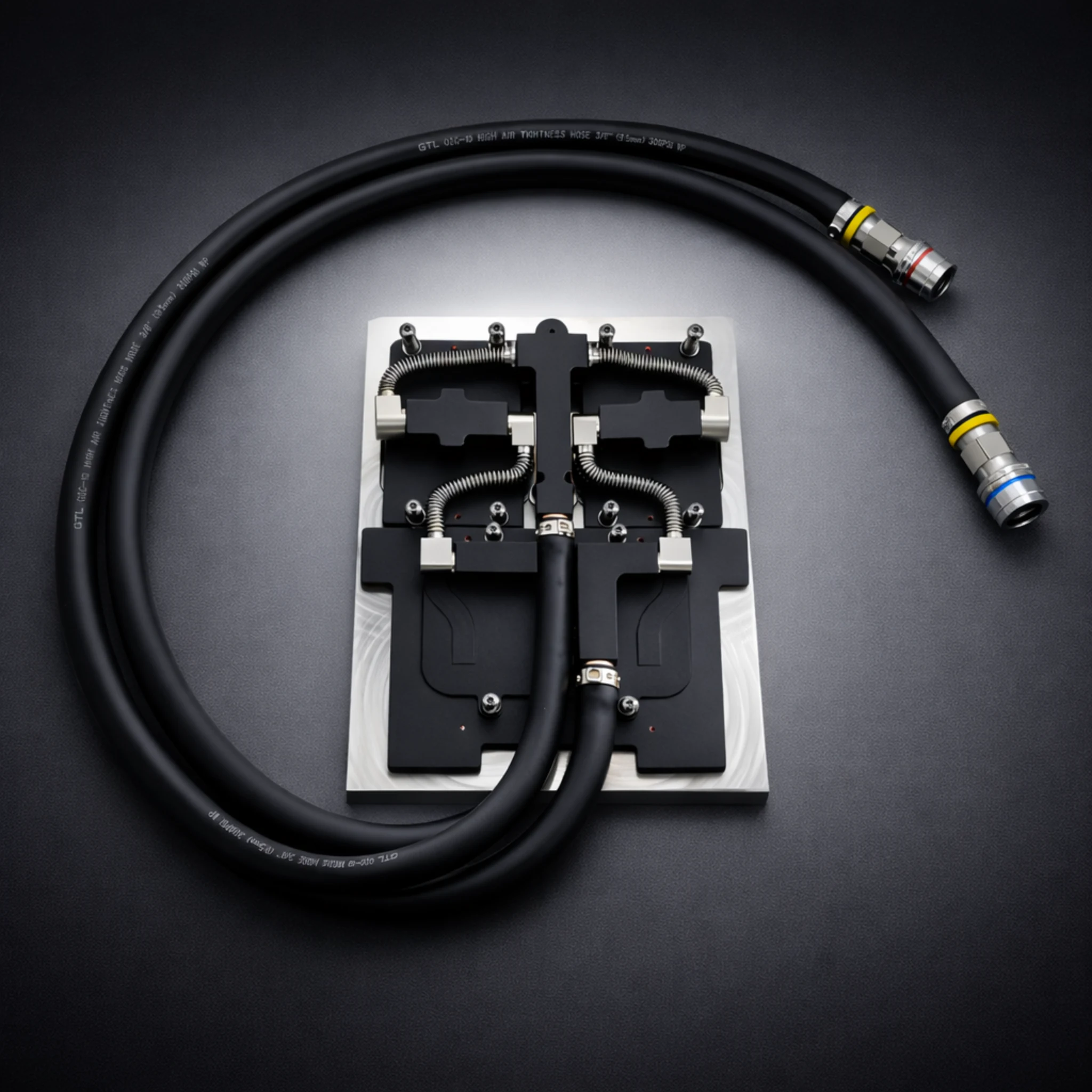
When the efficiency and yield rate of traditional vacuum brazing become bottlenecks limiting production capacity, the manufacturing industry urgently needs a new generation of welding technology. Transient Liquid Phase diffusion bonding, with its 5 minutes per piece welding speed, 0.85σb welding strength, and 99% product yield rate, provides reliable welding solutions for high-end manufacturing.

Is Your Production Facing These Welding Challenges? — Tlp welding
- ⚡ Low Production Efficiency – Vacuum brazing requires 1 hour per piece, severely limiting production capacity
- ⚡ Insufficient Welding Strength – Traditional processes can only achieve 0.75σb, affecting product reliability
- ⚡ Low Product Yield Rate – 90% yield rate leads to high quality costs
- ⚡ Poor Process Stability – Traditional welding methods struggle to ensure batch consistency
If these issues are affecting your production efficiency, continue reading to learn about TLP welding’s breakthrough solution
TLP Transient Liquid Phase Diffusion Bonding: Redefining New Standards in Welding Technology — Tlp welding
TLP vs Vacuum Brazing Performance Comparison
Performance Indicator | Vacuum Brazing | TLP Welding | Improvement |
|---|---|---|---|
Welding Efficiency | 1 hour/piece | 5 minutes/piece | 12x Improvement |
Welding Strength | 0.75σb | 0.85σb | 13.3% Improvement |
Product Yield Rate | 90% | 99% | 9 Percentage Point Improvement |
Process Stability | Relies on operator experience | Fully automatic control | Significant Improvement |
Core Technical Advantages of TLP Welding
- High Efficiency Production: 5 minutes to complete single piece welding, significantly increasing production capacity
- Excellent Strength: 0.85σb welding strength, close to base material performance
- Ultra-High Yield Rate: 99% product qualification rate, significantly reducing quality costs
- Excellent Consistency: Dedicated welding machines ensure stable performance between batches
TLP Process Principle Overview
Transient Liquid Phase diffusion bonding replaces vacuum radiation heating with heat conduction, uses low-melting-point eutectic alloys instead of traditional brazing filler metals, forming an alloy diffusion layer to achieve fast, high-strength, high-yield welding results.
TLP Welding Technology Application Scenarios
Heat Sink and Liquid Cold Plate Manufacturing
- High-performance server heat sink welding
- Liquid cold plate channel sealing welding
- Heat exchanger core welding
Electronic Device Heat Dissipation
- IGBT power module heat dissipation substrate
- GPU heat sink welding
- Power device heat dissipation solutions
High-End Equipment Manufacturing
- Aerospace thermal management systems
- New energy vehicle battery cooling systems
- Industrial laser heat dissipation devices
Answers to Customers’ Most Concerned Technical Questions (FAQ) — Tlp welding
Q1: What are the main advantages of TLP welding compared to vacuum brazing?
A: TLP welding has three core advantages:
- Efficiency Advantage: 5 minutes/piece vs 1 hour/piece, production efficiency improved by 12 times
- Quality Advantage: Welding strength 0.85σb vs 0.75σb, product reliability significantly enhanced
- Cost Advantage: 99% yield rate vs 90% yield rate, quality costs substantially reduced
Q2: How does TLP welding achieve 99% ultra-high yield rate?
A: This benefits from TLP welding’s process characteristics:
- Fully Automatic Control: Dedicated welding machines ensure precise control of process parameters
- Controllable Process: Real-time monitoring of welding process, timely parameter adjustment
- Material Optimization: Low-melting-point eutectic alloys provide better wettability and fillability
Q3: What does TLP welding’s 0.85σb strength mean in practical applications?
A: This means:
- Higher Reliability: Welded joint strength close to base material, longer service life
- Broader Application Range: Can withstand higher mechanical stress and thermal stress
- Better Heat Dissipation Performance: Reduced interface thermal resistance, improved heat dissipation efficiency
Q4: Is TLP welding equipment easy to integrate into existing production lines?
A: Yes, our TLP welding solution provides:
- Standardized Interfaces: Easy integration with existing production lines
- Flexible Configuration: Different specification equipment according to production volume requirements
- Technical Support: Professional team provides installation, debugging, and training services
Q5: What is the investment return period for TLP welding equipment?
A: Based on actual customer data:
- Efficiency Improvement Benefits: Increased production capacity directly increases revenue
- Quality Cost Savings: Higher yield rate reduces rework and scrap losses
- Comprehensive ROI: Typically 6-12 months to recover investment
Why Industry Leading Companies Choose TLP Welding Technology?
🔧 Mature Technology – Years of R&D and practical production validation
🔧 Stable Equipment – Dedicated welding machines ensure long-term stable operation
🔧 Comprehensive Service – Full support from process development to mass production
🔧 Significant Results – Customer production efficiency improved by 3-5 times on average
Act Now, Experience the Welding Technology Revolution!
Limited Time Professional Services:
- Free Process Evaluation – Professional engineers provide process feasibility analysis
- Sample Welding Test – Free sample welding test service
- Technical White Paper – Obtain “TLP Welding Technology Application Guide”
Your Three Choices:
① Continue enduring efficiency losses and quality risks of traditional welding processes
② Develop new processes in-house (high investment, long cycle, high risk)
③ Consult immediately for professional TLP welding solutions (Recommended)

For industry standards and best practices, refer to ASHRAE thermal guidelines.
What Is Tlp Welding?
Does ToneCooling offer OEM and ODM services?
Yes. ToneCooling provides full OEM and ODM services including custom design, prototyping, thermal simulation, and volume production. We serve customers in North America, Europe, and Asia-Pacific with engineering support and samples within 2–4 weeks.
What industries does ToneCooling serve?
ToneCooling serves data center, telecommunications, EV/automotive, power electronics, aerospace, medical devices, and industrial laser markets with custom thermal management solutions.
How can I get a quote from ToneCooling?
Visit tonecooling.com/contact or email info@tonecooling.com with your thermal requirements. ToneCooling responds to all inquiries within 24 business hours.
Get a Custom Thermal Solution from ToneCooling
ToneCooling is a professional liquid cooling solution provider specializing in custom cold plates, AIO coolers, and advanced thermal management systems. With ISO 9001:2015 certified manufacturing, we deliver prototype samples within 2–4 weeks. Contact ToneCooling today for a free consultation and quote — we respond within 24 business hours.
Related ToneCooling Resources
Industry References & Standards
Tlp Welding is a high-performance thermal management solution engineered by ToneCooling for demanding applications.
Transient Liquid Phase Bonding Cold Plate is a critical component in modern thermal management. ToneCooling engineers this solution for AI servers, data centers, EV batteries, and power electronics requiring high-performance liquid cooling.
Transient Liquid Phase Bonding Cold Plate: Key Specifications
When evaluating transient liquid phase bonding cold plate, engineers consider thermal resistance, pressure drop, flow rate, and material compatibility. ToneCooling provides detailed specs for every transient liquid phase bonding cold plate design, backed by CFD simulation and testing.
Why Choose ToneCooling for Transient Liquid Phase Bonding Cold Plate
ToneCooling has manufactured over 50,000 transient liquid phase bonding cold plate units for global OEM customers. Our transient liquid phase bonding cold plate production features vacuum brazing furnaces below 10⁻⁴ mbar, FSW machines with ≤0.02mm flatness, and helium leak detection at 10⁻⁸ mbar·L/s. Every transient liquid phase bonding cold plate undergoes 100% pressure testing at 25 bar.
Our engineering team provides free transient liquid phase bonding cold plate design consultation, CFD simulation, and rapid prototyping in 7-14 days. Production transient liquid phase bonding cold plate orders ship in 4-6 weeks under ISO 9001:2015 quality management.
Last Updated: 2026-04-08
DR Kevin, Thermal Engineer, ToneCooling