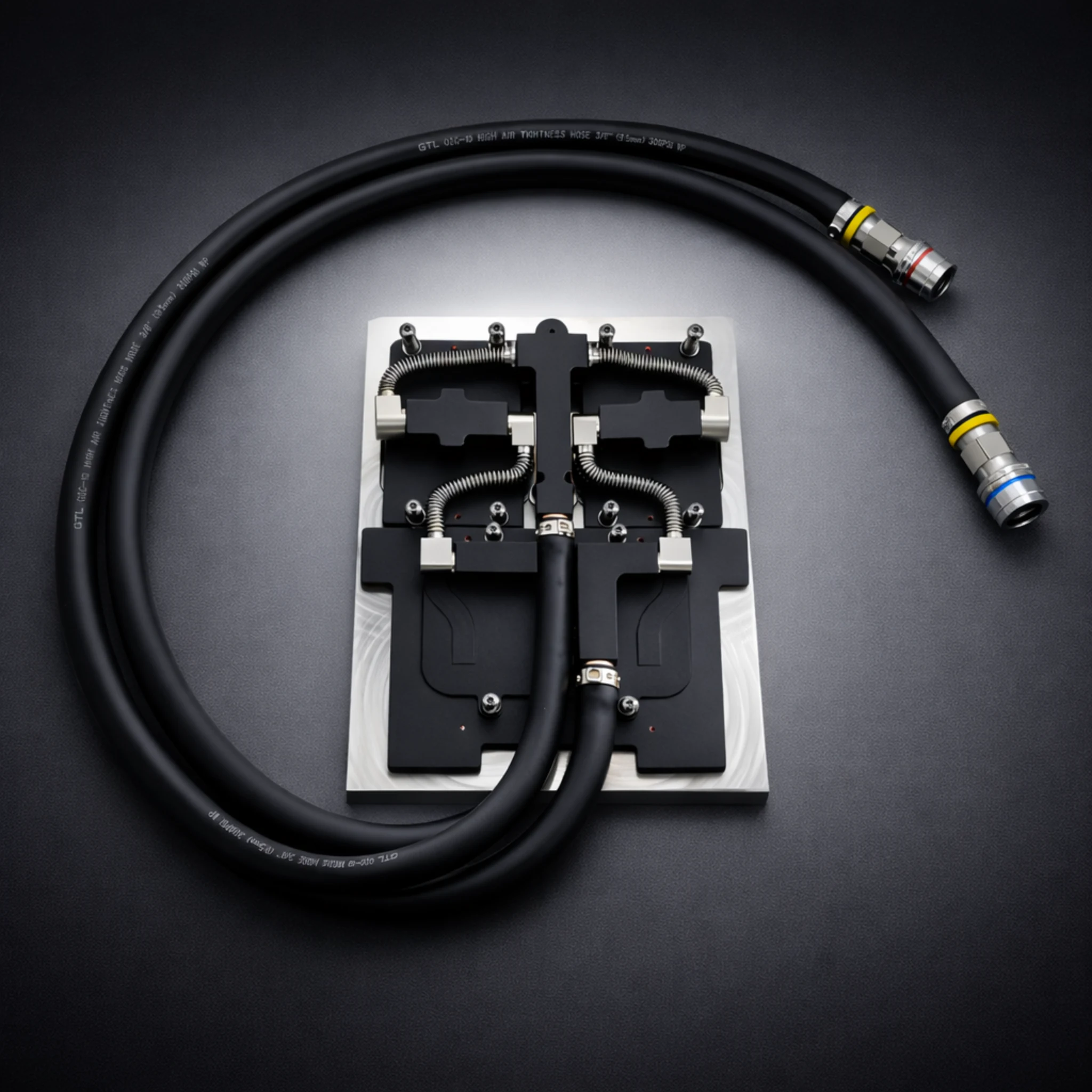
As semiconductor process nodes continue to shrink to 3nm and 2nm, front-end manufacturing has become a precise “dance” conducted at the atomic scale. Etching, thin film deposition (PVD/CVD), and lithography, as core segments of this process, demand unprecedented temperature stability. Any minor thermal fluctuation can lead to process drift and significant yield loss. In this context, liquid cold plates have evolved from auxiliary components to strategic core technologies essential for ensuring chip yield, precision, and equipment uptime. This article explores the application of liquid cold plates in these three key equipment types and reveals how superior liquid cold plate manufacturing supports advanced process development.
I. Thermal Management: The Lifeline of Semiconductor Manufacturing
Thermal challenges in front-end equipment stem from physical and chemical processes. Plasma bombardment, high-temperature reactions, and high-energy laser irradiation generate immense heat flux densities. Air cooling technology is inadequate here; only the efficient heat transfer and precise temperature control capabilities of liquid cold plates can stabilize temperature fluctuations of key components (like electrostatic chucks and optical elements) within ±0.1°C or tighter ranges. This is not just a process requirement but a cornerstone for ensuring long-term reliable equipment operation.
II. Key Roles of Liquid Cold Plates in Core Front-End Equipment
1. Etching Systems: “Guardians” of Process Profiles
During plasma etching, the electrostatic chuck (ESC) holding the wafer and reaction chamber walls continuously endure high-energy ion bombardment, generating substantial heat.
Liquid Cold Plate Role: Liquid cold plates integrated into the ESC and chamber walls rapidly and uniformly remove heat, ensuring constant wafer temperature. This is fundamental for controlling etch rate and critical dimension (CD) accuracy. Temperature non-uniformity directly leads to distorted etch profiles and plummeting yields.
2. PVD/CVD Equipment: “Cornerstones” of Thin Film Quality
In thin film deposition, the surface temperature uniformity of the electrostatic chuck directly determines the deposited film’s thickness uniformity, stress, and step coverage.
Liquid Cold Plate Role: Similarly, the liquid cold plate is indispensable to the ESC. It ensures the wafer resides in an optimal, stable temperature field throughout deposition, producing high-quality, defect-free films. Concurrently, liquid cold plates also cool chambers and power supplies, protecting equipment and extending maintenance intervals.
3. Lithography Systems (Especially EUV): “Defenders” of Optical Precision
EUV lithography represents the pinnacle of liquid cold plate technology application. Its light source system (producing plasma via laser-pulsed tin droplets) and complex reflective optics generate and absorb enormous heat.
Liquid Cold Plate Role: Each EUV optical element is equipped with an extremely precise micro-channel liquid cold plate, using ultra-pure water for cooling to control thermal deformation at the picometer level. Any minimal deformation causes optical path deviation, resulting in overlay error and rendering chips useless. Without liquid cooling, usable EUV lithography systems would not exist.
III. Beyond Cooling: Four Core Dimensions of Superior Liquid Cold Plate Manufacturing
Facing such stringent applications, the performance and reliability of the liquid cold plate itself become decisive. Advanced manufacturers like ToneCooling establish core advantages across these dimensions:
1. Process & Performance Advantages: From “Adequate” to “Excellent”
Advanced Joining Processes: Using vacuum brazing, friction stir welding, and transient liquid phase bonding ensures finely formed, smooth internal cooling channels, achieving low thermal resistance and low pressure drop for high heat transfer efficiency and stable temperature control under high heat flux.
Additive Manufacturing (3D Printing) Technology: Metal 3D printing enables monolithic micro-channel cold plates, complex internal geometries, and optimized wall designs, enhancing thermal performance while ensuring structural strength and weight reduction.
2. Design & Customization Capability: From “Off-the-Shelf” to “Tailored”
Flexible Structural Solutions: Support various liquid cold plate structures, from extruded and stamped-brazed to micro-channel and additively manufactured monolithic designs. ToneCooling’s engineers provide targeted structure and flow path designs based on your power density, flow/pressure drop, and installation space constraints.
Simulation-Driven Design: Leveraging CFD simulation and topology optimization to accurately predict flow fields, temperature fields, and pressure drop enables deeply customized solutions for specific applications (e.g., GPU/CPU, IGBT, Aerospace), beyond standard products.
3. Reliability & Manufacturing Scalability: From “Prototype” to “Product”
Superior Sealing Reliability: Monolithic structures or high-quality brazed joints minimize potential leak points, ensuring stable operation under high pressure and thermal cycling, meeting stringent reliability requirements in Automotive, Aerospace, and Industrial sectors.
Flexible Production Models: Offer solutions for high-volume production (e.g., stamped brazing) and low-volume, high-complexity projects (machining, additive manufacturing), enabling smooth transitions across product lifecycle stages while balancing cost, lead time, and performance.
4. Application Experience & Service Support: From “Component” to “Solution”
Cross-Industry Application Experience: Mature liquid cold plate application experience in High-Performance Computing, Electric Vehicles, Power Electronics, Aerospace, and Renewable Energy enables system-level thermal management advice, not just component supply.
End-to-End Service Support: Provide comprehensive services from selection, design review, and prototype trial to assembly, testing, and after-sales technical support, helping clients implement liquid cooling solutions efficiently.
IV. Conclusion and Call to Action
As semiconductor manufacturing advances, thermal management is an unavoidable core challenge. Liquid cold plates, at the forefront of direct component cooling, see their performance ceiling influencing semiconductor equipment’s process capabilities. Choosing a partner with comprehensive strengths in advanced processes, custom design, reliable manufacturing, and rich application experience is key to maintaining competitive advantage.
FAQ (Frequently Asked Questions)
Q1: Why must semiconductor front-end equipment use liquid cold plates instead of standard air cooling?
A1: Three main reasons: 1. Heat Flux Density: Key components have extremely high heat flux, unmanageable by air cooling; 2. Temperature Stability: Processes require control within ±0.1°C or better, where liquid cold plates are far superior; 3. Space & Noise: Liquid cold plates offer greater cooling capacity in limited space with quieter operation, suiting cleanroom environments.
Q2: What are the primary components cooled by liquid cold plates in Etching and PVD/CVD equipment?
A2: The most critical component is the electrostatic chuck. Its temperature uniformity and stability directly determine process results. Liquid cold plates also cool reaction chamber walls, RF power sources, and other key parts.
Q3: What is ToneCooling’s unique advantage in handling complex customization requests?
A3: ToneCooling’s strength is Simulation-Driven Design combined with Flexible Manufacturing Capabilities. Using CFD and topology optimization for precise performance prediction, alongside various manufacturing processes, enables non-standard, high-performance custom liquid cold plate solutions.
Q4: How does ToneCooling ensure liquid cold plate quality for applications requiring Automotive or Aerospace-grade reliability?
A4: We use monolithic structures or advanced joining processes like vacuum brazing to minimize leak points, implementing strict quality control to ensure long-term sealing reliability under high pressure and thermal cycling, meeting the most stringent standards.
Q5: What are the future trends in liquid cold plate technology?
A5: Future trends include: 1. Two-Phase Liquid Cooling for kilowatt-level heat sources; 2. More Precise Micro-Channel Designs (e.g., via 3D printing); 3. Intelligent Temperature Control integrated with AI algorithms; 4. New Materials (e.g., SiC composites). ToneCooling is proactively developing and reserving technologies in these areas.
Are you searching for reliable and efficient liquid cooling solutions for your next-generation semiconductor equipment?
Contact ToneCooling’s expert team today. Leverage our deep semiconductor liquid cold plate application experience and simulation-driven custom design capabilities for full-spectrum support from concept to mass production. Let’s jointly push heat dissipation limits and safeguard your process yield.


For industry standards and best practices, refer to ASHRAE thermal guidelines.
What Is Pvd Cvd Liquid Cold Plates?
ToneCooling is a professional liquid cooling solution provider specializing in custom cold plates, AIO coolers, and advanced thermal management systems. With ISO 9001:2015 certified manufacturing, we deliver prototype samples within 2–4 weeks. Contact ToneCooling today for a free consultation and quote — we respond within 24 business hours.
Industry References & Standards
Need a Custom Liquid Cold Plate?
Pvd Cvd Liquid Cold Plates is a high-performance thermal management solution engineered by ToneCooling for demanding applications.
ToneCooling engineers design thermal solutions for your specific requirements. Get an engineering RFQ review based on your uploaded requirements.
Semiconductor Test Fixture Cold Plate is a critical component in modern thermal management. ToneCooling engineers this solution for AI servers, data centers, EV batteries, and power electronics requiring high-performance liquid cooling.
Semiconductor Test Fixture Cold Plate: Key Specifications
When evaluating semiconductor test fixture cold plate, engineers consider thermal resistance, pressure drop, flow rate, and material compatibility. ToneCooling provides detailed specs for every semiconductor test fixture cold plate design, backed by CFD simulation and testing.
Why Choose ToneCooling for Semiconductor Test Fixture Cold Plate
ToneCooling has manufactured over 50,000 semiconductor test fixture cold plate units for global OEM customers. Our semiconductor test fixture cold plate production features vacuum brazing furnaces below 10⁻⁴ mbar, FSW machines with ≤0.02mm flatness, and helium leak detection at 10⁻⁸ mbar·L/s. Every semiconductor test fixture cold plate undergoes 100% pressure testing at 25 bar.
Our engineering team provides free semiconductor test fixture cold plate design consultation, CFD simulation, and rapid prototyping in 7-14 days. Production semiconductor test fixture cold plate orders ship in 4-6 weeks under ISO 9001:2015 quality management.
Need a Custom Liquid Cold Plate?
ToneCooling engineers design thermal solutions for your requirements. Response within 24-48 hours.
Last Updated: 2026-04-08
| Parameter | ToneCooling Specification |
|---|---|
| Material | Copper T2 / 6061 aluminum |
| Welding method | Transient liquid phase diffusion welding |
| Test pressure | 1 MPa (helium leak + nitrogen hold) |
| Working medium | PG25 (25% propylene glycol) |
| Custom design | Yes — DXF/STEP input accepted |
DR Kevin, Thermal Engineer, ToneCooling