

This comprehensive guide covers level technologies to tame solutions for industrial and OEM applications. ToneCooling provides expert insights on level technologies to tame technology and implementation.
Gpu Coolings Battle Chip Level is a high-performance thermal management solution engineered by ToneCooling for demanding applications.
This guide on Level technologies to tame provides key insights for engineers and procurement teams. Meta: A deep technical guide to chip-level cooling that addresses today’s 1,000–1,500W GPU power envelopes. This article explains core principles, microchannel cold plates, advanced TIMs, vapor chambers, direct-die cooling, AI thermal orchestration, market drivers, major players, risks and practical implementation guidance for data center decision-makers.
What Is Gpu Coolings Battle Chip Level?
The modern compute race is heating up — literally. Leading GPU platforms and AI accelerators are already pushing power consumption beyond 1,000 watts per package, and roadmaps suggest some designs will approach or exceed 1,500W in the near future. To put this into perspective: extracting 1,500W of heat from a die only a few square centimeters in area produces heat fluxes that are orders of magnitude higher than what conventional air cooling can handle.
Traditional air coolers and even board-level liquid coolers are now reaching practical limits: acoustic noise, fan power, dust, thermal gradients and physical airflow constraints impose severe limits on sustained performance. As a result, the thermal battleground has shifted to the chip itself — chip-level cooling (die-level cooling) is the fundamental architecture that enables continued performance scaling in AI servers and HPC systems.
2. What Is Chip-Level Cooling? Definition and the Thermal Chain — Level technologies to tame
2.1 Definition — Level technologies to tame
Chip-level cooling describes thermal solutions designed to remove heat at the smallest possible distance from the semiconductor junction — either through superior thermal interface materials (TIMs), thin vapor chambers, microchannel cold plates mounted directly over the package lid, or in extremis, direct-die contact where coolant or a microfluidic interface is placed very near the bare die.

2.2 The thermal chain and why every interface matters
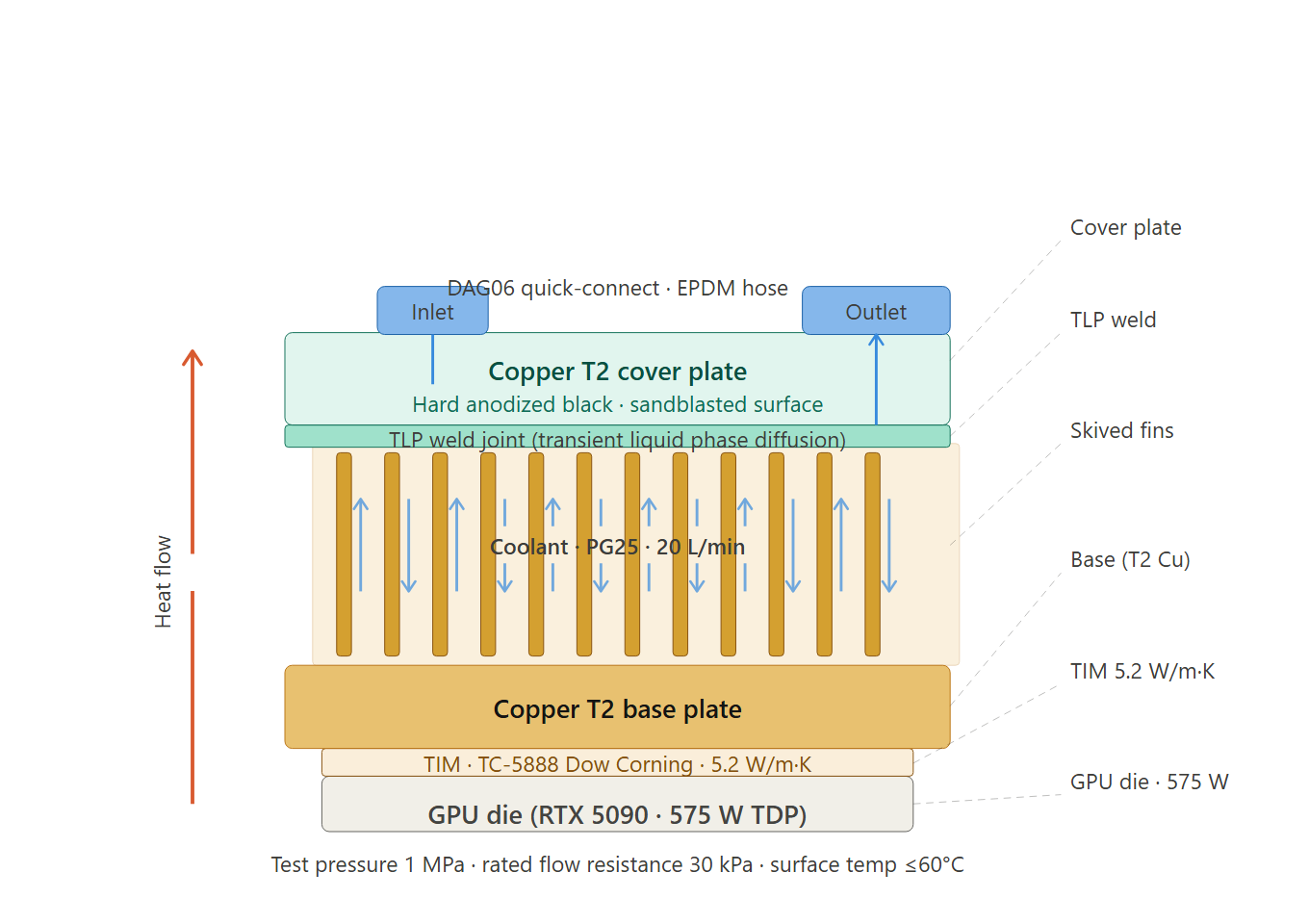
The thermal path from chip junction to heat sink comprises multiple resistances: junction → die/package → TIM → cold plate wall → coolant. Reducing the number and thickness of these interfaces and improving each interface’s thermal conductivity reduces junction temperature rise (ΔTj), which directly enables higher sustained clock rates and prevents thermal throttling.
3. Core Chip-Level Technologies and How They Work
3.1 Advanced Thermal Interface Materials (TIMs)
TIMs fill microscopic gaps between surfaces. Innovations in TIMs include:
- Liquid metal TIMs — extraordinary thermal conductivity but require barrier layers or coatings to avoid corrosion and electrical short risk.
- Phase change materials (PCMs) — improve transient heat conduction by melting to fill gaps during high power spikes.
- Nano-enhanced thermal greases and pads — polymer matrices loaded with graphene, carbon nanotubes or metal nanoparticles to substantially raise conductivity without electrical conductance issues.
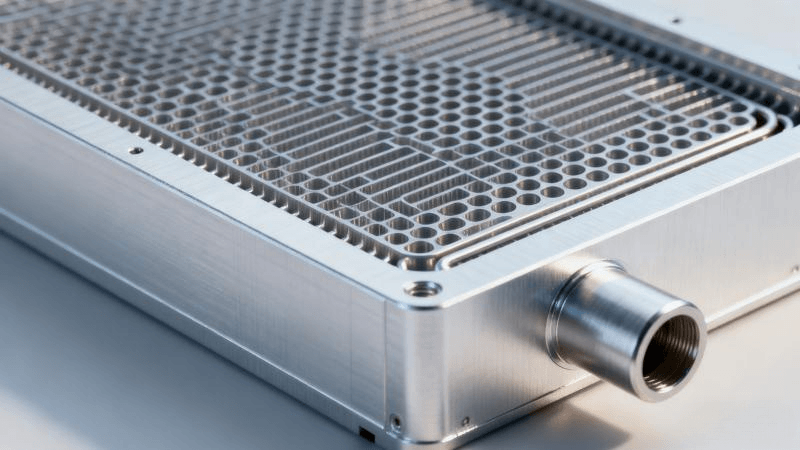
3.2 Microchannel Liquid Cold Plates (MLCP)
Microchannels are channels with hydraulic diameters typically in the tens to hundreds of microns. By massively increasing wetted surface area and thinning thermal boundary layers, microchannels increase convective heat transfer coefficients — enabling heat flux handling far beyond macro channels. Manufacturing approaches include micromilling, electroforming, metal additive manufacturing and precision diffusion or brazing techniques.
3.3 Vapor Chambers and Two-Dimensional Heat Spreading
Vapor chambers are flat heat pipes that spread heat laterally via phase change, reducing local thermal gradients before heat is extracted by a cold plate. Combining vapor chambers with microchannels (vapor + microchannel hybrids) yields both excellent spreading and local extraction.

3.4 Direct-Die and Immersion Options
Direct-die cooling removes the package lid or integrates microfluidics into the package to bring coolant closer to silicon. Immersion cooling (single-phase or two-phase) submerges entire boards in dielectric fluids; while immersion helps overall board cooling, chip-level solutions remain essential to address die-level hotspots.

3.5 Jet-Impingement and Micro-Pin Arrays
Targeted jet impingement cools hotspots by focusing high-momentum jets onto small areas. Micro-pin or micro-fin arrays enhance surface area and disrupt boundary layers, improving convective exchange.
4. The Physics Behind the Necessity — GPU Power and Heat Flux
4.1 Power scaling and heat flux
A 1,500W GPU concentrated on a 20–30 cm² package yields heat fluxes in the 50–75 W/cm² range on average and much higher locally (100–200 W/cm² on hotspots). Typical air-cooling solutions are effective below ~30–50 W/cm²; beyond that the cost of airflow, acoustic output and fan power skyrockets.
4.2 Impact on performance
High junction temperatures cause voltage and frequency limits, reducing achievable performance. Chip-level cooling maintains lower Tj and tighter temperature gradients, preserving peak operating frequency across sustained workloads. That means faster training runs and better utilization of expensive GPU hardware.
5. Chip-Level vs Traditional Air Cooling — A Direct Comparison
| Dimension | Chip-Level Cooling | Traditional Air Cooling |
|---|---|---|
| Heat flux handling | High to extreme (microchannel, jet, phase change) | Limited by airflow and boundary layers |
| Energy efficiency | Lower PUE due to reduced fan/chiller load | Higher PUE from fans and chillers |
| Noise & dust | Quiet; reduced dust risk; fluid maintenance required | Noisy; dust accumulates, more maintenance |
| System complexity | Higher (fluid handling, monitoring, service procedures) | Lower (well-understood ops) |
| Initial cost | Higher CAPEX and integration engineering | Lower CAPEX (but higher OPEX at scale) |
6. Innovation Directions — Materials, Structures and Intelligence
6.1 Materials innovation
Key material trends include ultra-high conductivity composites (e.g., copper-diamond), nanocarbon-enhanced TIMs, coatings to protect metal liquid TIMs, and low-GWP dielectric fluids for safe immersion and direct-die cooling.
6.2 Structural innovation
Microchannel topologies are evolving from straight parallel channels to biomimetic branching networks inspired by leaf venation. Additive manufacturing enables complex, bionic internal flow paths and integrated manifolds that reduce pressure drop and balance flow distribution. Hybrid structures combining vapor chambers and microchannels are gaining traction for their combined spreading and extraction capability.
6.3 Intelligent thermal management
Integration of dense temperature sensors, flow meters and AI/ML control loops allows predictive, adaptive thermal control: pumps and flow valves modulate in real time to meet thermal demand while minimizing energy. Workload scheduling can be integrated with thermal policies to distribute heat across the facility.
7. Market Size, Growth Drivers and Policy Context
7.1 Market snapshot and growth
Industry research consistently forecasts rapid growth for liquid cooling and chip-level cooling subsegments due to AI deployment. Market reports estimate multi-billion USD markets with high double-digit or low-double-digit CAGRs for direct-to-chip and TIM markets through the remainder of the decade. Demand is being driven primarily by hyperscalers, cloud providers, and enterprise AI clusters.
7.2 Key market drivers
- AI compute demand: large models and dense training clusters increase per-rack power and cooling requirements.
- Efficiency and regulation: PUE targets and decarbonization policies in many regions push data centers toward higher efficiency cooling.
- TCO and utilization: cooling that preserves peak performance reduces cost per training run and increases infrastructure utilization.
- Chip roadmap: device manufacturers continuing to increase power density accelerate the need for chip-level solutions.
8. Who Are the Key Players?
The ecosystem includes materials and TIM suppliers, cold plate and microchannel manufacturers, server OEMs and system integrators.
- Materials & TIM leaders — specialized polymer and nano-TIM makers, companies like 3M, Henkel and other specialty suppliers.
- Cold plate and microchannel manufacturers — precision brazing and micro-fabrication firms that can produce MLCP and vapor-microchannel hybrids.
- OEMs & Hyperscalers — NVIDIA, Intel, AMD, Dell, HPE and large cloud providers who set reference designs and drive adoption.
- Startups and integrators — companies focused on immersion, direct die, and AI thermal orchestration solutions.
Tone Cooling Technology Co., Ltd. — with expertise in vacuum brazing, friction stir welding and transient liquid phase diffusion bonding — is positioned to be a design and manufacturing partner for chip-level cold plate production and pilot programs.

9. Risks, Challenges and Implementation Barriers
9.1 Technical and reliability risks
- Fluid contamination and microchannel clogging require stringent filtration and maintenance regimes.
- Material compatibility and corrosion remain issues for some TIMs and liquid metals unless proper barrier coatings are used.
- Long-term reliability under thermal cycling and vibration needs robust qualification frameworks.
9.2 Operational and supply challenges
- New maintenance workflows, fluid handling protocols and tools are required for data center ops teams.
- Supply chain concentration for specialty fluids and nano-materials can create procurement risk.
- Standardization of connectors, quick-disconnects and CDU interfaces is incomplete, raising integration cost and complexity.
10. Short-Term and Long-Term Trends
10.1 Short term (1–3 years)
- Microchannel cold plates and improved TIMs will appear in more AI server designs.
- Hyperscalers will pilot direct-die and hybrid vapor-microchannel designs in specialized clusters.
- Operational best practices (filtration, monitoring) will become standardized inside large operators.
10.2 Mid term (3–5 years)
- Standardized CDU and connector interfaces may emerge, lowering integration costs.
- AI orchestration and thermal control will be integrated into datacenter orchestration platforms.
10.3 Long term (5–10 years)
- Chip and cooling co-design is likely to become common: packages and boards will be optimized with integrated microfluidics and thermal paths.
- Breakthrough materials (e.g., scalable diamond composites, carbon nanotube arrays in TIMs) could alter the thermal roadmap.
- Waste heat valorization becomes more common as liquid cooling delivers higher return temperatures.
11. Recent Developments
Recent industry announcements from major chip vendors and OEMs indicate a stepped increase in chip-level cooling pilots and investments. Partnerships between thermal solution providers and hyperscalers are accelerating qualification cycles for microchannel cold plates and direct die approaches. Likewise, materials vendors are releasing next-generation TIMs and low-GWP dielectric fluids tailored for high-density compute.
12. Practical Implementation Checklist
- Define thermal targets: peak and sustained per-die power, transient ramp, allowable ΔTj and hotspot thresholds.
- Select candidate TIMs and cold plate architectures (microchannel, vapor chamber + microchannel hybrids, direct die).
- Specify fluid purity, filtration, conductivity and particle size thresholds; plan CDU pump and flow head for microchannel pressure drop.
- Prototype: iterate mechanical design, TIM application method and cold plate mounting; validate with thermal cycling and vibration tests.
- Design maintenance workflows and operational monitoring (flow, temperature, conductivity, particle counters).
- Run TCO analysis: CAPEX vs OPEX, energy savings, increased rack density and projected ROI based on workload economics.
- Plan phased rollouts and pilot validations with service level targets and contingency plans.
13. FAQs
Q: Can TIM improvements alone solve 1500W GPU cooling?
A: No. TIMs reduce contact resistance and are necessary, but they are one part of a system. For 1,500W GPUs, aggressive extraction via microchannel cold plates, vapor chambers, or direct die methods is required to manage junction temperatures reliably.
Q: Are microchannel systems compatible with existing CDUs?
A: They can be, but microchannels typically require higher pump head and finer particulate filtration. CDUs may need upgraded pumps, finer filtration stages and revised flow balancing strategies.
Q: How do I evaluate whether my data center should pilot chip-level cooling?
A: Evaluate based on per-rack power density, cost per training hour, expected lifetime utilization of GPUs and local energy costs. If thermal throttling or PUE are material drivers of cost or performance loss, piloting chip-level cooling is recommended.
14. Conclusion — Chip-Level Cooling Is Strategic, Not Optional
GPU power trends mean thermal constraints will increasingly dictate compute capability. Chip-level cooling — combining advanced TIMs, microchannel extraction, vapor spreading and AI control — is now the decisive technology domain for enabling sustained, high-density AI compute. Early technical pilots and careful integration planning will separate successful adopters from those who pay in throttled performance and wasted opportunity cost.
Contact Tone Cooling for Custom GPU Liquid Cooling & Chip-Level Thermal Solutions
Tone Cooling Technology Co., Ltd. (est. 2004) specializes in custom liquid cold plates and chip-level thermal solutions for high-power GPUs, power electronics and AI servers. With advanced manufacturing capabilities — including vacuum brazing, friction stir welding and transient liquid phase diffusion bonding — and an R&D team of PhDs and senior thermal engineers, Tone Cooling can help you evaluate microchannel designs, select TIMs, run CFD simulations, prototype and scale production. Contact our team for a technical consultation and pilot program.
For industry standards and best practices, refer to NVIDIA Data Center.
Frequently Asked Questions
Does ToneCooling offer OEM and ODM services?
Yes. ToneCooling provides full OEM and ODM services including custom design, prototyping, thermal simulation, and volume production. We serve customers in North America, Europe, and Asia-Pacific with engineering support and samples within 2–4 weeks.
What server platforms does ToneCooling support?
ToneCooling liquid cooling solutions support Intel LGA4677, Intel LGA7529, AMD SP5, and NVIDIA GPU platforms including GB200 and H100/H200 configurations.
Can ToneCooling provide direct-to-chip cooling for AI clusters?
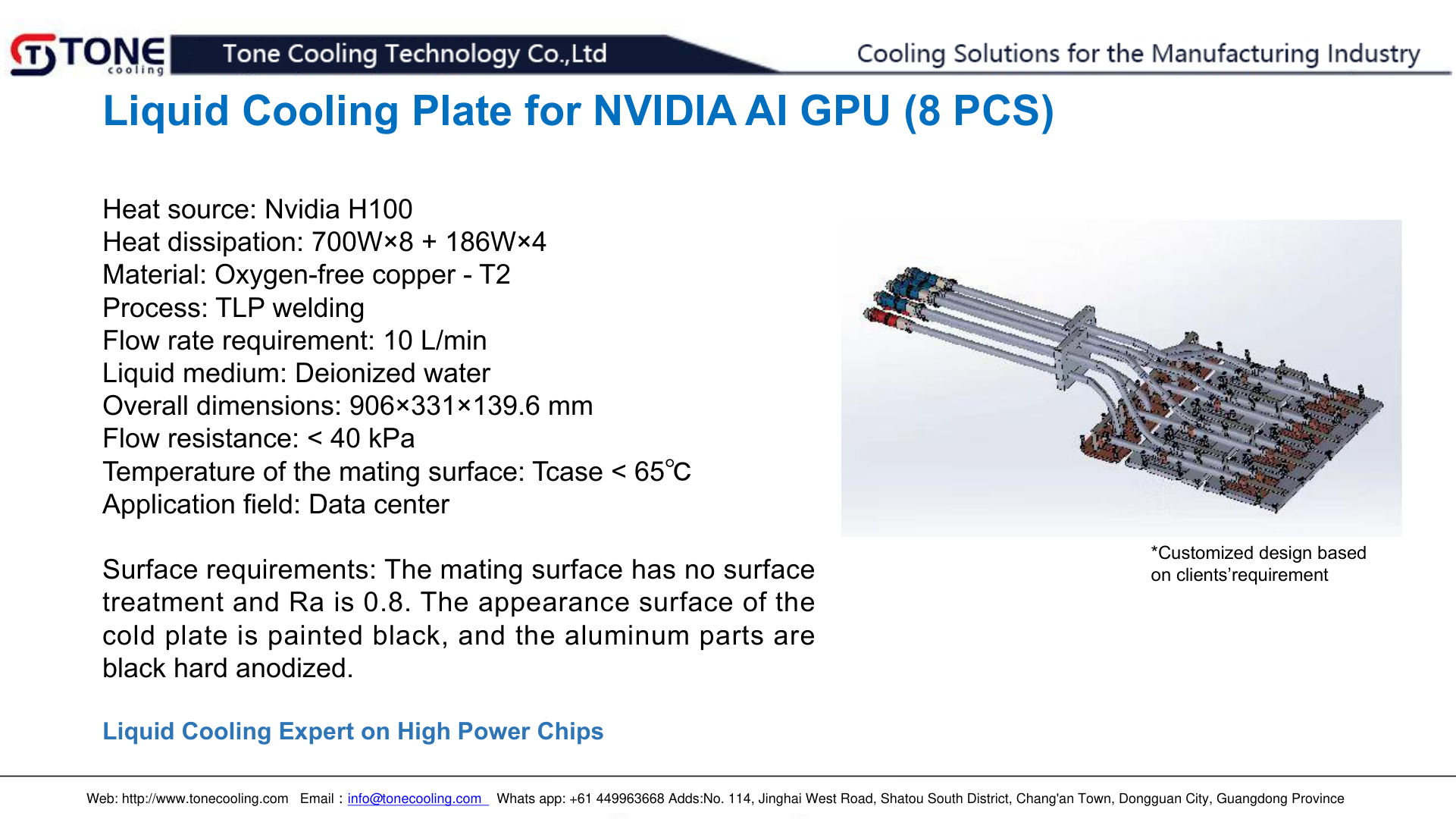
Yes. ToneCooling designs and manufactures direct-to-chip liquid cooling cold plates for GPU and CPU in AI training and inference clusters, supporting thermal loads exceeding 700W per chip.
Get a Custom Thermal Solution from ToneCooling
ToneCooling is a professional liquid cooling solution provider specializing in custom cold plates, AIO coolers, and advanced thermal management systems. With ISO 9001:2015 certified manufacturing, we deliver prototype samples within 2–4 weeks. Contact ToneCooling today for a free consultation and quote — we respond within 24 business hours.
References: ASHRAE thermal standards, Wikipedia: Heat Sink Technology
Related ToneCooling Resources
- Liquid Cold Plates Product Line
- Request a Custom Cold Plate Quote
- Technical Resources & Design Guides
Need a Custom Liquid Cold Plate?
ToneCooling engineers design thermal solutions for your specific requirements. Get a detailed response within 24-48 hours.
Semiconductor Test Fixture Cold Plate is a critical component in modern thermal management. ToneCooling engineers this solution for AI servers, data centers, EV batteries, and power electronics requiring high-performance liquid cooling.
Semiconductor Test Fixture Cold Plate: Key Specifications
When evaluating semiconductor test fixture cold plate, engineers consider thermal resistance, pressure drop, flow rate, and material compatibility. ToneCooling provides detailed specs for every semiconductor test fixture cold plate design, backed by CFD simulation and testing.
Why Choose ToneCooling for Semiconductor Test Fixture Cold Plate
ToneCooling has manufactured over 50,000 semiconductor test fixture cold plate units for global OEM customers. Our semiconductor test fixture cold plate production features vacuum brazing furnaces below 10⁻⁴ mbar, FSW machines with ≤0.02mm flatness, and helium leak detection at 10⁻⁸ mbar·L/s. Every semiconductor test fixture cold plate undergoes 100% pressure testing at 25 bar.
Our engineering team provides free semiconductor test fixture cold plate design consultation, CFD simulation, and rapid prototyping in 7-14 days. Production semiconductor test fixture cold plate orders ship in 4-6 weeks under ISO 9001:2015 quality management.
Need a Custom Liquid Cold Plate?
ToneCooling engineers design thermal solutions for your requirements. Response within 24-48 hours.
Last Updated: 2026-04-08
DR Kevin, Thermal Engineer, ToneCooling
Need a Custom Liquid Cold Plate?
Tell us your thermal requirements. Engineering team responds within 48 hours with design proposal and quotation.
Request a Quote →MOQ 5 pcs • Prototype 7-15 days • ISO 9001 Certified