For rail transit IGBT liquid cooling, pure water removes heat better while water-glycol protects against freezing at the cost of some thermal performance and higher pressure drop. This ToneCooling CFD study compares both coolants on a traction inverter cold plate.
Rail transit traction inverters operate under demanding thermal conditions — ambient temperatures ranging from -40°C to +55°C, vibration loads, and the requirement for decades-long service life. The IGBT modules in these inverters require liquid cooling systems that perform reliably with both pure water and glycol-based coolants, depending on climate zone and freeze protection requirements.
This CFD simulation evaluates ToneCooling’s 6-IGBT liquid cold plate under four operating conditions, comparing pure water and 50% ethylene glycol coolant at two inlet temperatures (25°C and 45°C).
Simulation Configuration
| Parameter | Value |
|---|---|
| IGBT Modules | 6 units (serial flow path) |
| Flow Rate | 20 L/min |
| Inlet Temperatures | 25°C and 45°C |
| Coolant Options | Pure water / 50% ethylene glycol |
| Ambient Temperature | 45°C |

Simulation Results: 4 Operating Conditions
| Condition | Tc1 (°C) | Tc2 | Tc3 | Tc4 | Tc5 | Tc6 | Outlet (°C) |
|---|---|---|---|---|---|---|---|
| 25°C Pure Water | 44.9 | 44.2 | 48.0 | 46.5 | 49.0 | 47.9 | 30.5 |
| 45°C Pure Water | 64.9 | 64.3 | 68.3 | 66.8 | 69.7 | 68.4 | 50.6 |
| 25°C 50% Glycol | 51.7 | 51.5 | 55.6 | 54.3 | 57.0 | 55.7 | 31.6 |
| 45°C 50% Glycol | 69.9 | 69.4 | 73.9 | 72.4 | 75.6 | 74.1 | 51.6 |

Key Engineering Findings
- Glycol penalty: Switching from pure water to 50% glycol increases IGBT surface temperatures by 6–8°C across all conditions
- Inlet temperature sensitivity: A 20°C increase in inlet temperature produces almost exactly 20°C higher surface temperatures — confirming linear thermal response
- Worst case: At 45°C inlet with 50% glycol, maximum IGBT temperature reaches 75.6°C — still within the 80°C safe operating limit for standard IGBT modules
- Temperature uniformity: Maximum temperature variation across 6 IGBT positions is less than 6°C, ensuring balanced thermal aging
Coolant Selection Guide for Rail Transit Applications
The choice between pure water and glycol coolant in rail transit depends on operating climate:

- Tropical/subtropical routes: Pure water provides the best thermal performance. Use corrosion inhibitor additives to protect aluminum components.
- Temperate climates: 30% ethylene glycol provides freeze protection to -15°C with moderate thermal penalty (~4°C)
- Cold climates (-30°C and below): 50% ethylene glycol is required for freeze protection, with the 6–8°C thermal penalty shown in this simulation
Frequently Asked Questions
Why is IGBT temperature non-uniform across the 6 positions?
The coolant flows serially through all 6 IGBT positions. Each successive module encounters slightly warmer coolant, resulting in progressively higher surface temperatures. The maximum delta of 6°C across 6 modules is considered excellent uniformity for serial-flow designs.
What is the expected service life for rail transit cold plates?
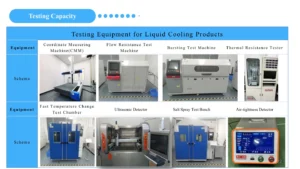
ToneCooling’s rail transit cold plates are designed for 30+ year service life with proper coolant maintenance. All units undergo 100% hydrostatic leak testing at 2× rated working pressure and thermal cycling validation per EN 50155 railway standards.
Can the cold plate handle higher flow rates for better cooling?
Yes. Increasing flow from 20 L/min to 30 L/min typically reduces IGBT temperatures by 3–5°C. However, pressure drop increases significantly. Contact ToneCooling for flow rate optimization specific to your traction inverter pump capacity.
prototypes from 1 piece · ISO 9001 · EN 50155 Compatible
Related: IGBT Cold Plates | IGBT 10kW CFD Analysis | All Liquid Cold Plates
Related ToneCooling Resources
Industry References & Standards
Why Choose ToneCooling for Liquid Cold Plate CFD Simulation
Engineering review and prototype planning are based on the project requirements. Custom prototype lead time is normally 4–6 weeks after drawing approval and order confirmation; confirm the production schedule in the quotation.
Need a Custom Liquid Cold Plate?
ToneCooling engineers review your drawings and requirements and reply by email with next steps.
Last updated: 2026-10-02