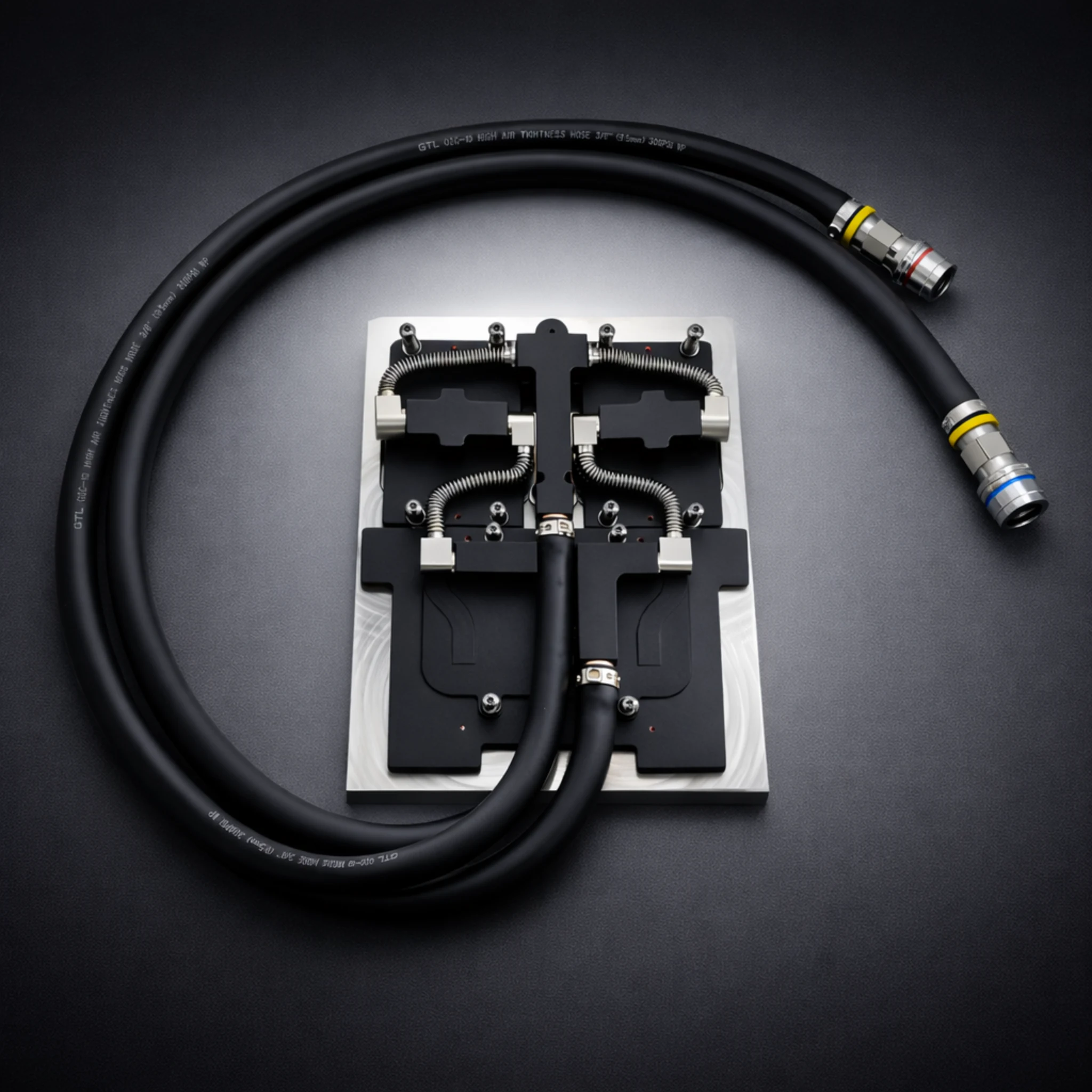
What Is a Liquid Cold Plate?
A liquid cold plate is a heat exchanger designed to transfer thermal energy from a heat-generating component to a circulating liquid coolant. Unlike air-cooled heat sinks that rely on convective airflow, a liquid cold plate uses internal fluid channels to absorb and carry away heat with significantly higher efficiency. This makes the liquid cold plate an essential component in high-performance thermal management systems across industries including data centers, electric vehicles, power electronics, and laser systems.
How Does a Liquid Cold Plate Work?
The operating principle of a liquid cold plate is straightforward: a coolant — typically water, water-glycol mixture, or dielectric fluid — flows through internal channels machined or formed within a metal plate. The plate is mounted directly to the heat source (CPU, GPU, IGBT module, laser diode, or battery cell). Heat conducts from the component into the plate body, then transfers to the flowing coolant. The heated coolant exits through an outlet port and is cooled by an external radiator, chiller, or cooling distribution unit (CDU) before recirculating.
Key performance factors include channel geometry, coolant flow rate, thermal interface material (TIM) quality, and plate material thermal conductivity. Design standards such as those from ASHRAE guide thermal management best practices for data center applications.
Types of Liquid Cold Plates
Liquid cold plate designs vary based on manufacturing method, internal channel structure, and application requirements. The most common types include:
Tubed Cold Plates
Tubed cold plates use copper or stainless steel tubes pressed or soldered into a machined aluminum or copper base plate. They offer a cost-effective solution for moderate heat loads (50–200W) and are widely used in power electronics and industrial applications. Explore ToneCooling tubed cold plates.
Brazed Cold Plates
Vacuum brazed liquid cold plates feature complex internal fin structures created by brazing multiple layers together in a vacuum furnace. This creates highly efficient turbulent flow paths capable of dissipating 200–1,000W+ heat loads. Brazed designs are preferred for high-density applications such as IGBT modules, AI accelerators, and EV battery systems. View ToneCooling vacuum brazed cold plates.

Friction Stir Welded (FSW) Cold Plates
FSW cold plates use friction stir welding to seal CNC-machined channels, creating leak-proof joints without filler materials. This method is ideal for large-format cold plates used in EV battery cooling and high-power laser systems. Learn about ToneCooling FSW cold plates.

Micro-Channel Cold Plates
Micro-channel liquid cold plates feature extremely fine channels (typically 0.1–1.0mm width) that maximize surface area contact between the coolant and plate material. These achieve the highest thermal performance per unit area and are used in semiconductor cooling, high-power laser diodes, and advanced AI chip cooling.
Cold Plate Materials: Copper vs Aluminum
Material selection significantly impacts liquid cold plate performance, weight, and cost:
Copper cold plates offer superior thermal conductivity (385 W/m·K) and are ideal for high heat flux applications. However, copper is heavier and more expensive than aluminum.
Aluminum cold plates provide good thermal conductivity (205 W/m·K) at roughly one-third the weight and cost of copper. Aluminum is the preferred choice for large-format cold plates in EV battery systems and telecom applications.
Many designs use a hybrid approach — copper inserts or copper base plates combined with aluminum bodies — to optimize both thermal performance and cost.
Key Applications of Liquid Cold Plates
The liquid cold plate is used across a wide range of thermal management applications:
- Data Centers & AI Servers: CPU and GPU direct-to-chip cooling for H100, GB200, and EPYC platforms
- Electric Vehicles: Battery module cooling, inverter cooling, and motor controller thermal management
- Power Electronics: IGBT module cooling, rectifier cooling, and power supply thermal management
- Laser Systems: Diode laser cooling, fiber laser cooling, and optical component thermal regulation
- Telecommunications: 5G base station cooling, RF amplifier cooling
How to Choose the Right Liquid Cold Plate
Selecting the optimal liquid cold plate requires evaluating several factors:
- Heat load (TDP): Total thermal power that must be dissipated
- Heat flux density: Watts per square centimeter at the component interface
- Coolant type: Water, water-glycol, or dielectric fluid compatibility
- Pressure drop budget: Available pump pressure for the cooling loop
- Size and weight constraints: Available mounting space and weight limits
- Volume and cost targets: Prototype vs mass production quantities
Contact ToneCooling for engineering support in selecting the right liquid cold plate for your application.
| Parameter | ToneCooling Specification |
|---|---|
| Material | Copper T2 / 6061 aluminum |
| Welding method | Transient liquid phase diffusion welding |
| Test pressure | 1 MPa (helium leak + nitrogen hold) |
| Working medium | PG25 (25% propylene glycol) |
| Custom design | Yes — DXF/STEP input accepted |
Ready to design your cold plate? See our custom liquid cold plate manufacturing capabilities or request a free thermal design consultation.
Frequently Asked Questions
What is the difference between a cold plate and a heat sink?
A heat sink dissipates heat through natural or forced air convection using fins. A liquid cold plate transfers heat to a flowing liquid coolant, achieving 2-5x higher thermal performance per unit area.
What coolant should I use with a liquid cold plate?
The most common coolant is a water-glycol mixture (typically 50/50 or 70/30 water-glycol). For electronics applications requiring electrical isolation, dielectric coolants such as 3M Novec or Fluorinert are used.
Can ToneCooling customize cold plates for my application?
Yes. ToneCooling specializes in custom liquid cold plate design and manufacturing for OEM customers. We support custom geometries, mounting patterns, fitting configurations, and material selections. Request a custom quote.
What is the typical lead time for custom cold plates?
Prototype cold plates are typically delivered in 2-3 weeks. Production orders depend on quantity and complexity — contact us for a detailed timeline.
Need a custom liquid cold plate for your project? Contact ToneCooling for a free thermal consultation and OEM quote.
Related ToneCooling Solutions
- Custom Cold Plate Solutions – High-performance liquid cooling cold plates for OEM applications
- AIO Liquid Cooler Systems – All-in-one liquid cooling solutions for servers and workstations
- Battery Cold Plate for EVs – Thermal management for electric vehicle battery packs
Request a Custom Quote from ToneCooling →
Industry References & Standards
Liquid Cold Plate is a precision-engineered thermal management component designed for high-power electronics cooling. ToneCooling provides liquid cold plate solutions validated for AI server, data center, EV battery, and power electronics applications.
Liquid Cold Plate Material Selection is a critical component in modern thermal management. ToneCooling engineers this solution for AI servers, data centers, EV batteries, and power electronics requiring high-performance liquid cooling.
Liquid Cold Plate Material Selection: Key Specifications
When evaluating liquid cold plate material selection, engineers consider thermal resistance, pressure drop, flow rate, and material compatibility. ToneCooling provides detailed specs for every liquid cold plate material selection design, backed by CFD simulation and testing.
Why Choose ToneCooling for Liquid Cold Plate Material Selection
ToneCooling has manufactured over 50,000 liquid cold plate material selection units for global OEM customers. Our liquid cold plate material selection production features vacuum brazing furnaces below 10⁻⁴ mbar, FSW machines with ≤0.02mm flatness, and helium leak detection at 10⁻⁸ mbar·L/s. Every liquid cold plate material selection undergoes 100% pressure testing at 25 bar.
Our engineering team provides free liquid cold plate material selection design consultation, CFD simulation, and rapid prototyping in 7-14 days. Production liquid cold plate material selection orders ship in 4-6 weeks under ISO 9001:2015 quality management.
Last Updated: 2026-04-08
DR Kevin, Thermal Engineer, ToneCooling
Need a custom liquid cold plate solution?
ToneCooling engineers respond within 24 hours with CFD-validated thermal recommendations.