An AlSiC heat sink manufacturer is a specialized company that produces thermal management components from aluminum silicon carbide (AlSiC) metal matrix composite — a material combining aluminum’s processability with silicon carbide’s low thermal expansion coefficient (CTE 7–12 ppm/°C) — for power electronics, aerospace, and telecommunications applications requiring CTE-matched cooling solutions. The top AlSiC heat sink manufacturers globally include ToneCooling (China), CPS Technologies (USA), Denka (Japan), Ceramtec (Germany), and TRUSUNG (China), each serving different market segments from prototype to high-volume production. ToneCooling manufactures custom AlSiC pin fin heat sinks and baseplates with SiC volume fractions from 50–70%, prototypes from 1 piece, and ISO 9001 certified quality.
Last Updated: 2026-04-09 | Author: ToneCooling Thermal Engineering Team
What Makes AlSiC the Preferred Material for Power Electronics Heat Sinks?
AlSiC (aluminum silicon carbide) is a metal matrix composite (MMC) specifically engineered to solve the thermal expansion mismatch problem in power electronics packaging. When a heat sink with high CTE (aluminum: 23.4 ppm/°C) is soldered directly to a low-CTE semiconductor substrate (silicon: 4.1 ppm/°C, alumina: 7.2 ppm/°C), thermal cycling causes differential expansion that cracks solder joints within 1,000–3,000 cycles.
AlSiC eliminates this failure mode by matching its CTE to semiconductor substrates:
| Material | CTE (ppm/°C) | Thermal Conductivity (W/m·K) | Density (g/cm³) | CTE Match to Si Die |
|---|---|---|---|---|
| AlSiC (60% SiC) | 8.4 | 190 | 3.0 | Excellent (2x) |
| Aluminum 6063 | 23.4 | 201 | 2.7 | Poor (5.7x) |
| Copper C1100 | 17.0 | 391 | 8.9 | Poor (4.1x) |
| CuMo (85/15) | 7.0 | 170 | 10.0 | Good (1.7x) |
| CuW (80/20) | 6.5 | 180 | 15.6 | Good (1.6x) |
| Silicon (die) | 4.1 | 150 | 2.3 | Reference |
| Al₂O₃ (substrate) | 7.2 | 25 | 3.9 | — |
| AlN (substrate) | 4.5 | 170 | 3.3 | — |
AlSiC offers the optimal combination: CTE close to semiconductor substrates, thermal conductivity comparable to aluminum, and density 3x lower than copper-based alternatives (CuMo, CuW). This makes it the preferred choice for IGBT baseplates, RF power amplifier carriers, and aerospace electronics packaging.

How to Evaluate an AlSiC Heat Sink Manufacturer
Not all AlSiC manufacturers offer the same capabilities. Use these seven criteria to evaluate potential suppliers:
- SiC volume fraction range: Can they adjust SiC content from 50–70% to fine-tune CTE? Lower SiC = higher thermal conductivity; higher SiC = lower CTE. ToneCooling offers 50–70% range.
- Manufacturing process: Pressure infiltration (highest density, best properties) vs. stir casting (lower cost, lower performance). ToneCooling uses pressure infiltration at 50–100 MPa.
- Machining capability: AlSiC is extremely abrasive — requires diamond-coated CNC tooling. Not all manufacturers can machine pin fins or complex geometries to tight tolerances.
- Surface finishing: Electroless nickel plating (5–15 μm) is essential for solderability. Quality of Ni plating determines solder wetting and long-term reliability.
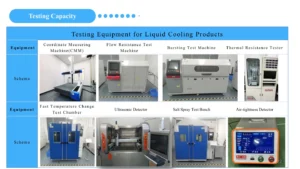
- Quality testing: CTE measurement (dilatometer), thermal conductivity (laser flash method), density (Archimedes method), and flatness inspection should be standard.
- Prototype capability: Quantity and lead time for prototypes. ToneCooling: prototypes from 1 piece, 4–6 weeks. Some manufacturers require Prototype quantity 50–100+.
- Certifications: ISO 9001 minimum. For aerospace: AS9100. For automotive: IATF 16949-aligned or PPAP documentation.

AlSiC Heat Sink Manufacturer Comparison
Overview of major AlSiC heat sink manufacturers serving the global market:
| Manufacturer | Location | Process | SiC Range | Strengths | Prototype quantity |
|---|---|---|---|---|---|
| ToneCooling | China (Huizhou) | Pressure infiltration | 50–70% | Custom pin fin, fast prototype, ISO 9001 | From 1 piece |
| CPS Technologies | USA (Boston) | Pressure infiltration | 55–68% | Aerospace heritage, hermetic packages | 25+ pcs |
| Denka | Japan | Squeeze casting | 50–65% | High-volume automotive, Japanese OEM network | 100+ pcs |
| Ceramtec | Germany | Pressure infiltration | 55–70% | European automotive, high reliability | 50+ pcs |
| TRUSUNG | China (Changsha) | Pressure infiltration | 50–70% | Large baseplate capability, cost-competitive | 20+ pcs |
| Heeger Materials | China | Various | 50–65% | Material supplier, small quantity | 1 pc |

AlSiC Heat Sink Applications by Industry
- Power Electronics (IGBT/SiC): Pin fin baseplates for IGBT modules in EV traction inverters, industrial drives, and renewable energy converters. CTE matching extends solder joint life from 2,000 to >10,000 thermal cycles.
- Aerospace & Defense: Radar T/R module carriers, phased array antenna heat spreaders, satellite power systems. MIL-STD-883 hermetic packaging with gas-tight AlSiC enclosures.
- Telecommunications: 5G massive MIMO RF power amplifier heat spreaders, GaN PA carriers requiring CTE <10 ppm/°C at operating frequencies above 3.5 GHz.
- Medical: MRI gradient amplifier cooling, high-power laser diode heat spreaders, CT scanner X-ray tube thermal management.
- EV Battery Management: Power module baseplates in battery management systems and onboard charger power stages.
Why Choose ToneCooling as Your AlSiC Heat Sink Manufacturer
ToneCooling differentiates from other AlSiC manufacturers in four key areas:
- Low-volume prototyping from 1 piece, enabling rapid design iteration
- Pin fin machining expertise: Diamond-coated 5-axis CNC capability for complex pin fin arrays, tapered pins, and integrated mounting features
- Complete thermal solution: Beyond AlSiC baseplates, we also supply IGBT liquid cold plates, aluminum heatsinks, and vapor chambers — one supplier for your entire thermal stack
- Validated quality: ISO 9001 certified. Every AlSiC batch includes CTE measurement, thermal conductivity test, and dimensional inspection report. Tsinghua University research contract validates our precision manufacturing capability.
Request AlSiC Heat Sink Samples or Quotation
Whether you need 5 prototype AlSiC baseplates for evaluation or 10,000 production units for an EV traction inverter program, ToneCooling delivers from concept to mass production with full quality documentation.
➔ Request AlSiC Heat Sink Quote | info@tonecooling.com | US: +1 (832) 720-7542
Frequently Asked Questions: AlSiC Heat Sink Manufacturer
What is AlSiC material used for in heat sinks?
AlSiC (aluminum silicon carbide) is used for heat sinks and baseplates in power electronics where CTE matching to semiconductor substrates is critical. Its CTE of 7–12 ppm/°C prevents solder joint cracking during thermal cycling, extending IGBT module life from 2,000 to over 10,000 cycles.
How much does an AlSiC heat sink cost compared to aluminum?
AlSiC heat sinks cost 5–8x more than equivalent aluminum designs due to specialized SiC preform fabrication and diamond tooling machining. The cost is justified by 5–10x longer thermal cycling life in demanding applications.
What prototype quantity does ToneCooling accept?
ToneCooling offers AlSiC prototypes from 1 piece with 4–6 week delivery. This enables rapid design iteration and qualification testing before committing to production volumes.
Can AlSiC heat sinks be directly soldered to DBC substrates?
Yes. AlSiC’s CTE (8.4 ppm/°C at 60% SiC) closely matches DBC ceramic substrates (Al₂O₃: 7.2 ppm/°C, AlN: 4.5 ppm/°C), enabling reliable direct solder attachment without CTE-induced stress cracking. Electroless nickel plating (5–15 μm) is required for proper solder wetting.
What certifications should an AlSiC heat sink manufacturer have?
Minimum: ISO 9001 quality management. For aerospace: AS9100. For automotive: IATF 16949-aligned or PPAP Level 3 documentation. ToneCooling is ISO 9001 certified and provides PPAP documentation for automotive OEM programs.