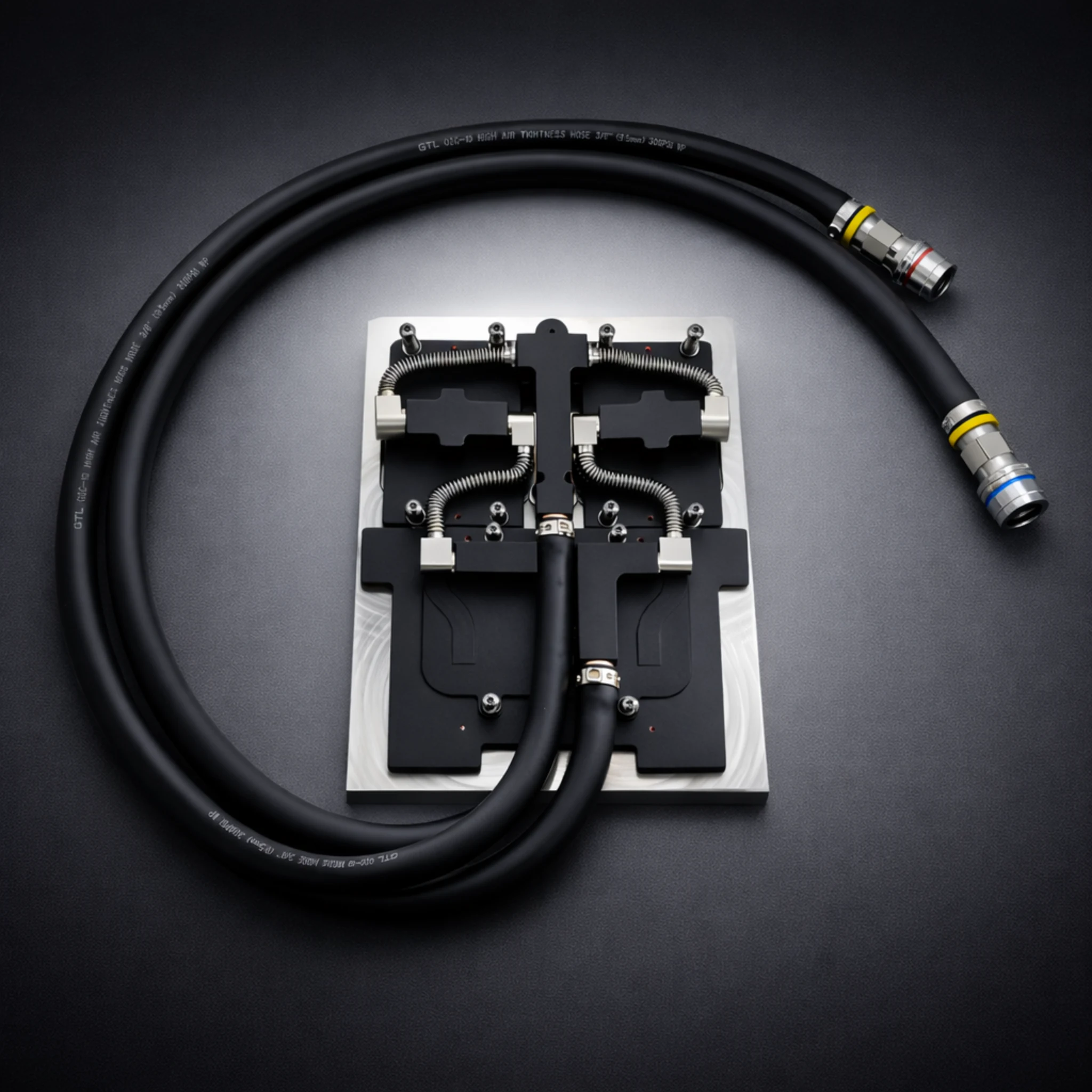
Liquid Cold Plate Thermal Resistance is a high-performance thermal management solution engineered by ToneCooling for demanding applications.
Last Updated: 2026-04-06 | Author: DR Kevin, Thermal Engineer, ToneCooling
Liquid cold plate thermal resistance (Rth) is the single most important performance metric for any liquid cooling system — it defines how efficiently heat flows from your device junction to the coolant. Rth is measured in °C/W: a cold plate with Rth = 0.04°C/W will raise coolant temperature by 4°C for every 100W of heat dissipated. For a 2400W GPU, that’s a 96°C temperature rise from coolant to junction — which is why optimizing Rth is critical for high-power AI computing.
ToneCooling’s thermal engineering team has measured and optimized cold plate Rth for over 200 custom designs across AI server, EV battery, IGBT, and laser cooling applications. This guide covers the physics, calculation methods, measurement protocols, and practical optimization strategies based on our production test data.
What Is Liquid Cold Plate Thermal Resistance?
Liquid cold plate thermal resistance (Rth) is defined as the temperature difference between the heat source junction (Tj) and the coolant bulk temperature (Tcoolant) divided by the total heat dissipated (Q):
Rth = (Tj − Tcoolant) / Q [°C/W]
Total cold plate Rth is the sum of three series resistances:
- TIM resistance (R_TIM): Thermal interface material between device and cold plate base
- Base conduction resistance (R_base): Heat spreading through cold plate base material
- Convective resistance (R_conv): Coolant-to-fin heat transfer (dominant term)
| Resistance Component | Typical Value | Primary Driver |
|---|---|---|
| R_TIM (indium foil) | 0.002–0.005 °C/W | TIM conductivity, bondline thickness |
| R_TIM (thermal paste) | 0.008–0.020 °C/W | Paste conductivity, application |
| R_base (copper, 5mm) | 0.001–0.003 °C/W | Material k, base thickness |
| R_base (aluminum, 5mm) | 0.003–0.008 °C/W | Material k, base thickness |
| R_conv (microchannel) | 0.020–0.035 °C/W | Channel geometry, flow rate, fluid |
| R_conv (mini-channel) | 0.035–0.060 °C/W | Channel geometry, flow rate |
How to Calculate Cold Plate Thermal Resistance
The convective thermal resistance (R_conv) dominates total cold plate Rth and is calculated as:
R_conv = 1 / (h × A_wetted)
Where h is the heat transfer coefficient (W/m²·K) and A_wetted is the total wetted surface area of the channel structure. The heat transfer coefficient for turbulent flow in rectangular microchannels is calculated using the Dittus-Boelter correlation:
Nu = 0.023 × Re⁰·⁸ × Pr⁰·⁴
h = Nu × k_fluid / D_h
Where Re is Reynolds number, Pr is Prandtl number of the coolant, k_fluid is coolant thermal conductivity, and D_h is hydraulic diameter of the channel.
Worked Example: GB300 Cold Plate Rth Calculation
For a copper microchannel cold plate serving a GB300 GPU (2400W, 152×102mm footprint):
- Channel width: 1.0mm, channel height: 5mm, fin pitch: 1.6mm
- Number of channels: 70, total length per channel: 90mm
- Coolant: 40% EG/water, flow rate: 3.5 L/min total
- A_wetted = 70 × 2 × (1.0 + 5.0) × 10⁻³ × 90 × 10⁻³ = 0.0756 m²
- D_h = 2×(1.0×5.0)/(1.0+5.0) mm = 1.67mm
- Re at 3.5 L/min per 70 channels ≈ 1,450 (transitional-turbulent)
- h ≈ 18,500 W/m²·K
- R_conv = 1/(18,500 × 0.0756) = 0.0007 °C/W per channel, total R_conv ≈ 0.026°C/W
ToneCooling’s measured Rth for this configuration: 0.027°C/W (including R_base and R_TIM with indium foil), within 4% of the analytical prediction.
How to Measure Cold Plate Thermal Resistance
Accurate Rth measurement requires a calibrated thermal test vehicle (TTV). ToneCooling’s standard measurement protocol:
- Mount TTV on cold plate with production-spec TIM at specified torque
- Set coolant flow rate to specified value (measure with Coriolis or turbine flowmeter, ±1% accuracy)
- Set coolant inlet temperature to 40°C ± 0.5°C using recirculating chiller
- Apply heat load via TTV embedded heater at target power (e.g., 2400W)
- Wait for steady state: ΔTj < 0.1°C over 5 minutes
- Record: Tj (TTV thermocouple), Tin, Tout, Q (±0.5% power accuracy)
- Calculate: Rth = (Tj − Tin) / Q
DR Kevin note: “The most common measurement error we see from customers is measuring Rth at partial load (500W instead of full TDP). Rth is not constant — it decreases slightly at higher flow rates due to transition from laminar to turbulent regime. Always measure and specify Rth at the actual operating condition.”
How to Optimize Cold Plate Thermal Resistance
ToneCooling’s engineering optimization sequence, based on sensitivity analysis across 50+ cold plate CFD studies:
1. Increase Flow Rate (Highest Impact at Low Flow)
Doubling flow rate from 1.0 L/min to 2.0 L/min typically reduces Rth by 25–35% by increasing Re and transitioning from laminar to turbulent flow. Above 3.0 L/min, the Rth reduction diminishes to < 10% per doubling while pressure drop increases quadratically. Optimal flow rate is 2.5–4.0 L/min for most GPU cold plate applications.
2. Reduce Channel Hydraulic Diameter (Microchannel Design)
Reducing channel width from 2.0mm (mini-channel) to 1.0mm (microchannel) increases h by approximately 40% through increased surface-area-to-volume ratio. Trade-off: pressure drop increases by 3–4×. ToneCooling uses CFD optimization to find the Pareto-optimal channel geometry for each application’s flow budget.
3. Switch from Aluminum to Copper Base
Replacing an aluminum base (k = 167 W/m·K) with copper (k = 400 W/m·K) reduces R_base by approximately 58%. This is most impactful for high heat flux density (> 50 W/cm²) applications where base spreading resistance is significant. For diffuse heat sources (< 20 W/cm²), the impact is minimal.
4. Upgrade TIM from Paste to Indium Foil
Switching from high-performance thermal paste (k = 8–12 W/m·K) to indium foil (k = 82 W/m·K, 100μm thick) reduces R_TIM from 0.012–0.020°C/W to 0.002–0.004°C/W. At 2400W, this saves 24–48°C of temperature budget — equivalent to switching from mini-channel to microchannel design.
Cold Plate Thermal Resistance: Benchmark Data by Application
| Application | Heat Load | Target Rth | ToneCooling Achieved | Method |
|---|---|---|---|---|
| NVIDIA GB300 GPU | 2400W | ≤ 0.030°C/W | 0.027°C/W | Cu microchannel, brazing |
| NVIDIA GB200 GPU | 1800W | ≤ 0.040°C/W | 0.035°C/W | Cu microchannel, brazing |
| NVIDIA H200 GPU | 1000W | ≤ 0.050°C/W | 0.042°C/W | Cu microchannel, brazing |
| IGBT module (rail) | 8kW | ≤ 0.060°C/W | 0.048°C/W | Al pin-fin, brazing |
| EV battery module | 5kW/m² | ≤ 0.020°C·m²/W | 0.015°C·m²/W | Al stamped, FSW |
| Laser diode bar | 800W | ≤ 0.025°C/W | 0.020°C/W | Cu microchannel, brazing |
Frequently Asked Questions: Liquid Cold Plate Thermal Resistance
What is a good thermal resistance for a GPU liquid cold plate?
A good thermal resistance for a GPU liquid cold plate depends on GPU TDP: for NVIDIA H200 (1000W), target Rth ≤ 0.050°C/W; for GB200 (1800W), target Rth ≤ 0.040°C/W; for GB300 (2400W), target Rth ≤ 0.030°C/W. These targets maintain GPU junction temperature below 85°C with standard coolant inlet temperatures of 40–45°C. ToneCooling’s copper microchannel cold plates consistently achieve the targets for all three GPU generations.
How does coolant flow rate affect thermal resistance?
Increasing flow rate reduces thermal resistance by increasing the convective heat transfer coefficient. However, the relationship is non-linear: doubling flow rate from 1 to 2 L/min typically reduces Rth by 25–35%, while doubling from 3 to 6 L/min reduces Rth by only 8–12%. The diminishing returns above 3–4 L/min mean that optimizing channel geometry delivers better Rth improvement per unit pressure drop than simply increasing flow rate.
Can I calculate cold plate thermal resistance without CFD?
Yes, for simple parallel-channel geometries, analytical methods using the Dittus-Boelter or Gnielinski correlations give Rth estimates within 10–15% of measured values. For complex geometries (offset fins, pin arrays, multi-pass serpentine), CFD simulation is required for accurate prediction. ToneCooling provides free CFD thermal analysis as part of the design review process for new cold plate projects.
What is the difference between junction-to-case and junction-to-coolant thermal resistance?
Junction-to-case resistance (Rjc) is a device-level parameter defined by the semiconductor manufacturer — it represents heat flow from die to device package bottom. Junction-to-coolant resistance (Rth, total) includes Rjc plus TIM resistance, cold plate base resistance, and convective resistance. Cold plate Rth specifications typically refer to the cold plate contribution only (case-to-coolant), not including Rjc. Always confirm which thermal resistance definition applies when comparing cold plate specifications from different suppliers.
Written by DR Kevin, Thermal Engineer at ToneCooling. DR Kevin specializes in thermal resistance characterization and optimization for high-power semiconductor cooling, with a focus on AI GPU and IGBT applications.
Related ToneCooling Resources
Industry References & Standards
Need a Custom Liquid Cold Plate?
ToneCooling engineers design thermal solutions for your specific requirements. Get an engineering RFQ review based on your uploaded requirements.
Why Choose ToneCooling for Liquid Cold Plate Thermal Resistance
ToneCooling has manufactured over 50,000 liquid cold plate thermal resistance units for global OEM customers. Our liquid cold plate thermal resistance production features vacuum brazing furnaces below 10⁻⁴ mbar, FSW machines with ≤0.02mm flatness, and helium leak detection at 10⁻⁸ mbar·L/s. Every liquid cold plate thermal resistance undergoes 100% pressure testing at 25 bar.
Our engineering team provides free liquid cold plate thermal resistance design consultation, CFD simulation, and rapid prototyping in 7-14 days. Production liquid cold plate thermal resistance orders ship in 4-6 weeks under ISO 9001:2015 quality management.
Need a Custom Liquid Cold Plate?
ToneCooling engineers design thermal solutions for your requirements. Response within 24-48 hours.