

Liquid Cold Plate Thermal Interface is a high-performance thermal management solution engineered by ToneCooling for demanding applications.
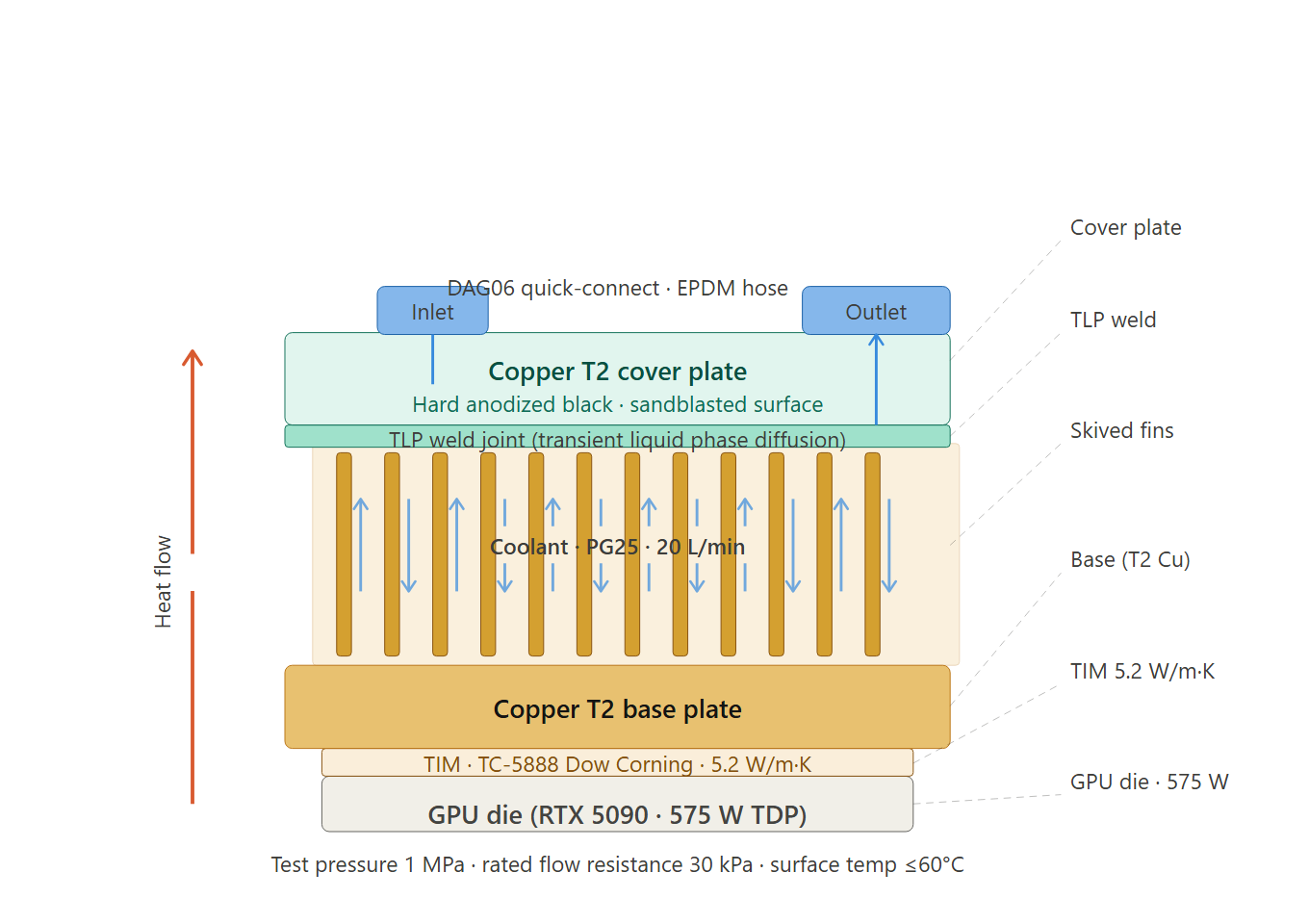
Thermal interface material (TIM) is the layer between a liquid cold plate and the component heat spreader that fills microscopic air gaps and enables efficient heat transfer. Selecting the wrong TIM for a liquid cold plate application can increase GPU junction temperature by 5–15°C — enough to cause thermal throttling in high-density AI server deployments. ToneCooling’s engineering team validates every cold plate shipment with matched TIM recommendations based on heat flux, surface flatness, and operating temperature.
What Is Liquid Cold Plate Thermal Interface?
Thermal interface material (TIM) is a thermally conductive compound, pad, or metal foil placed between the cold plate contact surface and the component being cooled. Even a mirror-polished metal surface traps microscopic air pockets — air has a thermal conductivity of only 0.026 W/m·K compared to 200 W/m·K for aluminum. TIM fills these gaps and creates a continuous thermally conductive path.
| TIM Type | Thermal Conductivity (W/m·K) | Bondline Thickness (μm) | Thermal Resistance (°C·cm²/W) | Temp Rise at 500W |
|---|---|---|---|---|
| No TIM (dry contact) | — | N/A | 0.25–0.50 | +12–25°C |
| Standard thermal grease | 3–5 | 75–150 | 0.08–0.15 | +4–7.5°C |
| High-performance thermal grease | 6–12 | 50–100 | 0.04–0.08 | +2–4°C |
| Phase-change pad | 3–6 | 100–200 | 0.06–0.12 | +3–6°C |
| Indium foil | 82 | 100–250 | 0.01–0.03 | +0.5–1.5°C |
For a 700W NVIDIA GB200 GPU, the difference between standard thermal grease and indium foil represents a 17–24°C junction temperature reduction — critical when the maximum junction temperature limit is 90°C.
How to Choose the Right TIM for Your Liquid Cold Plate Application
TIM selection requires matching three parameters: heat flux density, cold plate surface flatness, and the application’s maintenance requirements.
Step 1: Calculate Heat Flux Density
Heat flux (W/cm²) = Total heat load (W) ÷ Contact area (cm²). ToneCooling’s engineering guideline: applications exceeding 8 W/cm² should use thermal grease ≥6 W/m·K or phase-change pads ≥4 W/m·K. Applications exceeding 15 W/cm² should consider indium foil.
Step 2: Match TIM to Cold Plate Surface Flatness
| Cold Plate Flatness | Minimum TIM BLT | Recommended TIM | Application |
|---|---|---|---|
| ±0.025mm (premium) | 50μm | Indium foil 100μm | Direct-to-chip AI GPU |
| ±0.05mm (standard GPU) | 100μm | Phase-change pad 150μm or indium | GB200 / H200 / IGBT |
| ±0.10mm (general) | 200μm | Phase-change pad 200–300μm or grease | Server CPU / power electronics |
| ±0.20mm (economy) | 400μm | Thick phase-change pad ≥400μm | Industrial / EV battery |
TIM Comparison for AI Server GPU Cold Plates (GB200 / GB300 / H200)
| GPU Platform | TDP | ToneCooling Recommended TIM | Junction Temp Reduction vs Dry Contact |
|---|---|---|---|
| NVIDIA GB200 | 700W | Indium foil 150μm or phase-change pad ≥4 W/m·K | 18–24°C |
| NVIDIA GB300 | ~1000W | Indium foil 150μm mandatory | 22–30°C |
| NVIDIA H200 | 700W | Phase-change pad 4–6 W/m·K or indium foil | 16–22°C |
| AMD EPYC SP5 | 400W | High-performance thermal grease 8–12 W/m·K | 10–14°C |
ToneCooling internal testing on GB200 cold plates: switching from 3 W/m·K phase-change pad to indium foil reduces thermal resistance from 0.072°C·cm²/W to 0.018°C·cm²/W — a 75% reduction.
TIM for IGBT and Power Electronics Cold Plates
For IGBT liquid cold plates, ToneCooling recommends phase-change pad 3–5 W/m·K. ToneCooling’s 10kW IGBT cold plate (300mm × 200mm) with phase-change pad 4.5 W/m·K achieves module-to-coolant thermal resistance of 0.021°C/W, maintaining junction below 110°C at full rated power — per ToneCooling internal test report TC-IGBT-2025-003.
TIM Application Best Practices
Thermal grease: Apply 0.5–1.0g per 100cm². Tighten in star pattern to 0.5–0.8 N·m. Verify ≥90% contact coverage after first assembly.
Phase-change pads: Peel both protective films. First thermal cycle activates phase-change mechanism. ToneCooling ships pre-applied pads on GB200 cold plates.
Indium foil: Handle with clean cotton gloves. Anneal at 100°C for 30 minutes. Apply 0.3–0.5 MPa assembly force. Do not reuse after disassembly.
Frequently Asked Questions
What is the best thermal interface material for NVIDIA GB200 liquid cold plates?
ToneCooling recommends indium foil (82 W/m·K, 150μm thick) as the highest-performance TIM for NVIDIA GB200 liquid cold plates, reducing thermal resistance to 0.012–0.018°C·cm²/W. For standard installations, a 4–6 W/m·K phase-change pad provides excellent performance with easier serviceability.
How often does thermal interface material need to be replaced on liquid cold plates?
Phase-change pads and indium foil have service lives exceeding 10 years. Thermal grease should be replaced every 2–3 years due to pump-out effect at temperatures above 60°C.
What is thermal interface material bondline thickness (BLT)?
Bondline thickness (BLT) is the compressed thickness of TIM between the cold plate surface and component under assembly force. ToneCooling specifies BLT for each cold plate model based on measured surface flatness.
Can I use thermal grease instead of a phase-change pad on a ToneCooling cold plate?
Yes, but thermal grease requires careful application and torque-controlled fastener tightening. For GB200 applications, phase-change pad or indium foil is strongly preferred due to the risk of pump-out in high-temperature data center environments.
Does ToneCooling supply thermal interface materials with cold plate orders?
Yes. ToneCooling offers matched TIM kits (phase-change pad or indium foil, pre-cut to exact component dimensions) validated against the specific cold plate model’s flatness specification.
Industry References
Need TIM Recommendations for Your Cold Plate Project?
ToneCooling engineers provide free thermal budget analysis and TIM selection guidance with every cold plate inquiry.
Last Updated: 2026-04-07 | Author: DR Kevin, Thermal Engineer, ToneCooling
Need a Custom Liquid Cold Plate?
Tell us your thermal requirements. Engineering team responds within 48 hours with design proposal and quotation.
Request a Quote →MOQ 5 pcs • Prototype 7-15 days • ISO 9001 Certified