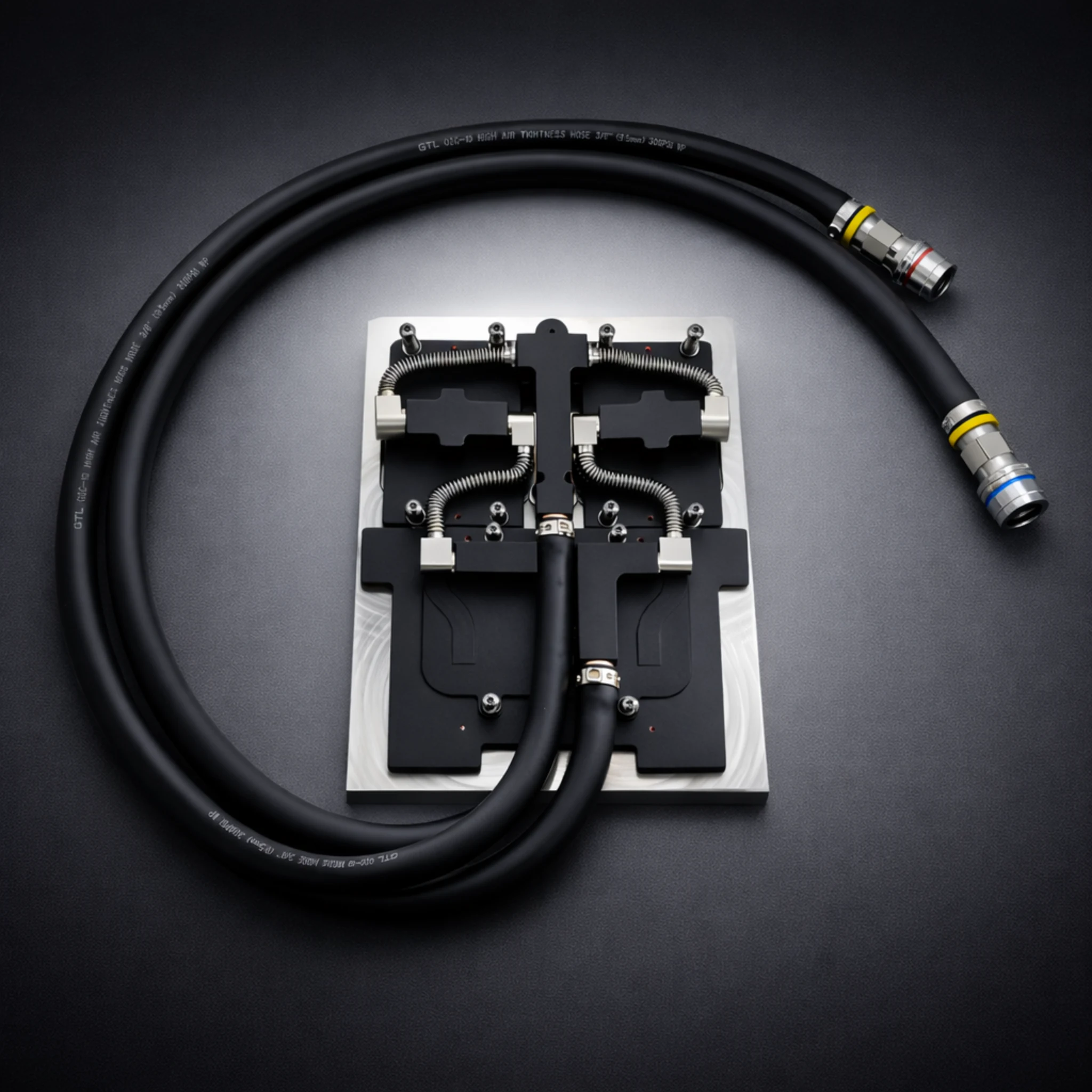
What Is Automotive Ecu Thermal Simulation Liquid?
Automotive Ecu Thermal Simulation Liquid is a high-performance thermal management solution engineered by ToneCooling for demanding applications.
Modern vehicles are becoming computing platforms on wheels. Advanced Driver Assistance Systems (ADAS), autonomous driving domain controllers, in-vehicle infotainment (IVI) systems, and centralized vehicle computing platforms now integrate high-performance SoCs that generate 30–150W of heat in compact, sealed enclosures with limited airflow.
Unlike data center servers with abundant airflow, automotive ECUs face unique thermal constraints: sealed IP67 enclosures, ambient temperatures up to 85°C under-hood, vibration loads, and 15+ year lifetime requirements. Liquid cold plates integrated into the vehicle coolant loop provide the most effective thermal solution for these challenging conditions.
Typical Automotive ECU Thermal Simulation Parameters
| Parameter | Typical Range |
|---|---|
| SoC Power Dissipation | 30–150W (ADAS: 50–100W typical) |
| Maximum Ambient Temperature | 85°C (under-hood) / 70°C (cabin) |
| Coolant | 50% ethylene glycol-water (vehicle coolant loop) |
| Coolant Inlet Temperature | 65°C (shared with engine/battery loop) |
| Flow Rate | 2–5 L/min (branch from main loop) |
| Enclosure Rating | IP67 sealed |
| Vibration | Per ISO 16750-3 |
| Design Life | 15+ years / 300,000 km |

Cold Plate Design Considerations for Automotive ECU
1. Thermal Interface Optimization
Automotive SoCs have smaller die footprints (typically 15×15 mm to 30×30 mm) but higher heat flux density than server CPUs. The cold plate mounting surface must achieve flatness within 0.02 mm and roughness Ra < 1.6 µm to minimize thermal interface resistance. ToneCooling provides precision-machined surfaces with guaranteed flatness specifications.
2. Vibration and Thermal Cycling Durability
Automotive cold plates must survive 10,000+ thermal cycles (-40°C to +125°C) and random vibration per ISO 16750-3. ToneCooling uses vacuum brazing or friction stir welding (FSW) — both create metallurgical bonds that withstand thermal fatigue far better than gasket-sealed or adhesive-bonded cold plates.
3. Coolant Compatibility
Vehicle coolant loops use 50% ethylene glycol-water with anti-corrosion additives per OEM specifications (e.g., VW TL 774-G, Ford WSS-M97B44-D). Cold plate materials and internal surface treatments must be compatible with these specific coolant formulations for the full 15-year vehicle lifetime.
ToneCooling Automotive Cold Plate Capabilities
- Materials: AL6061-T6, AL6063, copper (C1100) — selected based on thermal requirements and OEM specifications
- Joining methods: Vacuum brazing (CAB), friction stir welding (FSW), diffusion bonding
- Testing: 100% hydrostatic leak test at 2× rated pressure, burst test, thermal cycling validation
- Documentation: PPAP Level 3, FMEA, control plans, material certifications per automotive OEM requirements
- Volume capability: Prototype 5 pcs (7–15 days) through production 100,000+ units/year
Frequently Asked Questions
Can ToneCooling provide PPAP documentation for automotive programs?
Yes. ToneCooling provides full PPAP Level 3 documentation including dimensional reports, material certifications, process flow diagrams, control plans, and initial process capability studies. We support both AIAG and VDA quality frameworks for North American and European automotive OEMs.

What is the typical lead time for automotive cold plate prototypes?
Prototype samples (5–10 pieces) are delivered within 7–15 business days from drawing approval. Pre-production validation samples (50–100 pieces) require 4–6 weeks. Production tooling lead time is 6–8 weeks.
Do automotive cold plates require special surface treatment?
Yes. For automotive coolant loop integration, internal surfaces require either electroless nickel plating (for copper cold plates) or anodization (for aluminum cold plates) to prevent galvanic corrosion and ensure coolant compatibility over the 15-year vehicle lifetime.
MOQ 5 pcs · PPAP Level 3 · IATF 16949 Aligned
Related: EV Battery Cooling | Liquid Cold Plates | Design Guide
Related ToneCooling Resources
Industry References & Standards
Need a Custom Liquid Cold Plate?
ToneCooling engineers design thermal solutions for your specific requirements. Get an engineering RFQ review based on your uploaded requirements.
Semiconductor Test Fixture Cold Plate is a critical component in modern thermal management. ToneCooling engineers this solution for AI servers, data centers, EV batteries, and power electronics requiring high-performance liquid cooling.
Semiconductor Test Fixture Cold Plate: Key Specifications
When evaluating semiconductor test fixture cold plate, engineers consider thermal resistance, pressure drop, flow rate, and material compatibility. ToneCooling provides detailed specs for every semiconductor test fixture cold plate design, backed by CFD simulation and testing.
Why Choose ToneCooling for Semiconductor Test Fixture Cold Plate
ToneCooling has manufactured over 50,000 semiconductor test fixture cold plate units for global OEM customers. Our semiconductor test fixture cold plate production features vacuum brazing furnaces below 10⁻⁴ mbar, FSW machines with ≤0.02mm flatness, and helium leak detection at 10⁻⁸ mbar·L/s. Every semiconductor test fixture cold plate undergoes 100% pressure testing at 25 bar.
Our engineering team provides free semiconductor test fixture cold plate design consultation, CFD simulation, and rapid prototyping in 7-14 days. Production semiconductor test fixture cold plate orders ship in 4-6 weeks under ISO 9001:2015 quality management.
Need a Custom Liquid Cold Plate?
ToneCooling engineers design thermal solutions for your requirements. Response within 24-48 hours.
Last Updated: 2026-04-08
DR Kevin, Thermal Engineer, ToneCooling