This article compares major cold plate manufacturing processes including vacuum brazing, CNC machining, friction stir welding (FSW), and stamping. Engineers will learn how to select the optimal process based on thermal performance targets, production volume, cost constraints, and application requirements for automotive, telecom, and data center thermal management projects.
Cold plates are made by machining channels, forming them by stamping or extrusion, or embedding tubes, and then sealing the plate by brazing, friction stir welding or diffusion bonding, followed by leak and pressure testing. ToneCooling selects the process for each custom design during DFM review.
This article compares major cold plate manufacturing processes including vacuum brazing, CNC machining, friction stir welding (FSW), and stamping. Engineers will learn how to select the optimal process based on thermal performance targets, production volume, cost constraints, and application requirements for automotive, telecom, and data center thermal management projects. For an overview of designs and standard kits, see our liquid cold plates page.

Cold plate manufacturing determines thermal performance, reliability, and cost — with process selection (vacuum brazing, friction stir welding, CNC machining, or die casting) directly impacting thermal resistance by up to 40%, leak rates by orders of magnitude, and per-unit cost by 2–5× depending on production volume.
For OEM procurement engineers evaluating liquid cooling suppliers, understanding manufacturing processes is essential for specifying the right quality requirements, validating supplier capabilities, and making informed sourcing decisions that balance performance with cost at target volumes.
Cold Plate Manufacturing Process Overview
The manufacturing process transforms raw metal (copper or aluminum) into a precision thermal component with internal fluid channels, mounting features, and surface finishes that meet stringent thermal and mechanical specifications.
The typical manufacturing sequence follows these stages:
1. Design & Simulation: Thermal-hydraulic simulation (CFD) optimizes channel geometry for the target heat load and pressure drop budget. Mechanical simulation (FEA) validates structural integrity under operating pressure and vibration. ToneCooling’s engineering team, with backgrounds from Tsinghua University’s thermal engineering department, performs this analysis using proprietary simulation tools validated against thousands of physical test results.
2. Material Preparation: Raw plate stock (copper T2, aluminum 6061-T6, or other specified alloys) is cut to size, cleaned, and inspected for material certification compliance (mill certificates, alloy composition verification).
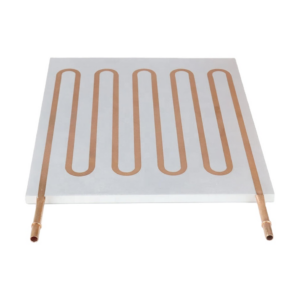
3. Channel Formation: Internal fluid channels are created through one of several processes: CNC machining, chemical etching, stamping/forming, or skiving. The choice depends on channel geometry complexity, production volume, and cost targets.
4. Assembly & Joining: The channel plate is joined to a cover plate to create sealed internal passages. Joining methods include vacuum brazing, controlled atmosphere brazing (CAB), friction stir welding (FSW), diffusion bonding, or laser welding.
5. Post-Processing: Machining of mounting surfaces, drilling of fluid port holes, surface treatment (anodizing, nickel plating, or passivation), and installation of fittings or manifold connections.
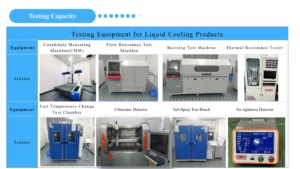
6. Quality Validation: Every cold plate undergoes helium leak testing, pressure testing, flow resistance measurement, dimensional inspection, and visual inspection before shipment.
Manufacturing Process Comparison
| Process | Materials | Channel Complexity | Volume Suitability | Thermal Performance | Relative Cost |
|---|---|---|---|---|---|
| Vacuum Brazing | Cu, Al | High (micro-channel) | Medium-High (1K–100K) | Excellent | Medium |
| CNC Machining | Cu, Al, SS | Very High | Low-Medium (1–10K) | Excellent | High |
| Friction Stir Welding | Al | Medium | Medium-High (1K–100K) | Very Good | Medium |
| Stamping + CAB | Al | Medium | Very High (100K+) | Good | Low |
| Die Casting | Al | Low-Medium | Very High (100K+) | Good | Very Low |
| Diffusion Bonding | Cu, Ti | Very High (micro) | Low (1–1K) | Excellent | Very High |
Vacuum Brazing: The Gold Standard
Vacuum brazing is ToneCooling’s primary manufacturing process for high-performance cold plates. The process bonds two or more metal components in a vacuum furnace at temperatures just below the base metal’s melting point, using a filler alloy that flows into the joint by capillary action.
Process Details: Components are assembled with brazing filler material (foil, paste, or pre-placed wire) at joint interfaces. The assembly enters a vacuum furnace (<5×10⁻³ Pa) and follows a controlled temperature profile: slow ramp to brazing temperature (580–610°C for aluminum, 780–850°C for copper), hold for 5–15 minutes, then controlled cool-down to prevent thermal stress.
Advantages: Produces hermetically sealed joints with >99.5% coverage, supports complex internal geometries including micro-channels, creates minimal distortion (no flux residue), and achieves excellent fatigue life. Vacuum environment prevents oxidation, producing clean joints with optimal metallurgical bonding.
Applications: AI server cold plates (NVIDIA GB200, H200), EV battery cooling plates, high-power laser cold plates, and any application requiring the combination of complex channels and leak-free reliability.
CNC Machining: Precision Without Compromise
CNC machining removes material from solid metal stock to create channel features with exceptional precision and geometric freedom.
Process Details: 3-axis or 5-axis CNC machines mill channel patterns into copper or aluminum plate stock using carbide end mills. Channel widths from 0.5 mm to 50+ mm with depth tolerances of ±0.05 mm are achievable. After machining, a cover plate is sealed by O-ring, brazing, welding, or mechanical fastening.
Advantages: Maximum geometric flexibility (any channel pattern achievable), excellent surface finish (Ra <1.6 μm), tight dimensional tolerances, and rapid prototyping capability (no tooling required). Ideal for development samples and low-to-medium volume production.
Limitations: Higher per-unit cost at scale due to cycle time. Not suitable for true micro-channels (<0.3 mm) without specialized micro-milling equipment.
Friction Stir Welding (FSW)
FSW creates solid-state joints by plunging a rotating tool into the interface between two aluminum components, generating frictional heat that plasticizes the material and creates a metallurgical bond.
Advantages: No filler material required, excellent joint strength (90–100% of parent material), superior fatigue life compared to fusion welding, no porosity or solidification defects, and good for thick sections (4–25 mm).
Applications: EV battery cooling plates, large-format industrial cold plates, and applications where brazing is impractical due to plate thickness or size. FSW is increasingly used in automotive applications where vibration fatigue is a primary reliability concern.
Quality Control & Testing
ToneCooling’s ISO 9001:2015 certified quality management system ensures every cold plate meets specifications:
Helium Leak Testing: Every cold plate is tested in a helium mass spectrometer leak detector to verify leak rate <1×10⁻⁶ mbar·L/s. This is the industry’s most sensitive leak detection method, capable of detecting defects invisible to pressure decay testing.
Burst Pressure Testing: Destructive testing on sample units verifies burst pressure exceeds 3× operating pressure. For cold plates rated at 0.6 MPa operating, burst must exceed 1.8 MPa.
Flow Resistance Testing: Each cold plate’s pressure drop is measured at design flow rate and compared to the specification tolerance band (typically ±10%). Plates outside tolerance are rejected or reworked.
Dimensional Inspection: CMM (Coordinate Measuring Machine) inspection verifies critical dimensions including mounting surface flatness (<25 μm for power electronics applications), port locations, and overall envelope dimensions.
Material Verification: XRF (X-ray fluorescence) testing confirms alloy composition matches material certificates. Hardness testing verifies heat treatment condition.
ToneCooling Manufacturing Capabilities
ToneCooling’s 12,000 m² manufacturing facility in Huizhou, China, combines multiple process capabilities under one roof:
Vacuum Brazing Furnaces: Multiple production-scale vacuum furnaces for both copper and aluminum brazing, with capacity supporting 900,000 pieces annual production.
CNC Machining Center: 3-axis and 5-axis CNC machines for precision channel machining and post-braze finishing.
Testing Laboratory: Fully equipped with helium leak detectors, burst test rigs, flow test benches, thermal performance test stations (constant temperature/humidity/flow automated testing), and CMM inspection equipment.
Certifications: ISO 9001:2015 quality management, with full traceability from raw material to finished product. PPAP documentation is available for automotive programs.
Frequently Asked Questions
Which manufacturing process is best for my cold plate application?
The optimal process depends on volume, complexity, and performance requirements. For prototypes and low volume (<1,000 units), CNC machining offers the fastest turnaround and maximum flexibility. For medium volume (1,000-100,000), vacuum brazing provides the best balance of performance and cost. For high volume (>100,000), stamping + CAB or die casting minimizes per-unit cost.
What is the typical lead time from design to production samples?
ToneCooling typically delivers first prototypes in 4–6 weeks from approved drawing, including thermal simulation, mechanical design, tooling preparation, sample fabrication, and validation testing. Production tooling for high-volume brazing or stamping requires an additional 6-10 weeks.
How do you ensure consistent quality at high volume?
ToneCooling ISO 9001:2015 quality system includes incoming material inspection, in-process controls at every manufacturing step, 100% helium leak testing, statistical process control on critical dimensions, and full traceability. Our 900,000 pieces annual capacity demonstrates proven volume manufacturing capability.
Can you manufacture both copper and aluminum cold plates?
Yes. ToneCooling manufactures cold plates in Purple Copper T2 (for high heat flux applications like GPU and power electronics), Aluminum 6061-T6 (for weight-sensitive applications like EV battery and aerospace), and stainless steel (for corrosion-critical applications). Each material requires specific brazing and machining parameters that our processes are optimized for.
What is the minimum order quantity for custom cold plates?
ToneCooling accepts custom cold plate orders from prototype quantities (1-5 pieces) through high-volume production. There is no minimum order quantity — we support the full product lifecycle from initial development samples through mass production ramp.
Related Articles
- Custom Liquid Cold Plates: Complete Engineering Guide for OEM Thermal Solutions
- Direct Liquid Cooling for AI Data Centers
- EV Battery Thermal Management
- AI Server Liquid Cooling Kits
For industry standards and best practices, refer to SAE International.
Get a Custom Thermal Solution from ToneCooling
ToneCooling is a professional liquid cooling solution provider specializing in custom cold plates, AIO coolers, and advanced thermal management systems. With ISO 9001 quality management and our own manufacturing facility in Huizhou, China, we deliver prototype samples typically within 4–6 weeks. Contact ToneCooling today for a free consultation and quote. An engineer reviews every RFQ and replies by email with next steps.
References: ASHRAE thermal standards
Why Choose ToneCooling for Friction Stir Welding Cold Plate
Engineering review and prototype planning are based on the project requirements. Custom prototype lead time is normally 4–6 weeks after drawing approval and order confirmation; confirm the production schedule in the quotation.
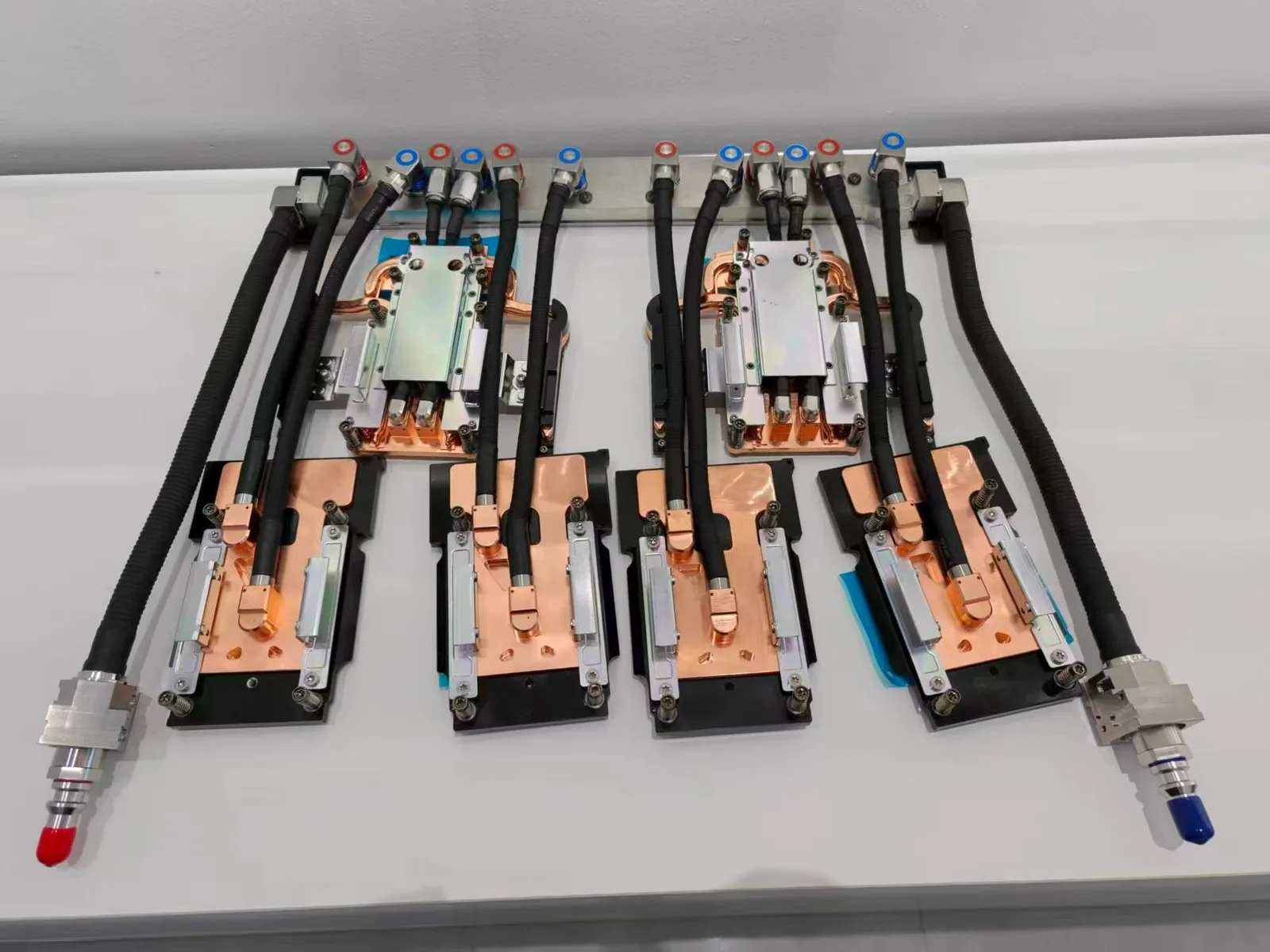
Building AI servers? See our standard GB300 4G+2C cold plate kit and GB200 cold plate kit, both supplied to published datasheets.
Need a Custom Liquid Cold Plate?
ToneCooling engineers review your drawings and requirements and reply by email with next steps.
Last updated: 2026-10-02
Frequently Asked Questions
How do I choose between vacuum brazing, CNC machining, and FSW for cold plates?
Vacuum brazing is optimal for high-volume production with complex internal channels. CNC machining suits prototypes and low volumes with tight tolerances. Friction stir welding (FSW) offers superior joint strength for medium volumes and is ideal for large cold plates. Selection depends on annual volume, thermal requirements, cost targets, and lead time.
What is the typical lead time for custom cold plate manufacturing?
Samples typically take 4–6 weeks, depending on process and tooling. Production lead time is confirmed at quotation based on volume and design.
What quality standards does ToneCooling follow for cold plate manufacturing?
ToneCooling works to ISO 9001, with IATF 16949-aligned practices for automotive programs. Every cold plate undergoes 100% helium leak testing, dimensional inspection per drawing tolerances, and visual inspection per IPC-A-610 workmanship standards. Full PPAP documentation is available for automotive OEM customers.