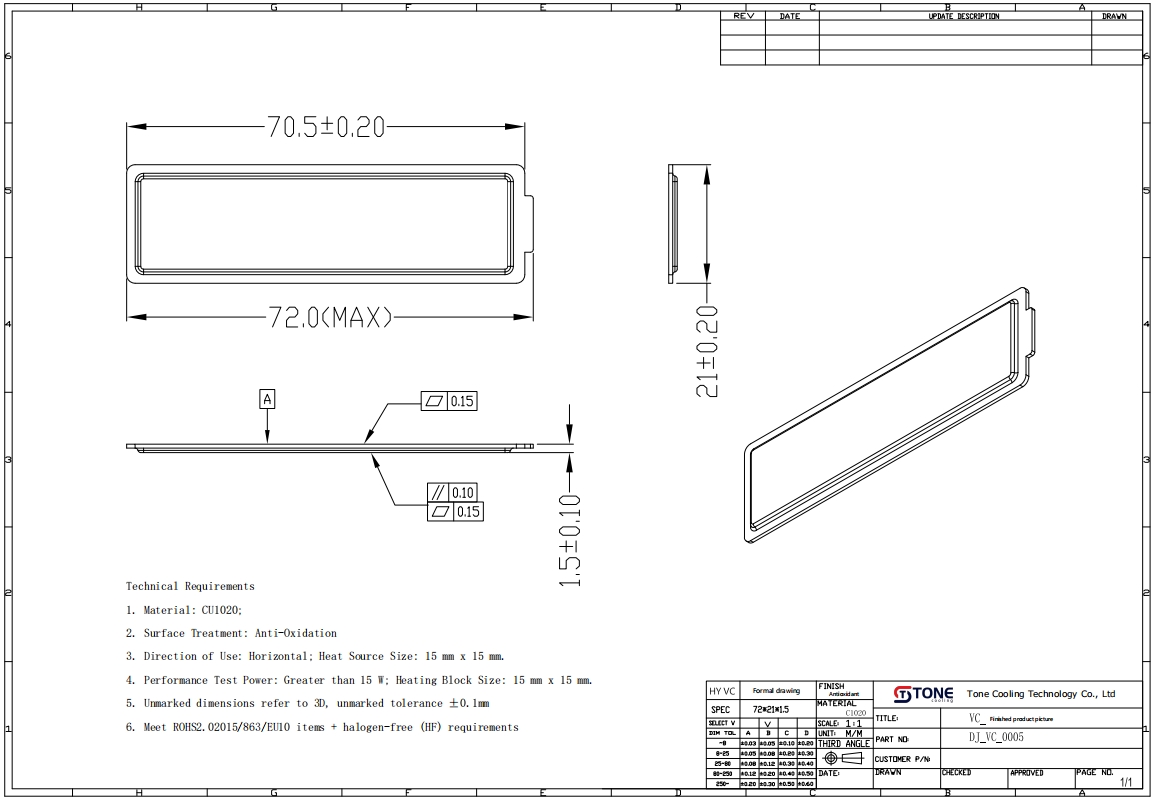
Optical module vapor chamber cooling is widely used to manage localized heat from DSPs and laser components in high-speed optical transceivers.
Optical module vapor chamber cooling provides an effective solution for managing localized hotspots generated by DSPs and laser components in high-speed transceivers.As optical modules move rapidly toward 400G, 800G, and co-packaged optics (CPO), thermal management has become a critical factor limiting performance, signal integrity, and long-term reliability. Rising power density, compact form factors, and localized hotspots challenge traditional heatsinks and solid copper spreaders.
ToneCooling designs and manufactures custom vapor chambers for optical module cooling, providing superior heat spreading, temperature uniformity, and ultra-thin integration for next-generation optical transceivers.
How Optical Module Vapor Chamber Cooling Works
Vapor chamber cooling is an advanced two-phase heat spreading technology designed to manage the rapidly increasing heat flux of high-speed optical modules. As data rates move to 400G, 800G, and beyond, traditional aluminum heat sinks and single-direction heat paths become insufficient to maintain temperature uniformity across the module.
In an optical module vapor chamber, heat generated by critical components such as DSPs, laser drivers, and high-power optical engines is transferred directly into a sealed copper vapor chamber. Inside the chamber, a small amount of working fluid evaporates at the heat source, rapidly spreading thermal energy across the entire vapor chamber surface through phase change and vapor diffusion.
The vapor then condenses in cooler regions of the chamber, releasing heat to the attached cold plate or external cooling interface, while capillary wick structures return the condensed fluid back to the heat source. This closed-loop, passive process enables extremely low thermal resistance and highly uniform temperature distribution, even under localized high heat density conditions.
By integrating vapor chamber cooling into optical modules, system designers can effectively reduce peak junction temperatures, improve thermal margin, and enhance long-term reliability for high-speed transceivers operating in dense data center environments.
Optical Module Vapor Chamber Cooling Structure
Thermal Challenges in Modern Optical Modules
High-speed optical modules integrate multiple heat-generating components in a confined space, including DSPs, lasers, and driver ICs. Typical challenges include:
Localized hotspots at DSP and laser regions
Strict operating temperature windows for optical stability
Limited vertical space in QSFP, OSFP, and on-board optics
Sensitivity of optical performance to temperature gradients
optical module vapor chamberoffer a highly effective solution by spreading heat laterally across the module, reducing peak temperature and improving overall thermal balance.optical module vapor chamber
ToneCooling provides application-specific vapor chamber solutions tailored to optical module architectures and thermal profiles.This thermal stability is critical for maintaining optical performance, signal integrity, and long-term reliability in 400G and 800G optical modules。
Manufacturing and Custom Design of Optical Module Vapor Chambers
Each optical module vapor chamber is engineered based on the specific heat map of the module.All optical module vapor chambers are produced using production-grade manufacturing processes, ensuring consistency from prototype to volume deployment.
Optical module vapor chambers require extremely tight mechanical tolerances, material purity, and process control due to their compact form factor and high thermal sensitivity. At ToneCooling, vapor chambers for optical modules are fully custom-designed and manufactured to match the exact thermal, mechanical, and integration requirements of each application.
Custom Vapor Chamber Design for Optical Modules
Each optical module vapor chamber is engineered based on the specific heat map of the module, including the location and power density of DSPs, optical engines, and laser components. Key design parameters include vapor chamber thickness, internal wick structure, working fluid selection, and effective heat spreading area.
For high-speed optical modules (400G / 800G), ultra-thin vapor chamber designs are often required to fit within strict module height limits while maintaining sufficient capillary pumping performance. Our engineering team optimizes wick geometry and vapor space layout to ensure stable two-phase operation even under transient and asymmetric heat loads.
Precision Manufacturing and Sealing Process
Optical module vapor chambers are manufactured using high-purity copper materials combined with precision forming, sintering, and vacuum sealing processes. Each vapor chamber undergoes controlled vacuum filling to ensure the correct working fluid charge and internal pressure, which are critical to long-term thermal performance and reliability.
Hermetic sealing integrity is verified through leak testing and thermal cycling validation to meet data center and telecom reliability standards. This ensures stable operation over extended lifetimes in high-density, continuously operating environments.
Integration with Cold Plates and Liquid Cooling Systems
Vapor chambers for optical modules can be supplied as standalone heat spreaders or pre-integrated with liquid cold plates for direct liquid cooling architectures. This hybrid vapor chamber + cold plate configuration enables rapid heat spreading from localized sources while efficiently transferring heat to the liquid cooling loop.
Such designs are increasingly adopted in next-generation optical modules and co-packaged optics (CPO) systems, where thermal margin, compact integration, and scalability are critical.
Manufacturing Capabilities
Precision CNC machining
Vacuum brazing and diffusion bonding
High-vacuum filling and hermetic sealing
Controlled surface finishing
Validation & Testing
100% helium leak testing
Thermal resistance and spreading verification
Thermal cycling and thermal shock testing
High-temperature aging upon request
These processes ensure long-term stability in 24/7 data center environments.
Typical Specifications & Design Parameters for Optical Module Vapor Chambers
Optical module vapor chambers are highly application-specific thermal components. For 400G / 800G and next-generation optical engines, the vapor chamber must be designed around heat density, mechanical constraints, and long-term reliability, rather than generic thermal ratings.
Below are the typical specification ranges we support for optical module vapor chamber cooling. Final designs are always optimized based on your actual module layout and operating conditions.
🔹 Mechanical & Structural Parameters
Overall thickness: typically 1.0 – 2.5 mm (ultra-thin designs available upon request)
Form factor: fully custom (rectangular, stepped, cut-out, asymmetric shapes)
Flatness: ≤ 0.05 mm after sealing and surface treatment
Weight: optimized for high-port-density optical cages
🔹 Thermal Performance
Supported heat load: typically 10 W – 60 W per module
Effective thermal spreading: designed to minimize local hot spots on DSP, laser drivers, and ASICs
Thermal resistance: optimized based on footprint, wick structure, and vapor path length
Uniform temperature distribution: critical for wavelength stability and optical signal integrity
🔹 Materials & Internal Structure
Base material: high-purity copper (C1020 / C1100)
Wick structure: sintered powder, etched micro-wick, or hybrid structures
Working fluid: selected and charged based on operating temperature range
Surface treatment: nickel plating, gold flash, or custom coatings upon request
🔹 Reliability & Compatibility
Designed for 24/7 data-center operation
Compatible with direct-contact cooling or integration into cold plates / hybrid liquid cooling assemblies
Validated for thermal cycling, mechanical stress, and long-term sealing integrity
Custom Design Support & RFQ Process
Each optical module vapor chamber is engineered based on the specific heat map of the module.Every optical module platform is different. At ToneCooling, we treat vapor chambers as engineered thermal components, not catalog items.
When you contact us, our engineering team can support:
Thermal and mechanical design review based on your module drawings
Vapor chamber geometry and wick optimization
Material and surface treatment recommendations
Prototype fabrication and performance validation
Smooth transition from prototype to volume production
📩 To start a technical discussion or RFQ, please prepare:
Vapor chambers can be used as standalone heat spreaders or integrated into hybrid liquid cooling architectures.
Engineering Collaboration Workflow
Thermal Requirement Review Heat sources, power map, interface constraints
Concept Design & Feasibility Vapor chamber structure and thickness optimization
Detailed Design & Simulation Heat spreading and capillary performance analysis
Prototype Manufacturing Engineering samples using production-intent processes
Testing & Validation Thermal and reliability qualification
Mass Production Support Stable supply with traceable quality control
Why Choose ToneCooling for Optical Module Vapor Chambers
Deep expertise in phase-change thermal technologies
Proven experience with optical module thermal management
Strong DFM capability for scalable production
Fast engineering response and technical collaboration
Solutions aligned with future optical roadmap (800G / 1.6T)
We focus on deployable solutions, not theoretical designs.
Request an Optical Module Vapor Chamber Design or RFQ
If you are developing 400G or 800G optical modules and facing thermal challenges, our engineering team is ready to support your program.By spreading heat laterally across the module, vapor chambers help reduce peak temperature and improve overall temperature uniformity。
Optical Module Vapor Chamber Cooling – FAQs
What is an optical module vapor chamber?
An optical module vapor chamber is a thin, sealed heat spreader that uses phase-change heat transfer to distribute heat evenly across high-speed optical modules. It is commonly used to manage localized heat generated by DSPs and laser components in 400G and 800G optical transceivers.
Why is vapor chamber cooling important for high-speed optical modules?
As optical modules operate at higher data rates, power density increases significantly within a limited footprint. Vapor chamber cooling helps reduce peak temperatures, improve temperature uniformity, and maintain optical stability under continuous operation.
Is optical module vapor chamber cooling suitable for 800G and future optical platforms?
Yes. Optical module vapor chamber cooling is well suited for 800G optical modules and emerging architectures such as co-packaged optics (CPO), where thermal margin and compact integration are critical.
Can optical module vapor chambers be customized?
Optical module vapor chambers can be fully customized in thickness, footprint, internal wick structure, and surface treatment to match specific module layouts and thermal requirements.
How does a vapor chamber compare to traditional heat sinks for optical modules?
Compared to traditional solid heat sinks, vapor chambers provide superior lateral heat spreading, lower thermal resistance, and improved temperature uniformity, making them more effective for compact optical modules with localized hotspots.
👉 Share your module drawings, power dissipation, and thermal targets 👉 Request a technical evaluation or quotation
Need a Custom Liquid Cold Plate? Get a Quote in 24 Hours
ToneCooling manufactures custom liquid cold plates for AI servers, EV batteries, and power electronics. MOQ 5 pcs. Prototype in 7-15 days. ISO 9001 certified.
A custom vapor chamber is a precision-engineered heat exchanger that uses liquid coolant flowing through internal channels to remove heat from high-power electronics, offering significantly higher thermal performance than air cooling. ToneCooling manufactures these for AI servers, data centers, EV batteries, and power electronics.
How does ToneCooling manufacture custom vapor chambers?
ToneCooling manufactures custom vapor chambers using vacuum brazing, friction stir welding, and CNC machining, with full in-house testing including pressure testing at 50 bar, helium leak detection, and thermal resistance measurement.
What materials does ToneCooling use?
ToneCooling uses 6061-T6 and 3003 aluminum alloys and oxygen-free copper (C11000). All materials meet RoHS compliance standards. Material selection depends on thermal conductivity requirements and coolant compatibility.
What is the minimum order quantity?
ToneCooling accepts orders from 1 piece prototypes to 10,000+ annual production. Prototype samples ship in 7-14 business days.
How do I get a quote for custom vapor chamber?
Submit your thermal requirements, dimensions, and flow rate specifications via our quote request form. Our engineering team responds within 24-48 hours with a detailed technical proposal.
Need a Custom Liquid Cold Plate?
Tell us your thermal requirements. Engineering team responds within 48 hours with design proposal and quotation.