Designing a liquid cold plate for high heat flux applications — AI GPUs, power electronics, laser diodes — requires a systematic engineering approach. This guide walks through the complete design process from requirements to prototype validation.

Overview
| Parameter | What to Define | Example (GPU) |
|---|---|---|
| Total heat load (Q) | Maximum power dissipation | 1000W |
| Heat source area | Active die footprint | 50 x 50 mm |
| Heat flux density | Q / Area | 40 W/cm2 |
| Max junction temp (Tj_max) | Component limit | 83C |
| Coolant inlet temp (T_in) | CDU supply | 35C |
| Temperature budget | Tj_max – T_in | 48C |
| Flow rate range | CDU capability | 0.5 – 2.0 LPM |
Step 2: Calculate Required Thermal Resistance
Rth_total = (Tj_max – T_in) / Q = (83 – 35) / 1000 = 0.048 C/W
This budget is shared among: TIM resistance (0.005-0.015 C/W), spreading resistance (0.002-0.010 C/W), convective resistance (0.010-0.030 C/W), and caloric rise (0.005-0.015 C/W).

Step 3: Select Channel Geometry
| Rth Target | Geometry | Material | Manufacturing |
|---|---|---|---|
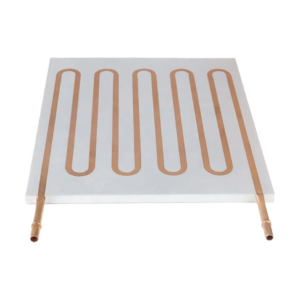
| < 0.015 C/W | Micro-channel (0.1-0.3mm) | Copper | Etching + vacuum brazing |
| 0.015-0.030 C/W | Micro-channel (0.2-0.5mm) | Copper | Vacuum brazing |
| 0.030-0.060 C/W | Mini-channel (0.5-2mm) | Cu or Al | CNC + brazing or FSW |
| 0.060-0.100 C/W | Mini-channel (1-3mm) | Aluminum | CNC + FSW |

Step 4: CFD Thermal Simulation
CFD simulation is essential for high heat flux cold plates. Key outputs to validate:
- Temperature distribution — Verify max surface temp within budget
- Flow uniformity — All channels within +/- 10% of mean flow
- Pressure drop — Confirm within system budget
- Flow velocity — Check for erosion risk (> 5 m/s in aluminum)

Step 5: Design for Manufacturing (DFM)
- Brazing clearance — 0.025-0.075mm gap for filler flow
- Wall thickness — Min 0.5mm for 500 kPa burst pressure
- Flatness — 25um for bare-die contact, 50um for IHS
- Surface finish — Ra 0.8um for contact surface
Step 6: Prototype and Validate
| Test | Method | Acceptance |
|---|---|---|
| Pressure test | 2x operating pressure, 30 min | No decay |
| Leak test | Helium mass spectrometer | < 10^-6 mbar-L/s |
| Thermal resistance | Heater block + thermocouples | Within 10% of CFD |
| Thermal cycling | 0-100C, 1000 cycles | No leak, < 5% Rth change |

ToneCooling Design Services
- Application engineering — Requirements definition and architecture selection
- CFD simulation — In-house ANSYS Fluent for thermal and hydraulic validation
- Rapid prototyping — prototypes from 1 piece, 4–6 weeks lead time
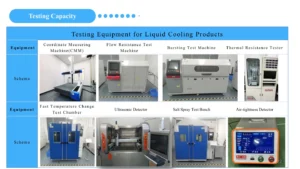
- Full testing — Pressure, leak, and thermal validation on every lot
Serving North America and Europe with local engineering support.
Contact Our Engineering Experts Now — ToneCooling offers prototypes in 4–6 weeks with prototypes from 1 piece. Request RFQ or contact us at info@tonecooling.com.
Frequently Asked Questions
How long does custom cold plate design take?
Preliminary design and CFD are part of the sample schedule. Total concept-to-prototype: typically 4–6 weeks.
What information do you need to start?
Heat source power and footprint, max junction temp, coolant type and inlet temp, flow rate and pressure constraints. Submit via our quote form.
Do you provide CFD simulation reports?
Yes. Detailed CFD reports with temperature contours, velocity vectors, pressure drop curves, and Rth calculations for every custom design.
Industry References & Standards
Why Choose ToneCooling for Semiconductor Test Fixture Cold Plate
Engineering review and prototype planning are based on the project requirements. Custom prototype lead time is normally 4–6 weeks after drawing approval and order confirmation; confirm the production schedule in the quotation.
Why Choose ToneCooling for Design Liquid Cold Plate High?
ToneCooling is a liquid cold plate and AIO cooler manufacturer serving AI server, EV battery, and power electronics applications. Our design liquid cold plate high solutions use copper T2 construction, transient liquid phase diffusion welding, and CFD-validated thermal design. Every unit passes 100% helium leak inspection and 6-hour nitrogen pressure hold testing before shipment.
Contact our thermal engineering team at info@tonecooling.com with your system layout and TDP requirements. → Request a quote
Last Updated: 2026-04-08