The choice between micro-channel and mini-channel flow geometry is one of the most impactful design decisions when engineering a liquid cold plate. This guide provides thermal engineers with the technical framework for making the right selection based on heat flux, pressure budget, reliability, and volume.

Overview
| Classification | Hydraulic Diameter | Manufacturing Method |
|---|---|---|
| Conventional | > 3 mm | CNC machining |
| Mini-channel | 0.5 – 3 mm | CNC, extrusion, skiving |
| Micro-channel | 0.1 – 0.5 mm | Chemical etching, EDM, stamping |

Thermal Performance Comparison
| Metric | Micro-Channel (0.2mm) | Mini-Channel (1.5mm) | Conventional (5mm) |
|---|---|---|---|
| Heat transfer coeff. (W/m2K) | 15,000 – 40,000 | 3,000 – 8,000 | 800 – 2,000 |
| Thermal resistance (C/W) | 0.015 – 0.025 | 0.03 – 0.06 | 0.08 – 0.15 |
| Pressure drop @ 1.5 LPM | 20 – 50 kPa | 5 – 15 kPa | 1 – 5 kPa |
| Max heat flux | > 100 W/cm2 | 30 – 60 W/cm2 | 5 – 20 W/cm2 |
Pressure Drop Trade-off
Pressure drop scales inversely with the fourth power of hydraulic diameter (Hagen-Poiseuille). Halving the channel diameter increases pressure drop by 16x. System designers must verify CDU pump capability.

Manufacturability and Cost
| Factor | Micro-Channel | Mini-Channel |
|---|---|---|
| Manufacturing | Chemical etching + vacuum brazing | CNC machining + FSW or brazing |
| Tolerance | +/- 0.02 mm | +/- 0.05 mm |
| Prototype cost (relative) | $$$ | $$ |
| Production cost (qty 1000+) | $$ | $$ (comparable) |
Application Selection Guide
Choose Micro-Channel When:
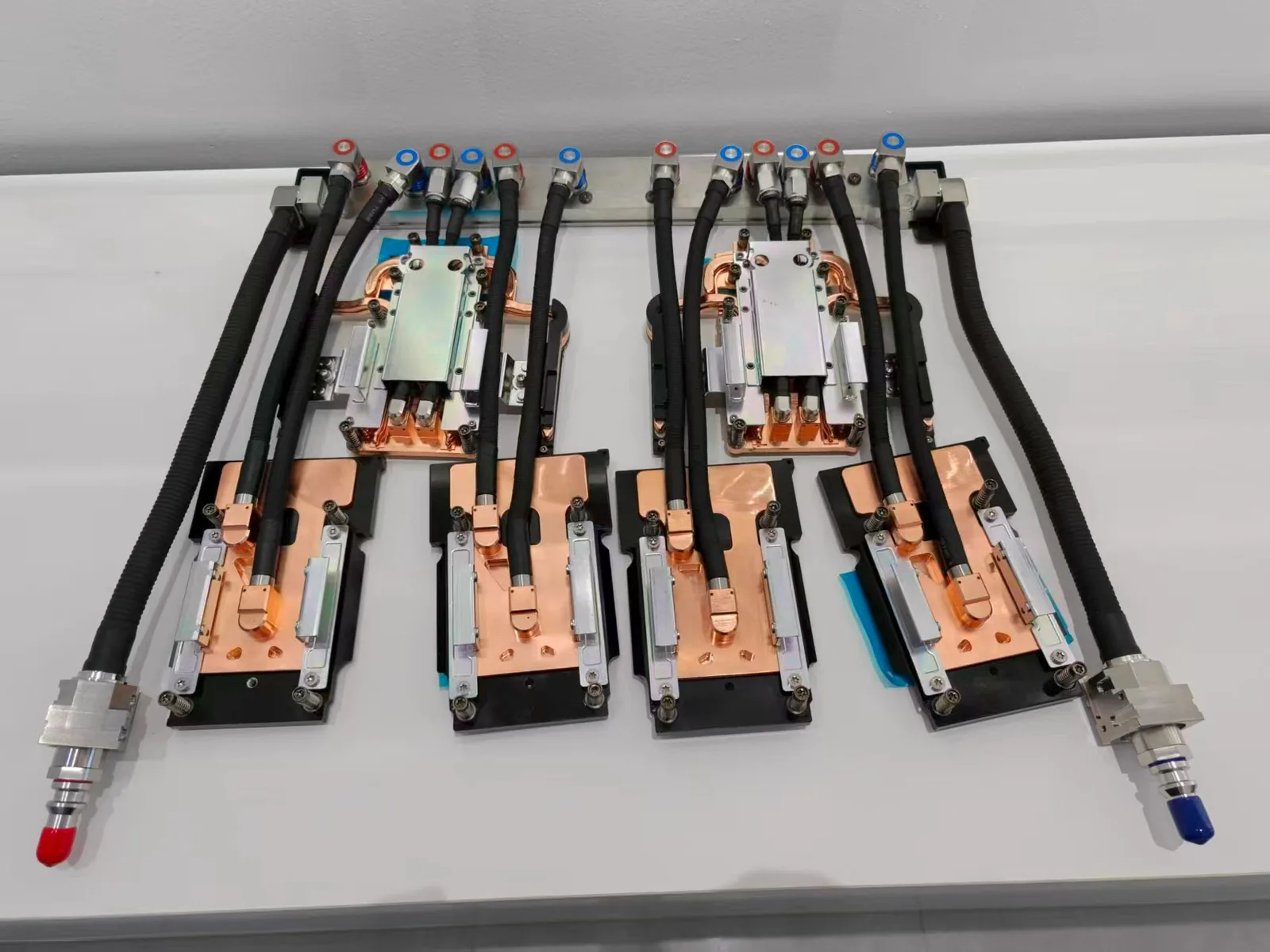
- GPU TDP exceeds 500W — NVIDIA GB200, GB300, AMD MI300X
- Heat flux density exceeds 30 W/cm2
- Maximum thermal performance is the primary objective
Choose Mini-Channel When:
- GPU TDP is 200-500W
- IGBT and power electronics with distributed heat sources
- EV battery cooling where uniform temperature distribution is key
- Production volume exceeds 1000 units/year
ToneCooling Capabilities
- Micro-channel — 0.15-0.5mm channels, vacuum-brazed copper
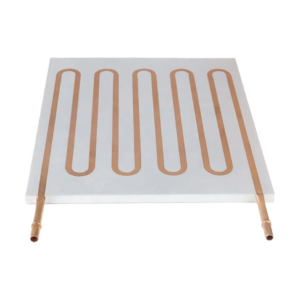
- Mini-channel — 0.5-3mm, CNC machined aluminum or copper
- Hybrid designs — Micro-channel in hot zone, mini-channel in periphery
- CFD validation — Every design simulated before manufacturing
Contact Our Engineering Experts Now — ToneCooling offers prototypes in 4–6 weeks with prototypes from 1 piece. Request RFQ or contact us at info@tonecooling.com.
Frequently Asked Questions
What is the smallest channel size ToneCooling can manufacture?
We manufacture micro-channels as small as 0.15mm width using chemical etching and precision stamping.
Do micro-channel cold plates clog easily?
With proper 10-25 um inline filtration, micro-channel cold plates operate reliably for 10+ years in data centers.
Industry References & Standards
Why Choose ToneCooling for Microchannel Liquid Cold Plate Design
Engineering review and prototype planning are based on the project requirements. Custom prototype lead time is normally 4–6 weeks after drawing approval and order confirmation; confirm the production schedule in the quotation.
Why Choose ToneCooling for Micro Channel Mini Channel Cold?
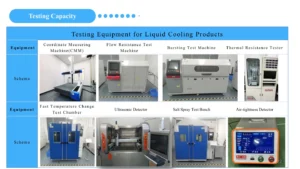
ToneCooling is a liquid cold plate and AIO cooler manufacturer serving AI server, EV battery, and power electronics applications. Our micro channel mini channel cold solutions use copper T2 construction, transient liquid phase diffusion welding, and CFD-validated thermal design. Every unit passes 100% helium leak inspection and 6-hour nitrogen pressure hold testing before shipment.
Contact our thermal engineering team at info@tonecooling.com with your system layout and TDP requirements. → Request a quote
Last Updated: 2026-04-08
Why Choose ToneCooling for Micro Channel Mini Channel Cold?
ToneCooling is a liquid cold plate and AIO cooler manufacturer serving AI server, EV battery, and power electronics applications. Our micro channel mini channel cold solutions use copper T2 construction, transient liquid phase diffusion welding, and CFD-validated thermal design. Every unit passes 100% helium leak inspection and 6-hour nitrogen pressure hold testing before shipment.
Contact our thermal engineering team at info@tonecooling.com with your system layout and TDP requirements. → Request a quote
Related guides
- Microchannel cold plates (MLCP) — how they work and design limits
- Microchannel cold plate design guide — ΔP, filtration and RFQ inputs
- Types of cooling plates — all construction types