Cold plates are the standard for EV battery thermal management because they remove heat evenly through the pack floor or between cells while using little space and working with the vehicle’s coolant loop. ToneCooling designs and builds custom aluminum battery cold plates for EV and energy storage packs.
EV battery cold plate technology is central to modern electric vehicle design. Battery thermal management is one of the most critical engineering challenges in electric vehicle development. Lithium battery cells operate optimally between 15°C and 35°C. Outside this range, capacity degrades, charging slows, and at elevated temperatures, thermal runaway risk increases. Liquid cold plates have become the industry-standard solution for maintaining battery temperature within this operating window across all driving conditions.
Overview
Lithium-ion cells are highly sensitive to temperature:
- Below 0°C: charging capability severely limited, capacity reduced up to 25%
- 15–35°C: optimal operating range, full capacity and charge rate
- Above 45°C: accelerated capacity degradation, increased internal resistance
- Above 60°C: thermal runaway risk, potential for fire and cell venting
Consistent temperature uniformity across the battery pack is equally important. Cell-to-cell temperature differences greater than 5°C accelerate differential aging and reduce pack lifespan. An effective EV battery cold plate system addresses both peak temperature and uniformity requirements simultaneously.
How Liquid Cold Plates Work in EV Battery Packs
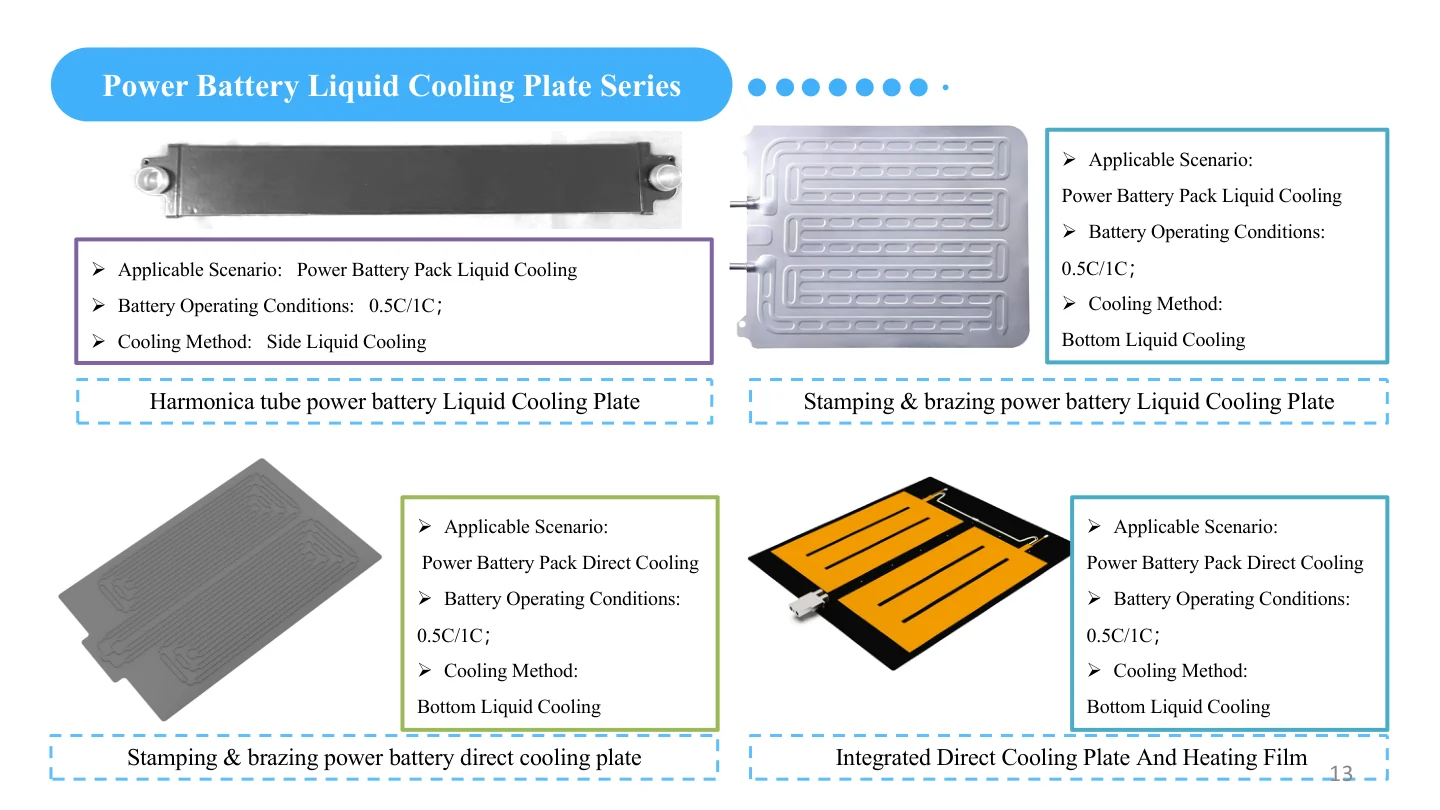
A battery cold plate is an aluminum plate with internal coolant channels, mounted directly beneath or between battery cell modules. Coolant (typically a water-glycol mixture) flows through the channels, absorbing heat from the cells through direct conduction via the plate surface. The heated coolant exits to an external heat exchanger or chiller, where heat is rejected before the coolant returns to the battery pack. This closed-loop system maintains precise temperature control regardless of ambient conditions or charge/discharge rate.
Why Cold Plates Outperform Air Cooling for EV Batteries
Air cooling limitations:
- Low heat transfer coefficient — requires large surface area
- Uneven temperature distribution across cell modules
- Performance degrades in high ambient temperatures
- Cannot support fast charging (high C-rate) thermal loads
Liquid EV battery cold plate advantages:
- 50–100x higher heat transfer coefficient vs air
- Uniform temperature distribution across entire pack
- Effective in all ambient conditions including hot climates
- Supports fast charging (2C–4C) thermal loads
- Enables higher energy density pack design
EV Battery Cold Plate Design Considerations

1. Material Selection
Aluminum (6061/6063) is standard for EV battery cold plates due to its combination of thermal conductivity, weight, corrosion resistance with glycol coolants, and cost efficiency at volume.
2. Manufacturing Process
Friction stir welding (FSW) is the preferred process for EV battery cold plates, offering superior leak integrity, high-pressure capability, and efficient production for large-format plates.
3. Channel Design
Serpentine or parallel channel configurations are selected based on required flow rate, pressure drop budget, and temperature uniformity targets.
4. Coolant Specification
50/50 water-ethylene glycol mixture is standard, providing freeze protection to -37°C and corrosion inhibition for aluminum circuits.
5. Surface Flatness
Battery cell modules require cold plate surface flatness within ±0.1mm to ensure uniform thermal contact across the cell base area.
ToneCooling EV Battery Cold Plate Capabilities
ToneCooling manufactures custom aluminum cold plates for EV battery thermal management:
- Manufacturing process: Friction stir welding (FSW)
- Material: Aluminum alloy 6061/6063
- Custom dimensions: available for any battery pack format
- Pressure rating: custom per application requirements
- Surface finish: machined flat to ±0.1mm tolerance
- Fittings: custom inlet/outlet positions and specifications
- OEM/ODM: full engineering support for new programs
Explore our full ToneCooling EV battery cold plates product range or learn about our custom cold plate solutions capabilities.
Frequently Asked Questions
Q: What material is best for EV battery cold plates?
A: Aluminum alloy (6061 or 6063) is the industry standard for EV battery cold plates. It offers adequate thermal conductivity (167 W/m·K), excellent compatibility with water-glycol coolants, low weight, and cost efficiency for high-volume production.
Q: Why is friction stir welding preferred for battery cold plates?
A: FSW creates a solid-state weld with no brazing alloys or adhesives, resulting in superior leak integrity and resistance to pressure cycling fatigue — critical for battery applications where coolant leaks pose serious safety risks.
Q: Can ToneCooling manufacture cold plates for different battery cell formats (cylindrical, prismatic, pouch)?
A: Yes. ToneCooling designs custom EV battery cold plate solutions for all major cell formats. Plate geometry, channel layout, and mounting features are engineered to match your specific battery module design.
Q: What is the minimum order quantity for custom EV battery cold plates?
A: Contact ToneCooling with your program details. We support prototype quantities through to high-volume production, with pricing scaled to order quantity.
Ready to start your EV battery thermal management project? Request an EV Battery Cold Plate Quote for a free thermal assessment and OEM pricing.
For industry standards and best practices, refer to SAE International.
References: ASHRAE thermal standards
Why Choose ToneCooling for EV Battery Liquid Cold Plate
Engineering review and prototype planning are based on the project requirements. Custom prototype lead time is normally 4–6 weeks after drawing approval and order confirmation; confirm the production schedule in the quotation.
Need a Custom Liquid Cold Plate?
ToneCooling engineers review your drawings and requirements and reply by email with next steps.
Last updated: 2026-10-02