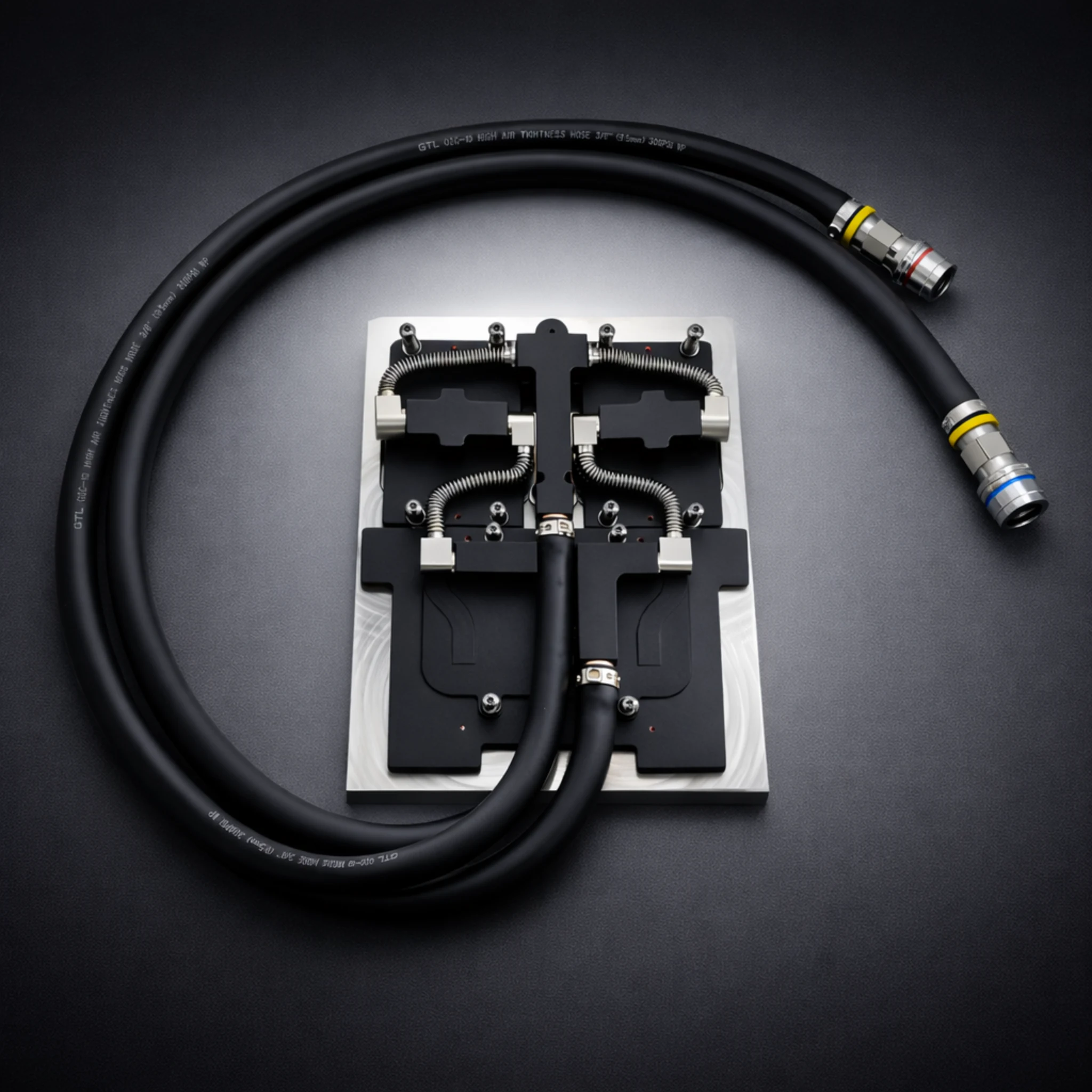
Select Liquid Cold Plate Gpu is a high-performance thermal management solution engineered by ToneCooling for demanding applications.
Selecting the right liquid cold plate for GPU cooling is one of the most critical decisions in high-performance computing thermal design. With GPU TDPs exceeding 700W (NVIDIA GB200) and approaching 1000W+ in next-generation chips, air cooling is no longer viable for dense deployments. This guide walks thermal engineers through the key selection criteria for GPU liquid cold plates.

What Is Select Liquid Cold Plate Gpu?
Modern AI GPUs generate extreme heat flux densities — often exceeding 30 W/cm2 at the die surface. Unlike CPU cooling, GPU cold plates must handle larger die areas, asymmetric heat loads from HBM memory stacks, and tight mechanical tolerances for bare-die contact. A poorly selected cold plate can cause thermal throttling, reducing compute performance by 20-40%.
For data center deployments, direct-to-chip liquid cold plates have become the standard approach for removing 80-120 kW per rack — far beyond what air cooling can achieve.

Key Selection Criteria for GPU Cold Plates
1. Thermal Resistance (Rth)
Thermal resistance is the primary performance metric. For GPU cold plates, target values are:
| GPU Platform | TDP (W) | Target Rth (C/W) | Max Junction Temp |
|---|---|---|---|
| NVIDIA H100/H200 | 700W | < 0.03 | 83C |
| NVIDIA GB200 | 1000-1200W | < 0.02 | 83C |
| AMD MI300X | 750W | < 0.025 | 90C |
| Intel Gaudi 3 | 600W | < 0.035 | 95C |
Lower thermal resistance means better heat transfer from the GPU die to the coolant. Micro-channel designs typically achieve 0.015-0.025 C/W, while mini-channel designs range from 0.025-0.045 C/W.
2. Flow Channel Design
The internal flow channel geometry directly determines thermal performance and pressure drop:
- Micro-channel (0.1-0.5 mm) — Highest thermal performance, higher pressure drop. Best for GPU TDP > 500W.
- Mini-channel (0.5-3 mm) — Good balance of performance and pressure drop. Suitable for 200-500W applications.
- Pin-fin array — Excellent for non-uniform heat flux. Common in IGBT and multi-chip modules.
- Skived fin — Cost-effective for moderate heat loads. Good for high-volume production.
3. Material Selection
| Material | Thermal Conductivity (W/mK) | Density (g/cm3) | Best For |
|---|---|---|---|
| Copper C1100 | 391 | 8.96 | High-performance GPU, AI servers |
| Copper C1020 (OFHC) | 398 | 8.94 | Premium applications, vacuum brazing |
| Aluminum 6061 | 167 | 2.70 | Weight-sensitive, EV, cost-optimized |
| Aluminum 6063 | 200 | 2.69 | Complex extrusion profiles |
For NVIDIA GB200 cold plates, vacuum-brazed copper (C1020) is the standard choice due to its superior thermal conductivity and compatibility with micro-channel geometries.

4. Mounting Interface and Contact Method
- Bare-die contact — Cold plate surface directly contacts the GPU die through TIM. Requires flatness < 25 um.
- IHS contact — Cold plate contacts the GPU’s metal lid. Less demanding on flatness.
- Spring-loaded mounting — Controlled contact pressure (20-40 psi) ensures uniform TIM bondline.
5. Pressure Drop Budget
| System Type | Loop Pressure Budget | Cold Plate Allocation | Flow Rate per GPU |
|---|---|---|---|
| Rack-level CDU | 80-120 kPa | 15-30 kPa | 0.5-1.5 LPM |
| Row-level CDU | 150-200 kPa | 20-40 kPa | 0.8-2.0 LPM |
| Facility water | 200-400 kPa | 30-60 kPa | 1.0-3.0 LPM |
Cold Plate Selection Workflow
- Define GPU platform and TDP envelope (including boost/turbo power)
- Determine cooling loop type and pressure budget
- Calculate required thermal resistance based on max junction temperature and coolant inlet temperature
- Select channel geometry (micro-channel vs mini-channel) based on Rth target and pressure budget
- Choose material (copper for performance, aluminum for weight/cost)
- Validate design with CFD simulation before prototype manufacturing
- Prototype testing: measure Rth, pressure drop, and leak test at 2x operating pressure
Common Mistakes to Avoid
- Ignoring flow maldistribution — Uneven flow through parallel channels causes hotspots. CFD simulation is essential.
- Over-specifying pressure drop — Tighter channels improve Rth but may exceed CDU pump capacity.
- Wrong TIM selection — Phase-change TIM or indium solder provides better long-term reliability than paste.
- Neglecting thermal cycling — GPU power cycling creates stress. Vacuum-brazed joints outperform epoxy-bonded joints.
ToneCooling GPU Cold Plate Capabilities
ToneCooling manufactures custom liquid cold plates for all major GPU platforms:
- NVIDIA GB200/GB300 cold plates — Up to 1200W, vacuum-brazed copper micro-channel
- Data center cold plates — H100, H200, AMD MI300X, Intel Gaudi compatible
- AI server liquid cooling solutions — Complete direct-to-chip cooling for high-density racks
Contact Our Engineering Experts Now — ToneCooling offers prototypes in 7-15 days with MOQ as low as 5 pieces. Request RFQ or contact us at info@tonecooling.com.
Frequently Asked Questions
What thermal resistance should a GPU cold plate achieve?
For modern AI GPUs (700W+), target thermal resistance below 0.03 C/W. For next-gen GPUs like NVIDIA GB200 (1000W+), target below 0.02 C/W. Micro-channel copper cold plates typically achieve 0.015-0.025 C/W.
Should I use copper or aluminum for a GPU cold plate?
Copper (C1020/C1100) is recommended for high-TDP GPUs above 500W due to its 2.3x higher thermal conductivity. Aluminum (6061) is suitable for lower power applications. See our liquid cold plates page.
What flow rate is needed for GPU liquid cooling?
Typical flow rate is 0.5-2.0 LPM per GPU depending on TDP and cold plate design. Higher flow rates reduce thermal resistance but increase pressure drop.
Industry References & Standards
Semiconductor Test Fixture Cold Plate is a critical component in modern thermal management. ToneCooling engineers this solution for AI servers, data centers, EV batteries, and power electronics requiring high-performance liquid cooling.
Semiconductor Test Fixture Cold Plate: Key Specifications
When evaluating semiconductor test fixture cold plate, engineers consider thermal resistance, pressure drop, flow rate, and material compatibility. ToneCooling provides detailed specs for every semiconductor test fixture cold plate design, backed by CFD simulation and testing.
Why Choose ToneCooling for Semiconductor Test Fixture Cold Plate
ToneCooling has manufactured over 50,000 semiconductor test fixture cold plate units for global OEM customers. Our semiconductor test fixture cold plate production features vacuum brazing furnaces below 10⁻⁴ mbar, FSW machines with ≤0.02mm flatness, and helium leak detection at 10⁻⁸ mbar·L/s. Every semiconductor test fixture cold plate undergoes 100% pressure testing at 25 bar.
Our engineering team provides free semiconductor test fixture cold plate design consultation, CFD simulation, and rapid prototyping in 7-14 days. Production semiconductor test fixture cold plate orders ship in 4-6 weeks under ISO 9001:2015 quality management.
Last Updated: 2026-04-08
DR Kevin, Thermal Engineer, ToneCooling