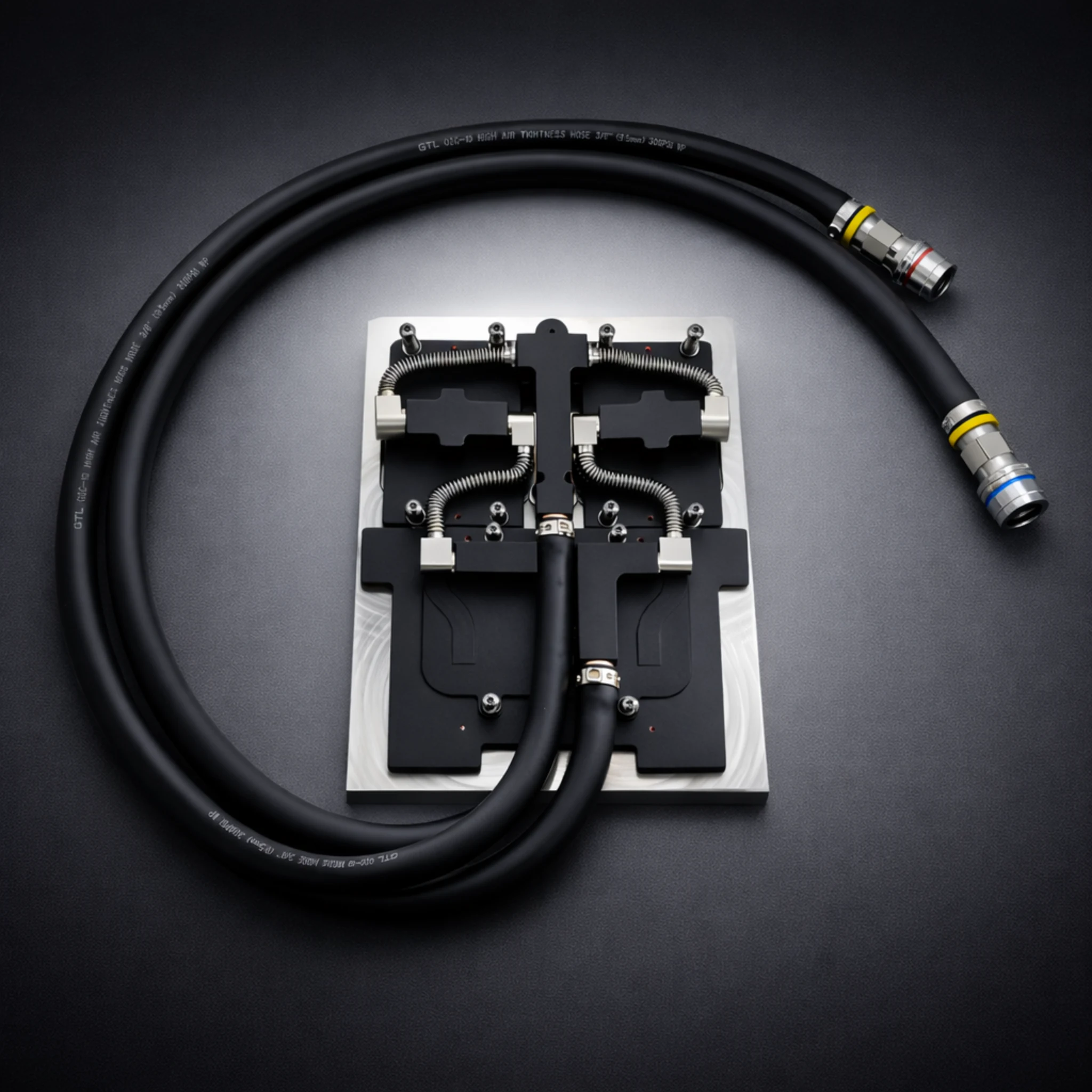
This technical article examines liquid cold plate solutions for industrial power electronics, covering IGBT modules, SiC devices, and high-power converters. Topics include thermal interface optimization, channel geometry for uneven heat flux profiles, and material selection for long-service-life industrial environments. ToneCooling delivers custom cooling solutions from prototype through volume production for demanding power conversion applications.
This comprehensive guide covers industrial liquid cooling solutions for industrial and OEM applications. ToneCooling provides expert insights on industrial liquid cooling technology and implementation.
This technical article examines liquid cold plate solutions for industrial power electronics, covering IGBT modules, SiC devices, and high-power converters. Topics include thermal interface optimization, channel geometry for uneven heat flux profiles, and material selection for long-service-life industrial environments. ToneCooling delivers custom cooling solutions from prototype through volume production for demanding power conversion applications.
As power electronics transition from silicon IGBTs to wide-bandgap SiC and GaN devices, thermal management has become the primary bottleneck limiting power density improvements. Industrial applications — from renewable energy inverters and motor drives to railway traction converters and grid-scale power conditioning systems — all face the same challenge: how to remove 100–500+ watts of concentrated heat from devices with junction-to-case thermal resistance measured in fractions of a degree.
This engineering guide examines the cold plate design principles, material selection criteria, and manufacturing processes that enable reliable liquid cooling for industrial power electronics platforms.
What Is Industrial Liquid Cooling Power Electronics?
The fundamental driver is power density. Modern IGBT modules (like Infineon’s PrimePACK or Mitsubishi’s HV-IGBT series) dissipate 500–2,000 W per module in steady-state operation, with transient peaks during switching events that can exceed 3× the steady-state value. SiC MOSFETs operate at even higher switching frequencies (50–200 kHz vs. 5–20 kHz for IGBTs), generating additional switching losses concentrated at the die level.
Air cooling can handle approximately 1–3 W/cm² of heat flux. Forced convection with optimized fin arrays extends this to roughly 5–10 W/cm². But power electronics modules routinely generate 30–100+ W/cm² at the baseplate, making liquid cooling the only practical solution for high-reliability industrial applications.

Cold Plate Design for IGBT & SiC Modules — Industrial liquid cooling
Baseplate Interface Design — Industrial liquid cooling
The interface between the power module baseplate and the cold plate surface is the most critical thermal junction in the entire cooling system. Achieving low thermal interface resistance requires:
Surface flatness: The cold plate mounting surface must achieve flatness better than 50 μm (0.002″) across the module footprint. For large-format modules (190mm × 140mm footprint like the Infineon PrimePACK 3), this requires precision CNC milling after brazing to compensate for any distortion introduced during the brazing thermal cycle.
Surface roughness: Ra 0.8–1.6 μm provides the optimal balance between thermal interface material (TIM) wetting and machining cost. Smoother surfaces (Ra < 0.4 μm) increase cost without meaningful thermal improvement when TIM is used.
Mounting pressure distribution: The cold plate must accommodate module mounting bolt patterns while providing uniform pressure across the entire baseplate contact area. Finite element analysis (FEA) of bolt preload and baseplate deflection is essential for modules with multiple mounting points.
Internal Flow Architecture
For power electronics cold plates, three flow architectures dominate:
Parallel micro-channel: Multiple parallel channels (0.5–2.0 mm width) machined directly below the module mounting zone. This provides the lowest thermal resistance (typically 0.03–0.08 °C·cm²/W) but requires careful attention to flow distribution across channels. ToneCooling uses computational fluid dynamics (CFD) optimization to design inlet manifold geometries that achieve ±5% flow uniformity across all channels.
Serpentine single-pass: A single meandering channel that traverses the entire cold plate surface. Simpler to manufacture and inherently provides uniform flow, but at the cost of higher pressure drop and potentially greater temperature variation from inlet to outlet. Best suited for moderate heat loads (< 200 W per module).
Pin-fin array: An array of cylindrical or diamond-shaped pins in a cavity between the top plate (module mounting surface) and bottom plate. Pin-fin designs excel when multiple heat sources at different locations must be cooled by a single cold plate, as the pin array allows multi-directional flow distribution. Pressure drop is moderate, and manufacturing is straightforward with CNC machining.

Material Selection: Aluminum vs. Copper vs. Hybrid
Material choice depends on the balance between thermal performance, weight, cost, and coolant compatibility:
Aluminum (6061-T6): The default choice for most industrial power electronics cooling. Aluminum’s thermal conductivity (167 W/m·K) is adequate for IGBT modules with baseplate heat fluxes up to ~80 W/cm². Aluminum is 60% lighter than copper, costs significantly less, and is easier to machine and braze. For water-glycol coolant systems (the standard in industrial applications), aluminum cold plates require proper passivation and corrosion inhibitors but offer excellent long-term reliability.
Copper (C110/C122): Required when heat fluxes exceed 100 W/cm² or when the absolute lowest thermal resistance is needed. Copper’s 388 W/m·K conductivity provides a 2.3× advantage over aluminum in spreading resistance. However, copper cold plates are 3.3× heavier and 4–5× more expensive than aluminum equivalents. Copper is the preferred material for SiC module cooling in high-frequency applications where switching losses create intense, localized heat generation.
Copper-aluminum hybrid: Places copper inserts at the exact locations of power die within the module, embedded in an aluminum body. This targets the high-conductivity material precisely where it is needed while keeping overall weight and cost close to an all-aluminum design. ToneCooling’s hybrid cold plates achieve thermal performance within 10% of all-copper designs at 40% of the weight.
Application-Specific Design Examples
Solar Inverter Cooling (String & Central Inverters)
String inverters (30–350 kW) typically use single or dual IGBT/SiC module configurations with total heat dissipation of 200–1,500 W. Cold plates for string inverters must be compact (often < 300mm × 200mm), lightweight, and cost-optimized for high-volume production. ToneCooling supplies stamped-and-brazed aluminum cold plates in volumes exceeding 10,000 units/year for major solar inverter OEMs, achieving per-unit costs that make liquid cooling economically viable even at the 30 kW inverter class.
Central inverters (500 kW–5 MW) require larger cold plates cooling 6–12 IGBT modules simultaneously. Flow distribution across multiple module positions becomes critical. Our multi-zone cold plate designs use optimized internal baffles to ensure each module position receives equal coolant flow within ±3%, preventing hot spots at downstream positions.
Railway Traction Converter Cooling
Railway traction applications impose extreme vibration and shock loads (EN 61373 Category 1, Class B) combined with wide temperature ranges (-40°C to +70°C ambient). Cold plates must withstand 30+ years of service life with maintenance intervals measured in years. ToneCooling’s vacuum-brazed aluminum cold plates for railway applications use thicker wall sections (min. 3mm), reinforced manifold connections, and 100% X-ray inspection of all brazed joints to ensure the structural integrity required for rolling stock applications.
Wind Turbine Converter Cooling
Wind turbine converters (2–15 MW) operate in nacelles with limited space and challenging access for maintenance. Cold plates must integrate into the turbine’s existing glycol-water cooling loop, which may operate at elevated temperatures (40–50°C coolant inlet) during summer conditions. The thermal design must guarantee junction temperatures within limits even at worst-case coolant temperatures. Our wind turbine cold plates feature oversized flow channels that maintain performance even with partial coolant flow degradation.
Manufacturing & Quality Assurance
ToneCooling’s ISO 9001:2015 certified manufacturing facility produces power electronics cold plates using:
- Vacuum brazing at 580–620°C with controlled atmosphere (10⁻⁵ Torr) for void-free joints
- 5-axis CNC machining for complex flow channel geometries and precision mounting surfaces
- Friction Stir Welding (FSW) for large-format cold plates where braze joint area would exceed practical furnace limits
- 100% helium leak testing to 1×10⁻⁹ mbar·L/s sensitivity
- Pressure cycling qualification per customer specifications (typically 100,000+ cycles at 1.5× MAWP)
- Thermal performance validation with calibrated test bench measuring thermal resistance at specified flow rates and heat loads
With production capacity from prototype quantities through high-volume runs (50,000+ units/year), ToneCooling supports power electronics OEMs at every program stage.
Partner with ToneCooling
Whether you are designing the next generation of solar inverters, upgrading traction converters for SiC technology, or developing high-power industrial motor drives, ToneCooling provides the thermal engineering expertise and manufacturing capability to deliver cold plates that meet your exact performance specifications.
With engineering and sales offices in China (HQ), Austin, Texas (US), and Melbourne, Australia, we provide localized support worldwide.
Get started: info@tonecooling.com (Global) | bd@tonecoolingtexas.com (Americas) | (Asia-Pacific) | Request RFQ
For industry standards and best practices, refer to IEEE.
| Parameter | ToneCooling Specification |
|---|---|
| Material | Copper T2 / 6061 aluminum |
| Welding method | Transient liquid phase diffusion welding |
| Test pressure | 1 MPa (helium leak + nitrogen hold) |
| Working medium | PG25 (25% propylene glycol) |
| Custom design | Yes — DXF/STEP input accepted |
Frequently Asked Questions
Does ToneCooling offer OEM and ODM services?
Yes. ToneCooling provides full OEM and ODM services including custom design, prototyping, thermal simulation, and volume production. We serve customers in North America, Europe, and Asia-Pacific with engineering support and samples within 2–4 weeks.
What materials are used in ToneCooling liquid cold plates?
ToneCooling manufactures cold plates in aluminum (6061/6063), copper (C1100/C1020), and stainless steel. Aluminum FSW cold plates are ideal for high-volume EV and industrial applications, while copper brazed cold plates provide maximum thermal conductivity (398 W/m·K) for high heat flux electronics.
What is the typical lead time for custom cold plates?
Prototype samples are delivered within 2–4 weeks. Production orders typically ship within 4–6 weeks after sample approval. ToneCooling responds to all quote requests within 24 business hours.
References: ASHRAE thermal standards, Wikipedia: Heat Sink Technology
Contact ToneCooling
This guide on Industrial liquid cooling provides key insights for engineers and procurement teams. Ready to discuss your thermal management requirements? ToneCooling’s engineering team supports OEM and B2B customers worldwide.
- Website: tonecooling.com
- Email: info@tonecooling.com
- US Phone: +1 (512) 601-7768
- AU Phone: +61 2 8005 1735
Contact us today for a fast, no-obligation consultation and quotation.
Industrial Liquid Cooling Power Electronics is a high-performance thermal management solution engineered by ToneCooling for demanding applications.
Igbt Liquid Cold Plate Manufacturer is a critical component in modern thermal management. ToneCooling engineers this solution for AI servers, data centers, EV batteries, and power electronics requiring high-performance liquid cooling.
Igbt Liquid Cold Plate Manufacturer: Key Specifications
When evaluating igbt liquid cold plate manufacturer, engineers consider thermal resistance, pressure drop, flow rate, and material compatibility. ToneCooling provides detailed specs for every igbt liquid cold plate manufacturer design, backed by CFD simulation and testing.
Why Choose ToneCooling for Igbt Liquid Cold Plate Manufacturer
ToneCooling has manufactured over 50,000 igbt liquid cold plate manufacturer units for global OEM customers. Our igbt liquid cold plate manufacturer production features vacuum brazing furnaces below 10⁻⁴ mbar, FSW machines with ≤0.02mm flatness, and helium leak detection at 10⁻⁸ mbar·L/s. Every igbt liquid cold plate manufacturer undergoes 100% pressure testing at 25 bar.
Our engineering team provides free igbt liquid cold plate manufacturer design consultation, CFD simulation, and rapid prototyping in 7-14 days. Production igbt liquid cold plate manufacturer orders ship in 4-6 weeks under ISO 9001:2015 quality management.
Last Updated: 2026-04-08
DR Kevin, Thermal Engineer, ToneCooling
Need a custom industrial liquid cooling power electronics solution?
ToneCooling engineers respond within 24 hours with CFD-validated thermal recommendations.
Frequently Asked Questions
What cold plate designs work best for IGBT and SiC power modules?
Pin-fin and jet-impingement cold plate designs provide the highest thermal performance for IGBT and SiC modules, handling heat fluxes exceeding 100 W/cm2. The pin-fin geometry creates turbulent flow directly beneath the power module baseplate, minimizing thermal resistance while maintaining acceptable pressure drop.
How do you optimize cold plates for uneven heat flux in industrial converters?
For industrial converters with multiple power modules generating uneven heat loads, cold plate channel geometry is zoned to match local heat flux density. High-heat zones use denser pin-fin or micro-channel arrays, while lower-flux areas use wider channels to balance pressure drop. CFD simulation validates temperature uniformity before prototyping.
What coolant temperature and flow rate is typical for industrial power electronics cooling?
Industrial power electronics cold plates typically operate with 50/50 ethylene glycol-water coolant at inlet temperatures of 35-45C and flow rates of 4-12 LPM depending on total dissipation. System design targets a maximum junction temperature margin of 25C below rated Tj(max) for long-term reliability.