This guide covers liquid cold plate design for aerospace and defense electronics. It covers material selection (aluminum 6061-T6, copper alloys), weight-optimized channel designs, vibration and shock resistance, and the qualification tests aerospace programs typically specify. ToneCooling builds custom cold plates with full traceability and documentation for airborne and space-grade electronics cooling.
This guide details liquid cold plate solutions for aerospace and defense applications. It covers material selection (aluminum 6061-T6, copper alloys), weight-optimized channel designs, vibration and shock resistance, and qualification testing per MIL-STD requirements. ToneCooling provides custom thermal management hardware with full traceability and documentation for airborne and space-grade electronics cooling.
Overview
Modern aerospace electronics face a unique convergence of challenges: extreme thermal loads from AESA radar arrays, compact avionics bays with minimal airflow, and mission-critical reliability requirements where failure is not an option. As power densities in military and commercial aerospace electronics push beyond 200 W/cm², traditional air-cooled heat sinks and fan-based solutions can no longer keep up.
Liquid cooling — specifically direct-to-chassis cold plates and flow-through manifold systems — has become the standard thermal management approach for high-performance aerospace platforms. From fighter jet radar modules to satellite power converters, liquid cold plates provide the thermal conductivity, weight efficiency, and reliability that aerospace applications demand.
Key Thermal Challenges in Aerospace Applications — Aerospace liquid cooling
1. AESA Radar & Electronic Warfare Systems — Aerospace liquid cooling
Active Electronically Scanned Array (AESA) radar systems generate concentrated heat loads across hundreds or thousands of transmit/receive (T/R) modules. A single radar panel may dissipate 5–15 kW within a compact footprint, with individual T/R module heat fluxes exceeding 50 W/cm². The cold plate must provide uniform temperature distribution across the entire array to maintain beam-forming accuracy and signal integrity. Temperature variation across the array face must typically stay within ±2°C to prevent performance degradation.
2. Avionics Bay Cooling
Avionics Line Replaceable Units (LRUs) must operate reliably in environments ranging from -55°C to +85°C, with rapid thermal cycling during mission profiles. Space and weight constraints are severe — every gram matters in flight systems. Liquid cold plates integrated into the LRU chassis provide a direct heat path from power electronics to the aircraft’s Environmental Control System (ECS) coolant loop, eliminating the need for dedicated fans or blowers that add weight and reduce reliability.
3. UAV & Unmanned Systems
Unmanned Aerial Vehicles (UAVs) increasingly carry sophisticated sensor payloads, AI-based edge computing for autonomous navigation, and high-power communications equipment. With payload weight budgets measured in single-digit kilograms, liquid cooling systems must achieve maximum thermal performance per unit weight. Aluminum cold plates with optimized micro-channel flow paths offer the best balance of thermal performance, weight savings, and manufacturability for UAV applications.
4. Space & Satellite Electronics
Satellite power converters and communication transponders operate in the vacuum of space, where convection cooling is impossible. Cold plates serve as the primary thermal interface between electronics and spacecraft radiator panels. The cold plate must accommodate thermal expansion mismatches between dissimilar materials while maintaining reliable thermal contact across years of thermal cycling in orbit (typically -120°C to +150°C).
Cold Plate Design Considerations for Aerospace
Material Selection
Aerospace cold plates are predominantly manufactured from aluminum alloys (6061-T6, 6063) due to their excellent thermal conductivity-to-weight ratio. For applications requiring higher thermal conductivity, copper-aluminum hybrid designs place copper inserts at high-heat-flux zones while maintaining an aluminum body for weight savings. In corrosive environments or where coolant compatibility is critical, stainless steel manifolds with aluminum cores may be specified.
Key material properties for aerospace cold plates:
| Property | 6061-T6 Aluminum | C110 Copper | Hybrid (Cu/Al) |
|---|---|---|---|
| Thermal Conductivity (W/m·K) | 167 | 388 | 200–300 (effective) |
| Density (g/cm³) | 2.70 | 8.94 | 3.5–5.0 (depending on ratio) |
| Weight Advantage | Baseline | 3.3× heavier | 1.3–1.9× heavier |
| Best Application | General avionics | Extreme heat flux | Targeted high-power zones |
Flow Channel Architecture
The internal flow channel design is critical to cold plate performance. For aerospace applications, three primary architectures are used:
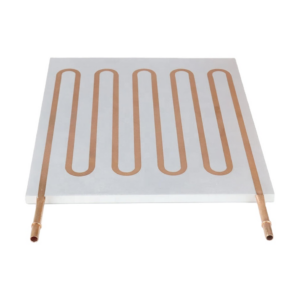
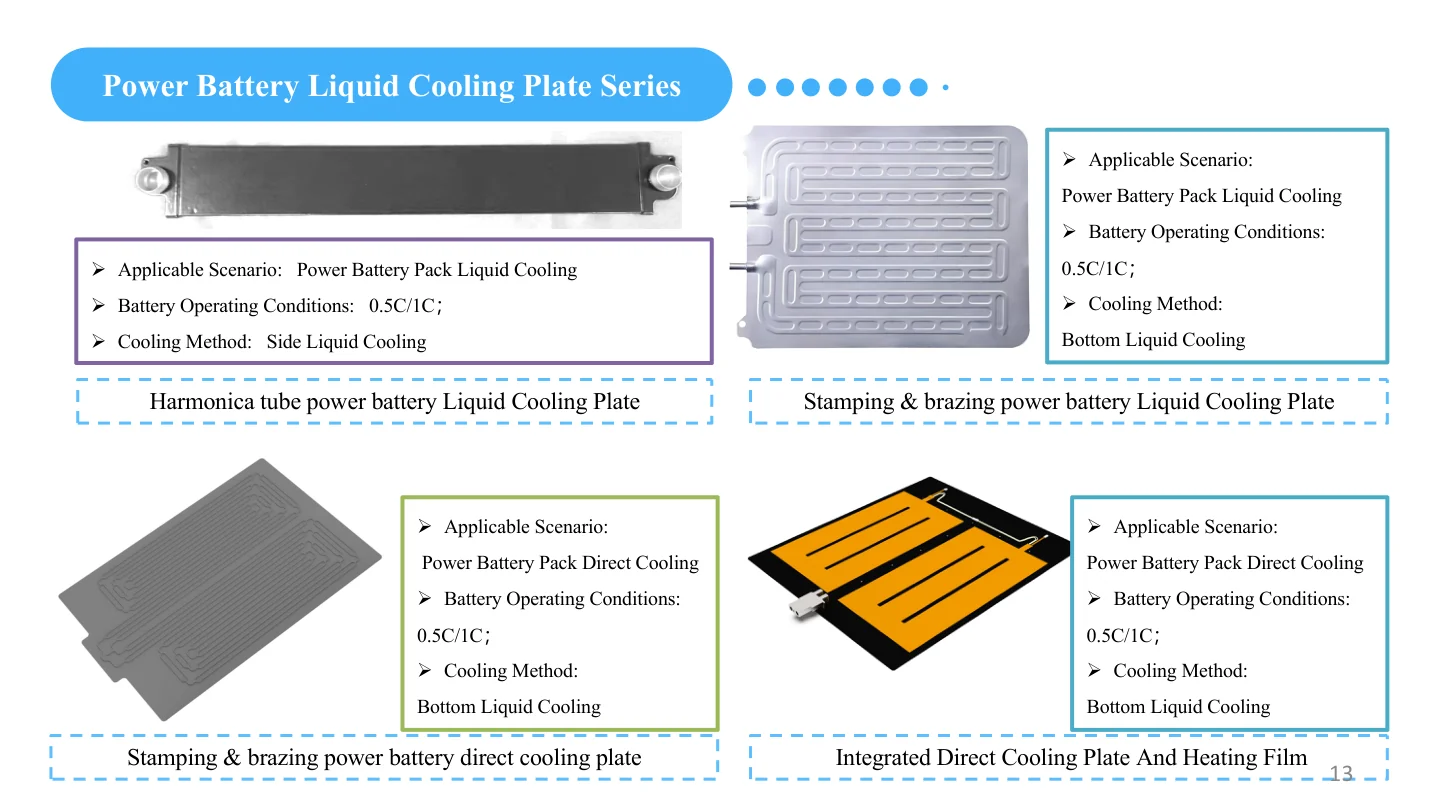
Gun-drilled channels provide simple, robust flow paths suitable for moderate heat loads. They are the most cost-effective option for standard avionics cooling and offer excellent pressure integrity for high-altitude applications where coolant pressure differentials are significant.
Micro-channel arrays (channel width 0.2–1.0 mm) deliver the highest thermal performance per unit area. These are essential for AESA radar cold plates and high-power-density electronics. ToneCooling’s micro-channel cold plates achieve thermal resistance values below 0.05°C·cm²/W, enabling direct cooling of GaN and SiC power devices at heat fluxes exceeding 300 W/cm².
Pin-fin arrays offer multi-directional flow capability and are particularly effective when the heat source location varies or when flow distribution across a large surface area is critical. Pin-fin cold plates are commonly used in power converter base plates and motor controller cooling applications.
Vibration & Shock Resistance
Aerospace cold plates must withstand MIL-STD-810G vibration and shock profiles, including random vibration spectra up to 20 g RMS and mechanical shock pulses of 40 g or more. This requires careful attention to joint integrity, particularly at brazed or welded connections between flow channels and manifold fittings. Vacuum brazing provides the strongest, most reliable joints for aerospace cold plates, as it creates metallurgical bonds with joint strengths approaching that of the parent material.
Manufacturing Process & Quality Assurance
Aerospace cold plate manufacturing demands process controls far beyond standard industrial requirements. At ToneCooling, our ISO 9001 quality management system ensures every cold plate meets the stringent traceability, documentation, and inspection requirements of the aerospace industry.
Our Aerospace Manufacturing Capabilities
CNC Machining: 5-axis CNC machining centers with positional accuracy of ±0.01 mm enable complex flow channel geometries and precision mounting surfaces. All machining operations follow controlled process plans with in-process inspection gates.
Vacuum Brazing: Our vacuum brazing furnaces achieve brazing temperatures of 580–620°C with temperature uniformity of ±3°C across the work zone. Vacuum levels of 10⁻⁵ Torr ensure oxide-free joint surfaces and void-free brazed joints. Post-braze X-ray inspection verifies joint integrity per AWS C3.7/C3.7M standards.
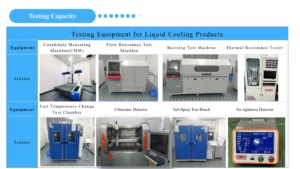
Leak Testing: Every aerospace cold plate undergoes helium mass spectrometer leak testing to a sensitivity of 1×10⁻⁹ mbar·L/s — the most stringent leak test standard available. This ensures zero leakage under all operating conditions, including pressure cycling and thermal shock.
Pressure Testing: Proof pressure testing at 1.5× Maximum Allowable Working Pressure (MAWP) and burst pressure testing at 4× MAWP per ASME standards confirm structural integrity for the full operating envelope.
Quality Certifications
ToneCooling maintains a comprehensive quality framework for aerospace customers:
- ISO 9001:2015 — Quality Management System
- 2 Invention Patents + 6 Utility Model Patents — Proprietary cold plate technologies
Full material traceability (heat lot, chemical composition, mechanical properties), First Article Inspection Reports (FAIR) per AS9102, and serialized production records are standard for all aerospace deliveries.
Typical Aerospace Liquid Cooling Specifications
| Parameter | Typical Range |
|---|---|
| Heat Dissipation per Cold Plate | 200 W – 15 kW |
| Coolant Type | PAO, EGW (50/50), Fluorinert, MIL-PRF-87252 |
| Operating Temperature | -55°C to +85°C (design target) |
| Coolant Pressure | Up to 6 bar (operating), 9 bar (proof) |
| Flow Rate | 2–20 LPM per cold plate |
| Thermal Resistance | 0.02–0.10 °C·cm²/W |
| Weight Target | Application-specific (typically 30–50% lighter than copper equivalent) |
| Surface Finish | Ra 0.8–3.2 μm (mounting surfaces) |
| Leak Rate | < 1×10⁻⁹ mbar·L/s (He mass spec) |
Engagement Model: From Concept to Qualified Hardware
ToneCooling supports aerospace OEM customers through the complete product lifecycle:
Phase 1 — Thermal Analysis & Concept Design: Our engineering team works with your thermal specifications to develop cold plate concepts, including CFD simulation of flow distribution, pressure drop, and temperature uniformity. We provide thermal resistance predictions and weight estimates of receiving your thermal requirements.
Phase 2 — Prototype & Validation: Rapid prototyping with 4–6 week lead times for first articles. Prototypes undergo full thermal performance testing, pressure testing, and leak testing. Test data is documented in formal test reports for your qualification review.
Phase 3 — Qualification & Production: Following prototype approval, we execute First Article Inspection per AS9102 and transition to series production. Our production capacity supports volumes from small-batch defense programs (10–100 units/year) to high-volume commercial aerospace programs (1,000+ units/year).
Why Choose ToneCooling for Aerospace Liquid Cooling
With global operations in China (HQ), United States (Texas), and Australia (Melbourne), ToneCooling provides localized technical support and logistics for aerospace customers worldwide. Our ISO 9001 manufacturing facility, combined with proprietary micro-channel and vacuum brazing technologies, delivers the performance, quality, and traceability that aerospace programs require.
Whether you are developing next-generation AESA radar cooling, upgrading avionics thermal management for a re-engine program, or designing thermal solutions for UAV sensor payloads, ToneCooling has the engineering depth and manufacturing capability to support your program from concept through production.
Contact our aerospace thermal engineering team: bd@tonecoolingtexas.com (US) | info@tonecooling.com (Global) | Request RFQ
For industry standards and best practices, refer to SAE Aerospace Standards.
Frequently Asked Questions
Does ToneCooling offer OEM and ODM services?
Yes. ToneCooling provides full OEM and ODM services including custom design, prototyping, thermal simulation, and volume production. We serve customers in North America, Europe, and Asia-Pacific with engineering support and samples within 4–6 weeks.
What materials are used in ToneCooling liquid cold plates?
ToneCooling manufactures cold plates in aluminum (6061/6063), copper (C1100/C1020), and stainless steel. Aluminum FSW cold plates are ideal for high-volume EV and industrial applications, while copper brazed cold plates provide maximum thermal conductivity (398 W/m·K) for high heat flux electronics.
What is the typical lead time for custom cold plates?
Prototype samples are delivered within 4–6 weeks. Production orders typically ship within 6–8 weeks after sample approval. ToneCooling engineers review all quote requests and reply with clear next steps.
References: ASHRAE thermal standards, Wikipedia: Heat Sink Technology
Contact ToneCooling
Ready to discuss your thermal management requirements? ToneCooling’s engineering team supports OEM and B2B customers worldwide.
- Website: tonecooling.com
- Email: info@tonecooling.com
- US Phone: +1 (512) 601-7768
- AU Phone: +61 2 8005 1735
Contact us today for a fast, no-obligation consultation and quotation.
Why Choose ToneCooling for Semiconductor Test Fixture Cold Plate
Engineering review and prototype planning are based on the project requirements. Custom prototype lead time is normally 4–6 weeks after drawing approval and order confirmation; confirm the production schedule in the quotation.
Last Updated: 2026-04-08
Need a custom aerospace liquid cooling solution?
ToneCooling engineers respond with CFD-validated thermal recommendations.
Frequently Asked Questions
What certifications are required for aerospace liquid cold plates?
Aerospace programs typically ask suppliers to work under an AS9100 quality system and require parts to pass qualification testing per the applicable MIL-STD standards including MIL-STD-810 for environmental testing and MIL-STD-461 for electromagnetic compatibility when integrated with avionics systems.
What materials does ToneCooling use for aerospace cold plates?
ToneCooling uses aluminum 6061-T6 as the primary material for aerospace cold plates due to its strength-to-weight ratio, machinability, and thermal conductivity. For high-temperature applications exceeding 150C, copper-tungsten and nickel alloys are available. All materials include full traceability documentation with mill certifications.
How are aerospace cold plates tested for flight qualification?
Aerospace cold plates are typically qualified by helium leak testing, proof pressure testing at 1.5x operating pressure, burst pressure testing at 4x operating pressure, thermal cycling from -55C to +125C, and random vibration testing per MIL-STD-810, as specified by each program. ToneCooling helium leak tests every cold plate and supplies test data with each shipment.