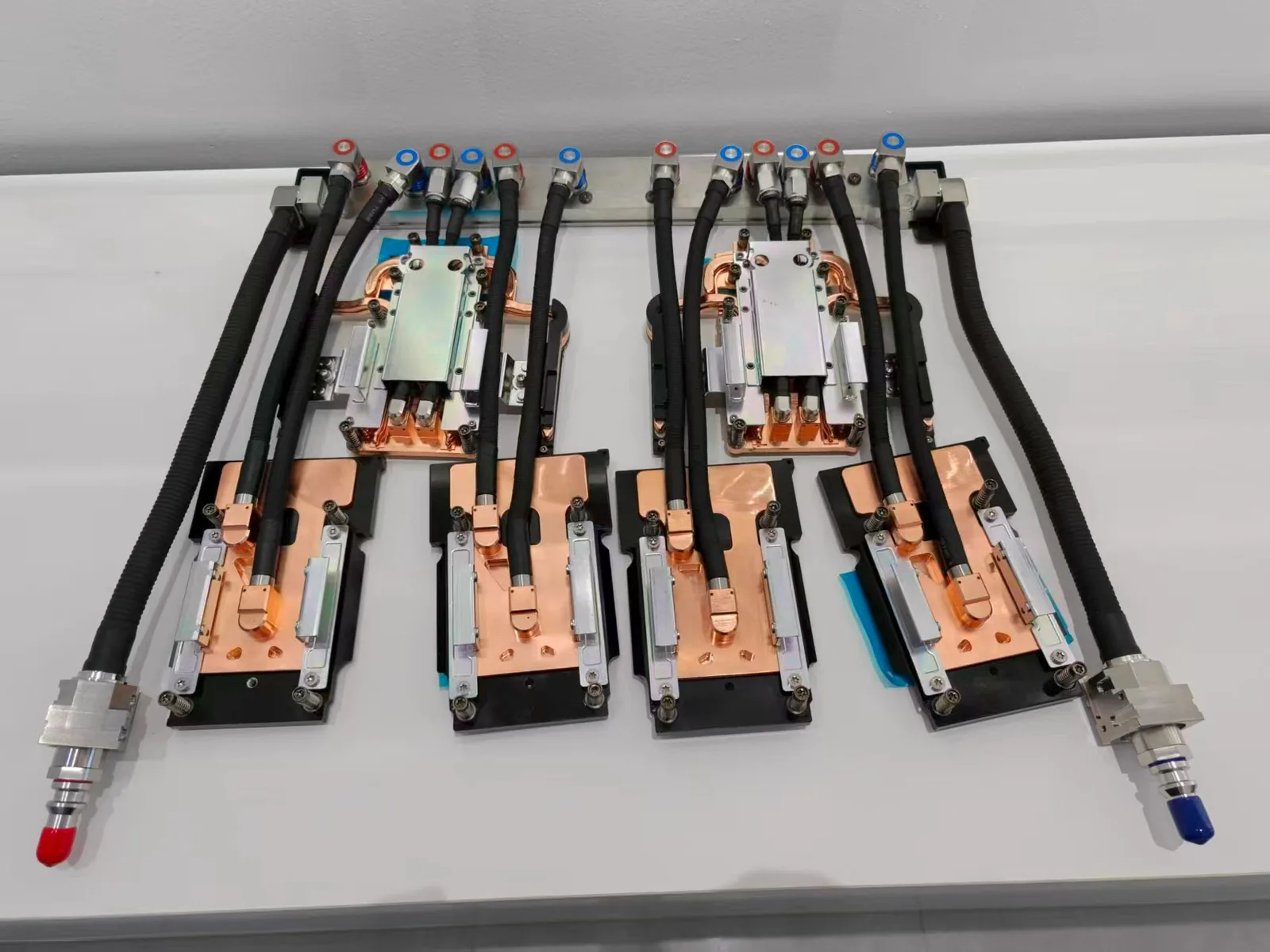
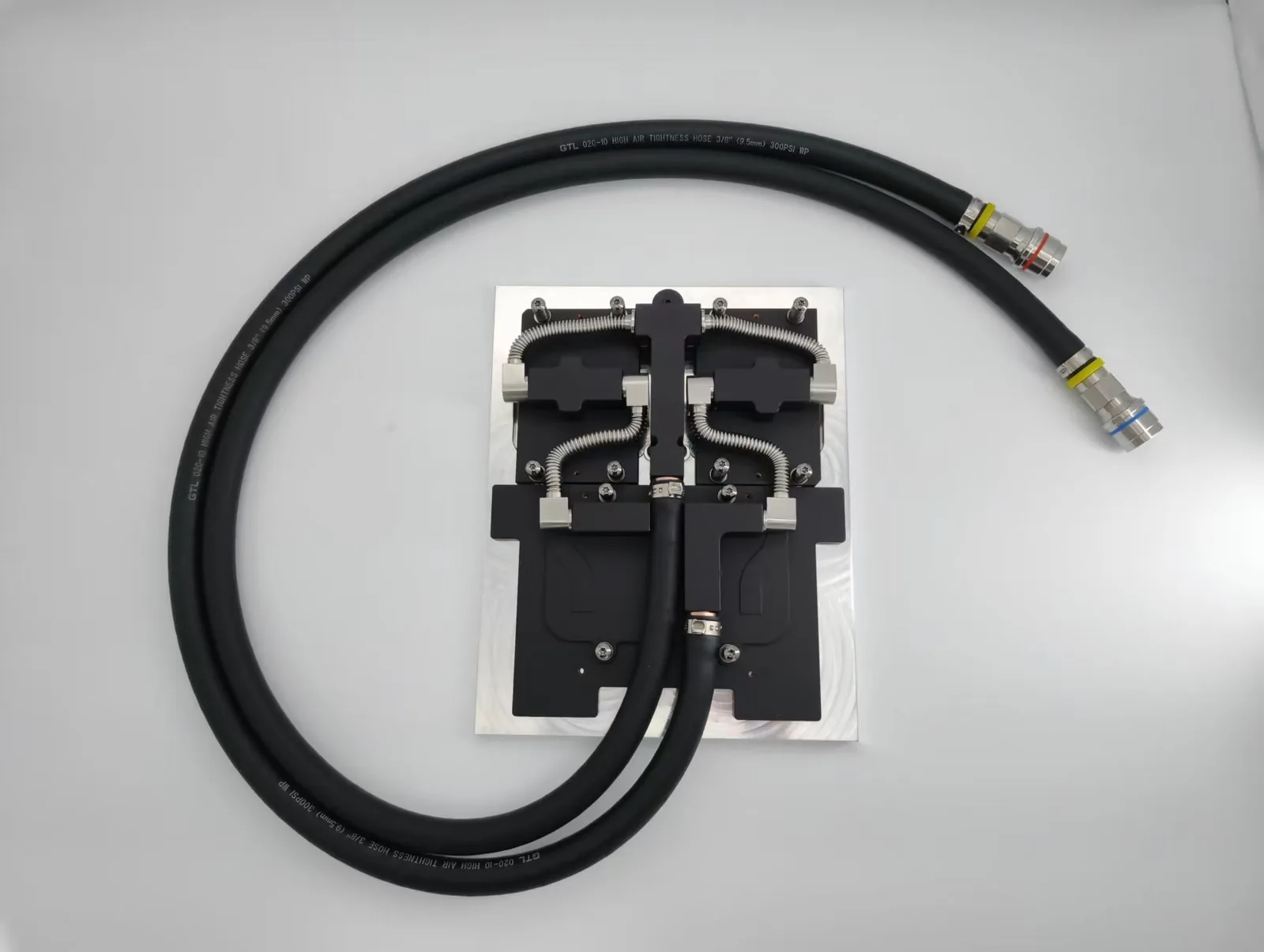
A 1,000 W liquid cold plate for a GPU or switch ASIC must spread kilowatt-level heat from a small die into coolant with low thermal resistance; ToneCooling’s DTC-1000 reference design is rated for 1,000 W. This article explains the thermal analysis behind such a design.
When your GPU/switch frequently throttles due to inadequate cooling, traditional thermal solutions have hit their performance ceiling. Facing the dual challenges of 1000W ultra-high heat density and compact spatial constraints, the Tonecooling1000 kilowatt-level liquid cold plate delivers measured 10°C temperature reduction, providing stable and reliable thermal protection for high-performance computing. For an overview of designs and standard kits, see our liquid cold plates page.

Is Your Equipment Facing These Thermal Challenges?
- 🔥 Consistently Exceeding Chip Temperature Limits – Traditional cooling solutions cannot handle 1000W heat sources.
- 🔥 Frequent Device Throttling – Inadequate heat dissipation causing significant computing performance drops.
- 🔥 Limited Space Constraints – Existing heatsink sizes cannot meet compact design requirements.
- 🔥 Poor Heat Dissipation Efficiency – Competing liquid cold plates run 10°C hotter under the same conditions.
If any of these issues are affecting your equipment performance, continue reading —
Tonecooling1000 Liquid Cold Plate: Redefining Kilowatt-Level Cooling Standards
Core Technical Advantages Comparison
Competitor Pain Points | Tonecooling1000 Solution |
|---|---|
❌ Low cooling efficiency, significantly higher temperatures | ✅ Excellent Cooling Performance – 10°C lower temperature under the same conditions |
❌ High thermal resistance values | ✅ Optimized Thermal Resistance Design – Minimum Rp of 0.0136°C/W |
❌ Questionable process reliability | ✅ TLP Welding Process – Ensures zero leakage risk during long-term use |
❌ Limited adaptability | ✅ Compact Design – 83×70×16.3mm adapts to various spatial layouts |
Key Performance Parameters
- Cooling Capacity: 1000W sustained stable heat dissipation
- Fluid Performance: 8kPa@2LPM ultra-low pressure drop
- Materials & Process: Copper alloy substrate, TLP welding, TIM LM-188J interface material
- Structural Dimensions: 83×70×16.3mm compact design
- Heat Source Compatibility: Perfectly matches 24.6×28mm chip size
Measured Performance Data Comparison
Under identical test conditions (1000W, 2LPM flow rate):
- Competitor Liquid Cold Plate: Tc temperature 68.45℃, thermal resistance 0.0381°C/W
- Tonecooling1000 Liquid Cold Plate: Tc temperature 56.41℃, thermal resistance 0.0278°C/W
- Performance Improvement: 12.04℃ temperature reduction, 27% thermal resistance optimization
Top 5 Technical Questions from Customers (FAQ)
Q1: How does Tonecooling1000 achieve a 10°C temperature advantage over competitors?
A: This advantage stems from three core technological innovations:
- Optimized Flow Channel Design: Achieves higher heat exchange efficiency through computational fluid dynamics simulation
- Advanced Welding Process: TLP welding ensures minimal interface thermal resistance
- Premium Material Selection: Copper alloy substrate combined with LM-188J interface material provides excellent thermal conductivity
Q2: What are the special advantages of TLP welding compared to traditional welding?
A: TLP (Transient Liquid Phase) welding is a core process for high-end liquid cold plates, offering:
- Zero Leakage Risk: Forms metallurgical bonds, completely eliminating leakage hazards
- Lower Thermal Resistance: Welding layer thermal conductivity significantly higher than traditional solder
- Enhanced Reliability: Withstands thermal cycling shock, far exceeding traditional process lifespan
Q3: What is the practical value of the low 8kPa@2LPM pressure drop design?
A: Low pressure drop means:
- Reduced Pumping Power: Lowers overall system energy consumption
- Higher System Compatibility: Adapts to more existing cooling systems
- More Stable Flow Distribution: Superior performance in multi-cold plate parallel systems
Q4: Can Tonecooling1000 be adapted to our specific GPU or switch models?
A: Absolutely. We provide professional customization services:
- Flexible Size Adjustments: Adapt to different installation spaces while maintaining performance
- Interface Customization: Customize inlet/outlet positions and connection methods based on system requirements
- Heat Source Adaptation: Optimize internal flow channels for different chip sizes

For industry standards and best practices, refer to ASHRAE thermal guidelines.
Overview
Does ToneCooling offer OEM and ODM services?
Yes. ToneCooling provides full OEM and ODM services including custom design, prototyping, thermal simulation, and volume production. We serve customers in North America, Europe, and Asia-Pacific with engineering support and samples within 4–6 weeks.
What materials are used in ToneCooling liquid cold plates?
ToneCooling manufactures cold plates in aluminum (6061/6063), copper (C1100/C1020), and stainless steel. Aluminum FSW cold plates are ideal for high-volume EV and industrial applications, while copper cold plates provide the highest thermal conductivity for high heat flux electronics.
What is the typical lead time for custom cold plates?
Prototype samples are delivered within 4–6 weeks. Production orders typically ship within 6–8 weeks after sample approval. An engineer reviews every RFQ and replies by email with next steps.
Get a Custom Thermal Solution from ToneCooling
ToneCooling is a professional liquid cooling solution provider specializing in custom cold plates, AIO coolers, and advanced thermal management systems. With ISO 9001 quality management and our own manufacturing facility in Huizhou, China, we deliver prototype samples typically within 4–6 weeks. Contact ToneCooling today for a free consultation and quote. An engineer reviews every RFQ and replies by email with next steps.
Industry References & Standards
Why Choose ToneCooling for Liquid Cold Plate Comparison Guide
Engineering review and prototype planning are based on the project requirements. Custom prototype lead time is normally 4–6 weeks after drawing approval and order confirmation; confirm the production schedule in the quotation.
Need a Custom Liquid Cold Plate?
ToneCooling engineers review your drawings and requirements and reply by email with next steps.
Last updated: 2026-10-02