

Cold plate material selection is one of the most consequential decisions in liquid cooling design. The choice between aluminum, copper, and stainless steel affects thermal performance, coolant compatibility, weight, corrosion resistance, and unit cost. Understanding the trade-offs between these cold plate materials helps engineers and procurement teams select the right solution for their specific application requirements.
What Is Cold Plate Materials Aluminum Copper?

Thermal conductivity: 167 W/m·K (6063 alloy)
Density: 2.70 g/cm³
Typical alloys: 6061, 6063
Manufacturing processes: FSW, tube-embedding, extrusion, machining
Advantages:
- Lightweight — approximately 3x lighter than copper
- Cost-efficient — lower cold plate material and processing cost vs copper at equivalent volume
- Excellent compatibility with water-glycol coolants
- Large format capability — FSW enables plates exceeding 500mm without joints
- Corrosion resistant with appropriate coolant inhibitors
Limitations:
- Lower thermal conductivity than copper
- Not compatible with deionized water without inhibitors (galvanic corrosion risk)
- Not suitable for very high heat flux (>150 W/cm²) without enhanced internal structures
Best applications: EV battery thermal management (large format, weight-critical), industrial electronics (distributed heat loads), automotive power electronics.
Copper Cold Plates

Thermal conductivity: 385 W/m·K (C11000)
Density: 8.96 g/cm³
Manufacturing processes: brazing, machining, diffusion bonding
Advantages:
- Highest thermal conductivity of common cold plate materials — 2.3x higher than aluminum
- Excellent for high heat flux applications (>150 W/cm²)
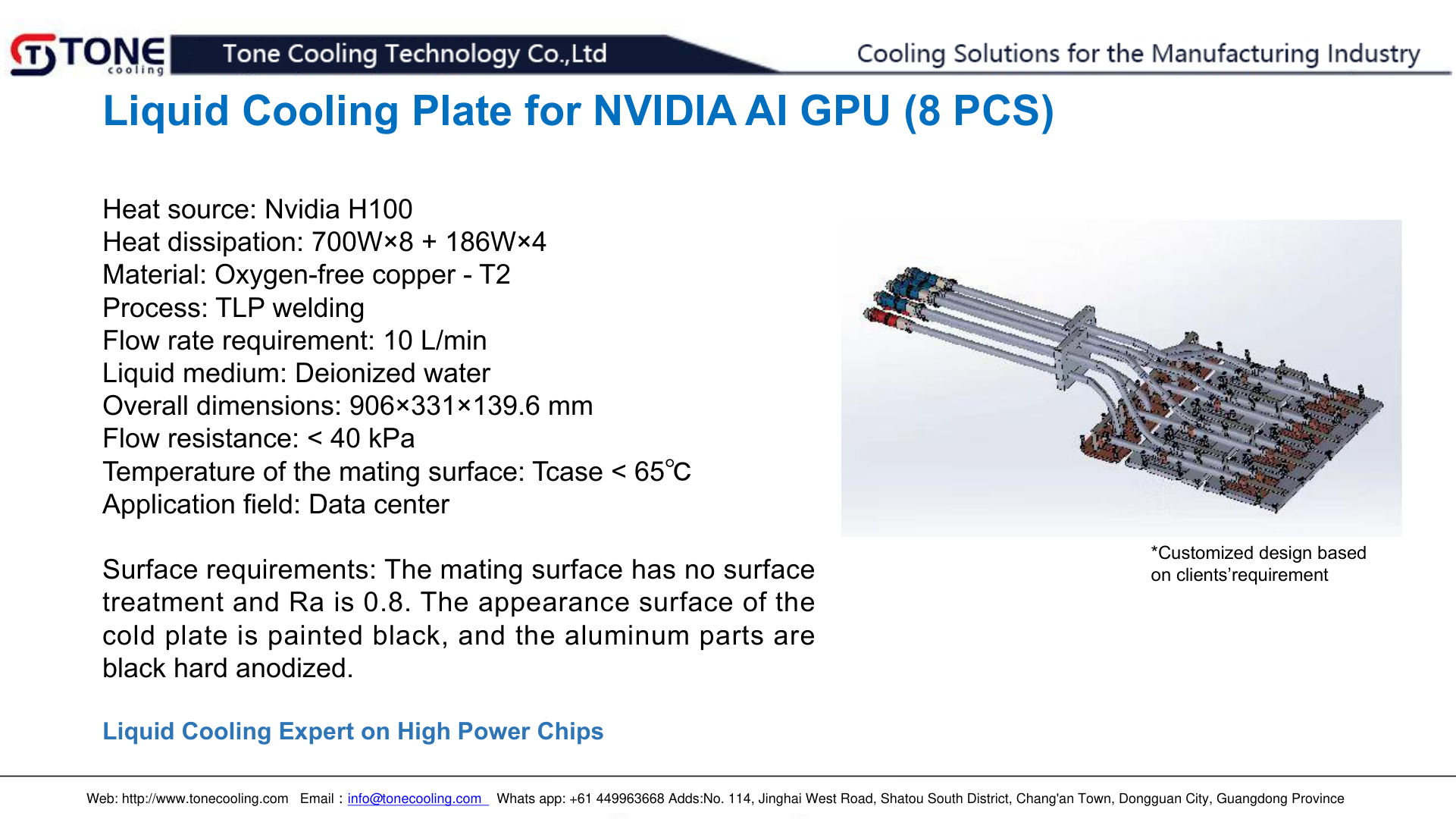
- Compatible with deionized water (standard data center coolant)
- Microfin brazed internal structures maximize heat transfer surface area
Limitations:
- Significantly heavier than aluminum (3.3x)
- Higher cold plate material and manufacturing cost
- Galvanic corrosion risk if mixed with aluminum components in same coolant loop
Best applications: Server CPU and GPU cold plates, IGBT and power electronics modules, high heat flux laser and photonics components, data center liquid cooling (DI water compatible).
Stainless Steel Cold Plates
Thermal conductivity: 16 W/m·K (316L)
Density: 7.93 g/cm³
Manufacturing processes: welding, machining, diffusion bonding
Advantages:
- Excellent corrosion resistance — compatible with aggressive coolants, seawater, and harsh environments
- High mechanical strength and suitable for high-pressure applications
- Compatible with virtually all coolant types
Limitations:
- Very low thermal conductivity — 10x lower than aluminum, 24x lower than copper
- Heavy — comparable to copper weight
- Rarely used for primary thermal management due to low conductivity
Best applications: Corrosive environment cooling (marine, chemical processing), high-pressure cooling loops, secondary manifold components.
Cold Plate Material Selection Summary
Choosing the right cold plate material depends on your application requirements. Here is a quick reference guide:
- EV battery packs: Aluminum 6061/6063 (FSW process)
- Server CPU/GPU: Copper C11000 (brazed process)
- IGBT/Power modules: Copper C11000 (brazed process)
- Industrial distributed loads: Aluminum 6061 (tube-embedded process)
- Corrosive environments: Stainless 316L (welded process)
- Large format (>400mm): Aluminum 6063 (FSW process)
- Weight-critical (aerospace): Aluminum 6061 (FSW or machined)
| Parameter | ToneCooling Specification |
|---|---|
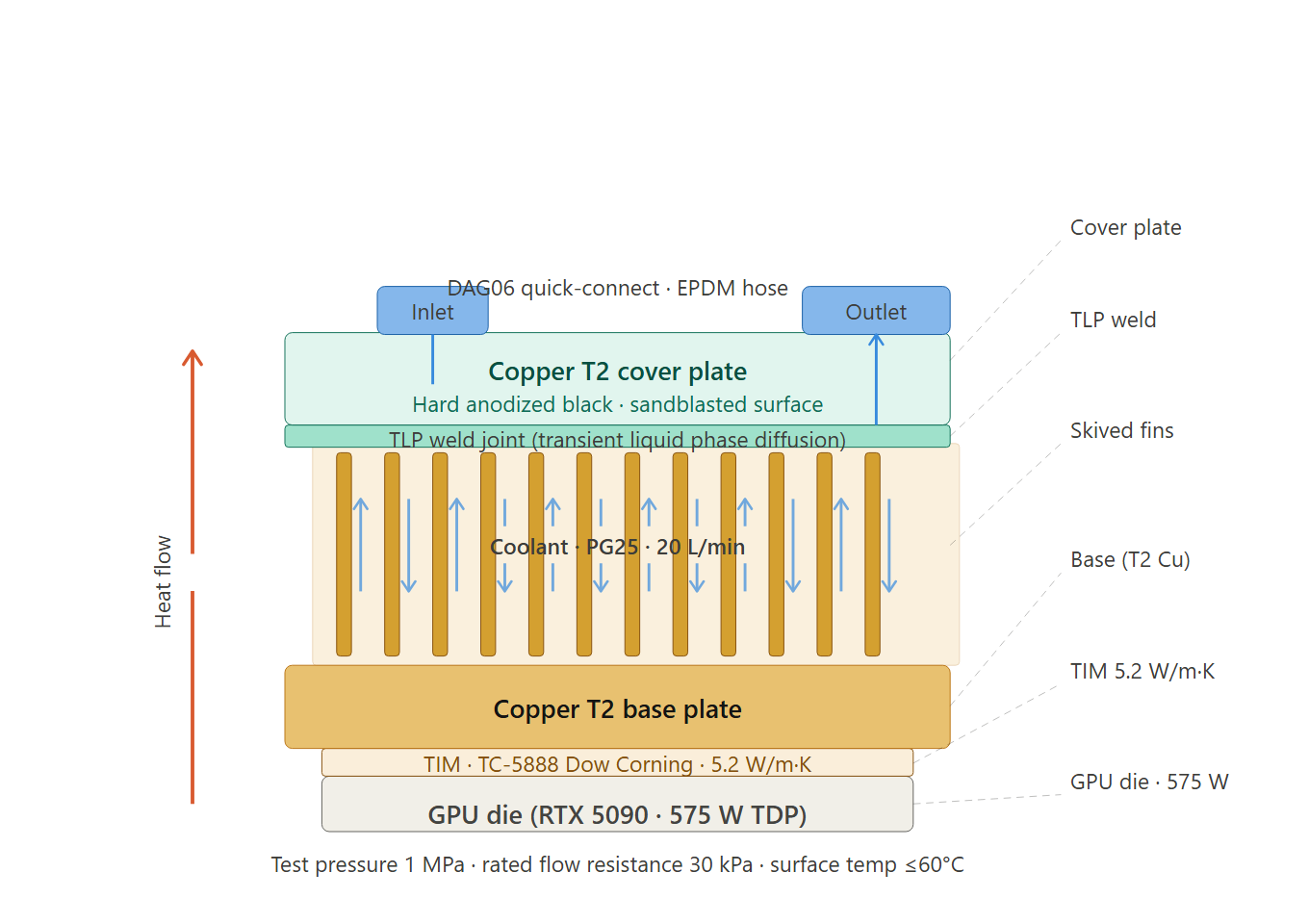
| Material | Copper T2 / 6061 aluminum |
| Welding method | Transient liquid phase diffusion welding |
| Test pressure | 1 MPa (helium leak + nitrogen hold) |
| Working medium | PG25 (25% propylene glycol) |
| Custom design | Yes — DXF/STEP input accepted |
Frequently Asked Questions
Can aluminum and copper cold plates be used in the same coolant loop?
Direct contact between aluminum and copper in a coolant loop creates galvanic corrosion risk, particularly with DI water. If mixed cold plate materials are required, use a compatible inhibited coolant and consult a corrosion engineer. ToneCooling can advise on compatible system designs.
Which cold plate material offers the best value for server CPU cooling?
Copper brazed cold plates offer the best thermal performance per unit area for server CPU applications, justifying the higher cold plate material cost. For lower TDP CPUs (below 200W), aluminum tube-embedded plates can be cost-effective alternatives.
Does ToneCooling manufacture cold plates in all three materials?
ToneCooling specializes in aluminum (FSW and tube-embedded) and copper (brazed) cold plates. Contact us for stainless steel or special alloy requirements.
For more information about cold plate material properties and manufacturing, see the cold plate Wikipedia page.
Cold Plate Materials Aluminum Copper is a high-performance thermal management solution engineered by ToneCooling for demanding applications.
Request a Material-Specific Cold Plate Quote →
Every cold plate material has unique manufacturing requirements that affect lead time and minimum order quantities. Aluminum cold plates can be CNC machined or friction stir welded in high volumes, while copper cold plates often require specialized brazing or skiving processes. Understanding these production differences helps OEM buyers plan procurement timelines and budget allocations more effectively.
Related ToneCooling Solutions
- Custom Cold Plate Solutions – High-performance liquid cooling cold plates for OEM applications
- AIO Liquid Cooler Systems – All-in-one liquid cooling solutions for servers and workstations
- Battery Cold Plate for EVs – Thermal management for electric vehicle battery packs
Request a Custom Quote from ToneCooling →
About ToneCooling
ToneCooling is a professional OEM manufacturer specializing in custom liquid cooling solutions, cold plates, and thermal management systems. With over 10 years of experience serving global OEM customers, we deliver high-performance cooling solutions for servers, data centers, electric vehicles, energy storage systems, and industrial applications. Our engineering team provides end-to-end support from thermal simulation and design optimization to prototype development and mass production. All products are manufactured in our ISO-certified facilities with rigorous quality control. Contact ToneCooling for custom cooling solutions tailored to your project requirements.
Industry References & Standards
Copper Aluminum Cold Plate Comparison is a critical component in modern thermal management. ToneCooling engineers this solution for AI servers, data centers, EV batteries, and power electronics requiring high-performance liquid cooling.
Copper Aluminum Cold Plate Comparison: Key Specifications
When evaluating copper aluminum cold plate comparison, engineers consider thermal resistance, pressure drop, flow rate, and material compatibility. ToneCooling provides detailed specs for every copper aluminum cold plate comparison design, backed by CFD simulation and testing.
Why Choose ToneCooling for Copper Aluminum Cold Plate Comparison
ToneCooling has manufactured over 50,000 copper aluminum cold plate comparison units for global OEM customers. Our copper aluminum cold plate comparison production features vacuum brazing furnaces below 10⁻⁴ mbar, FSW machines with ≤0.02mm flatness, and helium leak detection at 10⁻⁸ mbar·L/s. Every copper aluminum cold plate comparison undergoes 100% pressure testing at 25 bar.
Our engineering team provides free copper aluminum cold plate comparison design consultation, CFD simulation, and rapid prototyping in 7-14 days. Production copper aluminum cold plate comparison orders ship in 4-6 weeks under ISO 9001:2015 quality management.
Last Updated: 2026-04-08
DR Kevin, Thermal Engineer, ToneCooling
Need a custom cold plate materials aluminum copper solution?
ToneCooling engineers respond within 24 hours with CFD-validated thermal recommendations.
Need a Custom Liquid Cold Plate?
Tell us your thermal requirements. Engineering team responds within 48 hours with design proposal and quotation.
Request a Quote →MOQ 5 pcs • Prototype 7-15 days • ISO 9001 Certified