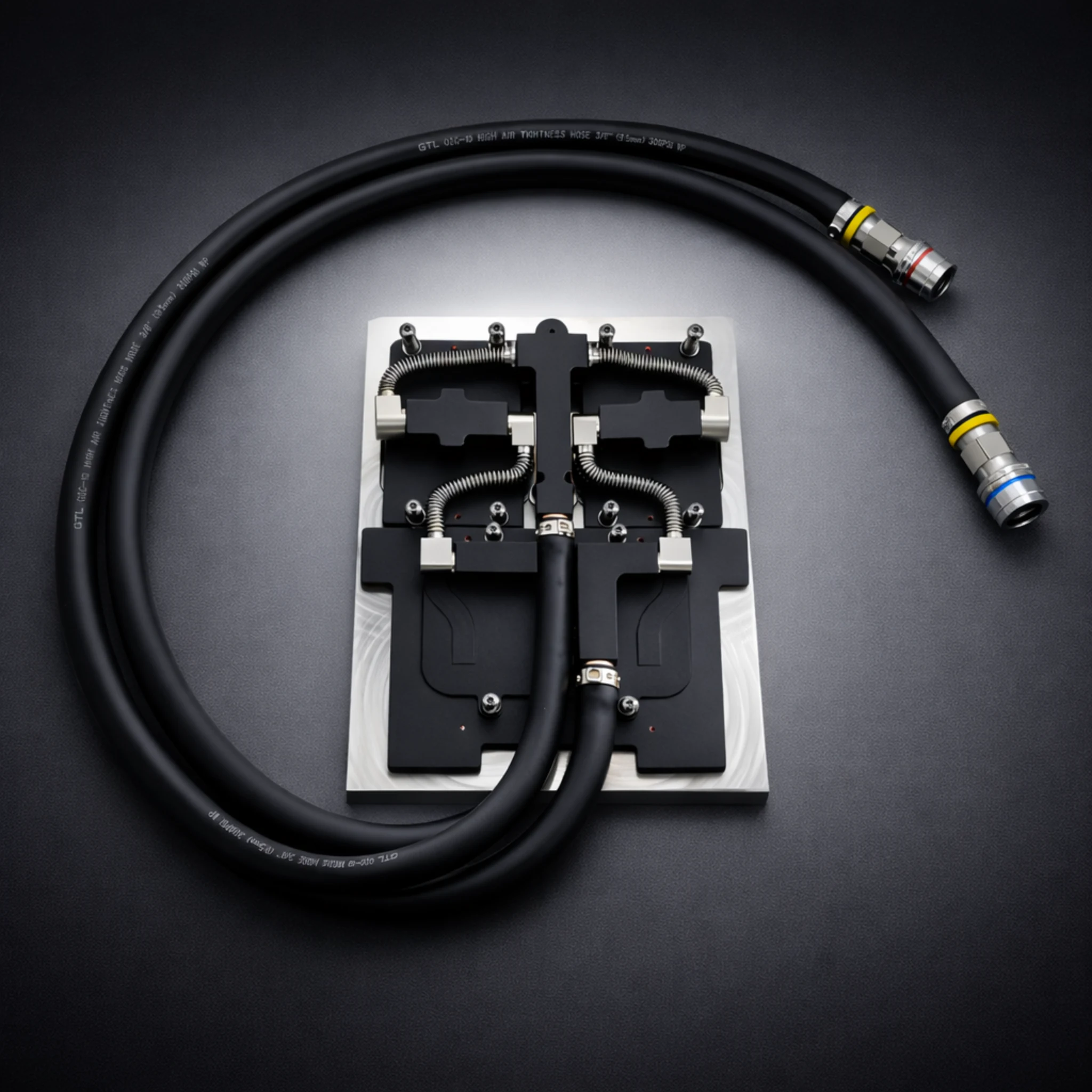
Bionic Blood Vessel Structure High is a high-performance thermal management solution engineered by ToneCooling for demanding applications.
A bionic blood vessel structure uses principles from biology to improve cooling in advanced systems. Engineers design these channels to mimic the flow patterns found in natural blood vessels and bionic vascular networks, which helps manage heat more efficiently. Bionic blood vessel cooling plate achieves a compact structure and keeps maximum temperatures at safe levels.
- Systems using bionic blood vessel structures show lower energy consumption and maintain stable operating temperatures.
- The unique channel design improves fluid distribution compared to traditional cooling plates.
These benefits make bionic blood vessel cooling plates highly relevant for high-power electronics and battery systems.
What Is Bionic Blood Vessel Structure High?
Biomimicry Principles
Engineers draw inspiration from nature when developing bionic blood vessel cooling systems. They use fractal-tree-like structures that resemble the branching patterns found in blood vessels and leaf veins. This approach supports the optimization of heat transfer and fluid movement.
Key biomimicry principles in bionic flow channel design include:
- Fractal branching for efficient fluid distribution
- Tree trunk and vein-inspired layouts for improved flow
- Optimization of heat transfer based on natural systems
These principles guide the design of bionic flow channels to achieve better cooling performance.

Structure and Flow
The structure of a bionic flow channel plays a critical role in fluid movement and thermal management. Branching patterns, channel geometry, and layout all influence how fluid travels and how heat dissipates. Researchers have studied various natural inspirations to optimize these designs.
| Study | Design Inspiration | Key Findings |
|---|---|---|
| Roshandel et al. | Leaf vein layout | Reduced energy loss in flow channels |
| Xia et al. | Veins and bird wings | Improved fuel cell performance and longevity |
| Liu et al. | Bionic vein branch channels | Alleviated battery temperature rise |
| Zhu et al. | Porous composite structure of veins | Enhanced heat transfer performance |
| Chai et al. | Plant vein networks | Examined heat transfer and flow performance in liquid channels |
Channel geometry also affects thermal performance. Straight-through channels are common but may struggle with temperature uniformity. Serpentine and U-shaped channels can reduce maximum temperature and thermal gradients. Bionic designs, such as tree-like and honeycomb structures, significantly improve temperature uniformity and reduce pressure drop.
Materials Used
The choice of materials and fabrication techniques impacts the effectiveness of bionic flow channel structures. Engineers use advanced methods to create precise and durable cooling plates.
| Technique | Description |
|---|---|
| Electrospinning | Creates 3D tubular structures with controlled fiber deposition, enhancing mechanical properties. |
| Bioprinting | Prints cell-containing bioink on rotating rods to fabricate hollow structures. |
| Rod Bioprinting | Deposits hydrogels on rotating rods, mimicking multilayer blood vessel structures. |
| Electrospinning 3D Rod Printing | Patterns polymers rapidly to create nanofiber tubular structures. |
Material selection often includes polymers and composites that support both mechanical strength and efficient heat transfer. These materials allow for the optimization of bionic flow channel design, ensuring reliable performance in high-power cooling applications.
Cooling and Heat Dissipation

Enhanced Heat Transfer
Bionic flow channel structures improve heat dissipation performance in high-power cooling systems. Engineers design these channels to maximize contact between the cooling fluid and heated surfaces. This approach increases heat transfer efficiency and maintains stable temperatures during operation.
Researchers have measured several parameters to evaluate heat dissipation capacity. The following table summarizes key findings from experimental and simulation studies:
| Parameter | Findings |
|---|---|
| Liquid Flow Rate | A flow rate of 0.6 m/s achieves stable maximum surface temperature and temperature differential. |
| Contact Radius | Increasing the contact radius initially raises temperature differentials, stabilizing at flow rates of 0.4 m/s or higher. |
| Pump Power Consumption | Remains consistent across various scenarios and flow rates, indicating efficiency. |
| Error Margin | The error between experimental and simulation results is within 9.8%, confirming simulation accuracy. |
| Discharge Rate | The bionic structure shows significant heat dissipation effects, especially at 3C discharge. |
Optimization of channel area and outlet width further enhances heat dissipation performance. Engineers observe that variable width at the outlet improves heat dissipation and temperature uniformity. Bionic flow channel designs consistently outperform conventional structures in both simulation and real-world tests.
Fluid Distribution
Fluid distribution plays a critical role in the effectiveness of bionic flow channel cooling systems. The unique structure of these channels ensures even fluid flow throughout the cooling plate. This design reduces temperature gradients and improves overall performance.
- Bionic cooling channel designs enhance fluid distribution and thermal performance compared to conventional designs.
- Improved heat dissipation and reduced pressure drops are observed in bionic designs.
- The bionic limulus-like fins showed better performance with reduced average temperature and pressure drop compared to conventional shapes.
Engineers focus on optimization of channel geometry to achieve balanced fluid flow. The structure of bionic channels allows for efficient heat transfer and minimizes energy loss. These improvements lead to better heat dissipation performance in demanding applications.
High-Power Applications
Bionic flow channel structures demonstrate superior performance in high-power cooling scenarios. Battery systems benefit from enhanced heat dissipation capacity and stable temperature control. The structure of bionic channels supports rapid fluid movement and effective heat removal.
Studies show that pipe distance, plate thickness, and inner pipe turning radius significantly affect heat dissipation performance. Optimization of these parameters leads to improved cooling efficiency in batteries and electronics. Bionic flow channel designs maintain consistent performance even under high discharge rates and heavy thermal loads.
Bionic vs. Conventional Cooling
Efficiency Comparison
Engineers compare bionic cooling systems to conventional cooling plates by measuring heat transfer rates and temperature uniformity. Bionic channels use a branching design that increases surface area and improves fluid contact. This design reduces hot spots and maintains lower operating temperatures. Conventional systems often rely on straight channels, which can limit fluid distribution and create uneven cooling. Bionic structures show higher efficiency in high-power environments.
| Cooling System | Heat Transfer Rate | Temperature Uniformity | Energy Consumption |
|---|---|---|---|
| Bionic | High | Excellent | Low |
| Conventional | Moderate | Average | Higher |
Tip: Bionic cooling channels help maintain stable temperatures during rapid discharge cycles.
Design Flexibility
Bionic cooling systems offer greater flexibility in design. Engineers can adjust channel geometry, branching patterns, and outlet widths to fit specific applications. This design approach allows for customization based on device size, heat load, and fluid type. Conventional cooling plates often have limited design options and may not adapt well to complex shapes. Bionic design supports integration into batteries, electronics, and automotive systems.
- Bionic channels can be tailored for unique layouts.
- Design changes improve performance for different power levels.
- Engineers use simulation tools to optimize each design.
Cost Factors
Cost plays a key role in selecting a cooling system. Bionic cooling plates may require advanced fabrication techniques, which can increase initial costs. However, the improved efficiency and reduced energy consumption often lead to lower operating expenses over time. Conventional systems use simpler designs and materials, resulting in lower upfront costs but higher long-term energy use. Engineers must balance design complexity, material choice, and manufacturing methods to achieve cost-effective solutions.
Note: Investing in bionic design can provide long-term savings for high-power applications.
Bionic Cooling Plate Applications

Battery Cooling
Bionic flow channel structures have transformed battery cooling. Engineers use bionic pipeline design to create efficient hydraulic flow channels in power battery liquid cooling systems. These channels mimic natural blood vessels, improving heat dissipation performance and temperature uniformity.
| Study Title | Description |
|---|---|
| Simulation and Experimental Study on Heat Transfer Performance of Bionic Structure-Based Battery Liquid Cooling Plate | This study proposes a composite biomimetic liquid cooling plate structure inspired by human blood vessels and insect wing veins, enhancing heat transfer efficiency and temperature uniformity through experiments and simulations. |
| Thermal characteristics and reliability analysis of liquid-cooled heat dissipation system for lithium-ion batteries with bionic … | This research introduces a new bionic blood vessel runner liquid cooling plate, demonstrating significant advantages in heat dissipation performance compared to traditional designs. |
The mass flow of coolant and flow channel arrangement both play a role in optimization. Bionic design ensures that fluid moves evenly, reducing hot spots and keeping batteries safe during high loads.
Electronics
Bionic flow channel design has also improved electronics cooling. Data centers and automotive systems benefit from advanced bionic pipeline design, which increases heat transfer and reduces energy use. Engineers use honeycomb, tree-like, and cobweb-inspired structures to optimize fluid flow and heat dissipation.
| Year | Study Description | Key Findings |
|---|---|---|
| 2011 | Development of a single-phase brass honeycomb porous microchannel cooling system for electronic chips. | Heat flux removal of 18.2 W/cm² with 2.4 W pumping power. |
| 2021 | Novel battery thermal management system modeled on spider webs and honeycombs. | Improved thermal performance with internal flow scheme. |
| 2022 | Bionic double-layer tree-like cooling plate design. | Reduced max temperature by 1.79%, temperature deviation by 69.25%, and pressure drop by 79.13%. |
| 2023 | Honeycomb structure liquid-cooling plate based on prismatic cells. | Optimal parameters resulted in a maximum temperature difference of 4.1 °C. |
| 2024 | Heat dissipation channels with a bionic leaf-vein structure. | Reduced Tmax by 1.06 °C and pressure drop by 40.03%. |
| 2024 | Bionic blade-like tiny-channel liquid-cooling plate. | Reduced Tavg by 0.875 °C and pressure drop by 501.686 Pa. |
| 2024 | Cobweb-like microchannel heat sink design. | Optimization reduced Tavg by 3 K and pressure drop by 1514 Pa. |
| 2024 | Wave-shaped channel liquid-cooling plate. | Enhanced heat transfer and reduced flow resistance. |
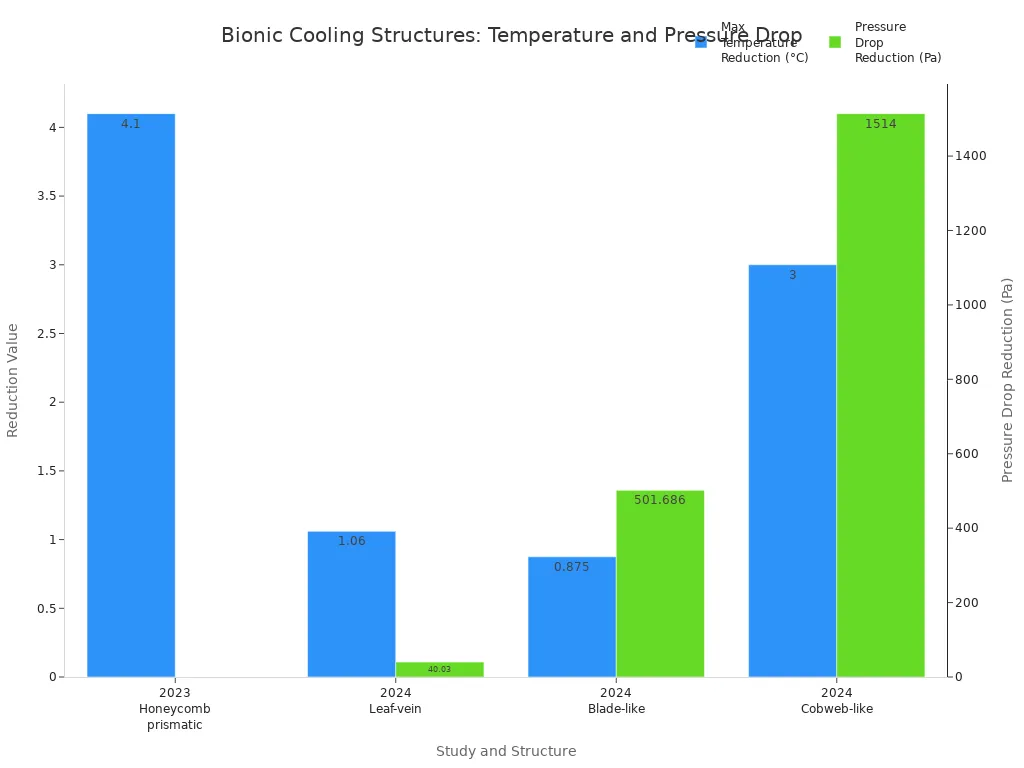
Bionic structures allow for better optimization of coolant flow and heat dissipation. These designs help electronics run cooler and more reliably.
Future Opportunities
Bionic design continues to open new possibilities. Engineers explore advanced bionic flow channel structures for next-generation cooling in electric vehicles, high-density servers, and renewable energy systems. Ongoing research focuses on optimization of hydraulic flow channel geometry, fluid distribution, and heat dissipation performance.
Bionic pipeline design may soon enable smarter, adaptive cooling systems that respond to real-time heat loads.
As technology advances, bionic flow channel design will likely become standard in many industries. The combination of efficient fluid movement, improved heat dissipation, and flexible structure makes bionic solutions a key part of future innovation.
Challenges and Future Trends
Technical Barriers
Engineers face several technical barriers when developing bionic blood vessel cooling systems. Fabrication of complex microchannel networks requires advanced manufacturing techniques. Achieving precise control over channel geometry and branching patterns remains a challenge for consistent performance.
Simulation analysis helps researchers predict fluid flow and heat transfer, but real-world results can differ due to material limitations. Integration of bionic channels into existing devices often demands redesign of electronic layouts. Maintaining durability and reliability under high-power conditions also presents obstacles.
Research Directions
Recent research focuses on improving the efficiency and adaptability of bionic cooling structures. Scientists use simulation analysis to optimize channel placement and branching, aiming for better fluid distribution. Innovations now mimic human capillaries, placing microchannels closer to heat sources for enhanced cooling.
Studies show that these new designs can achieve a coefficient of performance 50 times higher than traditional methods. Researchers combine simulation analysis with experimental testing to validate performance optimization strategies. As technology advances, bionic cooling systems may evolve to resemble the full branching architecture of human circulatory systems.
Note: Ongoing research explores how simulation analysis can guide the development of smarter, adaptive bionic cooling solutions.
Industry Impact
Bionic cooling technology continues to influence multiple industries. Battery manufacturers and electronics designers use simulation analysis to evaluate new cooling plate designs. Improved heat dissipation and energy efficiency support the growth of high-power applications.
Performance optimization in bionic cooling systems leads to safer and more reliable devices. As adoption increases, industries benefit from reduced energy consumption and enhanced thermal management. The future promises broader use of bionic cooling structures in automotive, data center, and renewable energy sectors.
Conclusion
Bionic blood vessel design delivers superior cooling by improving heat dissipation performance, fluid flow, and temperature uniformity. Recent studies highlight advantages such as higher heat transfer coefficients and lower pressure drops, as shown below:
| Advantage | Description |
|---|---|
| Improved Heat Transfer Performance | Bionic microchannels provide higher heat transfer coefficients. |
| Enhanced Fluid Flow Efficiency | The design allows for lower pressure drops compared to traditional microchannels. |
| Uniform Temperature Distribution | The introduction of biostructures leads to more uniform temperature distribution. |
Ongoing research in bionic flow channel optimization, including VasFluidics, expands cooling applications and enhances dissipation. Engineers continue to explore new designs for better heat management and performance. The broader impact of bionic cooling inspires innovation in engineering and supports safer, more efficient systems.
- The human vascular system inspires efficient fluid delivery in cooling.
- Liquid cooling plates use microchannel networks to reduce energy consumption.
- Bionic flow channel design sets new standards for heat dissipation and optimization.
For industry standards and best practices, refer to SAE International.
Frequently Asked Questions
Does ToneCooling offer OEM and ODM services?
Yes. ToneCooling provides full OEM and ODM services including custom design, prototyping, thermal simulation, and volume production. We serve customers in North America, Europe, and Asia-Pacific with engineering support and samples within 2–4 weeks.
What certifications does ToneCooling hold for automotive products?
ToneCooling is ISO 9001:2015 certified and follows IATF 16949 quality standards for automotive-grade products. All battery cold plates undergo 100% pressure testing and helium leak testing before shipment.
What coolant is compatible with ToneCooling battery cold plates?
ToneCooling battery cold plates are designed for 50/50 water-ethylene glycol coolant, providing freeze protection to -37°C. All wetted surfaces are corrosion-resistant and compatible with standard automotive cooling circuits.
Get a Custom Thermal Solution from ToneCooling
ToneCooling is a professional liquid cooling solution provider specializing in custom cold plates, AIO coolers, and advanced thermal management systems. With ISO 9001:2015 certified manufacturing, we deliver prototype samples within 2–4 weeks. Contact ToneCooling today for a free consultation and quote — we respond within 24 business hours.
Frequently Asked Questions
Does ToneCooling offer OEM and ODM services?
Yes. ToneCooling provides full OEM and ODM services including custom design, prototyping, thermal simulation, and volume production. We serve customers in North America, Europe, and Asia-Pacific with engineering support and samples within 2–4 weeks.
What certifications does ToneCooling hold for automotive products?
ToneCooling is ISO 9001:2015 certified and follows IATF 16949 quality standards for automotive-grade products. All battery cold plates undergo 100% pressure testing and helium leak testing before shipment.
What coolant is compatible with ToneCooling battery cold plates?
ToneCooling battery cold plates are designed for 50/50 water-ethylene glycol coolant, providing freeze protection to -37°C. All wetted surfaces are corrosion-resistant and compatible with standard automotive cooling circuits.
Get a Custom Thermal Solution from ToneCooling
ToneCooling is a professional liquid cooling solution provider specializing in custom cold plates, AIO coolers, and advanced thermal management systems. With ISO 9001:2015 certified manufacturing, we deliver prototype samples within 2–4 weeks. Contact ToneCooling today for a free consultation and quote — we respond within 24 business hours.
References: ASHRAE thermal standards, Wikipedia: Heat Sink Technology
Need a Custom Liquid Cold Plate?
ToneCooling engineers design thermal solutions for your specific requirements. Get an engineering RFQ review based on your uploaded requirements.
Bionic Channel Cold Plate High Power is a critical component in modern thermal management. ToneCooling engineers this solution for AI servers, data centers, EV batteries, and power electronics requiring high-performance liquid cooling.
Bionic Channel Cold Plate High Power: Key Specifications
When evaluating bionic channel cold plate high power, engineers consider thermal resistance, pressure drop, flow rate, and material compatibility. ToneCooling provides detailed specs for every bionic channel cold plate high power design, backed by CFD simulation and testing.
Why Choose ToneCooling for Bionic Channel Cold Plate High Power
ToneCooling has manufactured over 50,000 bionic channel cold plate high power units for global OEM customers. Our bionic channel cold plate high power production features vacuum brazing furnaces below 10⁻⁴ mbar, FSW machines with ≤0.02mm flatness, and helium leak detection at 10⁻⁸ mbar·L/s. Every bionic channel cold plate high power undergoes 100% pressure testing at 25 bar.
Our engineering team provides free bionic channel cold plate high power design consultation, CFD simulation, and rapid prototyping in 7-14 days. Production bionic channel cold plate high power orders ship in 4-6 weeks under ISO 9001:2015 quality management.
Need a Custom Liquid Cold Plate?
ToneCooling engineers design thermal solutions for your requirements. Response within 24-48 hours.
Last Updated: 2026-04-08
DR Kevin, Thermal Engineer, ToneCooling