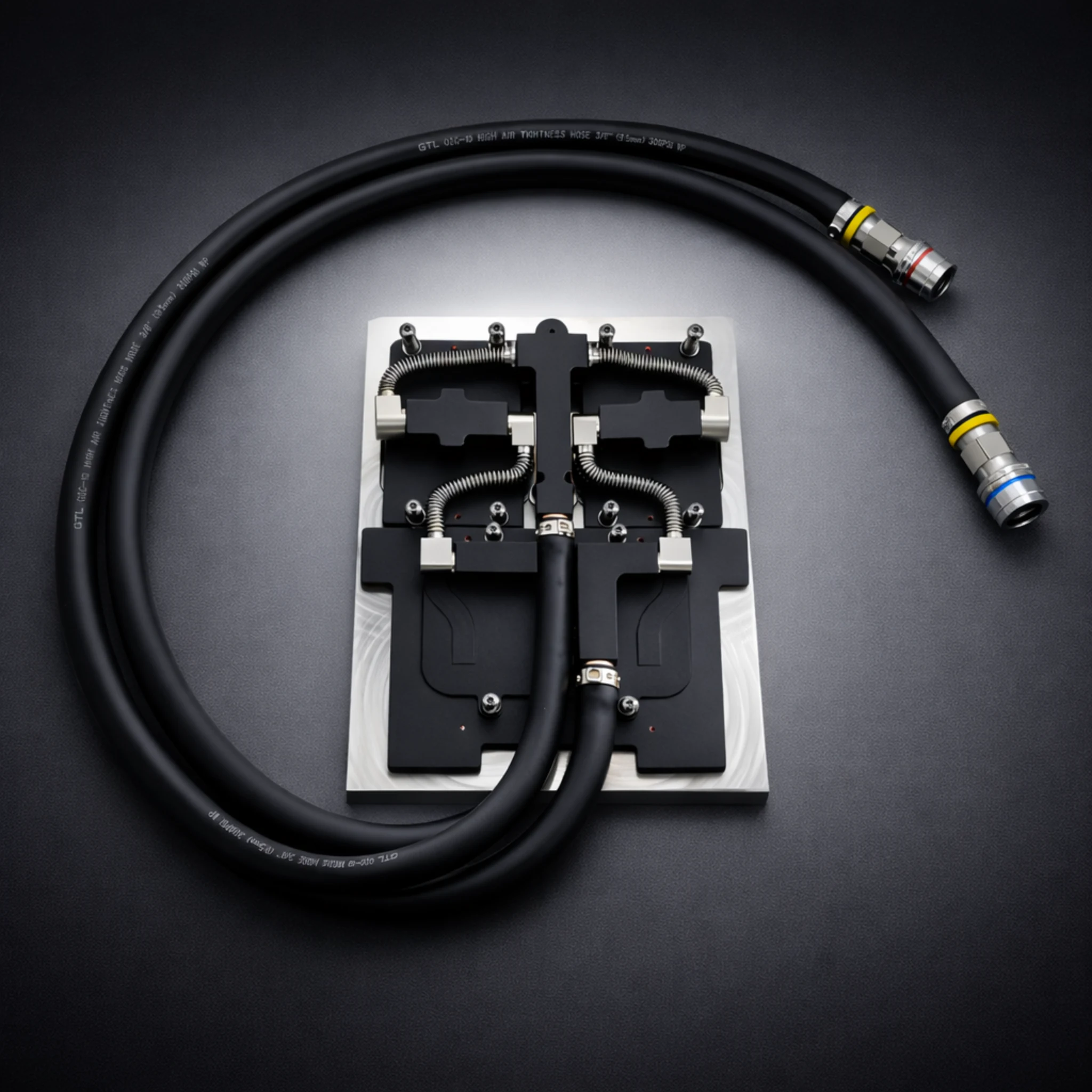
As power density in modern electronics rises, heat management becomes one of the biggest challenges for engineers. Traditional cooling methods often struggle to maintain stable performance, leading to overheating and reduced efficiency. Liquid cold plates with optimized microchannel design provide a powerful solution by improving heat transfer, lowering thermal resistance, and ensuring temperature uniformity.
This article explores how microchannel geometry, aspect ratios, flow configurations, and advanced manufacturing methods shape the performance of liquid cold plates, helping engineers achieve efficient and reliable thermal management.

What Is Liquid Cold Plate Microchannels?
Heat Transfer Performance — Liquid cold plate
Microchannel design plays a critical role in the heat transfer performance of liquid cold plates. Engineers measure effectiveness using metrics such as thermal resistance, heat exchanger effectiveness, and the heat transfer coefficient. These metrics help determine how well a cold plate removes heat from high-power devices.
| Parameter | Microchannel Cold Plate (Fin-H) | Traditional Cooler (Thermaltake) |
|---|---|---|
| Hydraulic Diameter | 0.49 mm | N/A |
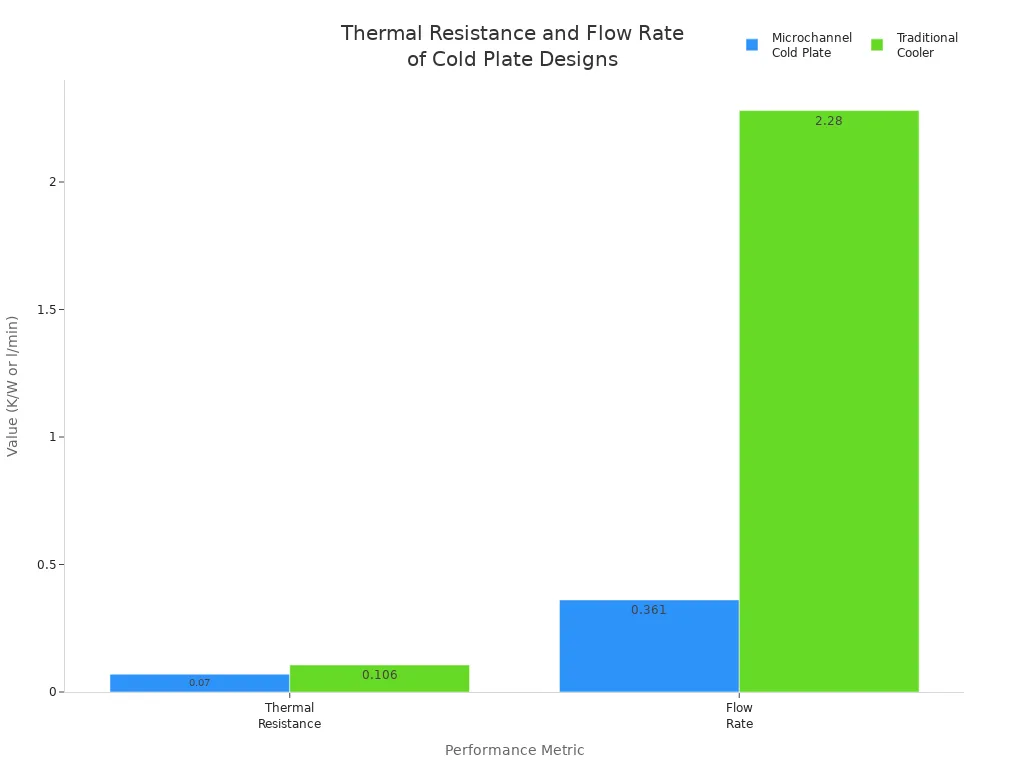
| Flow Rate | 0.361 l/min | 2.28 l/min |
| Thermal Resistance | 0.07 K/W | 0.106 K/W |
| Thermal Performance Improvement | 50% better | Baseline |
| Pressure Drop | Similar | Similar |
| Channel Aspect Ratio | ~7.4 | N/A |
| Fin Aspect Ratio | 8 | N/A |
Microchannel cold plates achieve superior heat transfer performance at much lower flow rates than traditional designs. Optimized aspect ratios and fin densities further enhance heat dissipation, enabling advanced cooling mechanisms. Thermal-hydrodynamic modeling shows that with proper design, microchannel cold plates can double cooling power requirements compared to conventional systems.
Microgrooved forced-fed boiling designs reach heat transfer coefficient peaks up to 300 kW/m²K before dryout. These values far exceed those of macrochannel alternatives. The ability to tailor microchannel geometry allows engineers to eliminate hot spots and maintain low thermal resistance.
Cooling Efficiency — Liquid cold plate
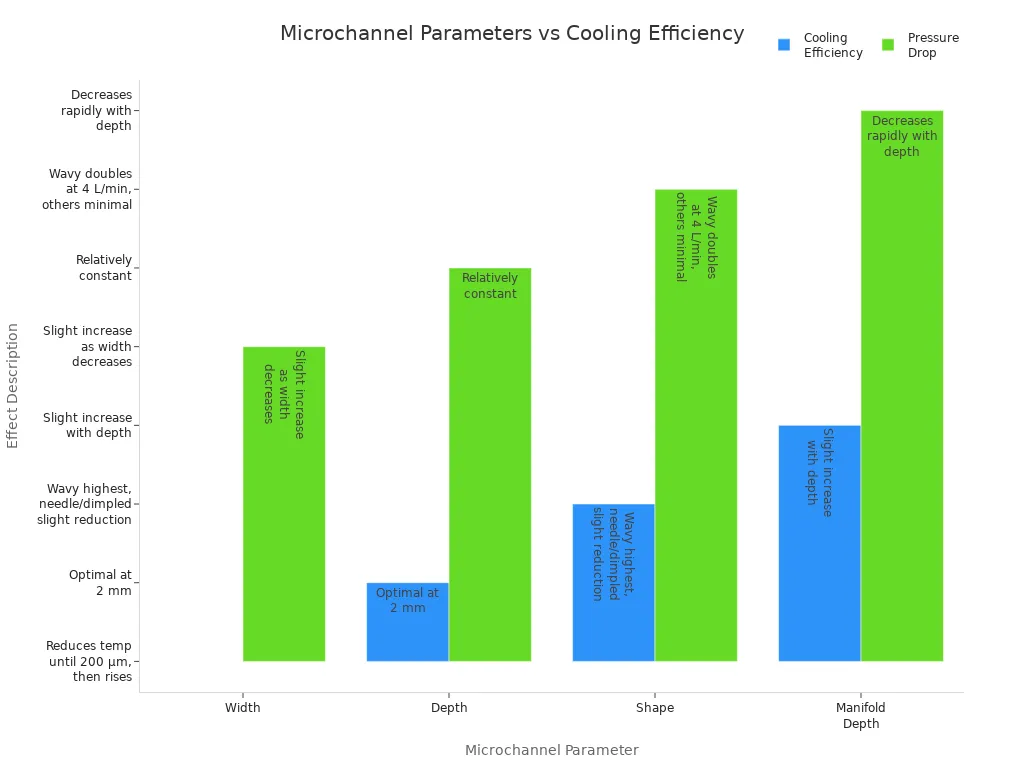
Cooling efficiency depends on several microchannel parameters, including width, depth, shape, and manifold depth. Engineers found that decreasing channel width lowers junction temperature until reaching 200 µm, where manufacturing and flow issues arise. Optimal channel depth is around 2 mm, maximizing heat dissipation without sacrificing efficiency.
| Microchannel Parameter | Effect on Cooling Efficiency | Effect on Pressure Drop | Notes |
|---|---|---|---|
| Width | Decreasing width reduces junction temperature until 200 µm; below this, temperature rises due to manufacturing and flow issues | Slight increase as width decreases | Optimal width ~200 µm due to manufacturing limits |
| Depth | Optimal depth around 2 mm for best heat dissipation; too shallow or too deep reduces efficiency | Relatively constant | Depth affects effective heat exchange area and fin heat transfer |
| Shape | Wavy shapes provide highest heat transfer efficiency; needle ribs and dimpled shapes slightly reduce junction temperature | Wavy shapes double pressure drop at 4 L/min; needle ribs and dimpled shapes have minimal impact | Local wavy shapes balance heat dissipation and pressure drop by applying wavy only in hotspot regions |
| Manifold Depth | Increasing manifold depth decreases pressure drop rapidly but slightly increases junction temperature | Decreases rapidly with depth | Trade-off between flow channel size and heat dissipation |
Microchannel cold plates with wavy channels induce secondary vortices, improving convective heat transfer coefficients and overall cooling efficiency. Increasing wave amplitude and decreasing wavelength further reduce thermal resistance but raise pressure drop. Engineers balance these factors to achieve optimal cooling in liquid cold plates.
Optimized microchannel designs have reduced switch chip maximum temperature from 121 °C to 97.3 °C and optical module maximum temperature from 33 °C to 31.3 °C, with nearly constant pressure drop. Cooling efficiency improves as engineers increase the number of microchannels, though temperature difference may rise. Wavy microchannels enhance heat transfer due to induced Dean vortices, but they also increase pressure drop.
Liquid microchannel cooling systems outperform alternative cooling technologies in energy efficiency and operational cost. Microchannel cold plates provide lower thermal resistivity, reduced pumping power, and compact size, eliminating the need for heat spreaders. These features make liquid cold plates the preferred choice for high-performance cooling applications.
Microchannel Design Fundamentals — Liquid cold plate
Channel Geometry
Microchannel design begins with channel geometry. The width, depth, and spacing of each microchannel influence coolant flow, velocity, and pressure distribution. Channel orientation relative to the heat source also affects thermal conductivity and heat dissipation efficiency.
Fluid flow in microchannels depends on velocity, pressure, and Reynolds number. The Reynolds number indicates whether the flow is laminar or turbulent. Turbulent flow increases mixing and convective heat transfer but can raise pressure losses.
Aspect Ratio
Aspect ratio describes the relationship between channel height and width. Optimized channel configurations with higher aspect ratios promote turbulent flow, which enhances heat transfer efficiency. Studies show that rectangular microchannels with aspect ratios between 8.9 and 11.4 achieve the best thermo-hydraulic performance.
Webb’s research found that a channel aspect ratio near 7.4, paired with a fin aspect ratio of 8, improves thermal resistance and reduces pressure drop. Adjusting aspect ratio in microchannel configurations helps balance heat transfer efficiency and hydraulic performance. Optimized channel configurations also allow for smaller pumps due to lower pressure drops.
Surface Area
Increasing the surface area-to-volume ratio in microchannel cold plates boosts heat dissipation. Fins and nanoscale features inside the channels increase the contact area between the coolant and channel walls. This design enhances fluid mixing and thermal conductivity, resulting in more uniform temperature distribution.
Experimental studies confirm that adding internal structures improves heat transfer rates and reduces thermal resistance. Although these features may increase flow resistance, well-designed microchannels maintain low pressure drop while maximizing cooling performance.
Flow Configuration
Flow configuration determines how coolant moves through the microchannel cold plate. Single Inlet Multiple Outlet (SIMO) designs, such as T-shaped and Y-shaped arrangements, improve temperature uniformity and reduce chip temperature compared to Single Inlet Single Outlet (SISO) designs.
| Configuration / Parameter | Pressure Drop (Pa) | Chip Temperature (°C) | Temperature Uniformity Coefficient (×10⁻³) | Thermal Resistance (°C/W ×10⁻²) |
|---|---|---|---|---|
| SIMO – T-shaped | N/A | 73.1 | 4.64 | 3.91 |
| SIMO – Y-shaped | N/A | 73.4 | 4.45 | 4.02 |
| SISO – U-shaped | N/A | 74.2 | 6.97 | 4.37 |
| SISO – I-shaped | N/A | 76.5 | 7.88 | 5.79 |
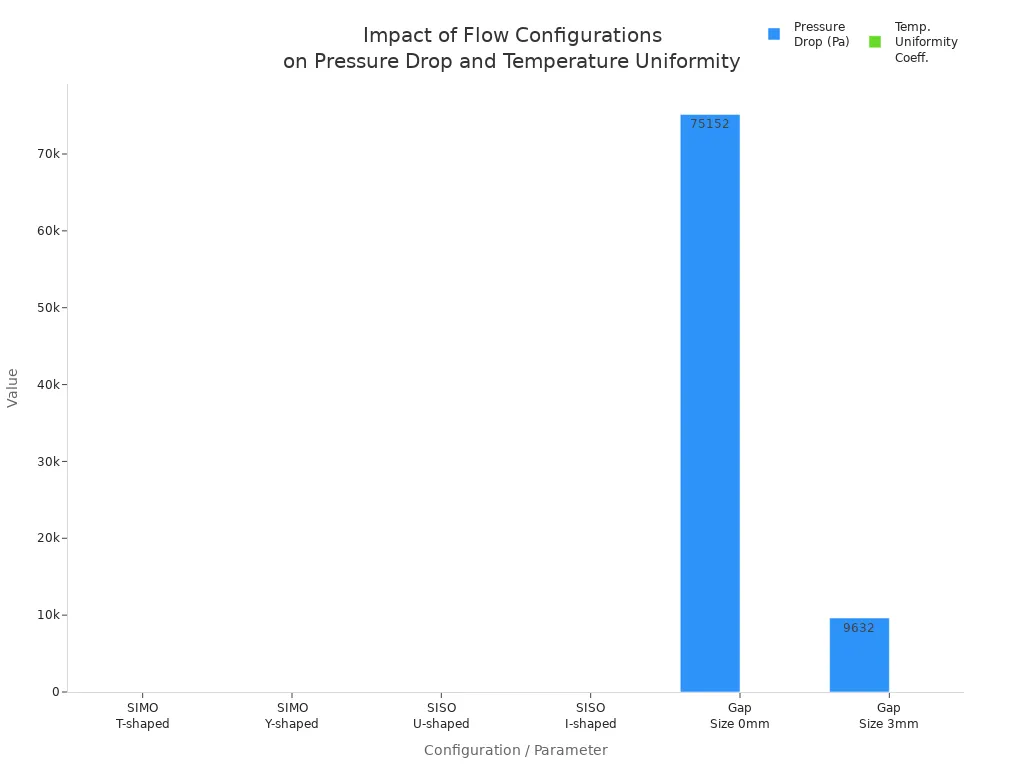
| Flow Channel Gap Size 0mm | 75,152 | 72.4 | 2.81 | N/A |
| Flow Channel Gap Size 3mm | 9,632 | 72.7 | 3.42 | N/A |
Optimized channel configurations with multiple outlets distribute heat load more effectively. This approach leads to better heat dissipation and improved reliability in high-performance applications. Precision microchannels and careful flow configuration design ensure efficient coolant flow and superior thermal conductivity.
Optimizing Cold Plate Cooling Systems
Minimizing Pressure Drop
Engineers improve cold plate cooling systems by reducing flow obstructions and unnecessary bends in the microchannel design. Straight channels and smooth transitions allow coolant flow to move efficiently, which lowers pressure drop and increases energy efficiency. This approach supports higher cooling performance without requiring larger pumps or higher operational costs.
Designers often use grid-type channels with optimized inlet and outlet layouts, such as T-shaped or Y-shaped configurations. These layouts help distribute coolant flow evenly and prevent bottlenecks. Adjusting orifice apertures and adding transverse gaps in fins further enhance fluid mixing and reduce pressure loss.
Mitigating Thermal Gradients
Uneven temperature distribution can cause hotspots and reduce the reliability of cold plate cooling systems. Engineers use several methods to balance temperature and improve efficiency:
- Distribute coolant evenly across all heated surfaces using multiple zones and levels.
- Direct larger coolant flows to areas with higher heat generation to lower local thermal resistance.
- Design cold plates with low thermal resistance and low pressure drop for efficient heat transfer.
- Support multi-zone cooling and multi-die packages to achieve balanced temperature profiles.
- Achieve high heat dissipation rates while maintaining low surface temperature rise.
- Lower junction temperatures to extend component lifespan and improve system reliability.
- Enable smaller pumping components, which reduces overall cost of ownership.
These strategies ensure uniform cooling, especially in high-power applications like EV batteries and GPUs.
Managing High Heat Flux
Cold plate cooling systems must handle high heat flux to protect sensitive electronics. Best practices include using liquid cooling, optimizing channel configuration, and controlling flow rate. The following table summarizes key aspects and performance metrics:
| Aspect | Details |
|---|---|
| Channel configuration | Grid-type channels with optimized inlet/outlet layouts improve temperature uniformity. |
| Flow rate and pressure drop management | Adjusting orifice size and adding fin gaps enhance fluid mixing and reduce pressure loss. |
| Performance metrics | Chip temperature (<85 °C), cold plate temperature, thermal resistance, temperature uniformity coefficient. |
| Key findings | Single-in multiple-out designs improve temperature uniformity; design details matter most. |
| Tools and methods | CFD simulations and experimental validation confirm design effectiveness. |
Engineers evaluate thermal performance by monitoring chip temperature, cold plate temperature, and temperature uniformity. Efficient design leads to better energy efficiency and reliable heat dissipation in demanding environments.
Advances in Microchannel Technology
Topology Optimization
Engineers now use topology optimization to create advanced microchannel designs that maximize thermal performance. This approach allows the design of complex flow channel shapes and distributions, improving both temperature uniformity and energy efficiency. Recent engineering case studies show that topology-optimized microchannel cold plates achieve a 26% increase in maximum heat transfer coefficient and a 20% reduction in maximum temperature deviation compared to conventional designs.
Multi-objective models help minimize both average temperature and energy dissipation. These models address the thermal and hydraulic performance of microchannel cold plates. Automated design methods enable engineers to develop fluid channels that are not limited by traditional experience.
Although the optimization process requires significant computational resources, advances in algorithms and manufacturing make these designs practical. Experimental tests confirm that topology-optimized microchannel cold plates deliver reliable results in real-world applications. This method supports the development of advanced microchannel designs for high-performance cooling.
Additive Manufacturing
Additive manufacturing has transformed the production of advanced microchannel designs. Technologies like Laser Powder Bed Fusion and Metal Binder Jetting allow the fabrication of intricate microchannel geometries and conformal cooling channels. These methods enable near-net shape production with complex internal features, such as internal projections that boost turbulence and heat transfer.
Next-generation cold plates use LPBF technology and advanced alloys to achieve a 55% reduction in thermal resistance. These microchannel designs can handle cooling capacities above 2,000 W, making them ideal for high-performance computing. Hybrid processes like Ultrasonic Additive Manufacturing allow precise control over channel widths and part sizes.
Direct metal printing produces heat exchangers with 20% higher efficiency and reduced weight. Generative design and computational optimization further enhance thermal performance and reduce pressure drop. These advancements make advanced microchannel designs possible for a wide range of applications.
CFD Simulation
Computational fluid dynamics (CFD) simulation plays a key role in optimizing advanced microchannel designs. Engineers use CFD to model unit cells of microchannel cold plates, capturing detailed heat transfer and fluid flow. This modeling provides critical data on pressure drop, heat transfer coefficients, and temperature profiles.
CFD-driven optimization helps balance heat transfer enhancement against pressure drop. For example, the finest microchannel networks reduce thermal resistance by 7% and increase heat transfer coefficient by 25%, though they double the pressure drop compared to coarser designs. Experimental validation shows CFD predictions match measured data within 2%, confirming the reliability of this approach.
Numerical simulations also guide the optimization of channel connection forms and structural parameters. These efforts lead to significant reductions in pressure drop and temperature, supporting the development of advanced microchannel designs for electronics cooling.
Practical Considerations for Liquid Cold Plates
Material Selection
Material selection directly affects the performance and reliability of microchannel cold plates in electronics. Engineers evaluate thermal conductivity, density, and specific heat capacity to match application requirements. The following table compares common materials:
| Material | Density (kg/m³) | Specific Heat Capacity (J/kg·K) | Thermal Conductivity (W/m·K) |
|---|---|---|---|
| Copper | 8900 | 400 | 390 |
| SiC | 3200 | 400 | 670 |
| Aluminum | 2700 | 210 | 880 |
| Equivalent | 4100 | 512.53 | 8.33 (XY) / 105.47 (Z) |
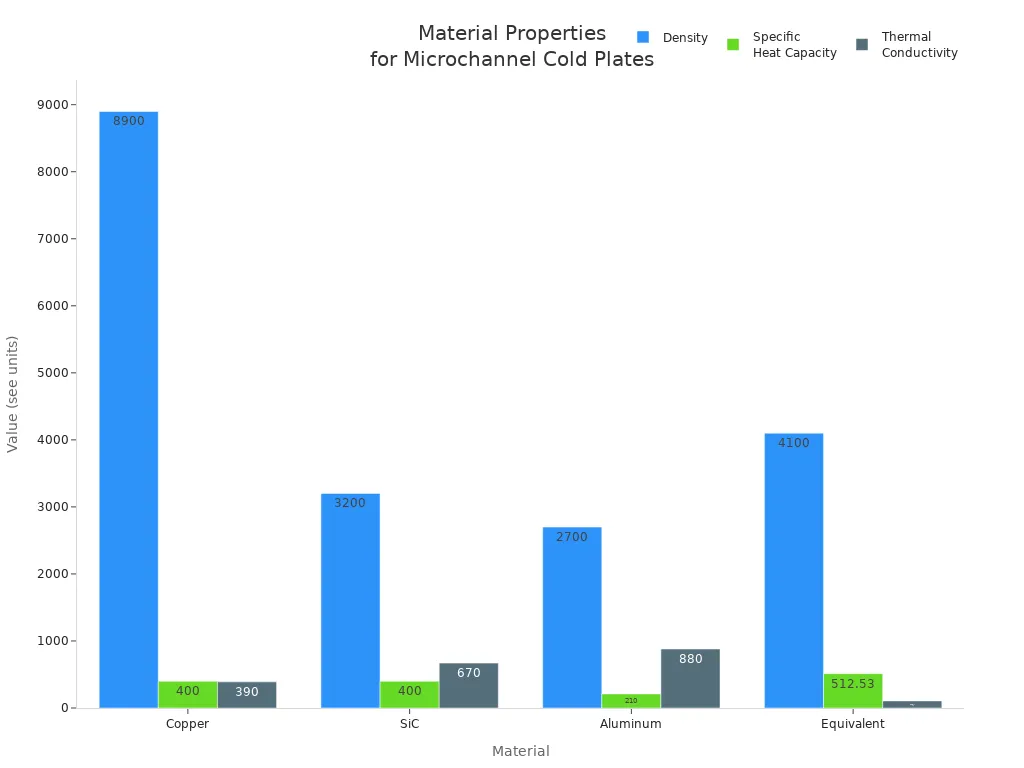
Thermal conductivity must align with the actual device to ensure accurate heat dissipation. Density and specific heat capacity influence temperature distribution and thermal resistance. Engineers select materials that meet both performance and reliability targets for high-power electronics.
Manufacturability
Manufacturability shapes the design and long-term reliability of microchannel cold plates. Complex designs increase lead time and cost, especially for custom electronics applications. Additive manufacturing enables intricate channels, while brazing and direct bonding improve thermal performance and reduce leakage risks.
Manufacturers face challenges such as potential clogging, coolant compatibility, and integration with existing systems. Industry addresses these by using advanced fabrication methods and optimizing channel geometry. Design teams must balance manufacturability with application requirements and reliability standards.
| Manufacturing Challenges | Industry Approaches to Address Challenges |
|---|---|
| High manufacturing cost due to precision machining and brazing | Investment in local fabrication capabilities to reduce import dependency |
| Design complexity requiring specialized R&D and engineering expertise | Design optimization using AI and ML |
| Material limitations (high thermal conductivity and corrosion resistance) | Material innovations such as copper-graphite composites and additive manufacturing (3D printing) |
| Scale limitations in manufacturing capacity | Expansion of local manufacturing base and partnerships |
| Market penetration inertia (reliance on legacy cooling systems) | Targeted investments and innovation to unlock market opportunities |
Cost and Maintenance
Cost and maintenance play a critical role in the reliability and total ownership of microchannel cold plates for electronics. Material choice, manufacturing complexity, and installation drive initial costs. Long-term savings come from improved energy efficiency and extended equipment lifespan.
Routine inspections help prevent leaks, corrosion, and clogging. Engineers recommend monthly checks for coolant levels and pump operation. Proper mounting and coolant maintenance ensure reliability and meet application requirements.
Trade-offs exist between performance, cost, and reliability. Aerospace values lightweight and vibration-tolerant designs, while data centers focus on thermal efficiency and corrosion resistance. Each industry must weigh these factors to select the best solution for their electronics.
Future Trends in Microchannel Cold Plates
Emerging Materials
Engineers continue to explore new materials for microchannel cold plates. The following table highlights key options and their advantages:
| Material Type | Description & Examples | Potential Advantages | Typical Applications |
|---|---|---|---|
| Aluminum | Lightweight, good thermal conductivity (~205 W/m·K) | Balanced performance and weight | Electronics, electric vehicles |
| Copper | Superior thermal conductivity (~400 W/m·K) | Best for minimizing hot spots | High-performance computing, power electronics |
| Stainless Steel | Lower conductivity, excellent corrosion resistance | Robust in harsh environments | Chemical, marine, pharmaceutical industries |
| Composite Materials | Metal-matrix and aluminum-graphite composites | Enhanced conductivity, significant weight reduction | Aerospace, satellites, next-gen vehicles, portable HPC |
Composite materials, such as metal-matrix and aluminum-graphite composites, offer tailored thermal properties and extreme weight reduction. These features support advanced applications where both performance and weight matter.
Smart Thermal Management
Smart thermal management technologies are changing how engineers design cooling systems. Adaptive control systems now adjust coolant flow rates in real time. Nanotechnology, including nano channel structures and coatings, improves heat transfer.
IoT-enabled architectures allow cooling networks to self-optimize. These systems respond to changing heat loads and improve reliability. Advanced manufacturing methods, like photolithography, help create complex microchannel designs.
These innovations will define the next generation of thermal management systems. Engineers will continue to push the limits of cooling capacity, reliability, and energy efficiency.
Conclusion
Efficient thermal management depends heavily on microchannel design in liquid cold plates. Channel geometry, aspect ratio, and surface enhancements directly influence heat transfer and pressure drop, while modern manufacturing techniques make complex designs practical.
Emerging materials and smart thermal management will further expand the capabilities of liquid cold plates for high-performance applications. For engineers and businesses seeking advanced cooling solutions, exploring customized liquid cold plate designs is the next step toward improved reliability and energy efficiency.
For industry standards and best practices, refer to ASHRAE thermal guidelines.
Frequently Asked Questions
Does ToneCooling offer OEM and ODM services?
Yes. ToneCooling provides full OEM and ODM services including custom design, prototyping, thermal simulation, and volume production. We serve customers in North America, Europe, and Asia-Pacific with engineering support and samples within 2–4 weeks.
What materials are used in ToneCooling liquid cold plates?
ToneCooling manufactures cold plates in aluminum (6061/6063), copper (C1100/C1020), and stainless steel. Aluminum FSW cold plates are ideal for high-volume EV and industrial applications, while copper brazed cold plates provide maximum thermal conductivity (398 W/m·K) for high heat flux electronics.
What is the typical lead time for custom cold plates?
Prototype samples are delivered within 2–4 weeks. Production orders typically ship within 4–6 weeks after sample approval. ToneCooling responds to all quote requests within 24 business hours.
Get a Custom Thermal Solution from ToneCooling
ToneCooling is a professional liquid cooling solution provider specializing in custom cold plates, AIO coolers, and advanced thermal management systems. With ISO 9001:2015 certified manufacturing, we deliver prototype samples within 2–4 weeks. Contact ToneCooling today for a free consultation and quote — we respond within 24 business hours.
Frequently Asked Questions
Does ToneCooling offer OEM and ODM services?
Yes. ToneCooling provides full OEM and ODM services including custom design, prototyping, thermal simulation, and volume production. We serve customers in North America, Europe, and Asia-Pacific with engineering support and samples within 2–4 weeks.
What materials are used in ToneCooling liquid cold plates?
ToneCooling manufactures cold plates in aluminum (6061/6063), copper (C1100/C1020), and stainless steel. Aluminum FSW cold plates are ideal for high-volume EV and industrial applications, while copper brazed cold plates provide maximum thermal conductivity (398 W/m·K) for high heat flux electronics.
What is the typical lead time for custom cold plates?
Prototype samples are delivered within 2–4 weeks. Production orders typically ship within 4–6 weeks after sample approval. ToneCooling responds to all quote requests within 24 business hours.
Get a Custom Thermal Solution from ToneCooling
ToneCooling is a professional liquid cooling solution provider specializing in custom cold plates, AIO coolers, and advanced thermal management systems. With ISO 9001:2015 certified manufacturing, we deliver prototype samples within 2–4 weeks. Contact ToneCooling today for a free consultation and quote — we respond within 24 business hours.
Need a Custom Liquid Cold Plate?
Liquid Cold Plate Microchannels is a high-performance thermal management solution engineered by ToneCooling for demanding applications.
ToneCooling engineers design thermal solutions for your specific requirements. Get an engineering RFQ review based on your uploaded requirements.
Microchannel Liquid Cold Plate Design is a critical component in modern thermal management. ToneCooling engineers this solution for AI servers, data centers, EV batteries, and power electronics requiring high-performance liquid cooling.
Microchannel Liquid Cold Plate Design: Key Specifications
When evaluating microchannel liquid cold plate design, engineers consider thermal resistance, pressure drop, flow rate, and material compatibility. ToneCooling provides detailed specs for every microchannel liquid cold plate design design, backed by CFD simulation and testing.
Why Choose ToneCooling for Microchannel Liquid Cold Plate Design
ToneCooling has manufactured over 50,000 microchannel liquid cold plate design units for global OEM customers. Our microchannel liquid cold plate design production features vacuum brazing furnaces below 10⁻⁴ mbar, FSW machines with ≤0.02mm flatness, and helium leak detection at 10⁻⁸ mbar·L/s. Every microchannel liquid cold plate design undergoes 100% pressure testing at 25 bar.
Our engineering team provides free microchannel liquid cold plate design design consultation, CFD simulation, and rapid prototyping in 7-14 days. Production microchannel liquid cold plate design orders ship in 4-6 weeks under ISO 9001:2015 quality management.
Need a Custom Liquid Cold Plate?
ToneCooling engineers design thermal solutions for your requirements. Response within 24-48 hours.
Last Updated: 2026-04-08
DR Kevin, Thermal Engineer, ToneCooling